APAH: Unit 7: West and Central Asia
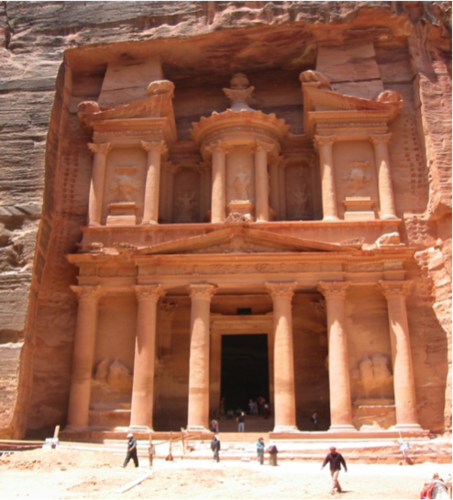
181. Petra, Jordan: Treasury and Great Temple
Form:
-cut rock
-treasury carved into a cliff
-red sandstone walls
-lower platform paved with hexagonal stones
Content:
-complex water system
-temple on platform like apadana and built on hillside
-buried dead in tombs cut out of sandstone cliffs
Function:
- city of powerful nomadic Arabic tradespeople (Nabataeans)
-important commercial center
-connected silk road and other trade routes
Context:
-found in 1812
-probably made around 400-100 CE
-ancient city in Jordan
-influence of Greek and Roman
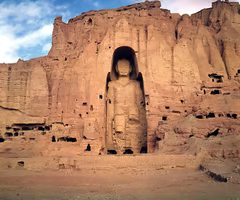
182. Buddha
Form:
-cut rock with plaster and polychrome paint
- carved into niches on the side of a cliff
Content:
-staircase that ascended up to the Buddha's shoulder for travelers
-mutras: hand gestures
-hair in bun and big ears
Function:
-was the largest Buddha sculpture in the world until it was blown up in 2001 by Taliban
-travelers were Buddhists who offered gifts of thanks or prayers to the statue
Context:
-Bamiyan, Afghanistan- Gandaran 400-800 CE
-located on crossroads of the Silk Road
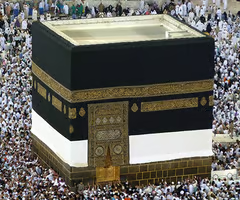
183. The Kaaba
Form:
-calligraphy on cloth covering the cube (kisna)
-corner points on the cardinal points
-granite with silk curtain
-set in a mosque
Content:
-kaaba in middle of Mecca
-kaaba filled with pagon god statues and the Black Stone
Function:
-holds relics of Muhammad
-walking meditation in counter-clockwise motion
-place of pilgrimage-hajj (one of the 5 pillars)
Context:
- Mecca, Saudi Arabia
-pre-Islamic monument
-631-632 CE
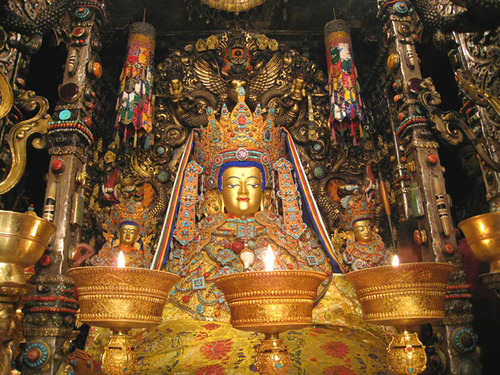
184. Jowo Rinpoche
Form:
-gilt metals with semiprecious stones, pearls, and paint
Content:
-various offerings, candles
Function:
-sacred image of Tibet
-idea is that you don't have to meditate or site a mantra; just seeing this will be a religious experience itself
-pilgrimage site
-believed to have ability to grant wishes
Context:
-enshrined in the Jokhang Temple
-Llasa, Tibet- Yarlung Dynasty
-brought to Tibet in 641 CE
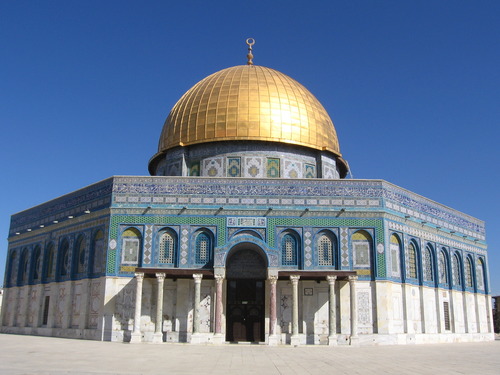
185. Dome of the Rock
Form:
-octagonal centralized plan
-arcades, colonades
-heavily decorated on outside
-stone masonry decorated
-wooden roof and cermaic tile
-bronze dome
Content;
-building surrounding a rock
-mosaic contains no human or animal figures
Function:
-building over rock
Context:
-Jerusalem, Palestine 691-692 CE
-Umayyad- islamic
-rock is where Abraham prepared to sacrifice his son
-Mohammed's night journey
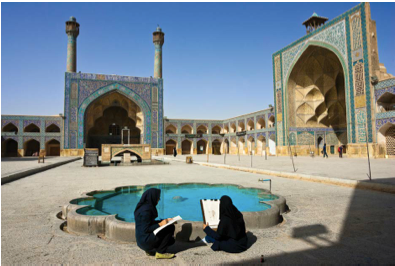
186. Great Mosque (Masjid-e Jameh)
Form:
-stone, brick. wood. plaster, and glazed blue ceramic
-each entrance corbelled
Content:
-built around a courtyard with 4 arches coming from it
-madrassa- place for Islamic instruction
-iwan: vaulted space that opens on one side to the courtyard)
Function:
-prototype for future iwan-mosques
-connects political, commerical, social, and religous activities within the city
Context:
-Isfahun, Iran- 700 CE
-Islamic, Persian- Timrud and Safavid dynasties
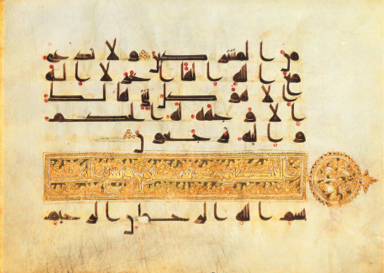
187. Folio from a Qu'ran
Form:
-ink, color, and gold on parchment
-wide page rather than vertical like normal
Content:
-brown Arabic ink read from right to left
-vegetal and geometric motifs because animal and human figures not allowed
Function:
-made for a wealthy patron
-Mus'haf: a codex Qu'ran (bound version)
Context:
-Arab, North Africa, or Near East- Abbasid
-8th-9th century
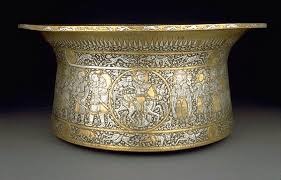
188. Basin
Form:
-brass inlaid with gold and silver
-very detailed, interconnected
Content:
-battle scenes on interior
-sea animals interconnected designs
-men on horseback
-men hunting
-artist's signature (6 times)
Function:
-orginially: washing hands at ceremonies
-later: used for baptism in the French royal family (St. Louis)
Context:
-Mumluk artists
-1320-40 (14th century)
-Egypt and Syria
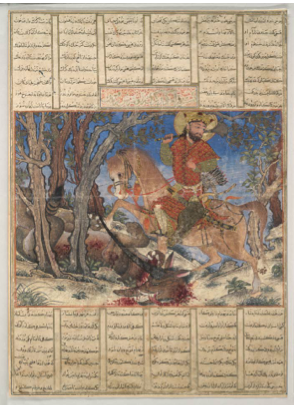
189. Bahram Gur Fights the Karg
Form:
-ink, opaque watercolor, and gold on paper
-shown wearing European clothing but background looks Chinese (combination of cultures)
Content:
-Bahram Gur went on the court of Hind disguised so he could observe the kingdom and its civilians
-king tricks him into showing his true identity and decided to send him away by making him slay a karg (horned wolf)- Barham pierces the wolf with arrows and cuts off his head
-this folio shows Bahram after he has defeated the wolf- confident and relaxed
Function:
-expresses political power attempting to legitimize the Elkhanid's claim to Iranian kingship
-shows the ideal king (crown and halo)
Context:
-folio from the Great II-Khanid
-1330-1340 CE (Islamic/Persian)
-from the Book of Kings
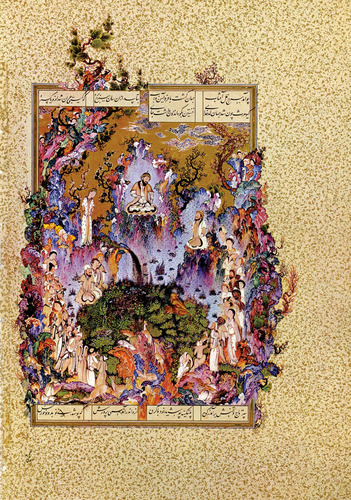
190. The Court of Gayumars
Form:
-ink, opaque watercolor, and gold on paper
-clothing identifies who they are not their faces
-minute scale drawing and detail
Content:
-opening page of the Shahnama
-Gayumar is surrounded by his son and grandson he looks down on the court to address them
Function:
-telling ancient history of Persia
Context:
-folio from Shah Tahmasp's Shahnama
-artist: Sultan Mohammad
-1522-1525 CE
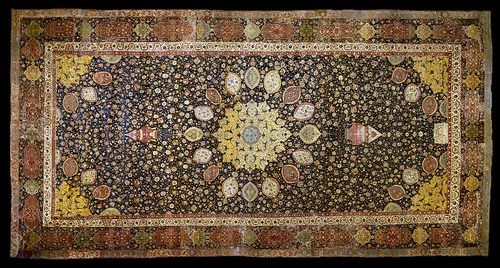
191. the Arbabil Carpet
Form:
-many many details
-silk and wool carpet
-central sunburst medallion creates illusion of a heavenly dome with lamps reflection in a pool of water full of lotus flowers
-slightly symmetrical
Content:
-two different lamps suspended from the ceilings
-one panel with inscription that tells you who made it and when
Function:
-made for the funerary shrine of Safi al-Din Ardabil
-prayer carpet
Context:
-Maqsud of Kashan 1539-40 CE
-one in a pair of carpets