What happens after contraction, explaining how relaxation occurs and how the sarcoplasmic reticulum (SR) is refilled with Ca²⁺ so the heart (or muscle
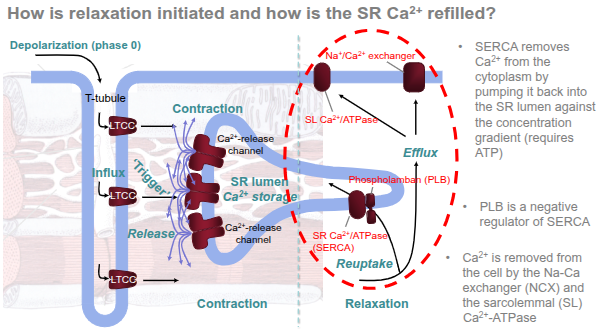
🧠 Overview
During contraction, Ca²⁺ floods into the cytoplasm from the SR (via RyR) and binds troponin, triggering actin–myosin cross-bridge cycling.
For relaxation to occur, that Ca²⁺ must be removed from the cytoplasm — either pumped back into the SR (for storage) or expelled from the cell.
⚙ Step-by-step explanation
1. End of contraction
Once the action potential ends, the L-type Ca²⁺ channels (LTCC) close.
The Ca²⁺-release channels (RyR) on the SR also close.
No more Ca²⁺ enters or leaves the SR → now the cell must remove the cytosolic Ca²⁺.
2. Cytoplasmic Ca²⁺ removal
There are two main routes for lowering cytoplasmic Ca²⁺:
A. Reuptake into the SR (Reuptake / SERCA pathway)
The SR Ca²⁺-ATPase (SERCA) pump actively transports Ca²⁺ from the cytosol back into the SR lumen.
This requires ATP, because Ca²⁺ is pumped against its concentration gradient.
As Ca²⁺ re-enters the SR, it is stored again (often bound to calsequestrin).
This process directly enables muscle relaxation, since cytosolic Ca²⁺ levels fall and troponin releases Ca²⁺, stopping cross-bridge cycling.
B. Efflux out of the cell (Extrusion / Sarcolemmal pathway)
Na⁺/Ca²⁺ exchanger (NCX):
Moves 1 Ca²⁺ out of the cell in exchange for 3 Na⁺ in (electrogenic).
Does not use ATP directly; relies on the Na⁺ gradient maintained by the Na⁺/K⁺ ATPase.
Sarcolemmal (SL) Ca²⁺-ATPase:
A plasma-membrane pump that also actively extrudes Ca²⁺ from the cytoplasm into the extracellular space using ATP.
Together, these mechanisms ensure that cytosolic Ca²⁺ returns to its resting low level (~100 nM).
3. Regulation by phospholamban (PLB)
Phospholamban (PLB) is a regulatory protein attached to the SR membrane.
When unphosphorylated, PLB inhibits SERCA, slowing Ca²⁺ reuptake.
When phosphorylated (e.g. by PKA during β-adrenergic stimulation), PLB inhibition is relieved → SERCA activity increases, Ca²⁺ reuptake speeds up, and relaxation (lusitropy) is enhanced.
This allows the heart to relax and refill faster during stress or exercise.
4. Energy requirement
The SERCA and sarcolemmal Ca²⁺-ATPase both consume ATP to move Ca²⁺ against its gradient.
Efficient ATP supply (via mitochondria) is essential for proper Ca²⁺ handling and relaxation.
5. Final result
Cytosolic Ca²⁺ concentration decreases.
Ca²⁺ unbinds from troponin C → tropomyosin moves back to block actin–myosin interaction.
The muscle relaxes.
Meanwhile, the SR Ca²⁺ stores are refilled by SERCA, ready for the next contraction cycle.
🔁 Summary of the three key players
Mechanism | Location | Direction of Ca²⁺ movement | Energy source | Role |
|---|---|---|---|---|
SERCA (SR Ca²⁺-ATPase) | SR membrane | Cytosol → SR | ATP | Reuptake / refilling of SR |
NCX (Na⁺/Ca²⁺ exchanger) | Sarcolemma | Cytosol → Extracellular | Na⁺ gradient | Ca²⁺ extrusion |
SL Ca²⁺-ATPase | Sarcolemma | Cytosol → Extracellular | ATP | Ca²⁺ extrusion (minor route) |
💡 Key concepts
Relaxation = removal of cytosolic Ca²⁺.
Reuptake (SERCA) and Efflux (NCX, SL Ca²⁺-ATPase) are both essential.
Phospholamban modulates SERCA’s speed — phosphorylated PLB → faster relaxation.
All these mechanisms restore ionic balance for the next heartbeat.