Introduction to Psychology: Developmental Psychology
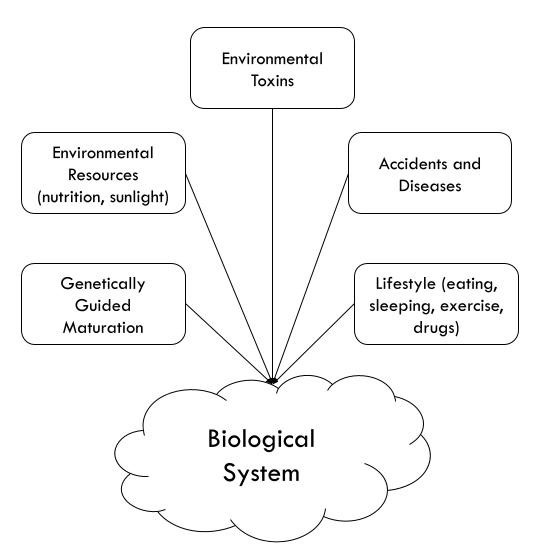
Biological System
- Includes all processes necessary for the physical functioning of the organism and for mental activity
- Genetic, skeletal, sensory, motor, respiratory, endocrine, circulatory, waste elimination, sexual reproductive, digestive, central nervous system
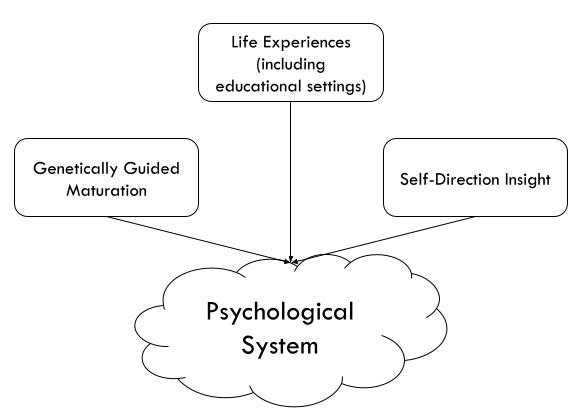
Psychological System
- Includes mental processes central to a person’s ability to make meaning of experiences and take action
- Provides resources for processing information and navigating reality
- Motivation, emotion, perception, learning memory, critical thinking, reasoning, problem solving, language skills, symbolic abilities, self-awareness, reality testing, self-regulation
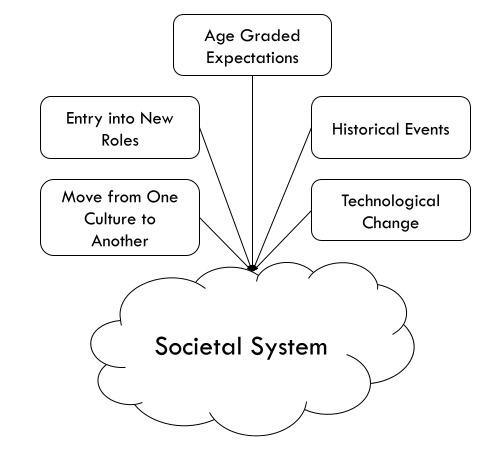
Societal System
- Includes those processes that foster or disrupt a person’s sense of social integration and social identity
- Interpersonal relationship, social roles, rituals, cultural myths, social expectations, leadership styles, communication patterns, family organization, social support, political and religious ideologies, patterns of economic prosperity (poverty, war, or peace), patterns of intolerance or discrimination
General Principles of Cognitive Development
- All children do not develop at the same rate
- Development as a process is continuous and relatively orderly
- Learning, experience, and social interaction all contribute to development
- Development is affected by both heredity and the environment
Jean Piaget (1896-1980)
- Met Theodore Binet, who collaborated with Simon Binet in devising the first useful intelligence tests
- Piaget administered many intelligence tests to many children to develop better test norms
- Measuring children’s intelligence was less interesting than studying how children use their intelligence
- Many of the ideas were based on his insights gleaned from careful observation of his own 3 children during their infancy
- According to Piaget: * Children actively explore the world around them * Interaction with the environment a maturation gradually alter the way children think
- Organization * An ongoing process of arranging information and experience into mental systems or categories * Schema schemata
- Adaptation * Adjustment to the environment * Assimilation Accommodation
- Equilibrium * Search for mental balance between cognitive schemes and information form the environment * Equilibrium Disequilibrium
Basic Cognitive Concepts
- Schema * Mental network for organizing concepts and information * Ex. Banging is a favorite schema used by babies to explore their world.
- Assimilation * The process of making sense of experiences and perceptions by fitting them into previously established cognitive structure * Ex. Assimilation occurs when they incorporate new objects into the schema
- Accommodation * Process of creating new schema * A process used to modify an existing schema in order to be able to understand information that would otherwise be incomprehensive with existing schemata * Ex. Accommodation occurs when the new object doesn’t fit the existing schema.
- Equilibration * Actual changes in thinking takes place here * Apply a particular scheme to an event or situation and the scheme works
- Disequilibrium * If the scheme does not produce satisfying result * Motivates us to keep searching for a solution
- Example: * Scheme: Four-legged pets are called “puppies”. * Assimilation: The child encounters cats; applies the “puppies” scheme to understand the new event. * Accommodation: Eventually, the child discovers that cats and puppies are different types of animals; adjustments to mental schema
Piaget’s Stages of Cognitive Development
- Sensorimotor Stage * 0 to 2 years old * The child begins to interact with the environment * Begins to: * Make use of imitation, memory, thought * Recognize that objects do not cease to exist when they are hidden * Logical goal-director actions
- Preoperational Stage * 2 to 6 or 7 years old * The child begins to represent the world symbolically * Gradually develops use of language and ability to think in symbolic form * Able to think operations through logically in one direction * Has difficulty seeing another person’s point of view * Conservation * Decentering * Egocentrism * Collective monologue * Mastering Conservation and Reversibility * Semiotic Function * Ability to use symbols (language, pictures, signs) or gestures (to represent objects mentally) * Conservation * Principle that some characteristics of an object remain the same despite changes in appearance * Centration * Reversibility * Egocentrism * Decentering * Focusing on more than one aspect at a time * Reversible Function * Thinking backward, from the end to the beginning * Egocentrism * Assuming that others experience the world the way you do * Collective Monologue * Form of speech in which children in a group talk but do not really interact or communicate
- Concrete Operational Stage * 7 to 11 or 12 years old * The child learns rules such as conservation * Able to solve concrete (hands-on) problems in logical fashion * Understands laws of conservation and is able to classify and seriate * Understands reversibility * Decline in egocentrism and gradual mastery of conservation * Identity * Principle that a person or object remains the same over time * Compensation * The principle that a person changes in one dimension can be offset by changes in another * Classification * Grouping objects into categories * Reversibility * A characteristic of Piagetian logical operations (the ability to think through a series of steps than mentally reverse the steps and returning to the starting point) * Seriation * Arranging objects in sequential order according to one aspect such as size, weight, or volume
- Formal Operational Stage * 12 years old to adulthood * The adolescent can transcend the concrete situation and think about the future * Able to solve problems in logical fashion * Becomes more scientific in thinking * Can consider contrary-to-fact questions * Develops concerns about social issues, identity * Formal Operations * Mental tasks involving abstract thinking and coordination of a number of variables * What might be * Hypothetico-Deductive Reasoning * Identifying all the factors that might affect a problem and then deduces and systematically evaluates specific solutions
- Some students remain at the concrete-operational stage throughout their school years, even throughout life.
- Deductive Reasoning: general assumption to specific implications
- Inductive Reasoning: specific observations to general implication
Lev Vygotsky (1896-1934)
- Wrote about language and thought, the psychology of art, learning and development, and educating students with special needs
- Work was banned in Russia because he referenced Western psychologists
- His ideas have become major influences in psychology and education and provided alternatives to many of Piaget’s theories
- According to Vygotsky: * Human activities take place in a cultural setting and cannot be understood apart from these settings * Emphasizes cooperative dialogues between children and more knowledgeable members of society
Sociocultural Theory
- Social Construction of Meaning * Teachers, parents, and peers interact with children to help them learn and develop
- Internalization * Children begin to give themselves the instructions to guide their behaviors that heretofore have been provided by others * Social speech >> self-talk or private speech >> inner speech
- Cultural Tools * Allow people in a society to communicate, think, solve problems, and create knowledge
- Material Tools * Computers, the internet, rulers, calculators, etc.
- Psychological Tools * Numbers, mathematical systems, works of art, language, etc.
- Zone of Proximal Development * The teaching space between the boring and the impossible * The area between the child’s current development level as determined by independent problem solving and the level of development that the child could achieve through guidance or in collaboration with more capable peers
- Scaffolding * Assistance provided by others that enables children to proceed through their zone of development * Clues, reminders, encouragement, breaking the problem down into steps, providing an example
Jean Piaget
- Provide opportunities for play and communicating through symbols
- Use actual experiences and concrete objects as tools for learning concepts
- Encourage students to follow their interests and experiment
- Provoke students to examine alternative explanations for their experiences and to share feedback with peers
Lev Vygotsky
- Use guided participation apprenticeship, modeling, and verbal cues
- Give students increasing responsibility for doing activities on their own
- Use peers as role models and promote collaboration in exploring ideas
- Provide instructional support within the zone of proximal development and gradually reduce such support
\