L8 - Extinction
What is Extinction and How Do We Recognize It?
Definition: Extinction is the deletion or destruction of a species as a unit.
Proposed by French biologist and paleontologist Georges Cuvier.
Challenged the idea that undiscovered organisms existed in unexplored regions.
*Humans Have Witnessed Extinction Events
Dodo Bird: Extinct in the 1600s due to competition from non-native species.
Oxford University Museum possesses the most complete dodo specimen with soft tissues.
Thylacine (Tasmanian Tiger): The last known individual died in 1936 in the Hobart Zoo, likely due to human hunting and competition from introduced species (e.g., dogs).
Passenger Pigeon: Once abundant in North America, the last individual died in the Cincinnati Zoo.
Mass ExtinctionsJohn Phillips' Diversity Curve: Drawn shortly after Cuvier's death, it speculated about periods of declining biodiversity.
The Equation for Species Diversity: \text{Number of species} = \text{Number of new species} - \text{Number of species going extinct}
During evolutionary radiations, the rate of speciation (new species creation) significantly exceeds the extinction rate.
In mass extinctions, the extinction rate is much greater than the speciation rate, causing overall diversity to decline.
The Raup and Sepkoski Curve (1980s): Identified five major mass extinction events based on the first and last appearances of species in the fossil record. Mass extinctions occur when there is an elevated extinction rate compared to background extinction.
End Ordovician
Late Devonian
Permo-Triassic
Triassic-Jurassic
Cretaceous-Paleogene (K-Pg)
Extinction Rate: \text{Extinction Rate} = \frac{\text{Number of species extinct}}{\text{Unit Time}}
While extinction occurs constantly, mass extinctions exhibit significantly elevated rates.
Challenges in Estimating Extinction
Extinction is based on the last appearance of fossils, which is a difficulty due to lack of samples or fossils.
Counting Higher-Order Extinctions: Due to the difficulty of identifying species in the geological record, scientists often count extinctions at the level of orders and families.
Extrapolating Species Numbers: If 20% of orders go extinct, it's estimated that approximately 96% of species are lost.
Unconformities: Time missing in the geological record can obscure the true nature of extinction events.
Gradual vs. Abrupt Extinctions: Unconformities can make gradual extinctions appear abrupt.
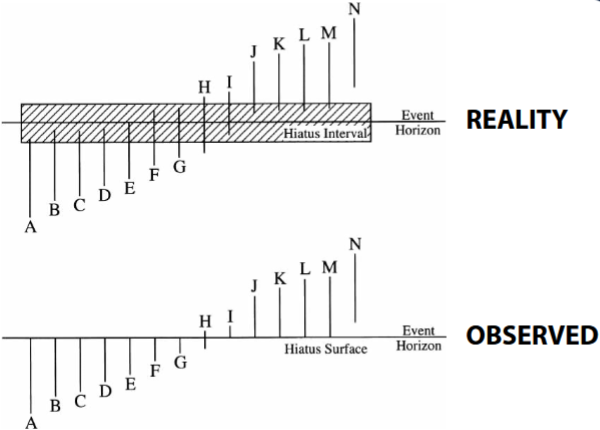
Signor-Lipps Effect: The fossil record is incomplete; the last fossil occurrence of a species may not represent its actual extinction time.
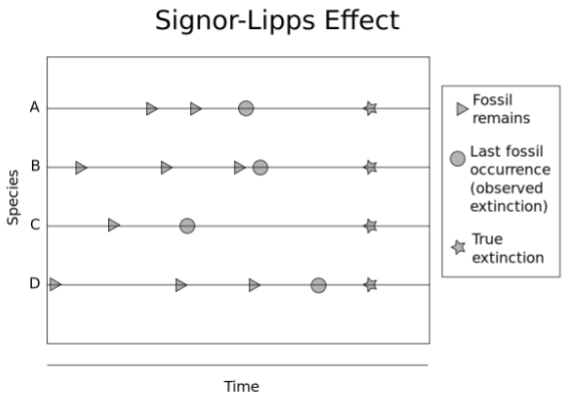
Rarity: Declining populations become less likely to be fossilized, potentially exaggerating the appearance of extinction.
The Permian-Triassic Extinction
Scale: Largest mass extinction event, with possibly over 90% of marine species lost.
Ecological transformation: Transition from Paleozoic to Mesozoic ecosystems.
Pre-Extinction: Diverse marine ecosystems with brachiopods, clams, corals, and bryozoans.
Post-Extinction: Simplified ecosystems dominated by disaster taxa like the clam Claraia (disaster taxon).
Reef Ecosystems: Shift from diverse reefs (bryozoan, coral, sponge, algal, and microbial) to microbial reefs, resembling Precambrian stromatolites.
Selectivity: Organisms with robust calcium carbonate skeletons were disproportionately affected.
Terrestrial Changes: Replaced large, energy-intensive predators (e.g., gorgonopsians) with slow, low-metabolism organisms (e.g., Lystrosaurus). Specialist organisms were replaced with generalists.
Timing: Approximately 251.9 million years ago, based on radiometric dating at the Permian-Triassic boundary (e.g., Meishan, China).
The Siberian Traps: Massive volcanic eruptions covering a huge area released toxic gases, causing climatic and ocean chemistry changes.
Volume estimated at 10^6 \text{ km}^3.
Volcanic Effects:
Release of carbon dioxide and sulfur dioxide leads to ocean acidification, ash blocks sunlight, short-term cooling. These gases are also toxic.
Long term, substantial global warming occurs, altering oxygen solubility.
Hypercapnia: Direct physiological effects of CO_2 on organisms.
Asphyxiation and sulphide poisoning
Isotopic Evidence: A significant drop in carbon isotopes indicates a large input of isotopically light carbon from volcanic sources.
Volcanic carbon (\delta^{13}C \approx -7%) and methane (\delta^{13}C \approx -5% ) signatures.
Estimated release of 10^{17} \text{ to } 10^{19} moles of CO2, increasing atmospheric CO2 by 10 to 10,000 times.
Ocean Acidification: Boron isotopes indicate a pH drop of almost one unit.
Rock Type Matters: The Siberian Traps erupted through Proterozoic and Cambrian carbonates and oil deposits, volatizing large amounts of carbon.
Fossil Evidence: Marine organisms with calcium carbonate skeletons were more strongly impacted due to ocean acidification where skeletons are much harder to form given carbonate saturation.
Spatial Variation in Extinction: Modeling shows higher extinction rates at the poles due to limited adaptive capacity compared to the tropics.
The Cretaceous-Paleogene (K-Pg) Extinction
Scale: Approximately 75% of species went extinct.
Notable Extinctions: End of the dinosaurs (except birds), ammonites, and rudist bivalves.
Historical Theories: Various ideas, including changing plant vegetation, loss of lagoonal habitats, and supernovae.
Alvarez HypothesisThe Discovery: In 1980, Walter Alvarez and his team found an iridium spike at the K-Pg boundary in Gubbio, Italy.
Iridium Anomaly: Significantly elevated (30x) iridium levels at the K-Pg boundary, suggesting an extraterrestrial source (meteorite).
Additional Evidence: Shocked minerals and siliceous spherules indicate a meteorite impact. Ejecta is globally distributed
The Chicxulub Crater: Discovered in the early 1990s on the Yucatan Peninsula, Mexico, confirming the impact event and leading to planet wide distribution of debris.
Kill Mechanisms: Enormous energy release (30,000,000 megatons) leading to earthquakes, tsunamis, ejecta, wildfires, acid rain, and global darkness causing inhibition of the global productivity.
Dinosaur Debate: Initial resistance from paleontologists citing gradual dinosaur extinction patterns prior to the K-Pg boundary, now believed to be a result of sparse sample and the Signor-Lipps effects.
Deccan Traps: Volcanic activity in India may have contributed to environmental stress.
Idea of Deccan Traps & Meteorite Impact Relation
Deccan Volcanism: Most Deccan Trap volcanism may have occurred after the impact and mass extinction.
Provocative Hypothesis: The impact on one side of the planet may have triggered increased volcanism on the opposite side (Deccan Traps).
The Sixth Mass Extinction
Current Trends: Many species are currently threatened or going extinct, raising concerns about a potential sixth mass extinction, that can potentially match or pass the big 5.
Comparison to Past Events: Similarities to the end-Permian extinction with rapid increases in atmospheric carbon dioxide.
Paleontology's Role: Understanding past extinctions can inform present-day conservation strategies.
Analyzing which species survived past events and how they did so (e.g., migration) to guide future conservation efforts.