PS210 T1 W2 - Lecture 1 - Nature vs Nurture in Language Acquisition and Critical Periods - Lecture notes and Required Reading
Nature vs Nurture in Language Acquisition and Critical Periods
The role of Nature in Language Acquisition
To start to understand the role of nature in language acquisition, it will be useful to understand what Developmental Language Disorder (DLD) is (formerly known as Specific Language Impairment). DLD is a condition that affects a child’s ability to acquire a language despite normal cognitive development and no obvious sensory or neurological issues. Children with DLD may struggle with understanding and producing language, which can manifest in difficulties with vocabulary and grammar. This then affects things such as their everyday communication, academic performance, and social interactions. This condition is usually discovered when a child first goes to school, and it is different from other disorders, such as dyslexia.
This condition has been given the name “the most common childhood disorder that you have never heard of”. It is estimated that 1 in 15 children has some form of DLD. This is more prevalent in boys than in girls.
Video of a young girl with DLD:
As a young child, I made lots of noise, but few proper words and no structured sentences.
Required pictures and symbols to communicate
Eventually developed language through songs and familiar stories
Language continued to develop through things such as music and acting.
Also received intensive training to develop language further
Researchers found that DLD could run through families, with high concordance rates between genetically close family members
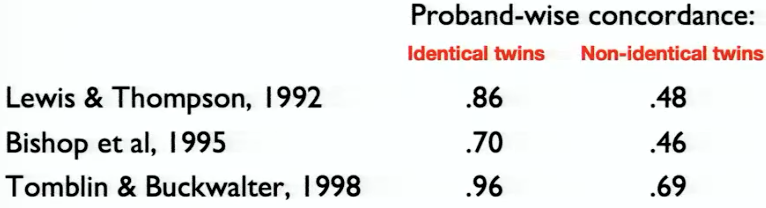
(Proband-wise concordance) - Stats measure used in genetics to estimate how frequently a trait or disorder is shared between two people when one of them has a trait or disorder. The closer the number is to 1, the higher the likelihood that the trait or disorder will be shared between the two people. Since identical twins share 100% of their DNA, the pattern shown strongly suggests that DLD has a root in genetics. From here, it can then be asked, “Does this mean that there is a language gene?”
When looking for the answer to this question, researchers discovered the KE Family.
KE Family
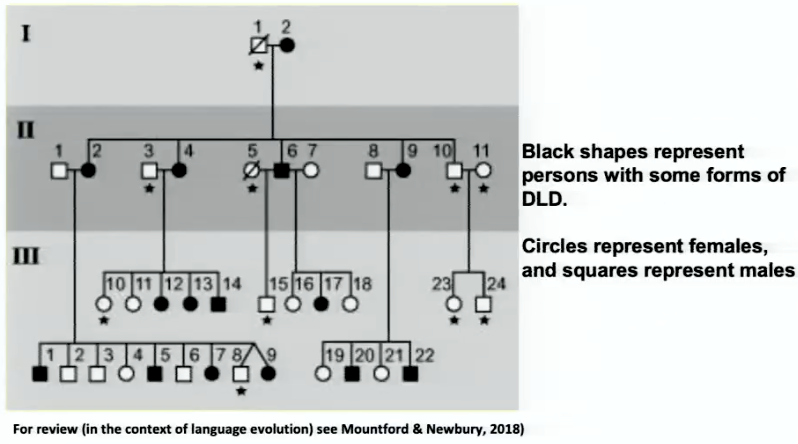
Out of 37 members spread across three generations, 15 were discovered to be suffering from some form of DLD, represented by the black shapes shown. Such a high number of affected individuals within the same family is a strong indication that the disorder could be linked to a single gene.
Initially, the researcher failed to identify any defective genes that caused/increased the likelihood of DLD, and this was possibly due to the high number of genes needing to be looked at.
A breakthrough came later, when a young boy who had DLD but was not a member of the KE family. After the analyses, it was found that the boy had a visible defect on the chromosome “FOXP2”. After focusing attention on this particular defective gene, it was found that it did correlate with DLD. When researchers then took this back to the KE Family, it was found that the affected members also had defective FOXP2 genes. From here, it was largely publicly assumed that FOXP2 was the “language gene”.
However, i reality, it is a lot more complex than this, as there is no one gene that directly affects and brings about DLD in one person. DLD involves multiple factors that interact in complex ways, which makes it difficult to single out what directly causes the disorder.
The KE Family is considered an exception, rather than a rule, as the genetic mutation in the FOXP2 gene is rare and not representative of the wider population of people who have been diagnosed with DLD.
DLD is said to be “polygenic”, meaning that it is influenced by mutliple genes, where these genes have a small effect on their own, but whne they are combined with the effects of other genes and environmental factors, these small effects build up the likelihood of being diagnosed with DLD.
Overall:
DLD has a heritable biological basis
Language: has a nature component
However, there isn’t a single “language gene”.
Genes obviously matter
If language was not a product of nature, it would mean that all types of animals would be able to pick up the language that we as humans use.
The role of Nurture in Language acquisition
Nurture definitely plays a role in language acquisition, as if not, all people would speak 1 language.
However, it can be asked whether there is a specific time period within ones life where the effects of nurture in learning language has to take place? To consider this question, we can take a look at another function humans have: vision.
Vision is not something that humans are born fully equipped with. While the structures of the eyes and visiual cortex are present at birth, the brain must learn to process, interpret and understand this visual information. This learning is best done within a certain time period in the infants life - this time period being known as the “critical period”. During this period, the brain is highly sensitive to visual input. Adequate stimulation strengthens the required neural connections needed for vision and processing. If deprived of this stimulation, even with healthy eyes, the neural pathways and connections will dwindle, resulting in difficulties in perceiving visual information.
E.g. a condition known as “lazy eye” in children may result in the child having their stronger eye being closed with an eye patch, leaving only their weaker (lazy) eye being the eye used to process visual information. This process results in the lazier eye being required to work harder and thus over time becomes equal to the other eye. Overall, this shows how important a stimulating environment is for children as a key function, that being sight, will be hindered and result in difficulties in that function.
Criticial period hypothesis in psycholinguistics

The critical theory hypothesis is part of a lobgstanding debate over the extent to which our ability to master a language is linked to our biological age.
The hypothesis states that missing the opportunity for language exposure during early years can lead to lifelong language deficits. Meaning that if you do not learn one language before a certain age, you will not be able to learn any languages ever in life past that point.
The majority of researchers agree on the point that there is a window of opportunity for language exposure. What is less clear is how wide this window is.
The case of Genie
The Child Affair Department in Los Angeles in the 70’s discovered a 13 year old girl named Genie. She had suffered severe neglect, being confined to a small room and deprived of social and linguistic stimulation. This had been the case since she was around 20 months old, and in this time, no one spoke to her and di not learn a word in any language. Such a case provided researchers the opportunity to study the topic of critical periods.
The question is, has she lost her chance to speak forever?
The answer is that whilst Genie was able to learn, understand and use words in speech and communicate on a simple level with the researchers, it was found that she was never able to reach the level of language proficiency that someone who was a native speaker and fluent in the language would have achieved. Now it can be asked, how much language did Genie learn?
How much language she learned can be understood by breaking down language into parts. Phonology (sound) - at the beginning of testing, researcher found that her voice was soft and high pitched, which was believed to be contributing to the abnormalities in her language. After training, her voice became lower and louder, though still higher pitched than what would be expected of fluent speakers. Her ability to articulate words improved, but she still “deleted” or “substiuted” sounds, which would still make communicating through language difficult for her.
Semantics (meaning) - Through testing, researchers noted the rapid growth in her vocabulary. It got to the point that Genie would be able to nam most objects that she encountered in her life. Her receptive vocabulary is much larger than her expressive vocabulary. Researchers noted that she had little difficulty learning hundreds of words.
Morphosyntax (grammar) - In contrast to her rapid progress in vocabulary, she faced significant difficulties in learn grammatical principles. Whilst she mastered some principles, her receptive comprehension of gramar outpaced her ability to produce it. This means that she was able to understand grammar, but not able to produce fully grammatically correct sentences. Examples of sentences made by Genie:
“Genie stomach full.”
“Father fake piece wood. Hit. Cry.”
“Want milk.”
“Genie bad cold live father house.”
So what does this tell us about the critical period hypothesis?
The case of Genie may tell us something about how wide the window of opportunity is for language acquisition. Genie was discovered around the age of onset for puberty, ~13, and whilst she was able to understand and gain some language skills, her struggless with grammar may have passed before the age of 13. This suggests that there is a “window of opportunity” for each part of language, each with varying starts and finishes.
However, it is important to note that Genie’s case is an extreme case, and there many confounding variables in her condition, as her neglect and abuse would not have only just affected her language ability, but would have also affected her emotional and intellectual development. This then makes it difficult to draw clear conclusions based on her case.
Critical Period research using less extreme cases
Newport (1990) - deaf children - studied users of ASL (American Sign Language)
Participants would fall into one of three categories: Native ASL signers (those who’s parents had communicated with them through ASL since birth), Early learners (those who were exposed to ASL between ages 4-6), Late learners (those who were exposed to ASL at the age of 12 and above).
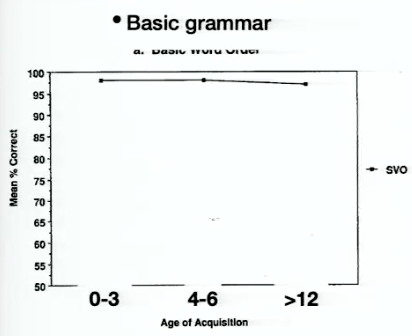
Researchers measured the participants’ grammar knowledge and the results showed that in basic grammar and forming basic sentences, all participants performed well.
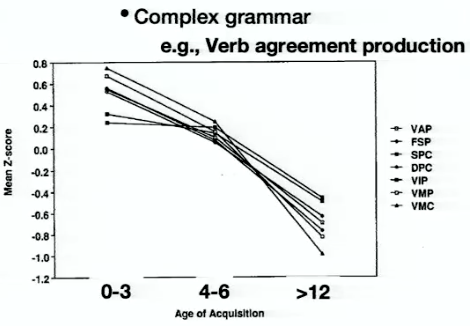
However, when it comes to complex grammar, things look different. One way to test complex grammar is through “Verb Agreement Produciton”. E.g., in english, you may say things such as “I wish”, “you wish”, “he wishes”. Whether the verb has an “es” on the end depends on the subject. The results of testing for complex grammar show that the later a child learns ASL the worse their performance and understanding of complex grammar will be. This shows that the window of opportunity for learning complex grammar closes very early in life.
All the studies shown thus far have been concerned with just the native language (L1)
From what we have seemed, we can summarise that:
The window of opportunity for learning of complex grammar in the L1 is relatively small. However, the window of opportunity for semantics does not seem to be as strict.
But now we may ask, what about the critical period in second language acquisition (L2)?
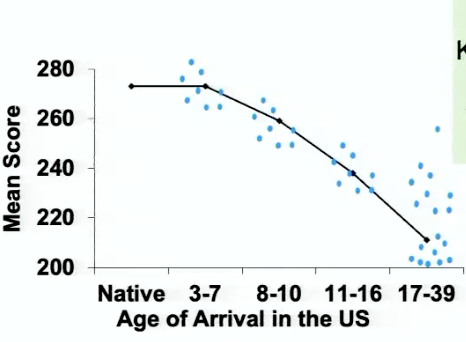
Johnson and Newport (1989) - Researchers compared the english proficiency of 46 native Korean/Chinese participants who had arrived in the US at various ages. These individuals had lived in the US for an amount of time ranging from 3 to 26 years. They were tested through a grammaticality judgments task - where they had seen a sentence on a computer screen and had to decide whether the sentence was grammatically correct or not. The results showed a clear and strong advantage towards those who had arrived in the US from earlier on.
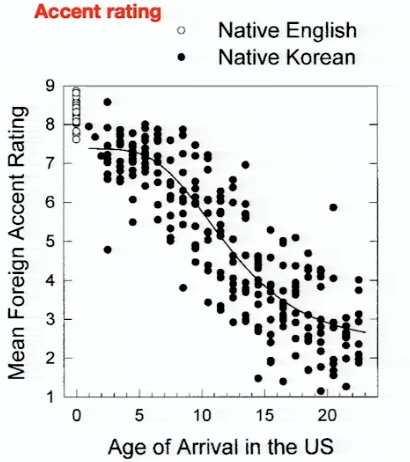
Flege et al., (1999) - 240 native speakers of Korean who moved to the US at different ages, and lived there for at least 5 years. They were asked to read aloud some English text and they were then judged by native speakers on how “native” the Korean participants were in their readings of the texts. The results showed that the later the arrival in the US, the “less-native” the Korean participants had sounded in their readings.
Required Reading
Paper 1 - Age Constraints on Second Language Acquisition - James Emil Flege
✅ 1. Main aims of the study
Aim (with quote):
The authors wanted to test the Critical Period Hypothesis (CPH) for second-language acquisition by examining how Age of Arrival (AOA) affected adult Korean immigrants’ English phonology (accent) and morphosyntax.
📌 Direct quote:
“This study evaluated the critical period hypothesis for second language (L2) acquisition.”
PS210 T1W2 - required reading -…
More specifically, they aimed to:
Test whether age effects show discontinuities (sharp drops) expected under CPH
Compare phonology vs. morphosyntax under age constraints
Examine whether age effects disappear when AOA is statistically disentangled from confounding variables like English use, education, and length of residence.
✅ 2. Author’s initial hypothesis
Although not labelled explicitly as “the hypothesis,” the logic of the paper clearly states that:
If a maturationally defined critical period exists, then L2 performance should sharply decline after this age and should not be strongly correlated with AOA after the critical period.
So the initial hypothesis being evaluated is:
💡 Hypothesis: Performance in both accent and grammar will be significantly constrained by age, showing nonlinear age effects supporting a critical period.
This stems from text such as:
“The critical period hypothesis rests on the assumption that the age-related effects seen in L2 studies are the result of maturational changes in brain structures…”
PS210 T1W2 - required reading -…
✅ 3. Key research questions
From the aims and method, the main questions were:
Does Age of Arrival predict L2 accent and grammar performance?
Does the relation show a discontinuity consistent with a critical period?
Do phonology and morphosyntax differ in how strongly they are age-constrained?
Are age effects actually due to age, or to correlated factors like English use or education?
Do rule-based vs. lexically-based grammar items show different sensitivity to age?
✅ 4. Key arguments made (with quotes)
Argument 1 — Age effects exist, but do NOT match predictions of a strict critical period.
Evidence: age effects were linear, not sharply discontinuous.
“The relation between AOA and degree of foreign accent appeared to be linear… which fails to provide support for the critical period hypothesis.”
PS210 T1W2 - required reading -…
Argument 2 — Accent is more age-constrained than morphosyntax.
“AOA may constrain the learning of L2 phonology to a greater extent than L2 morphosyntax.”
PS210 T1W2 - required reading -…
Argument 3 — When confounding variables are controlled, age effects on grammar largely disappear.
“The effect of AOA on the grammaticality judgment test scores became nonsignificant when variables confounded with AOA were controlled.”
PS210 T1W2 - required reading -…
Argument 4 — Exposure and education affect learning differently for rule-based vs lexically-based grammar.
“The scores for sentences testing knowledge of rule-based, generalizable aspects… varied as a function of how much education the Korean participants had received… The scores for sentences testing lexically based aspects… depended on how much the Koreans used English.”
PS210 T1W2 - required reading -…
✅ 5. What experiments did they conduct?
They conducted two major tasks:
Experiment 1 — Phonological production task (foreign accent ratings)
Participants repeated 21 English sentences after hearing them twice.
Native English listeners rated the recordings on a 1–9 accent scale.
Experiment 2 — 144-item grammaticality judgment test
Participants heard English sentences (half grammatical, half ungrammatical).
They judged whether sentences were grammatical.
The test covered nine morphosyntactic rule categories, later reorganised into:
rule-based grammar items
lexically based grammar items
✅ 6. HOW the authors conducted the experiments (with quotes)
Phonology task procedure (quote):
“The participants repeated 21 English sentences… A short tone was presented 700 ms after the first presentation… To reduce the likelihood of direct imitations, the participants were required to wait until hearing the tone before repeating each sentence.”
PS210 T1W2 - required reading -…
“Listeners rated sentences… using a scale that ranged from ‘very strong’ foreign accent (1) to ‘no accent’ (9).”
PS210 T1W2 - required reading -…
Grammar task procedure (quote):
“The native Korean participants’ knowledge of English morphosyntax was assessed using a 144-item grammaticality judgment test.”
PS210 T1W2 - required reading -…
“The sentences were presented a single time via a loudspeaker… The participants were told to wait until they heard the entire sentence before checking ‘Yes’ (grammatical) or ‘No’ (not grammatical). The test was unspeeded.”
PS210 T1W2 - required reading -…
✅ 7. Findings of the experiments (with quotes)
Finding 1 — Accent declines strongly and linearly with higher AOA.
“As AOA increased, the foreign accents grew stronger.”
PS210 T1W2 - required reading -…
And:
“A significant correlation was found… for AOAs less than 12 years… and for AOAs greater than 12 years.” (i.e., even adults show age effects)
PS210 T1W2 - required reading -…
Finding 2 — Grammar scores decline with AOA, but age is not the true cause.
“As AOA increased… grammaticality judgment test scores decreased steadily.”
PS210 T1W2 - required reading -…
BUT crucially:
“The effect of AOA… became nonsignificant when variables confounded with AOA were controlled.”
PS210 T1W2 - required reading -…
Finding 3 — Rule-based vs. lexically-based grammar show different patterns.
“Scores for rule-based items varied as a function of education… scores for lexically based items depended on how much the Koreans used English.”
PS210 T1W2 - required reading -…
Finding 4 — More Koreans achieved native-like grammar than native-like accent.
“The number… who met the ‘two SD’ criterion… differed significantly: 18 vs. 76.”
PS210 T1W2 - required reading -…
✅ 8. Discussion section summary (with quotes)
Overall interpretation:
The authors conclude that age affects learning, but not in the way predicted by a strict critical period. Age effects appear continuous, graded, and influenced by social and educational variables, rather than a sharp biological cutoff.
📌 Quote 1 — Accent effects do not support a critical period:
“The relation between AOA and degree of foreign accent appeared to be linear… which fails to provide support for the critical period hypothesis.”
PS210 T1W2 - required reading -…
📌 Quote 2 — Grammar age effects disappear when controlling confounds:
“The observed decrease in morphosyntax scores was not the result of passing a maturationally defined critical period.”
PS210 T1W2 - required reading -…
Key ideas in the discussion:
Age affects L2 ability, but social and experiential factors also play a large role.
Phonology is more age-sensitive than grammar.
Lexically-based grammar depends heavily on L2 input quantity, not just age.
Findings argue against a strong maturational Critical Period Hypothesis.
✅ 9. Conclusions of the study (with quotes)
Conclusion 1 — Strong age effects for accent, weaker & confounded age effects for grammar
“As AOA increased, the foreign accents grew stronger… however… the effect of AOA on the grammaticality judgment test scores became nonsignificant when variables confounded with AOA were controlled.”
PS210 T1W2 - required reading -…
Conclusion 2 — Age is not sufficient to explain grammar outcomes
“This suggested that the observed decrease in morphosyntax scores was not the result of passing a maturationally defined critical period.”
PS210 T1W2 - required reading -…
Conclusion 3 — Phonology and morphosyntax are differently constrained
Phonology shows robust, continuous age effects, but grammar is heavily influenced by:
Education
English use
Linguistic properties of the rules tested
Paper 2 - A critical period for Second Language Acquisition - Joshua K. Hatshorne
1. Main aims of the study
Aim:
To determine how underlying language-learning ability changes with age, particularly whether there is a critical period for second-language (L2) grammar learning, and if so, when it begins to decline.
They also aimed to overcome limitations of previous research by analyzing a massive dataset (~670k participants) and using computational modeling to separate age of first exposure, current age, and years of experience.
Quote:
“This allows us to provide the first direct estimate of how grammar-learning ability changes with age, finding that it is preserved almost to the crux of adulthood (17.4 years old) and then declines steadily.”
PS210 T1W2 - Required Reading -…
2. Author’s initial hypothesis
Although they frame it cautiously, the authors hypothesize that:
There is a critical period for L2 acquisition.
The decline in learning ability might not occur as early as traditionally believed (i.e., not at age 5 or puberty).
The relationship between age and proficiency cannot be understood without disentangling exposure length, age at exposure, and age at testing.
This hypothesis is implicit but clear from the introduction: previous theories lacked clarity because learning ability and ultimate attainment were confounded, and their study aims to resolve that.
3. Key questions investigated
The authors investigate three core questions:
1. How does underlying L2 grammar-learning ability change with age?
(e.g., is decline gradual, sudden, early, or late?)
2. How long does it take learners—native and non-native—to reach asymptotic (ultimate) performance?
3. At what age of first exposure can learners still realistically reach native-like proficiency?
(I.e., where does the “optimal period” end?)
These correspond to gaps in the existing literature highlighted in the introduction.
4. Key arguments made
The authors argue:
1. A massive dataset is required to properly estimate learning ability.
Prior studies had too little statistical power to distinguish between theoretical models.
2. The ultimate attainment curve is not the same thing as learning ability.
You cannot infer ability changes just from end-state proficiency.
3. L2 grammar-learning ability remains stable until about age 17, then declines sharply.
4. Learners require ~30 years of exposure to reach asymptote, even native speakers.
5. Learners who start by age 10–12 can still achieve near-native ultimate attainment, but those who begin later progressively fall short—not because they can’t learn, but because they “run out of time” before the steep decline in learning rate begins.
Quote:
“The results support the existence of a sharply-defined critical period for language acquisition, but the age of offset is much later than previously speculated.”
PS210 T1W2 - Required Reading -…
5. What experiments did they conduct?
The paper contains two empirical components:
Experiment 1 – Internet-based grammar quiz (massive dataset)
669,498 participants
Judgement and sentence–picture matching items (132 items; 95 critical items)
Participants provided demographic + linguistic background
The quiz allowed extraction of:
Age of first exposure
Current age
Years of English experience
Performance on syntactic items
Experiment 2 – Computational modelling (ELSD model)
They applied a model (Exponential Learning with Sigmoidal Decay) to:
Estimate the learning rate at each age
Identify when decline begins
Compare models with and without a critical period
Fit curves to monolinguals, immersion learners, and non-immersion learners
This modelling counts as an experiment because they test hypotheses against data through model comparisons.
6. HOW the authors conducted the experiments
For the behavioural data (the quiz):
Participants were recruited through a viral online grammar quiz.
They completed grammaticality judgments and sentence–picture matching tasks.
The authors cleaned the data for inconsistent demographics.
They categorized participants into:
Monolinguals
Immersion learners
Non-immersion learners
Performance curves were plotted against:
Age of first exposure
Years of experience
Current age
For the modelling:
They used Differential Evolution to fit parameters.
Compared models using cross-validated R².
The best-fitting model estimated the decline in learning rate begins at age 17.4.
Quote:
“We modeled syntax acquisition as a simple exponential learning process… and fitted the model using cross-validated R², comparing against alternative hypotheses.”
PS210 T1W2 - Required Reading -…
7. Findings of the experiments
1. The critical period exists and ends around age ~17.4
Learning ability remains high until late adolescence.
2. Learners require ~30 years to reach asymptote
Even native speakers develop until age ~30.
3. Ultimate attainment is similar for those starting by age 10–12
After this, proficiency declines with increasing age of first exposure.
4. Later starters “run out of time” before the steep drop in learning ability
They can still learn but cannot reach native-like mastery.
5. Results were robust across immersion vs. non-immersion learners
Both groups showed similar patterns.
Quote:
“Grammar-learning ability is preserved almost to the crux of adulthood (17.4 years old) and then declines steadily.”
PS210 T1W2 - Required Reading -…
8. Detailed yet succinct summary of the Discussion
The Discussion emphasizes:
1. Grammar-learning ability stays high until age ~17, then declines rapidly.
This supports a late-onset critical period.
2. Native and non-native learners both need decades to reach asymptotic performance.
This finding clarifies why early exposure is advantageous.
3. Ultimate attainment is stable for starters up to age 10–12.
But later starters cannot catch up because the steep decline hits before they have enough experience.
4. Prior studies failed due to low statistical power.
Their contradictory findings were likely noise; large datasets are required to study ultimate attainment reliably.
5. The findings integrate theoretical debates
They propose that:
The critical period exists
Its offset is later than believed
Differences across studies can be explained by modeling + statistical noise
Quote:
“Taken together, the analyses above all point to a grammar-learning ability that is preserved throughout childhood and declines rapidly in late adolescence.”
PS210 T1W2 - Required Reading -…
9. Conclusions the author arrived at
1. There is a critical period for L2 grammar acquisition.
But it ends much later (~17–18 years old) than previously thought.
2. Early starters (≤10–12 years) can still achieve native-like attainment.
3. Later starters fail to reach native levels not due to inability, but due to insufficient time before the decline begins.
4. Studies of ultimate attainment must include thousands of participants; prior studies were too underpowered.
5. The modelling approach used here resolves decades of confusion by separating learning ability from exposure time.
Quote:
“Our findings demonstrate a sharply defined critical period, with the decline beginning at 17.4 years, and show that reliable conclusions require thousands of subjects.”
PS210 T1W2 - Required Reading -…