Homeostasis
Homeostasis regulates a range of variables in humans
body temperature: 36 - 37.5 C
blood pH: 7.35 - 7.45
blood glucose levels: 3.9 - 5.6 mmol/L
levels increase after a meal but return to normal within a few hours
blood osmotic concentration: 275 - 295 mOsm/kg of water
blood osmotic concentration - measure of concentration of solutes in the blood
negative feedback - response that reverses a detected change to return body to homeostatic equilibrium within a tolerable range of set point
homeostatic variable increases → negative feedback decreases variable → returns it to set point
homeostatic variable decreases → negative feedback increases variable → returns it to set point
positive feedback - response that amplifies a detected change
variable is increasing/decreasing → positive feedback further increases/decreases variable
variable does not return to a set point
hormones - chemical messengers released by endocrine glands
transported to target cells via bloodstream
Regulation of blood glucose levels
Increase
blood glucose levels increase after a meal → pancreas detects change → beta cells in islet of Langerhans secrete insulin into bloodstream
insulin travels to target cells (liver, muscle cells) → insulin binds to insulin receptors on surface of target cells → cells remove glucose from bloodstream
liver cells convert glucose into glycogen for storage
muscle cells use increased quantities of glucose for aerobic respiration
decrease
blood glucose levels decrease during excercise → pancreas detects change → alpha cells in islets of langerhans secrete glucagon into bloodstream
glucagon travels to liver cells → glucagon binds to glucagon receptors on the liver cells
glucagon triggers liver cells to convert glycogen into glucose → glucose released into bloodstream
example of negative feedback loop
Diabetes
Type 1
autoimmune disease
beta cells are damaged
body no longer produces insulin
risk factors = mainly genetic/autoimmune
cannot be prevented
treatment
blood sugar monitoring
injections of insulin
benefit from healthy diet + regular excercise
Type 2
beta cells produce insulin → liver and muscle cells DO NOT RESPOND
aka target cells are resistant to insulin
risk factors
excess body weight
lack of excercise
diet high in sugars/fats
genetics
prevented via healthy diet + lifestyle
treatment
lifestyle changes
healthy diet
excercise
medicines
thermoregulation - process by which an organism maintains body temperature within a narrow range
involves negative feedback loops
peripheral thermoreceptors - monitor body temperature
sense a change in body temperature → send nerve signals to thermoregulatory center of hypothalamus (in brain)
hypothalamus - monitors body temperature → initiates range of negative feedback responses → warms/cools body as required
body temperature drops → hypothalamus sends nerve signals to skeletal muscles → shivering
muscles = effectors
stimulated by motor neurons
pituitiary gland secrets thyroid stimulating hormone → regulates secretion of thyroxin from thyroid gland → controls metabolic rate
increase in thyroxin → increased rate of metabolism → warm up body
adipose tissue (body fat) - under skin, acts as insulator + reduces heat loss
endotherms - animals that generate internal heat to maintain body temperature
ex, birds + mammals
ectotherms - rely on external sources of heat
vasoconstriction - narrowing of blood vessels
less blood flowing
body is cold → blood vessels near skin vasoconstrict → reduce heat loss through skin
vasodilation - widening of blood vessels
more blood flowing
body is hot → blood vessels near skin vasodilate → increase heat loss through skin
shivering - caused by rapid involuntary contraction/relaxation of skeletal muscles
occurs when cold
muscle contractions require ATP energy
generation of ATP by respiration → releases heat energy → warms up body
sweating - release of water from sweat glands
occurs when hot
water absorbs heat energy from skin → water evaporates → body cools down
body is cold → muscles in skin contract → pulls hair shafts upright + erect → upright hair traps air + acts as insulator → prevents heat loss
piloerection - hair erection
humans have sparse body hair → limited thermoregulatory effect
brown adipose tissue (BAT) - specialized type of adipose tissue containing high concentration of mitochondria
uncoupled respiration - involves aerobic respiration producing heat instead of ATP
protons return to matrix through another proton channel instead of ATP synthase → ATP not produced
body is cold → brown adipose tissue produces heat via uncoupled respiration → body is heated up
water molecules form hydrogen bonds w each other
water has high latent heat of vaporization
latent heat of vaporization - energy required to convert liquid water to gas
water = excellent coolant
requires a lot of heat energy to evaporate
human behaviors to regulate body temperature
use of shelter
moving into shade/cooler areas when hot
adding/removing clothes
changing activity levels in response to external temperatures
hydration to cool down body
fans/ventilation
heating
planning activities to avoid colder/hotter parts of day
excretion - removal of metabolic waste from body
kidneys excrete urea
osmoregulation - maintenance of internal balance between water + dissolved material
regardless of environmental conditions
kidneys maintain osmotic balance btwn concentration of blood + tissue fluids + cytoplasm of cells
unit for osmotic concentration = osmol L-1
Nephron - functional units of kidney that filter blood + produce urine
structure includes
glomerulus
bowman’s capsule
proximal convoluted tubule
loop of henle
distal convoluted tubule
collecting duct
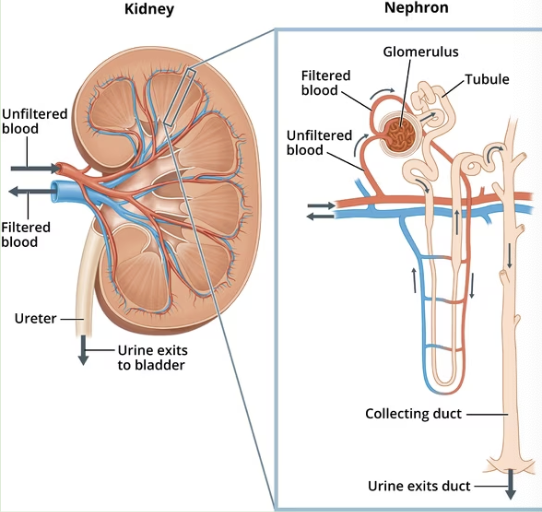
Ultrafiltration of blood
produces filtrate that enters Bowman’s
occurs in glomerulus
glomerulus - cluster of capillaries in bowman’s capsule
blood enters glomerular capillaries at high pressure
capillaries are much narrower than the arteriole that brings blood to the nephron
Afferent arteriole - brings unfiltered blood
thicker
Efferent arteriole - takes away filtered blood
thinner → higher pressure
glomerular capillaries are fenestrated → 20% of blood plasma leaks out
fenestrated - have many large pores in walls
glomerulus prevents large molecules from entering nephron
Stays in blood
RBCs/WBCs
platelets
proteins
antibodies
clotting factors
prothrombin
fibrinogin
glomerulus adaptations
fenestrated capillaries
basement membrane - glycoprotein that filters blood plasma
podocytes - surround capillaries in bowman’s capsule
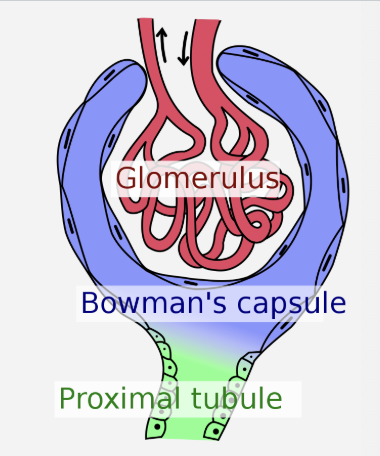
glomerulus produces glomerular filtrate → filtrate enters nephron through bowman’s capsule
glomerular filtrate does not contain large molecules
BUT other materials are in same concentration as blood entering glomerulus
H2O
glucose
amino acids
salts/NaCl
urea
many useful substances from blood plasma are in glomelular filtrate
useful substances reabsorbed in bloodstream as filtrate passes through proximal convoluted tubule
selective reabsorption
large volumes of glomerular filtrate produced
contain water + nutrients that the body doesnt wanna lose
1 liter of filtrate produced every 10 minutes by kidneys
proximal convoluted tubules - selectively reabsorb nutrients + most of water in filtrate
all glucose + amino acids in filtrate taken out
actively transported or facilitated out of proximal convoluted tubule → capillaries surrounding nephron
80% of minerals = actively transported out of tubules → capillaries
high concentration of solutes outside tubule → 80% of water in filtrate leaves proximal convoluted tubule (osmosis)
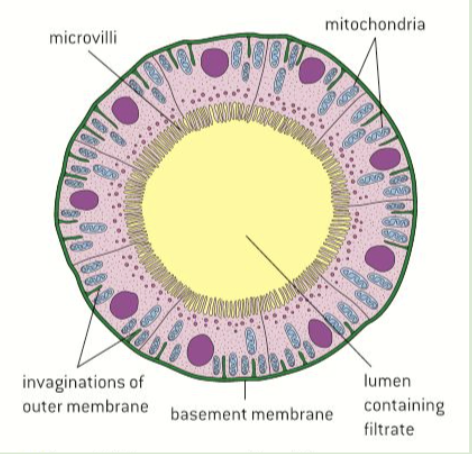
adaptations of convoluted tubules - reabsorb nutrients + water
folded → increases surface area
microvili → increases surface area
one cell thick → rapid transport
protein pumps in plasma membrane → active transport
many mitochondria produce ATP via aerobic respiration → active transport
proximal convoluted tubules surrounded by capillaries → transport nutrients + water away from kidney
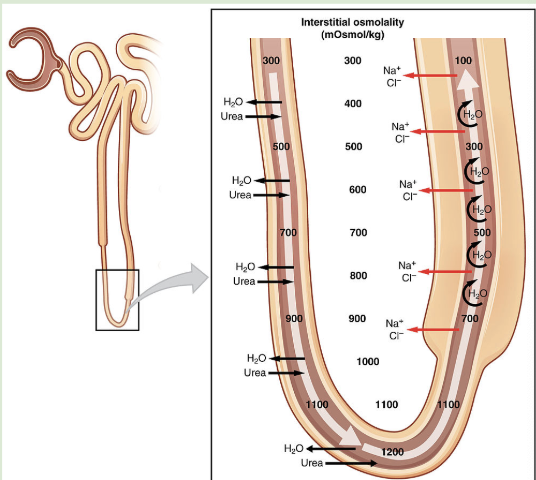
loop of henle - reduces volume of filtrate
transports water + sodium ions into medulla (kidney)
proximal convoluted tubule reabsorbs 80% of water BUT leaves a lot of water to be reabsorbed
ascending + descending limbs have different permeabilities to water + sodium
descending
permeable to water
has many aquaporins
water leaves by osmosis into high sodium concentration of medulla
impermeable to sodium
ascending
actively transports sodium into medulla
aka permeable to sodium
high sodium ion concentration in medulla → medulla is hypertonic compared to filtrate
impermeable to water
distal convoluted tubule - balances blood pH + mineral concentration
fluid that enters the DCT = dilute urine
urine enters collecting duct after leaving DCT
all useful substances + most water has been reabsorbed → remaining filtrate = urine
urine has high concentration of metabolic waste (ex. urea)
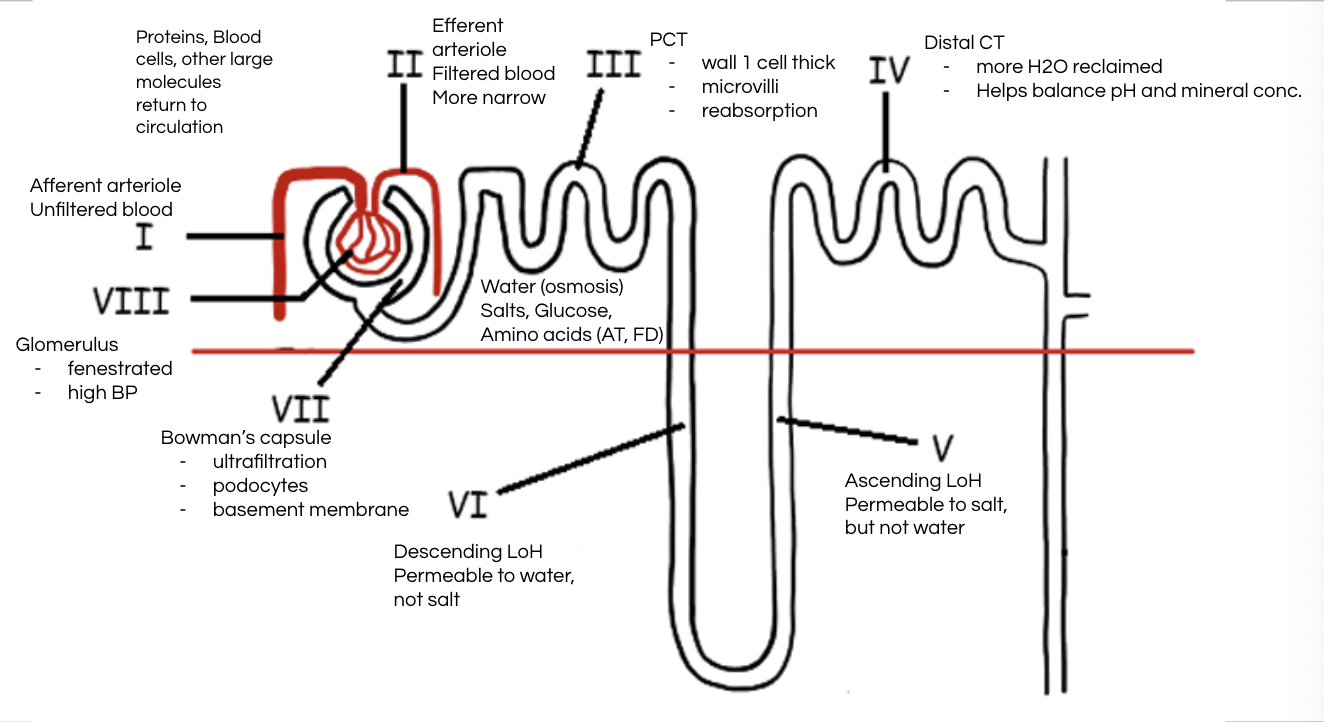
osmoregulation - maintenance of internal balance btwnn dissolve materials and water
osmoreceptors - monitor osmotic concentration of blood
located in hypothalamus
hypothalamus - regulates concentration of urine by stimulating pituitary to release antidiuretic hormone (ADH) when osmotic concentration of blood is too high
collecting ducts = differentially permeable to water
osmotic concentration of blood is too high
hypothalamus stimulates pituitary → pituitary release ADH into blood → ADH binds to receptors on cells lining collecting ducts
aquaporins switched from vesicles to cells’ plasma membranes → collecting duct is permeable to water
action of loop of henle → medulla has high solute concentration → water leaves by osmosis
osmotic concentration of blood is low
hypothalamus inhibits secretion of ADH → absence of ADH → aquaporin switch from plasma membrane to vesicles of cells in collecting duct → reduces permeability of collecting ducts
water is not reabsored as urine passes through collecting duct
dilute urine produced w low concentration of urea
negative feedback loop
nephrons - filter blood to form a glomerular filtrate
filtrate passes through nephron → converted to urine
sleep
sympathetic + parasympathetic nervous systems - involved in regulating blood supply to organs depending on body’s activity
body metabolic rate is low during sleep → parasympathetic nervous system changes blood supply to maintain basic body functions
blood flow to muscles reduced
not engaged w physical activity
blood flow to gut reduced
digestion slows during sleep
blood supply to brain + kidneys = constant
vigorous activity
energy + oxygen demands of body increase during vigorous activity → sympathetic nervous system becomes active
blood flow to muscles increased
engage in physical activity
blood flow to gut reduced
blood flow to muscles prioritized
blood supply to brain constant
blood flow to kidneys reduced
wakeful rest
there is a balance btwn sympathetic + parasympathetic systems during low level activities
blood flow to muscles low
BUT higher than sleeping
blood flow to gut stable
blood flow increases after a meal
blood supply to brain constant
support cognitive function
blood flow to kidneys stable