1.1.1 Localization
↳◦
Key Definitions
Localization of function: theory that certain areas of the brain are responsible for certain psychological functions
Strict localization: idea that there is a clear correspondence between psychological functions and brain area, and that all functions can be clearly mapped onto the brain
Weak localization: idea that one brain area may be responsible for a function, but not exclusively, and other areas may take over the function
Widely distributed functions: functions that cannot be localized anywhere in the brain
Essential Understanding
Strict localization
→ Research for localization of function has not been entirely conclusive
→ Though we now believe that functions are localized, the strict localization has been gradually replaced with relative localization
→ Studies supporting strict localization were based on patients with brain damage
↳ Earliest documented phenomena were Broca’s aphasia and Wernicke’s aphasia
→ Research inspired the creation of “brain maps”
↳one attempt done by Wilder Penfield using neural stimulation to create his cortical homunculus
Contrary to Strict Localization
→ Other research has opposed strict localization of functions
↳Ex: Karl Lashley (1929): claimed that memory of a maze in rats was distributed, not localized
Relative localization
→idea that several brain areas are responsible for the same function (some areas can potentially take over, but one stays dominant)
↳Example of studies: Sperry (1968) and Gazzaniga (1967): supported that language (production and comprehension) were weakly localized in the left hemisphere using split brain research
→ It can be claimed psychological functions are relatively localized
Broca’s Aphasia, Wernicke’s Aphasia, and Mapping Sensory and Motor Cortex
→ The first case studies used post-mortem exams of the brains of patients with unique speech disorders
↳ inspired the idea of strict localization
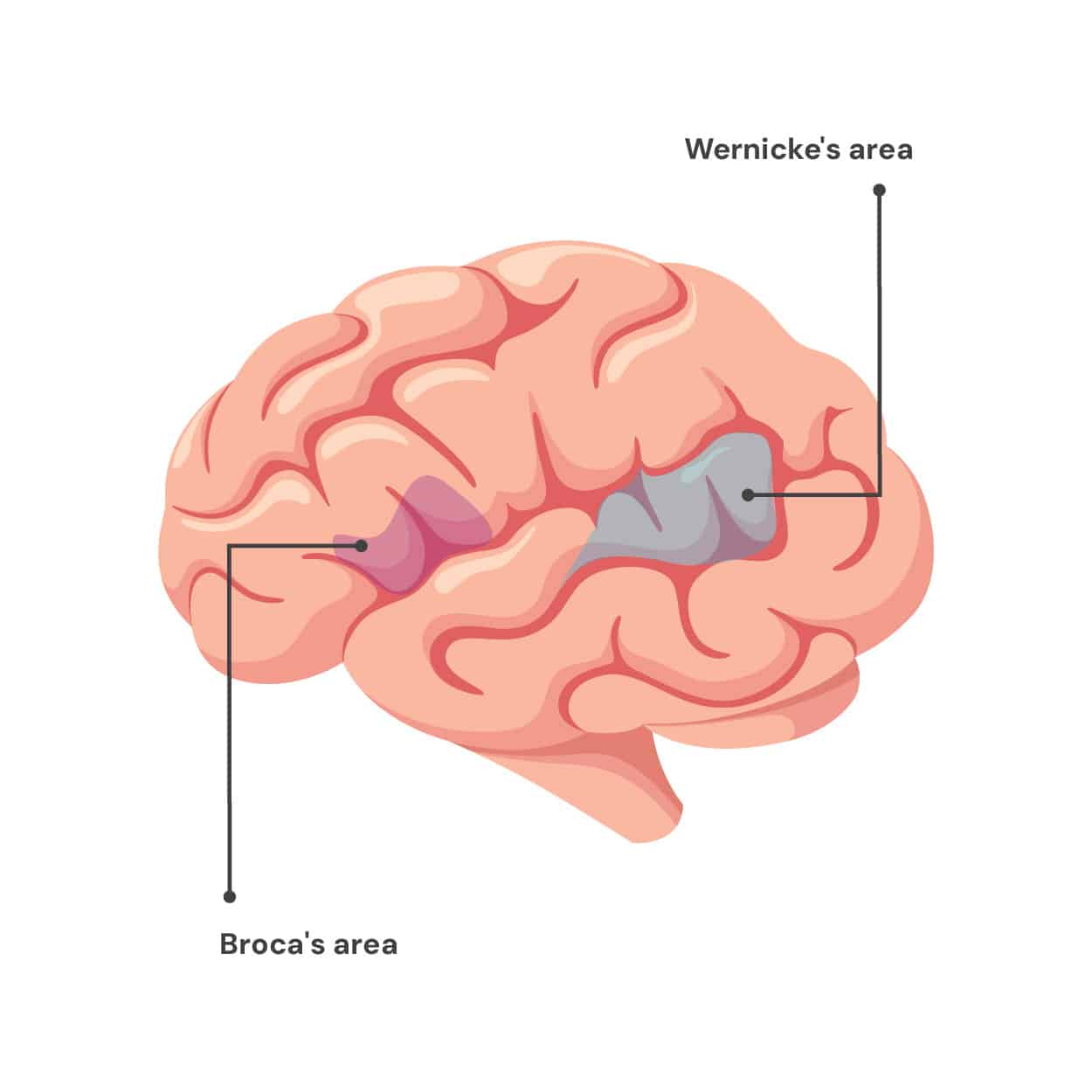
↳ it appears that articulate speech is localized in Broca’s area; speech comprehension in Wernicke’s area
Paul Broca (1861)
→documented case study “Tan”, a patient who lost the ability to speak or write but retained other functions like speech comprehension and intelligence
→" “Tan” understood everything and tried to talk but he could only make out “Tan”
↳ this condition would later be known as Broca’s aphasia
↳ after his death, an autopsy was done in which it was discovered that his brain had a lesion in the left hemisphere (posterior inferior frontal gyrus)
↳ this region would become Broca’s area
Carl Wernicke (1874)
→ conducted similar case studies where he discovered the brain area responsible for comprehension of written and spoken language, Wernicke’s area
→ Wernicke’s area: located in the temporal lobe of dominant hemisphere (usually left)
→ Wernicke’s aphasia: people have an impairment of speech comprehension, but they can still talk
Wilder Penfield
→Key: attempts to establish that strict localization of function has culminated in the creation of cortical maps
→ used neural stimulation (stimulated various parts of the cortex with electrodes) while the patient was awake and observed its effects on sensations and behavior
→ overtime, he covered the whole cortex and made the cortical homunculus: map showing the relative representation of body parts in the cortex (Penfield, Boldrey 1937)

Researches
Karl Lashley (1929)
→used experiments with induced brain damage in rats to show that memory was widely distributed rather than localized in the cortex
→carefully controlled brain damage in rats’ cortex that were trained to run through a maze
↳Procedure:
→ in a typical study, he trained rats to go through a maze without mistake to find food
→ he would then cut a part of their cortex to see how it would affect them (from 10% to 50% on different trials)
↳Results:
→ results didn’t support Lashley’s original hypotheses and led to the following new ideas
→Principle of mass action: memory of the maze depended on the percentage of cortex destroyed, but not the location of the lesion
→Equipotentiality: idea that one part of the cortex can take over the functions of another part of the cortex when necessary
↳Conclusion:
→ based on observations, he concluded that memory was not localized and was widely distributed across the cortex
→ for every cortex part lost, other parts may take over the functions of the missing part
Sperry (1968) and Gazzaniga (1967)
→split brain research that demonstrated that both production and comprehension of language are weakly localized (lateralized) in the left hemisphere
↳Aim: investigate how the two hemispheres function independently when the connection between them is severed
↳Participants: four patients who underwent novel treatment for epilepsy that involved surgically cutting the corpus callosum
↳Method: in-depth case study of four unique individuals
↳Procedure:
→ technique was used where the researchers project stimuli to the left or right eye of participant
→ participants sat in front of a table with a board on it, and fixed their eyes on a dot in the center
→stimuli was flashed on either far right or left of the board for one-tenth of a second: used concept that since optic nerves of right eyes connects to left hemisphere and vice versa, researcher could show stimuli on one hemisphere only
→in some trials, the table had a curtain with objects behind it, and participants could reach behind the curtain and feel the objects
↳Results:
→multiple results:
Examples:
→ i. when showing a spoon to left visual area and were asked to describe the object, participants said nothing. When asked to pick an object behind the curtain, they picked a spoon with their left hand) even though they didn’t know why
↳ supports the idea that language is localized in left hemisphere: right hemisphere saw the object and was able to tell the left hand what to do, but because language is localized in the left, they were not able to explain what they did and why
→ii. when showing a word (like pencil) to the right hemisphere, participants could pick a pencil behind the curtain
↳goes contrary to previous finding and shows that right hemisphere can do simple speech (shows how language comprehension may be in both hemispheres→ shows weak localization of language comprehension)
→ iii. when researchers placed four letters in a pile behind the curtain and asked participants to spell “love”, one of them was able to do it with his let hand, but wasn’t able to name the word
↳shows that language production, mostly basic, may be located in the right hemisphere but not for all people
↳Conclusions:
→support the idea of some localization of language
→ both language production and language comprehension are mostly localized in the left hemisphere
→right hemisphere can still perform some basic tasks
Note: split brain studies are lateralization studies: studying the special division of functions between left and right hemisphere
Relative Localization of Function
→ localization of functions is relative with certain aspects:
→ some functions are strictly localized like in Broca’s and Wernicke’s area
→ some functions are widely distributed like in Lashley’s study
→ some functions are weakly localized like in the split brain research
→ some functions may be localized while others distributed like how speech production seems to be more localized than speech comprehension