Topic 2: DNA & Cell Division
Structure and Function
Inside the nucleus of almost all the cells in our body contain chromosomes
Chromosomes are made of DNA - our genetic information
DNA stands for DeoxyriboNucleicAcid
DNA function - 2 functions
Pass on information to offspring
Production of proteins
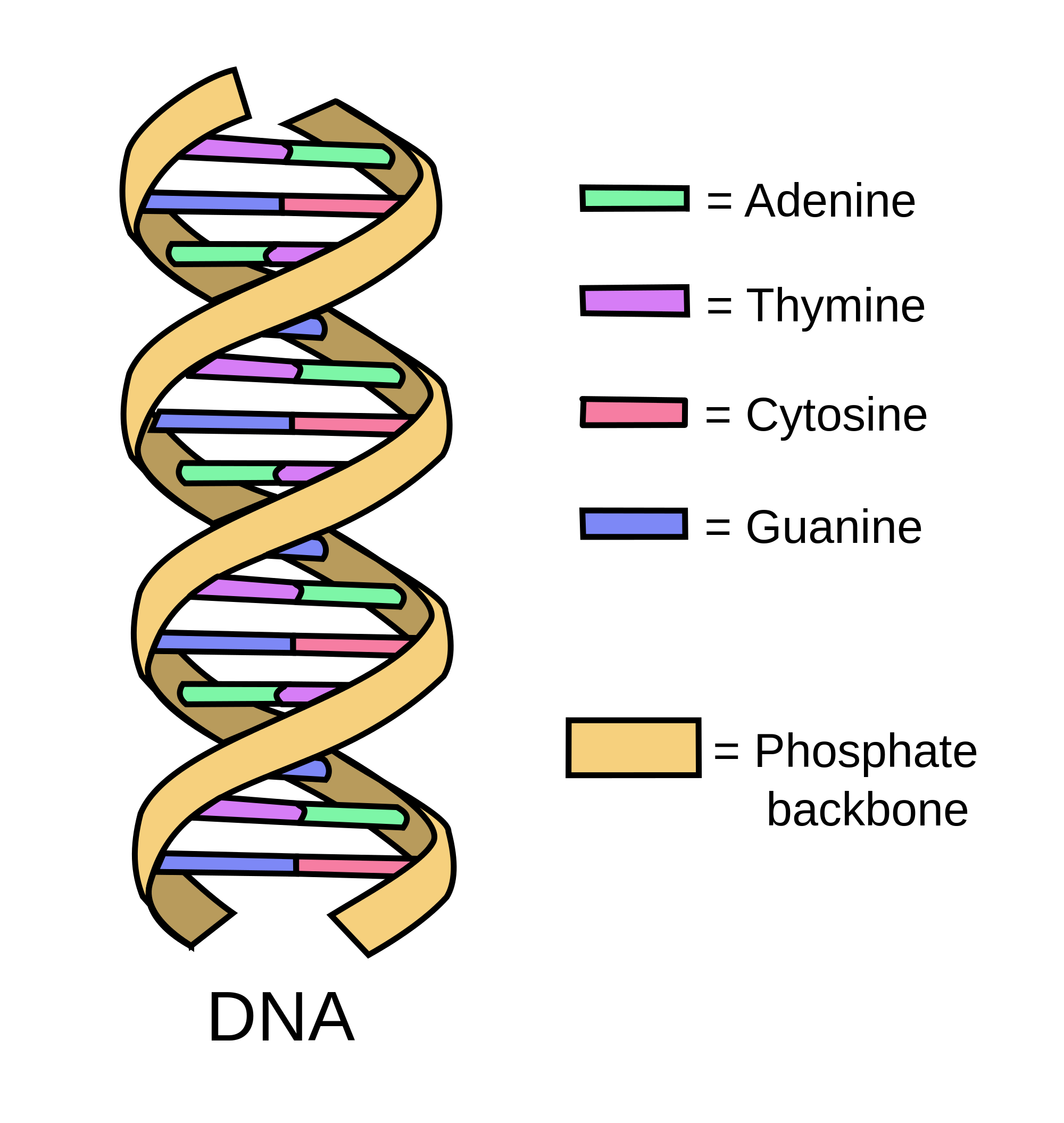
DNA structure → Spiral Staircase = Double Helix
Structure: 2 Complementary strands(2 sides)
Backbone: Alternating deoxyribose sugar and phosphates
Rungs: 2 Nitrogen bases
Adenine - Thymine
Guanine - Cytosine
Nitrogen bases are like the instructions in a recipe, therefore different instructions = different products
Nucleotide: basic building block of DNA
made up of:
One sugar
One phosphate
One nitrogen base
DNA is made up of many nucleotide monomers
Protein Synthesis
Gene - small sections of a chromosomes(DNA) that carries instructions for a specific protein
A gene is like a recipe in a cookbook
Composition of Proteins
Proteins are made up of amino acids linked together in a chain
There are 20 different amino acids
Different proteins are made of different amino acids
Protein Synthesis
Proteins make up 50% of body mass and play an important role in the body
Type of protein | Role of protein | Example |
Enzyme | Speed up the rate of chemical reactions |
|
Structural | Gives shape and structure to cells |
|
Defense | Protects the body against disease |
|
Hormone | Chemical messenger to maintain homeostasis |
|
Transport | Move materials in and out of cells and the body |
|
Energy | Act as a source of chemical potential energy that can be broken down |
|
DNA → Amino Acid
Each amino acid is coded for by 3 nitrogen bases on a DNA molecule called a triplet
To find the amino acid chain produced, use the strand that is given
It is not necessary to find the complementary strand
Genetic Engineering
Genetic engineering - Modification of genetic material where scientists isolate genes from one organism and insert it into the DNA of another organism using a virus(vector)
Application of Genetic Engineering
Application
Agriculture - crops
Agriculture - animals
Medicine
Gene Therapy
Examples
Roundup Ready Canola - herbicide resistant
Flavor Savor Tomatoes - longer shelf life
Super salmon - grow and mature faster
Human hormones
Human organs - making organs more compatible for transplants
Used to treat and possibly cure genetic diseases
Ex) cystic fibrosis, hemophilia
A vector, such as a virus, is used to insert/deliver a functional copy of a gene into the cell of a patient with a defective gene
As a result, the patient can now produce the missing or defective protein
Pros and cons of genetic engineering
Pros
Treat genetic disorders
Create crop resistant to pesticide and certain weather
Therapeutic cloning - decrease of organ donor rejections
Cons
Is it ethical?
GMO deformities
Reproductive cloning
Introduction to Cell Division
Cells divide for 2 reasons:
Mitosis: 2n→2n
Growth, maintenance, and repair
Meiosis: 2n→n
Gamete formation
Diversity
Chromosomes
Our DNA is stored in strands called chromosomes
Humans have 46 individual chromosomes or 23 homologous pairs
In each pair, one chromosome comes from each parent(mom and dad)
The first 22 pairs are known as Autosomes
The last pair are sex chromosomes
Basic females have xx chromosomes
Basic males have xy chromosomes
Diploid and Haploid
Diploid cell - 2n
Total number of chromosomes in every body(somatic) cell
A diploid cell has both pairs of homologous chromosomes
In humans: diploid cells have 46 chromosomes
Haploid cell - n
Total number of chromosomes in every gametes(sperm and egg)
A haploid cell has only one chromosome from a homologous pair
In humans: haploid cells have 23 chromosomes
DNA replication
DNA replication necessary for cell division because it creates 2 identical copies
ensures there is a correct number of chromosomes when the cell divides
DNA replication is know as semiconservative replication
Every chromosomes must be replicated so that they look like X’s
Process of DNA replication
The DNA double helix shape untwist and unzip
H bonds break
Free nucleotides come and pair up with exposed nitrogen bases
Mutations are most prone to happen here
Retwisting of DNA
Old strands are paired with new strands creating 2 new double helix shapes that are semi-conservative(half new, half old)
Duplicated/replicated chromosomes
Mitosis
IPMAT → I Pee on a MAT
Interphase
DNA replication occurs
DNA is not visible
In chromatin form(looks like noodles)
Centrioles, nucleus, and nucleolus are present
Prophase
Replicated chromosome are present
visible as an X
Nuclear walls are disappearing
Spindle fibers form
Metaphase → “middle”
Replicated chromosomes line up in the middle of the cell(equatorial plate)
Spindle fibers attach to centromere
Anaphase → “Away”
Centromeres split and daughter chromosomes are pulled to opposite poles
Telophase → “Two”
Division of the cytoplasm
2 cells form
Chromosomes lengthen to form chromatin
Nuclear walls reappear
Asexual reproduction - cloning
When a organism is able to reproduce through mitosis
Cloning usually occurs when environmental conditions are stable/favorable as offspring are identical to their parent
Pros
Quick
No partner needed
Cons
No genetic variation = limited gene pool
Mutations are pass on
Meiosis
A type of cell division that makes haploid cells called gametes
2n → n
Gametes include
Sperm(formed in the testes)
Egg(formed in the ovaries)
Haploid cells are necessary for sexual reproduction because it ensures that the embryo has the correct number of chromosomes when 2 haploid gametes fertilize
Synapsis(joining of homologous pairs) and crossing over allow pieces of DNA to be exchanged between chromatids
Allows for genetic variations
Therefore, daughter cells are not genetically identical in meiosis
Significant pro for crossing over is that it increases genetic diversity where a population can be less prone to diseases.
Gametogenesis → meiosis in humans
Spermatogenesis - Sperm productions
occurs in testes
produces 4 haploid sperm
Oogenesis - egg production
Occurs in ovaries
Produced 1 haploid egg and 3 polar bodies
Mutations
Mutations is a mistake in replication that happens naturally or are caused by outside factors
outside factors ex)chemicals or radiation
Mutations can cause genes to stop working or to function differently
Mutations can be passed on
Types of Mutations
Chromosomal Mutations
When there are changes in structure or number of chromosomes
Can be diagnosed by a karyotype
Organized by size, banding pattern, and centromere position
Cells are collected by amniocentesis or chorionic villus sampling
Point/Gene Mutations
When there are changes in part of a DNA strand
occurs in DNA replication
Can affect the amino acids and proteins produced
Types of point mutations
Addition or Deletion of 1 or 2 nitrogen bases to a DNA sequence
Often has more sever consequences as it changes the rest of the sequence
Substitution of 1 or 2 nitrogen bases for another
Antibiotic Resistance
Bacterial infections are usually treated with antibiotics
However, over time bacteria may become resistant
There are 3 main ways this occurs
Mutation and Natural Selection
Random mutations can occur in genes that make bacteria resistant to antibiotics
When bacteria reproduce, their mutated gene is passed on
Increases bacteria’s survival
Transformations of DNA Fragments
Process of transformation
When bacteria picks up pieces of DNA from their environment
The new DNA is then added to the bacterial chromosomes
This allows the bacteria to make the proteins from the new DNA
Transformations of Plasmids
Plasmids are special small circular pieces of DNA in bacteria
They have genes that are not necessary for regular function of the cell but often have extra genes like antibiotic resistance
When bacteria come in contact with each other, they can exchange plasmids.
This means that genes for antibacterial resistance can be shared