Perfect Competition
Earlier in the course, we listed competition as one of the six main characteristics of a market economy. In today's lesson, we'll delve deeper into the effects competition has on producers and consumers.
Completely perfect competition has rarely (if ever) existed. There is a wide spectrum between perfect competition and a total monopoly, where one company dominates the whole market.

Governments of most market economies usually try to keep the market as close to perfect competition as possible. The United States, for example, has many antitrust laws designed to prevent monopolies. We will talk more about these in the next lesson. Today, we will look at an idealized model of perfect competition and examine its effect on producers and consumers.
Four Characteristics of Perfect Competition
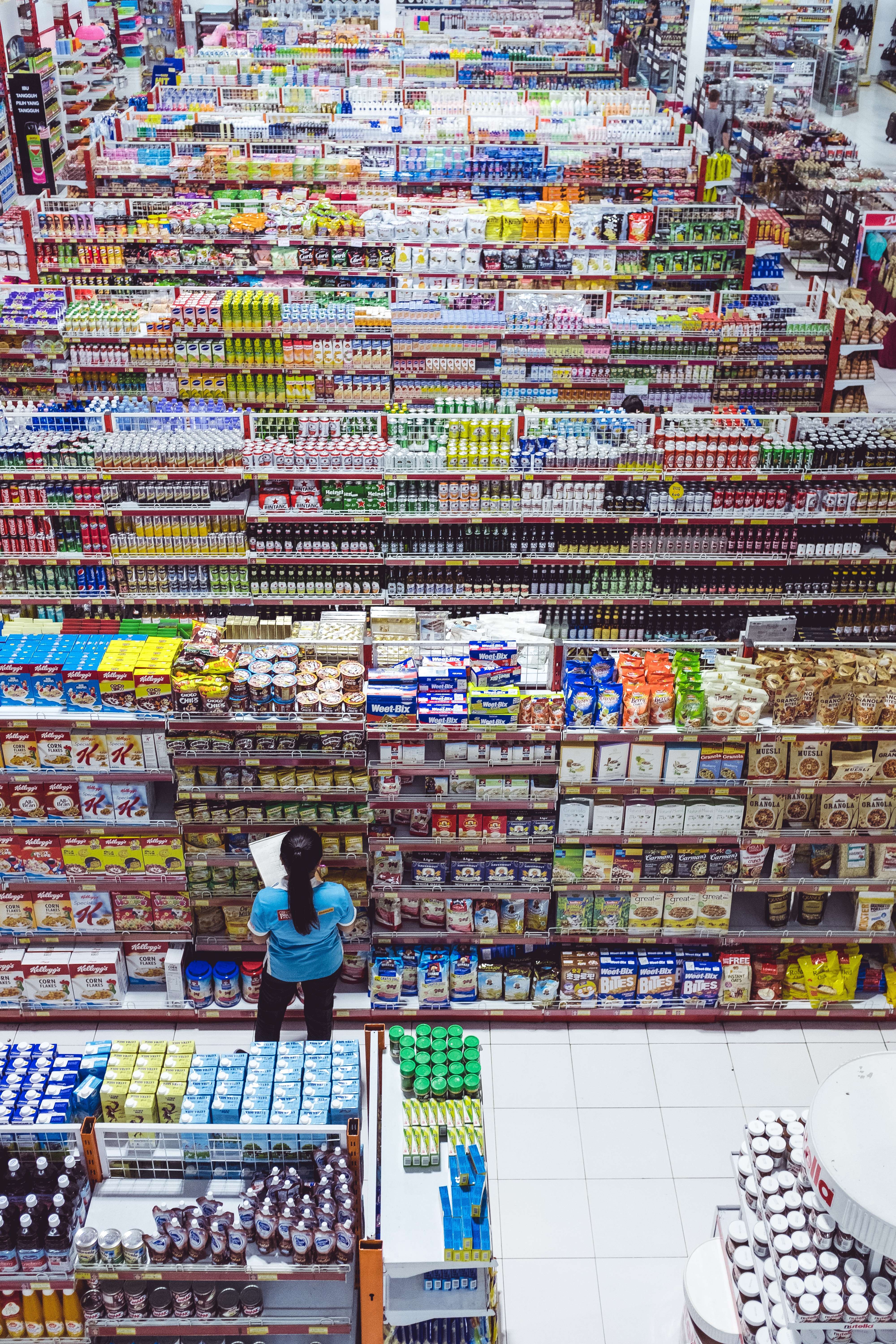

When we assume that a market is perfectly competitive, we are assuming that all buyers and sellers must take the market price as a given. All buyers and sellers are therefore price takers—they are forced to buy or sell their goods at the market price and have no influence over that market price. This price is determined purely by the forces of supply of demand, and a single individual can't do anything to affect it. If you go into a retail store like Walmart, you're a price taker. If the price of a dozen eggs is $1.00, then you'll have to pay $1.00 for those eggs. You can't haggle or negotiate with the cashier to pay less than $1.00.
Producers and sellers can also be price takers. Farmers often have little control over the price of their produce. If the market price for corn is only $3.00 a bushel, then all farmers will only be able to sell their corn for $3.00 a bushel. A farmer might try to demand $4.00 a bushel, but no one would buy it at that price. Why pay $4.00 when you could buy from a different farmer and only pay $3.00? Similarly, when investors sell a stock, they must sell that stock at whatever the current price is. The investors don't individually determine the selling price of their stock; they must sell their stock for whatever the current market price is.
The following four characteristics of perfect competition all work together to create this price-taking behavior.
1. Large Number of Buyers and Sellers
To have perfect competition, there must be a large number of buyers and sellers in the market. If there are only a few buyers or a few sellers, then each individual will have too much power over the price of goods and services. Returning to our farming example, let's say there were only three corn farmers in the entire world. Each one of these farmers would have enormous control over the price of corn. If one of them decided to sell for $4.00 a bushel instead of $3.00, they would still have buyers because people wouldn't be able to get all the corn they wanted from the farmers who were selling it for $3.00. In a perfectly competitive market, there will be so many corn producers that none of them will have any power over the market price. As we said before, if one tries to sell corn for $4.00, then consumers will simply buy from the many other farmers who are selling corn for $3.00.
2. Identical Products
To be perfectly competitive, products of the same type also have to be identical. Corn is a great example of this. One farmer's corn is no different from another farmer's corn. If one farmer differentiated her product in some way (by labeling it organic, for instance), then that farmer would gain power over the price of her corn.
With perfect competition, there are no brands. Cola would just be cola. There would be no Coca-Cola, Pepsi, or Dr. Pepper. There wouldn't even be store brands—no Great Value Cola at Walmart. Every bottle of soda would have plain labeling with just the word Soda or Cola, and they would all taste exactly the same. When the sodas taste different and get a brand name attached, then the companies that produce the soda start to gain power over the price they charge for it.
3. Complete Knowledge
In this model of perfect competition, both buyers and sellers have complete knowledge about every product in the market. All buyers know the prices every seller is charging for their products and are able to obtain this information at little to no cost. If price information isn't known by all buyers, then sellers could try to sell goods at a higher price than the market price. Buyers may not know that those goods are available for a lower price elsewhere.
Producers also need complete knowledge of the prices charged by all sellers, as well as an understanding of the most efficient technology and production practices available. If one producer could make the same product more cheaply than another, then they would have more control over pricing.
4. Easy Entrance and Exit
For a market to be perfectly competitive, it also must be easy for companies to enter and exit the market. If virtually anyone can start producing a good or service and quickly make sustainable profits, then that market is easy to enter. Producers also need to be able to exit the market easily. If a market is difficult to exit, it might cause producers to think twice about entering it in the first place (even if it's easy to enter). If a market is difficult to enter or exit, it will result in fewer producers, which will give pricing power to those producers who are already in the market.

Competition between Producers
By now it should be obvious that no market economy is perfectly competitive. Even with the internet, buyers and sellers can't have perfect knowledge of prices, different producers have access to different levels of technology, and few competing products are identical. But most of the world's market economies are still much more competitive than they are monopolistic. This competition between producers and sellers has three important effects:
1
1
More choices. Competition requires multiple producers, and this means that consumers get to choose which company they’ll buy products from. They might make these decisions based on the quality of the product, the price of the product, or their perception of the company that makes the product. For instance, if consumers think one car manufacturer is acting unethically or harming the environment, they can choose to buy automobiles from a different producer.
2
2
Improved quality. Because consumers are able to choose which products to buy, producers have to attract customers by offering a higher quality product than their competitors. This results in improved quality as companies try to outdo each other.
3
3
Lower prices. Another way producers attract customers is by lowering prices. To do this, they must make their business more productive and efficient. In the long run, this increases the wealth of the entire economy as consumers are able to buy more products for less money.
Competition between Consumers

Competition between consumers might be less obvious than competition between producers, but it still exists. When a new iPhone is released, customers sometimes camp outside Apple stores the night before so they can get an early spot in line. Since there are a limited number of phones, they're competing with the other consumers to try to get one. There are two important effects of competition between consumers:
1
1
Higher prices. Competition between producers leads to lower prices, but this is partially offset by the higher prices caused by competition between consumers. Remember that when demand is high, prices rise. This happens because consumers are competing against each other for the right to buy those products. Think about an auction for a painting. If there is only one bidder, then they will get the painting for a low price. They can make a low bid and get the painting because there's no one else to bid the price higher. But if there are a dozen people interested in the painting, they will bid the price higher and higher until the price gets so high that only one person is still interested in buying it.
2
2
Goods are allocated to those willing to pay the most. When sellers decide who to sell their goods to, they usually only have one consideration: who is going to pay them the most money? At our auction, it wouldn't make sense for the auctioneer to reject a bid for $10,000 and instead sell the painting to someone who only bid $9,000. The consumer who is willing to pay the most for a particular product will almost always get that product. Note that this cost isn't always solely in dollars. In our iPhone example, the people camping all night paid not only with money but also with the time they spent waiting in line. Every customer had to pay the same dollar price for the iPhone; the differentiator between them was the time they spent. Those who were willing to get in line first (and thus spend the most time in line) came away with a new iPhone.
Though no market economy has perfect competition, many aspects of the modern economy have made business more competitive and pushed the economy towards perfect competition. These developments include cheaper transportation and the advent of e-commerce, the combination of which allows companies from across the world to compete with each other more easily. Producers have access to a much larger number of buyers (and vice versa), and it's become much easier to enter markets across the world.
Review of Key Terms
perfect competition: an idealized model of competition where all buyers and sellers must take the market price as a given
price taker: a buyer or seller who is forced to accept the market price of a product and has no influence over that price
The opposite of perfect competition is a monopoly. In the next lesson, we'll study monopolies and near monopolies in more detail.