Kinetics
How do chemical reactions occur?
For a chemical reaction to occur the reactants have to collide with sufficient energy and the correct orientation
The minimum energy for reaction to take place is the activation energy
Not all collisions will be successful
Some will not have sufficient energy
Some will not have the correct orientation
What affects the rate of chemical reactions?
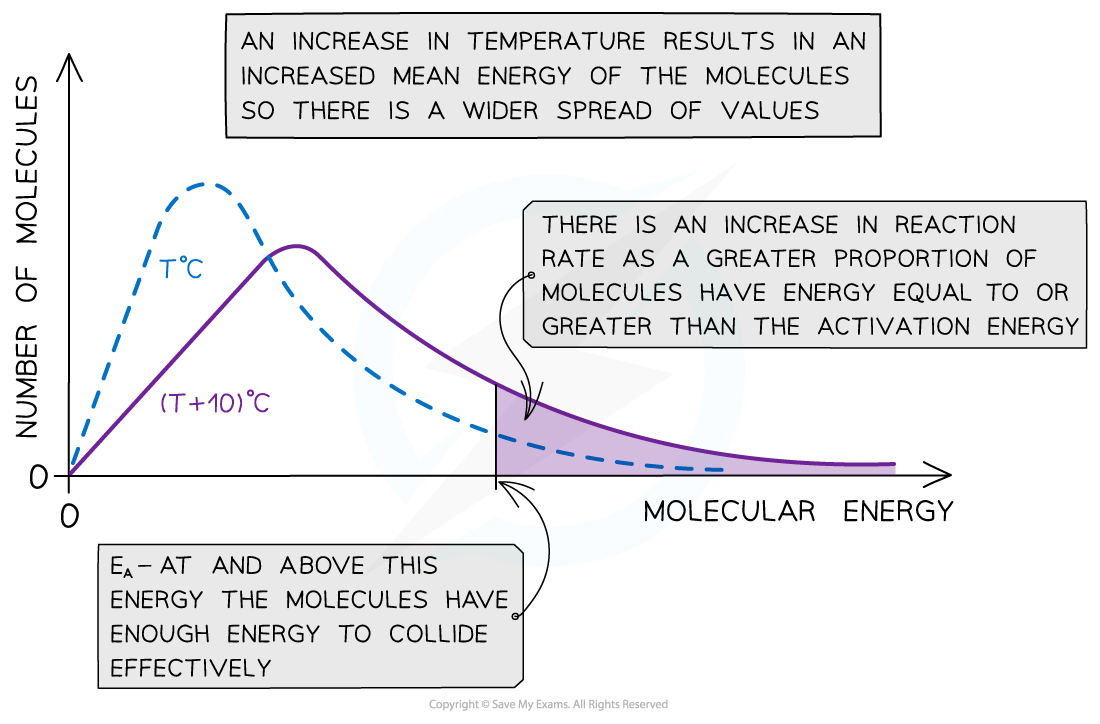
Increasing temperature
A higher temperature means the particles have a higher kinetic energy
This means they will collide more frequently
It also means a greater proportion of collisions will have enough energy to react
Increasing concentration (or pressure for gas phase reactions)
Higher concentration means more reactants per unit volume and thus more frequent collisions
Increased surface area (for solid reactants)
The higher the surface area, the more particles available for collision (on the surface) and thus more frequent collisions
Catalysts
These change the rate of a reaction without being used up
Provides an alternate reaction pathway with a lower activation energy, does not lower activation energy
Measuring rates of reaction
How can we measure the rate of a chemical reaction?
Spectroscopy (UV-Vis, IR, NMR)
Colorimetry
Titration
Chromatographic techniques (HPLC, GC)
Stopped flow
Flash photolysis
Laser techniques
Basically if anything measurable changes during the reaction then it can be used to obtain suitable data
Maxwell-Boltzmann Distribution
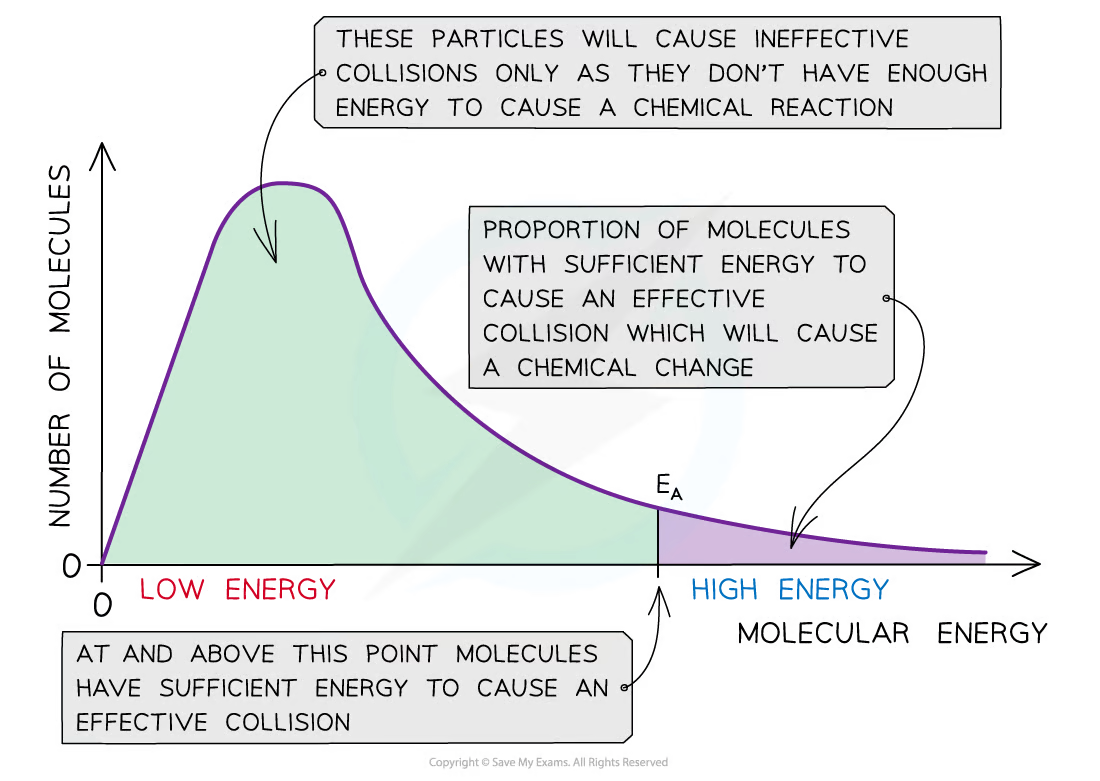
On the diagram, the line never goes through the origin
The line approaches the X axis but never touches it other than at the origin - it is asymptotic
The most probable energy is at the highest point of the curve
The average energy will not be the same as the most probable energy
Higher temperatures:
The new curve goes through the origin
It will have a maximum that is lower in height but higher in energy
The higher temp line will only cross the lower temp line once