Medication Administration Overview
Medication Administration Overview
Presenter Information
Presenter: Linda Sheen, PhD, APRN, FNP-BC
Organization: UTHealth Cizik, The University of Texas School of Nursing
Patient Safety
Importance of adherence to protocols for safe medication administration.
Topics Covered:
The 7 Rights of Medication Administration
Medication Distribution Methods
Types of Medication Orders
Fundamental Components of a Medication Order
Procedures for Medication Verification
Medication Errors and Prevention Strategies
The Seven "Rights" of Medication Administration
Right Medication: Ensure the medication administered is exactly what was prescribed.
Right Dose: Administer the correct dosage of the medication.
Right Patient: Verify the identity of the patient receiving the medication.
Right Route: Administer the medication via the appropriate route (oral, intravenous, etc.).
Right Time: Give the medication at the scheduled time as per the prescription.
Right Documentation: Accurately document the administration of the medication in the patient’s chart.
Right Indication: Ensure there is a valid reason for the medication's use specific to the patient's condition.
Footnote:•Regardless of how the nurse receives a medication order, he or she compares the prescriber’s written orders with the medication administration record (MAR) or the electronic medication administration record (eMAR) when medication is initially ordered.
•When performing medication calculations or conversions, have another qualified nurse check the calculated doses.
•
•An important step in safe medication administration is making sure that you give the right medication to the right patient. Before administering a medication, use at least two patient identifiers.
•
•Always consult the prescriber if an order does not designate a route of administration. Likewise, if the specified route is not the recommended route, alert the prescriber immediately.
•
•You need to know why a medication is ordered for certain times of the day, and whether you are able to alter the time schedule.
•
•A medication order is required for every medication that you administer to a patient. If any question arises about a medication order because it is incomplete, illegible, vague, or not understood, contact the prescribing health care provider before administering the medication.
•
•Never document that you have given a medication until you have actually given it.
Medication Distributions
Automated Medication Administration Equipment:
Pyxis
SureMed
MedServe
These systems support efficient and accurate medication dispensing in clinical settings.
Types of Medication Orders
Standing or Routine Orders:
Administered until the dosage is changed or another medication is prescribed.
PRN Orders:
Medications given as needed based on patient conditions (as required).
Single (One-Time) Orders:
Administered only once for a specific reason.
STAT Orders:
Medications that must be given immediately in emergencies.
Now Orders:
Required urgently, but not immediately (i.e., within a few hours).
Prescriptions for Home Use:
Medications designated to be taken outside of the hospital setting.
Essential Components of a Medication Order
Patient's Full Name: Clearly identify the patient.
Date and Time of Order: Document when the order was written.
Name of Medication: Specify the exact medication being prescribed.
Dosage of Medication: Indicate the specific dose.
Route of Administration: Clearly state how the medication is to be given.
Time/Frequency of Administration: Include detailed schedule for when to administer the medication.
Provider’s Signature: Confirmation from the prescribing provider.
Note:What’s missing from this order: Patient’s name, Date and time, Route of medication, Frequency, Provider’s signature?
Never attempt to interpret a prescriber’s handwriting. This is how errors are made.
Medication Verification Roles
Provider:
Writes medication orders and prescriptions.
Ensures accuracy in dosing and medication selection.
Pharmacist:
Confirms medication order accuracy, conducts consultations, prepares, and distributes medications.
Responsible for medication reconciliation and acts as a final checkpoint before administration.
Nurse:
Administers medication accurately and timely, monitors for side effects, participates in patient education, and maintains documentation reflecting accurate administration and patient response.
Patient - adverse effects
Note:Nursing students are prohibited from transcribing or receiving verbal or telephone orders. Telephone orders must be signed within 24 hours.
Nurse's Responsibilities
Assessment:
Evaluate the patient’s ability to tolerate medications.
Accurate and Timely Administration: Administer prescribed medications according to schedule.
Monitoring for Side Effects: Observe for adverse reactions post-administration.
Know Contraindications
Patient Education: Teach the patient about the medications they are receiving.
Practice the Seven Rights: Adhere strictly to the rights of medication administration.
Evaluation: Assess the effectiveness and the patient's response to the medication.
Maintaining Patients’ Rights
Patient Information Rights:
Right to be informed about their medication and its effects.
Medication History Rights:
Right to have an accurate medication history documented.
Refusal Rights:
Right to refuse any medication prescribed.
Experimental Nature Rights:
Right to be informed about the nature of experimental medications if applicable.
Safety and Support Rights:
Right to receive labeled medications safely and appropriate supportive therapy.
Right not to receive unnecessary medications.
Steps to Prevent Medication Errors
Administering Medication
Patient Identifiers: Use at least two identifiers such as name, date of birth (DOB), or medical record number (MRN).
Follow the Seven Rights of Medication Administration: Ensure compliance with all rights.
Avoid Distractions: Minimize interruptions during the administration process.
Clinical Judgment: Apply sound clinical judgment, especially when administering PRN medications.
Immediate Documentation: Record all medication administered as soon as it is given.
Preparing Medication
Single Patient Preparation: Only prepare medications for one patient at a time to prevent mixups.
Check for Allergies: Always verify allergy status prior to preparing medication.
Label Reading: Read labels three times and compare against the Medication Administration Record (MAR).
Double Check High-Risk Medications: Confirm all calculations, especially for medications with higher risk for errors.
Note:•Read labels 3 TIMES and compare with MAR orders
•Removing medications from storage
•Before taking the pt’s room
•Before administration of medication
Medication Errors
Patient Safety: Patient safety is paramount in the event of a medication error.
Immediate Assessment: Assess the patient’s condition before any intervention is taken.
Documentation: Document what occurred, the patient's response, and the treatment provided. Use incident reports for all medication errors (these are separate from the patient’s chart).
Note:•Incident Report needs to be filed within 24 hours of the error.
•Report includes
• the location and time of the incident;
•an accurate, factual description of what occurred and what was done;
•signature of the nurse involved.
• The occurrence report is NOT a permanent part of the medical record and is not referred to anywhere in the record. This legally protects the nurse and the institution. Agencies use occurrence reports to track incident patterns and initiate quality improvement programs as needed.
Considerations Prior to Medication Administration
Nursing Assessment Elements:
Past Medical History
Allergies
Medication History
Diet History
Current Patient Condition
Patient's Attitudes and Learning Needs
Considerations Post Medication Administration
Nursing Assessment Elements:
Monitor for adverse effects, side effects, and toxic effects.
Identify idiosyncratic reactions and allergic reactions to medications. Past Medical History, Allergies, Diet, Current Condition, Attitudes
Patient Education Elements:
Inform patients about the efficacy of the medication and what adverse effects may occur.
Note: Adverse effect – undesired, unintended and often unpredictable responses to medication.
Side effect – predictable and often unavoidable adverse effect produced at a usual therapeutic dose. If the side effects are serious enough, medication must be discontinued.
Toxic effect – develops after prolonged intake of a medication or when a medication accumulates in the blood because of impaired metabolism or excretion
Idiosyncratic reactions – medications causing unpredictable effects in which a patient overacts or underreacts to a medication or has a reaction different from normal.
Routes of Administration
Oral Routes: Tablets, capsules, caplets, enteric-coated, sustained release, elixir, extract, syrup, aerosol, lozenges.
Sublingual and Buccal Administration: Location of administration is crucial for effectiveness.
Parenteral Routes: Include intradermal (ID), subcutaneous (SQ), intramuscular (IM), intravenous (IV) administration.
Topical Routes: Application on skin, nasal, ear, eye, vaginal, or rectal regions.
Intraocular
•The route prescribed for administering a medication depends on the properties and desired effect of the medication and the patient’s physical and mental condition.
•
•Parenteral administration involves injecting a medication into body tissues. The following are the four major sites of injection:
1. Intradermal (ID): injection into the dermis just under the epidermis.
2. Subcutaneous: injection into tissues just below the dermis of the skin.
3. Intramuscular (IM): injection into a muscle.
4. Intravenous (IV): injection into a vein.
•Some medications are administered into other body cavities: epidural, intrathecal, intraosseous, intraperitoneal, intrapleural, and intra-arterial, as well as intracardiac and intra-articular.
•
•Nurses usually are not responsible for administration of medications through these advanced techniques. Whether or not you actually administer the medication, you remain responsible for monitoring the integrity of the medication delivery system, understanding the therapeutic value of the medication, and evaluating the patient’s response to the therapy.
•
•Intraocular medication delivery involves inserting a medication similar to a contact lens into the patient’s eye. The eye medication disk has two soft outer layers that have medication enclosed in them. The nurse inserts the disk into the patient’s eye, much like a contact lens, and it can remain there for up to 1 week.
Oral Route Details
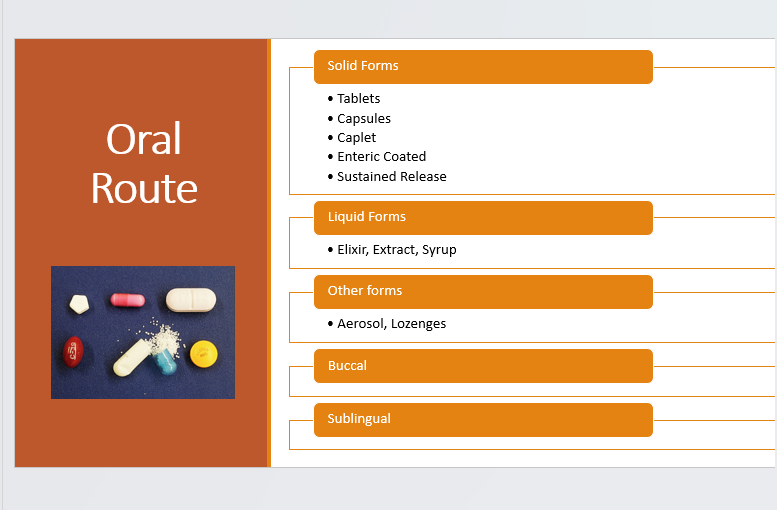
Solid Forms:
Tablet – powdered medication that’s compressed in hard cylinder. Usually have scoring if breakage is needed.
Capsule – medication encased in a gelatin shell, can be opened.
Caplet – shaped like capsule and coated for ease of swallowing
Enteric Coated – coated tablet that does not dissolve in stomach, coatings dissolve in intestines where it is absorbed
Sustained Release – will be released a varying amount of time to dissolve
Liquid Forms:
Elixirs – clear fluid containing water/and or alcohol, often sweetened.
Extract – syrup or dried form of pharmacologically active medication, usually made by evaporating solutions
Syrup – medication dissolved in concentrated sugar solution
Other forms:
Aerosol – aqueous medications sprayed and absorbed in mouth or upper airway, not meant for ingestion
Lozenges – flat round tablets that dissolve in mouth to release medication, not meant for ingestion
Advantages
Convenient and economical.
Disadvantages/Contraindications
May irritate GI lining or cause discoloration of teeth.
Contraindicated in patients with impaired swallowing or altered GI function.
Aspiration Prevention
Define Aspiration: Occurs when food, fluid, or medication intended for the gastrointestinal tract enters the respiratory tract, potentially leading to aspiration pneumonia.
Assessment methods to evaluate a patient’s risk of aspiration include checking for a gag reflex and assessing swallowing abilities.
Prevention methods include administering medications on the stronger side of the mouth, giving medications one at a time, and preparing liquids in thicker consistencies.
Note:Aspiration is when food, fluid or medication that is intended for GI administration inadvertently enters the respiratory tract. Can cause serious problems such as pneumonia
Use another medication route if there is a significant risk of aspiration!!
Sublingual and Buccal Administration
Sublingual: Administered under the tongue, should not be swallowed or consumed with food or drink until dissolved completely.
Buccal: Placed against the mucous membranes of the cheek and should alternate cheeks to minimize irritation.
Note:Aspiration is when food, fluid or medication that is intended for GI administration inadvertently enters the respiratory tract. Can cause serious problems such as pneumonia
Use another medication route if there is a significant risk of aspiration!!
Key Points for Oral Medication Administration
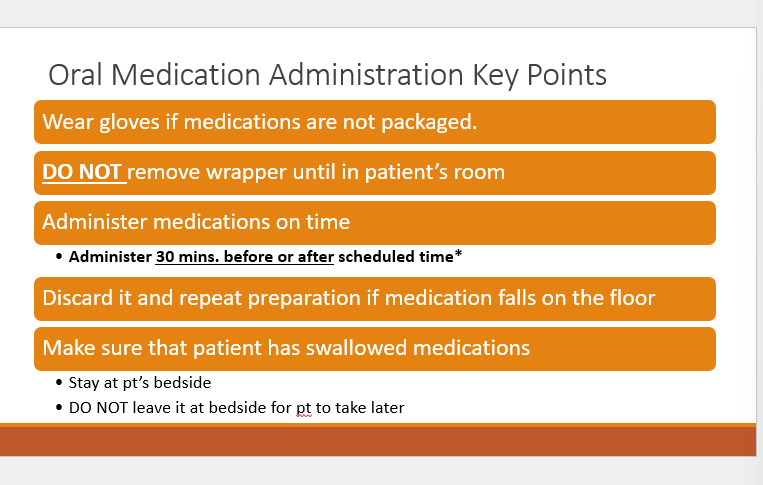
Required precautions and techniques include wearing gloves, timely administration, immediate documentation, and verifying patients have swallowed the medications.
Specific guidelines for crushing tablets: Do not crush enteric-coated or sustained-released medications.
Topical Route Details
Note:•Direct to skin service
i.e. nitro cream or transdermal patches
•Body cavity
Suppository
Irrigation
Medications Functions
Local and systemic effects; assessed cautiously to prevent irritation or contained residual medication from previous doses.
Administration Guidelines
Clean and properly prep skin based on condition (intact or non-intact).
Nasal and Ophthalmic Medication Administration
Nasal Medications
Methods for proper administration, including positioning and avoiding contamination.
Ophthalmic Medications
Drops and Ointments: Various procedures outlined for the safe application in a sterile manner. Essential techniques involve avoiding contact with the eye’s surface or surrounding tissue during administration.
Injection Administration (Parenteral Route)
Types of Injections
Different injection techniques outlined for subcutaneous, intramuscular, and intradermal methods, including anatomical landmarks for correct site locations and techniques for minimizing patient discomfort.
Important aspects regarding injection safety and needlestick injury prevention are emphasized.
Z-Track Method for IM Injections
A technique recommended for IM injections that helps prevent medication from leaking into the subcutaneous layer and minimizes tissue irritation.
Quick Quiz Examples
Situational questions regarding the appropriate nursing actions in response to different patient statements and clinical scenarios.
REFER TO PP FOR THE REST !!!!!!!!!!!!!!!!!!!!!!!!!!! A lot missing