Week 9: Knitting while Australia Burns
How do bushfires occur?
There are 3 main categories:
Starters: lightning strikes, humans
Fuel: dead grass, bark, trees, logs
Weather and climate: hot conditions, drought conditions, thunderstorms
Example
In 2019, Australia had a series of bushfires. They arose due to the perfect mix of conditions being very hot and dry among many.
33 human fatalities, ~400 smoke related deaths, >3000 homes destroyed
Massive infrastructure loss and damage
Smoke hazard effects from PM2.5 particles felt by many people in towns and cities; smoke carried to South America
Overall cost* to Australia: >$10 billion (Royal Commissions), $100 billion (J. Quiggin, UQ)
*Costs of wildfire not included
Impacts of the fires on wildlife (estimates based on extrapolations of densities based on extrapolations of densities across bioregions + modelling)
2.46 billion reptiles
1.81 million birds
144 million mammals, inc. 4.96 million kangaroos & wallabies, and 38.93 million possums & gliders
51 million frogs
Up to 240 trillion inverts (C. Reid)
Ecological communities* needing urgent attention: - 37 (of 84 EPBC Act-listed communities)
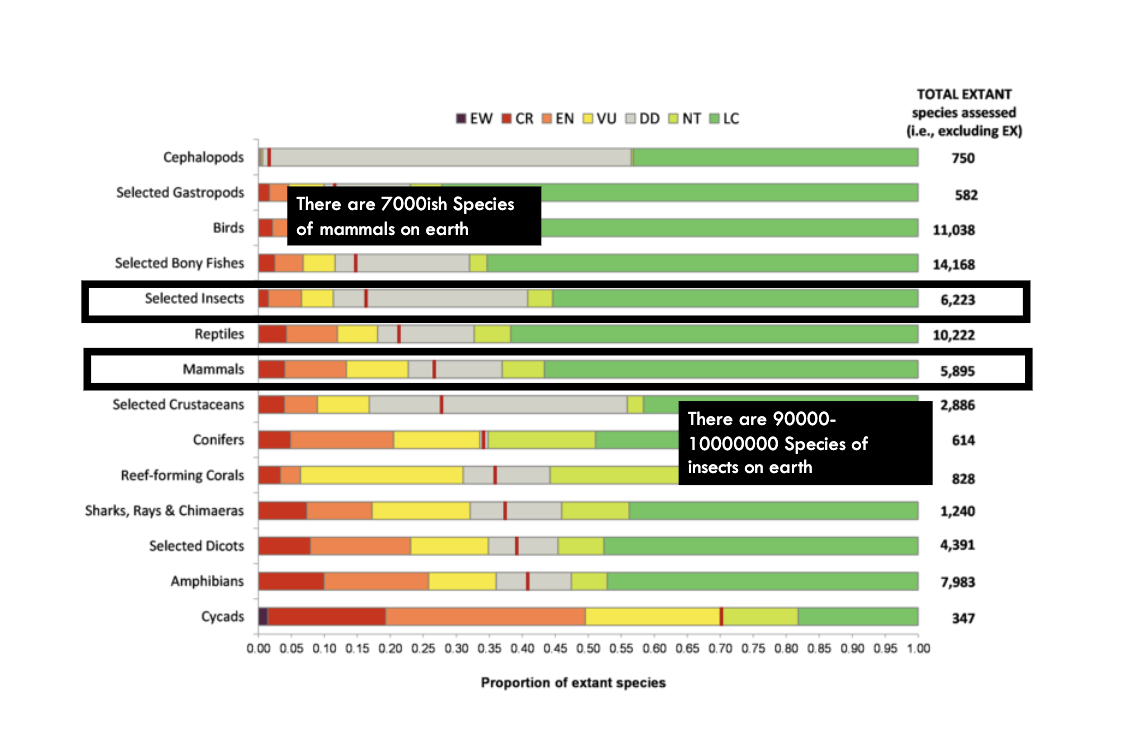
• *Assessments made by the Wildlife and Threatened Species Bushfire Recovery Expert Panel & collaboratorsThe state of the environment report shows the status of invertebrates is poor. Rainforest litter invertebrates decimated by high sevrity burns during Australia’s gigafires.
Forecasting fires
Recent projections of fire weather suggest that fire seasons will start earlier, end slightly later, and generally be more intense. This effect increases over time, but should be directly observable by 2020.
Velvetworms and fires
Live in rotting wood
Risk of desiccation from bushfires
4 species listed at priority species post bushfire
Acanthakara kaputensis had 100% of its known range impacted by severe fires in 2020
Wildlife (and management) responses
Post fire rains have stimulated regrowth (but lead litter, logs, hollows will take longer)
Post-fire surveys indicate some survival (dunnarts, pink slugs, etc)
But survival typically «10% (eco logical etc)
Lack of food, water, shelter, elevated fox, and cat activity, corvids etc.
Monitoring limited (low capacity COVID- 19)
Pro-active management (E.g added food, water, shelter), huge career response + surveys
Targeted asset protection (e.g. Wollemi pines)
Erection of predator proof fending
Translocation of animals near fire front, drones, heat-sensors
$$ commitments at state and federal levels, donations to NGOs
Emergency response at all levels
A quote,
Bad things happen. Sometimes they happen
suddenly, at enormous scale, and without comparable
precedent. The chain of wildfires afflicting Australia
in 2019-20, and continuing, is such an example. With
escalating global climate change, such large-scale
ecological catastrophes are likely to become more
widespread and frequent. Here, we describe a
blueprint for conservation responses to these wildfires,
to document the challenge and attempted solutions to
this particular event and as a potential template for
dealing with comparable future events”
State of climate impacting housing
Drought
Fire risk
Heatwaves
Sustainability
Floods
Coastal erosion
Human wildlife conflict
Increases house prices (subject more to location)
Heatwaves can impact wildlife
Mammals and birds change behaviour in heat (panting, may become too hot for certainmechanisms to work etc)
Possums burning feet/ cooking on roofs and solar panels
Turtle beeding: impacts on temperature-dependent sex determination
Invertebrates sensitive to heat more likely to die or reduce breeding capacity
Food resources reduce, reducing population of prawns in WA
Reducing heatwave impact
Provide vegetation for shade
Reduce usage of dark roofs
Monitor food sources of animals
Mitigation of heat in Western Sydney
White roofs
Utilising heatwaves with solar panels
Increasing canopy cover
LECTURE 2: HOPE
Some species as examples
Lord Howe Island Stick Insect
Lord Howe island stayed pristine for ~65 million years
Human settlement in 1834
Rats in 1918
Extinction: 5 birds, 13 invertebrates, 2 plants
Thought to be extinct: 1969 exoskeletons found on Balls Pyramid
2001 frass/poo discovered
2001 (that night), 3 individuals found
2003: breeding program begins with 19000 hatched
Campbell’s kneeled glass snail
Norfolk Island: extinctions caused by climate change, invasive species (chickens and rats), habitat loss
Campbells keeled glass snail: extinct in 1996
Population of snails found in 2020
Moderately successful breeding program at Taronga Zoo
Kangaroo Island Assassin Spider
Kangaroo Island had a lightning strike in December 2019. Fire burned for weeks and 211474 hectares of land burnt
~70% of habitat of Glossy black cockatoo burnt
~95% of KI dunnart habitat burnt
100% of known habitat of Assassin spider burnt
2 individuals were then found outside of known habitat
Still critically endangered, but an important sign to research invertebrate habitats
TUTORIAL NOTES: MICROPLASTICS
History of plastics
Started production in 1950’s
Become prominent now, we are now producing 380 million tonnes a year. Of this approximately 8 tonnes end up in the ocean.
Waste in out waterways
Waste that is picked up need to be categorised
Microplastics
2 kinds: less than 5mm and things that break into really small pieces
Plastic takes a lot of energy to make