IB Exam (Unit 3)
2.6 Structure of DNA and RNA
Understanding
U1 The nucleic acids DNA and RNA are polymers of nucleotides.
U2 DNA differs from RNA in the number of strands present, the base composition and the type of pentose.
number of strands present
Base Composition
Type of Pentose
DNA
2
A, C, G, T
deoxyribose
RNA
1
A, C, G, U
ribose
U3 Explain that DNA is double helix made of two antiparallel strands of nucleotides linked by hydrogen bonding between complimentary base pairs.
Application
A1 Crick and Watson’s elucidation (clarification) of the structure of DNA using model making*
started off with cardboard cut-outs
how they learned that h-bonds occurred between nitrogenous bases
realized that the strands had to run antiparellel
Skills
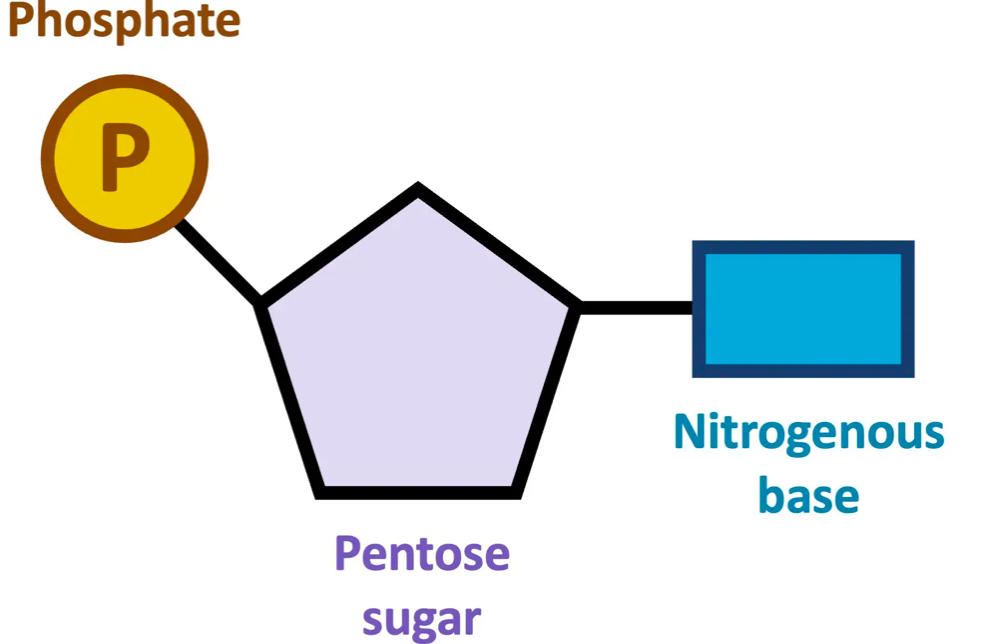
S1: Drawing simple diagrams of the structure of single nucleotides of DNA and RNA, using circles, pentagons, and rectangles to represent phosphates, pentoses and bases.
Nature of Science
NOS 1 Using models as representation of the real world- Crick and Watson used model making to discover the structure of DNA.
2.7 DNA Replications, Transcription and Translation
Understanding
U1 State that the replication of DNA is semi-conservative and depends on complimentary base pairing.
U2 Explain that DNA Helicase unwinds the double helix and separates the two strands by breaking hydrogen bonds.
U3 Explain that DNA polymerase links nucleotides together to form a new strand, using a pre-existing strand as a template.
U4 Transcription is the synthesis of mRNA copied from the DNA base sequences by RNA polymerase
U5 Translation is the synthesis of polypeptides on ribosomes
U6 The amino acid sequence of polypeptides is determined by mRNA according to the genetic code
U7 Codons of three bases on mRNA correspond to one amino acid in a polypeptide.
U8 Translation depends on complimentary base-pairing between codons on mRNA and anticodons on tRNA. balls
Application
Use of Taq DNA polymerase to produce multiple copies of DNA rapidly by the polymerase chain reaction (PCR)*
PCR allows for strands of DNA to be replicated into the millions
To speed up PCR, it is carried out at high temperatures
special type of heat-stable DNA polymerase: Taq DNA polymerase
obtained from Thermus aquaticus, a bacterium that is adapted to living in hotsprings,
Millions of copies of the DNA can be produced by PCR in a few hours because of the high temperatures used
Steps
DNA heated to 95°C to separate strands
DNA cooled to 53°C to allow primer to bind
DNA reheated to 73°C to separate strands
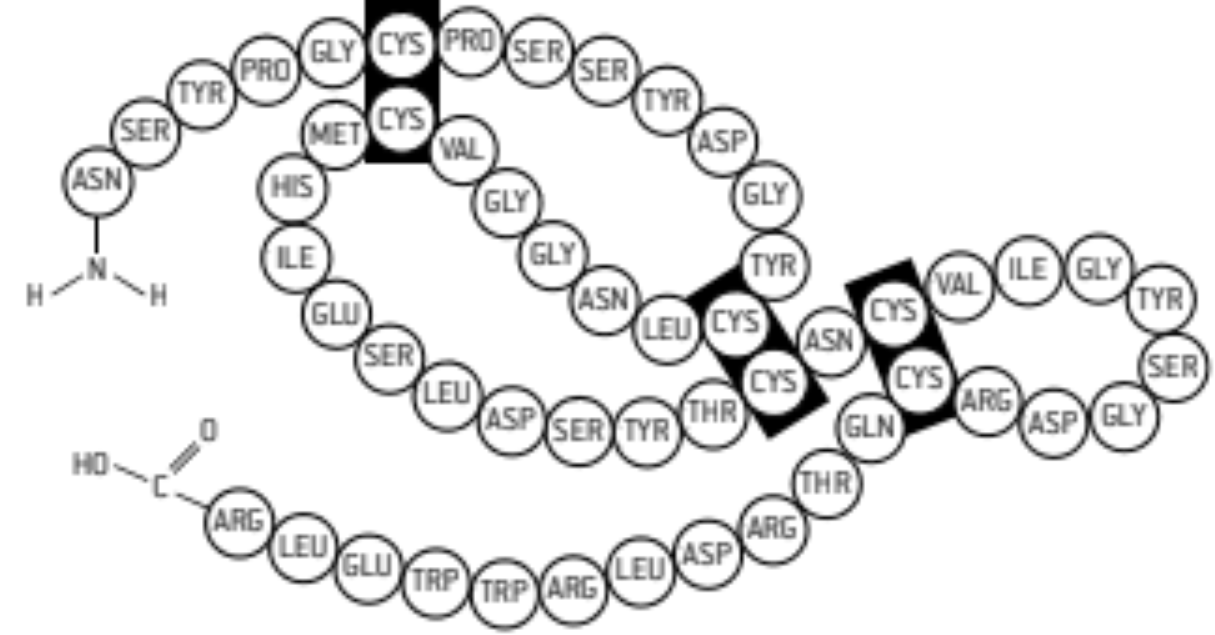
Production of human insulin in bacteria as an example of the universality of the genetic code allowing gene transfer between species.*
The gene that codes for insulin has been transferred from humans to the bacterium E. coli and to other organisms, to produce insulin
aa sequence for insulin in bacteria = aa sequence in humans
because of universality of genetic code
codons in bacteria = codons in human mRNA
there are some exceptions
Skills*
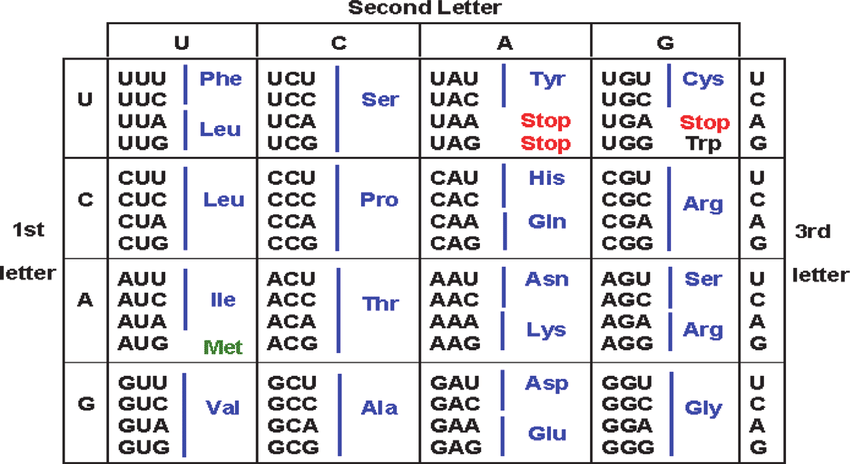
S 1 Use a table of the genetic code to deduce which codons corresponds to which amino acids.*
Identify if the given nitrogenous base is the
5’ strand - match complementary letters, turn into codons, and chart
3’ strand - match same letter for codon, chart
mRNA strand -order codon, chart
Anti-codon - find opposite letter, chart
ALWAYS DOUBLE CHECK
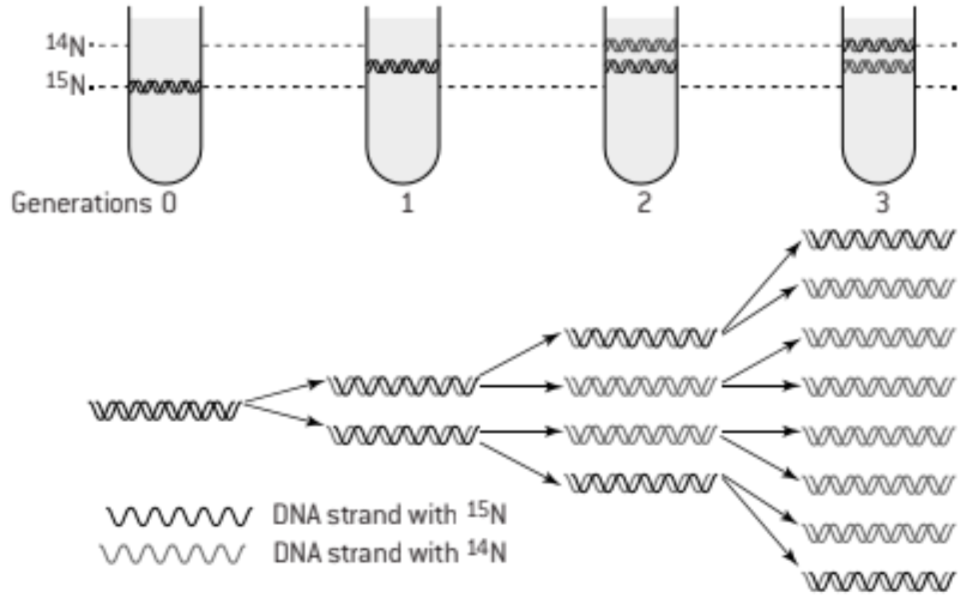
S2 Analysis of Meselson and Stahl’s results to obtain support for the theory of semi-conservative replication of DNA
E. coli cultures in N15 environments
they were transferred to N14 environments
After 1 generation, DNA was intermediate in density between N14 and N15
After 2 generations, N14+N15 DNA was present along side solid N14 DNA
simply: it kept a strand of the old DNA and created a new strand with the light nitrogen
S3 Use a table of mRNA codons and their corresponding amino acids to deduce the sequence of amino acids coded by a short mRNA strand of known base sequence.
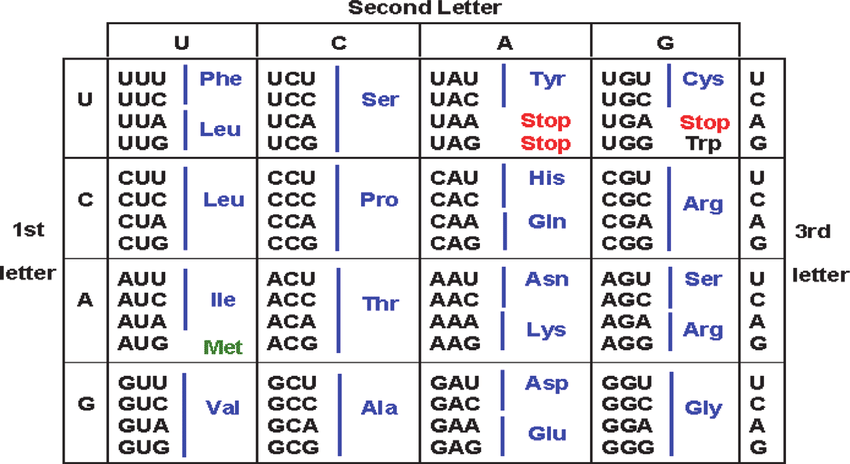
S4 Deducing the DNA base sequence for the mRNA strand.
Template strand of DNA is usually 3’-XXX-5’
mRNA is always 5’-XXX-3’
2.8 Cell Respiration
Understanding
U1 Cell respiration is the controlled release of energy from organic compounds to produce ATP
U2 ATP from cell respiration is immediately available as a source of energy in the cell.
U3 Anaerobic cell respiration gives a small yield of ATP from glucose.
U4 Aerobic cell respiration requires oxygen and gives a large yield of ATP from glucose.
Application
A 1 Use of anaerobic cell respiration in yeasts to produce ethanol and carbon dioxide in baking.
A2 Lactate production in humans when anaerobic respiration is used to maximize the power of muscle contractions.
Skills*
S 1 Use a table of the genetic code to deduce which codons corresponds to which amino acids.*
Identify if the given nitrogenous base is the
5’ strand - match complementary letters, turn into codons, and chart
3’ strand - match same letter for codon, chart
mRNA strand -order codon, chart
Anti-codon - find opposite letter, chart
ALWAYS DOUBLE CHECK
S2 Analysis of Meselson and Stahl’s results to obtain support for the theory of semi-conservative replication of DNA
E. coli cultures in N15 environments
they were transferred to N14 environments
After 1 generation, DNA was intermediate in density between N14 and N15
After 2 generations, N14+N15 DNA was present along side solid N14 DNA
simply: it kept a strand of the old DNA and created a new strand with the light nitrogen
S3 Use a table of mRNA codons and their corresponding amino acids to deduce the sequence of amino acids coded by a short mRNA strand of known base sequence.
S4 Deducing the DNA base sequence for the mRNA strand.
Template strand of DNA is usually 3’-XXX-5’
mRNA is always 5’-XXX-3’