Sympathetic Nervous System
Most Sympathetic Neuroeffector Pathways:
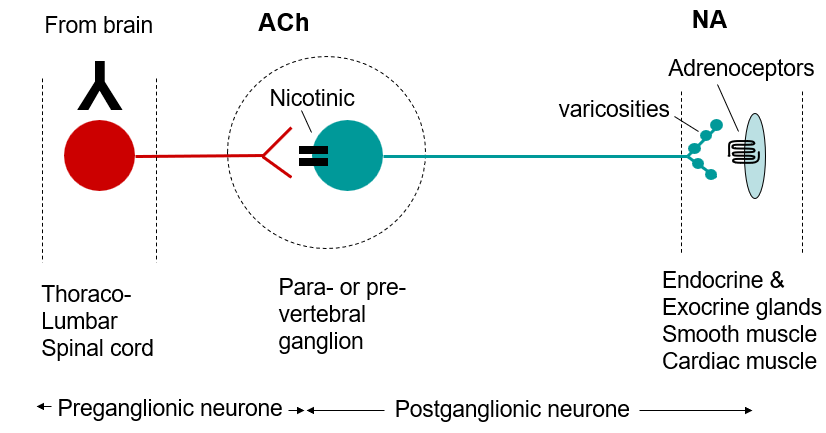
Branches can form to increase sympathetic action, with varicosities that release neurotransmitters.
Other Sympathetic Neuroeffector Pathways:
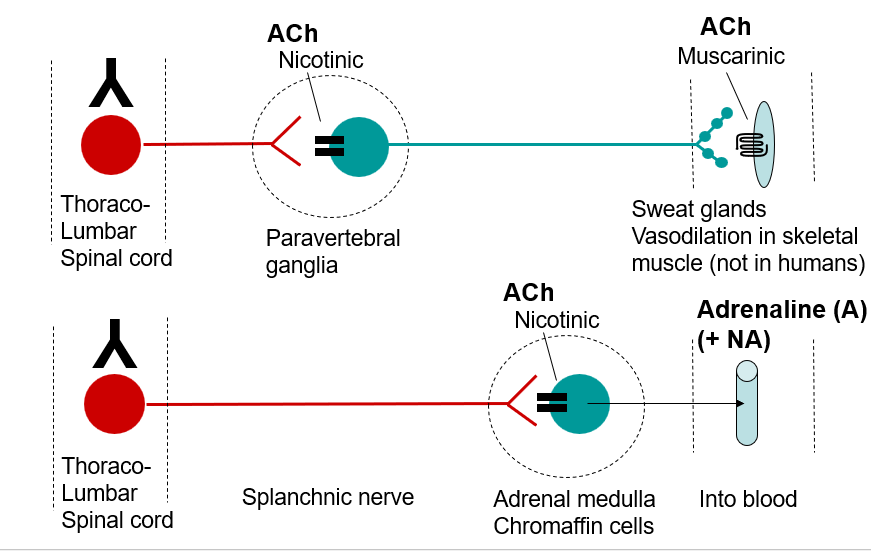
In the second example, the neurotransmitter released from chromaffin is adrenaline, and some noradrenaline, which helps with fight-or-flight.
Sympathetic Neurotransmitter Release:
1. Synthesis of Norepinephrine (NA)
Tyrosine, enters the adrenergic varicosity (a swelling along the sympathetic nerve terminal).
It is converted to norepinephrine by tyrosine hydroxylase.
NA is stored in synaptic vesicles within the varicosity.
2. Release of Norepinephrine (NA)
Upon stimulation, vesicles containing NA fuse with the membrane and release NA into the synaptic cleft by exocytosis.
Released NA diffuses across the synaptic cleft and binds to adrenergic receptors ((α and β receptors) on the postsynaptic effector cell (e.g. smooth muscle).
3. Regulation of NA Release
Presynaptic α₂-adrenoceptors (autoreceptors) bind some of the released noradrenaline and act to inhibit further release - a negative feedback mechanism.
This helps prevent overstimulation and conserves neurotransmitters.
4. Breakdown and Reuptake
MAO (monoamine oxidase), that is present in the varicosity, metabolises NA that is not reused.
Uptake 1 - the primary method of clearing NA — it is reabsorbed into the varicosity for reuse or breakdown.
Uptake 2 - a secondary process where NA is taken up by the postsynaptic cell, although less efficient than uptake 1.
5. Recycling
Reabsorbed NA via Uptake 1 is either:
Repackaged into vesicles for release.
Broken down by MAO into inactive metabolites.
Alpha and Beta Adrenoceptors are Metabotropic Receptors:
Structure
The receptor spans the cell membrane 7 times.
These are called transmembrane domains.
The N-terminal (amino end) is outside the cell.
This is where noradrenaline binds.
The C-terminal (carboxyl end) is inside the cell — it interacts with G-proteins.
How does it work?
Noradrenaline binds to the outer part of the receptor.
This causes a conformational change on the inside of the membrane.
The shape change actives a G-protein inside the cell.
The G-protein then triggers a secondary messenger system, for example:
→ β-adrenoceptors activate adenylyl cyclase, which increases cAMP.
→ α₁-adrenoceptors activate phospholipase C, leading to IP₃ and DAG.
These secondary messengers cause enzyme activation, ion channel changes, or other effects.
The cell responds — e.g. by increased heart rate, glandular secretion etc.
Types of Adrenoceptor:
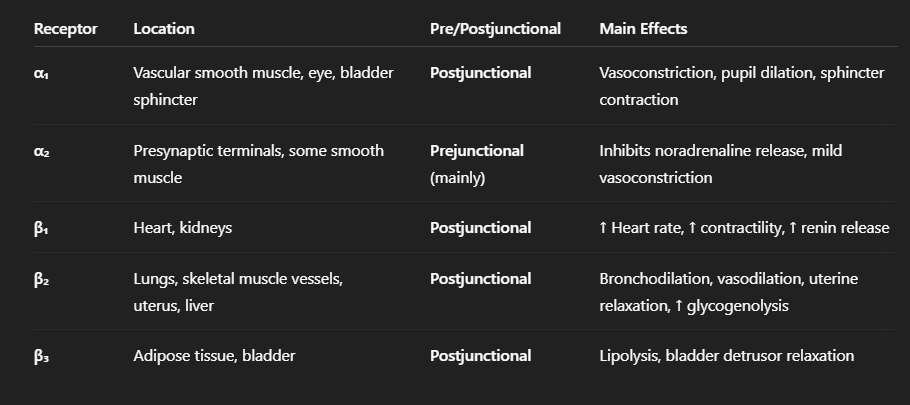
Adrenergic Neurotransmission:
1. Inhibition of Noradrenaline Synthesis
α-methyltyrosine blocks tyrosine hydroxylase, the rate-limiting enzyme in noradrenaline synthesis, reducing NA production.
2. Modulation of NA Release via Presynaptic α₂-Receptors
α₂-agonists (e.g. clonidine) bind to presynaptic α₂-receptors, inhibiting further NA release (negative feedback).
α₂-antagonists (e.g. yohimbine) prevent this inhibition, allowing more NA release.
3. Inhibition of NA Reuptake (Uptake 1)
Uptake 1 reabsorbs NA into the presynaptic terminal.
Inhibitors (e.g. cocaine, tricyclic antidepressants) block Uptake 1, prolonging NA action in the synaptic cleft.
4. Inhibition of NA Breakdown (MAO Inhibitors)
Monoamine oxidase (MAO) breaks down NA inside the nerve terminal.
MAO inhibitors (e.g. phenelzine) prevent this, increasing intracellular NA levels.
5. Promotion of NA Release
Indirect sympathomimetics (e.g. amphetamines) can promote vesicular release of NA into the synaptic cleft, enhancing sympathetic effects.
6. False Transmitter Formation
Methyldopa is converted into α-methylnoradrenaline (MeNA), a false transmitter that gets stored in vesicles.
MeNA is less active at postsynaptic receptors but still activates presynaptic α₂-receptors → reduced NA release.
7. Action of False Transmitters
False transmitters like MeNA are released instead of NA, but produce weaker postsynaptic responses, contributing to antihypertensive effects.
Sympathetic Control of Pupil Diameter:
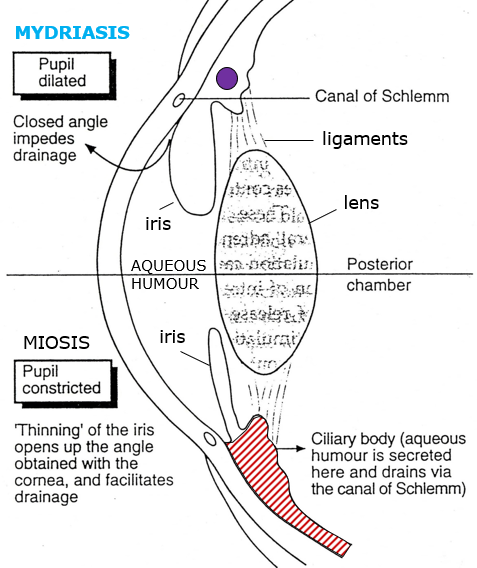
In response to light, the sympathetic nervous system causes the dilation of the pupil (mydriasis) by acting on the radial muscles of the iris, facilitating enhanced vision in low light conditions.
Sympathetic Drugs and the Eye
Mydriatic Drugs - sympathomimetic drugs that cause mydriasis due to contraction of constrictor pupillae.
Antiglaucoma Drugs - sympathomimetic drugs that induce vasoconstriction by impairing secretion of aqueous humour from the ciliary body, and facilitates reabsorption from canal of Schlemm to ease pressure build up.
Sympathetic Co-transmission:
NA + NPY + ATP
NPY = neuropeptide Y, made up of 26 amino acids.
Adenosine-5’-triphosphate (ATP) - acts on P2 receptors.
These act together to cause vasoconstriction.