B cell memory
3: B cell activation T dependent or independent
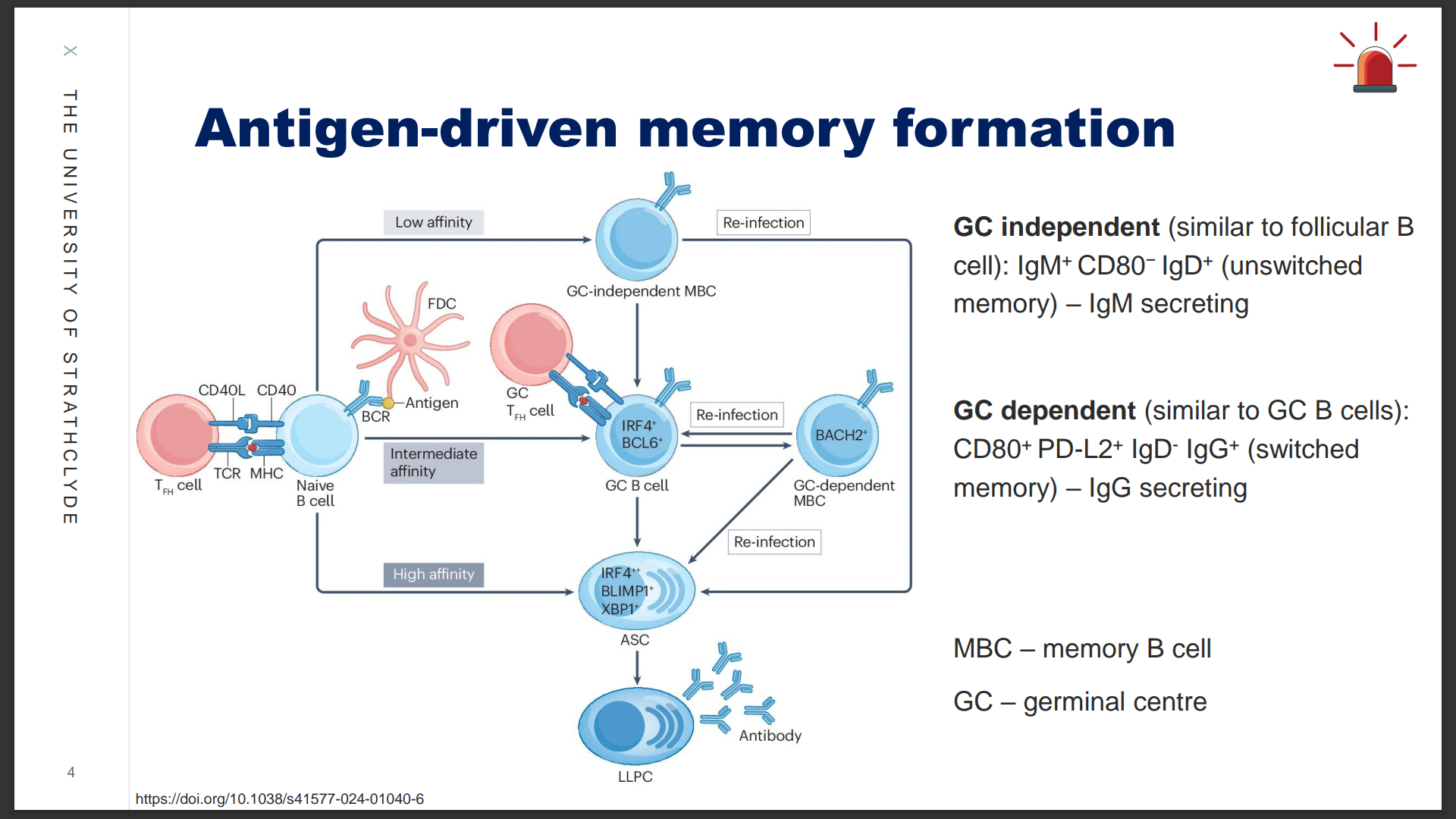
Memory B cells may be GC (germinal centre) independent or dependent. GC independent memory B cells are produced in B cell proliferation, which also produces GC B cells and short-lived plasma cells.
Typical memory B cells result from GC B cells. GC B cells undergo proliferation and somatic hypermutation in the ‘dark zone’ (?) and enter the ‘light zone’ upon encountering antigen. GC B cell interacts with T follicular helper cells causing activated GC B cell to differentiate into memory B cells, long lived plasma cells or cells which reenter dark zone. In the secondary immune response when an antigen is re-encountered the memory B cell differentiates into a long lived plasma cell or GC B cell.
4: Memory B cells are GC independent or dependent.
GC independent are similar to follicular B cells and secrete IgM. They’re IgM+CD80-IgD+ (unswitched memory)
GC dependent are similar to GC B cells and CD80+PDL2+IgD-IgG+ - switched memory. They secrete IgG
5: In flow cytometry, two markers used to identify memory B cells: CD27 and IgD. IgD negative CD19+CD27+ cells are switched memory cells - secrete IgG. IgD positive CD19+CD27+ cells are unswitched - secrete IgM.
CD27 is required for activation into plasma cells and is a member of the TNF receptor family, its ligand being CD70.
6: Initial circulating response after antigen exposure is low affinity IgM which has low affinity. High affinity, antigen specific IgG response begins to mount and peaks after IgM response depletes.
7: Antibody production is different after repeated exposures than after initial exposure. Antibody levels greater in subsequent exposures and affinity greater, and IgM levels decrease in favour of more suitable isotypes. IgG production limits IgM production.
Memory cells prevent naive B cell activation and subsequent responses are performed by memory cells. Non-switched memory B cells still secrete lower amounts of IgM
8: Is our immune system able to ‘forget’
9: 9 most common/harmful antibody associated autoimmune conditions: type 1 diabetes, rheumatoid arthritis, MS, lupus, Graves’, psoriasis, IBD, Sjorgen syndrome and coeliac. Majority progressive, ongoing work to try and get immune system to ‘forget’ autoreactivity
10: what if immune memory can’t be produced? Body will keep answering to infection as if it’s first time - this requires a lot of energy. Constantly being exposed to antigens.
Normal people have bit of memory to influenza every year as even though new strains develop backbone remains same/similar so can usually respond relatively quickly. If no immune memory would have no kickstarted immune response/help for flu.
11: would want to block immune memory for allergy,
11: would there be a situation you’d want to block immune memory in?
12: is there a way to erase immune memory?
Measles induces immune amnesia, its vaccine which contains inactive measles doesn’t
What would the consequences be?
Extra reading required:
antigen driven memory formation
B cell memory markers
memory B cell subtypes
implications of memory, loss of memory etc - critical evaluation
how do memory b cells prevent naive B cell activation