The Mass of Stars and Binary Stars (Part 7)
Determining Stellar Masses
Stellar mass determination cannot occur directly by examining isolated stars.
Mass can be inferred via gravitational effects on other bodies by applying Newton’s Law of Gravity.
Newton's Law of Gravity and Stellar Mass
Newton's exploration of Kepler's third law leads to the conclusion that the orbital period of two objects depends on the sum of their masses.
For example, in a star system:
If a planet orbits the Sun, we can neglect the planet's mass.
However, for binary star systems, we use Newton’s more complex equations taking into account both masses.
Binary Star Systems
More than half of the stars near Earth form binary systems where two stars orbit each other, though many appear as isolated in the night sky.
Observations using telescopes allow for measurements of orbital periods and distances, facilitating mass calculations.
Types of Double Stars
Optical Double (Apparent Binaries):
Appearing close together in the sky but may not be physically near each other (optical doubles).
Example: Herculis (an optical double).
True Binary Stars:
Pairs of stars that are physically orbiting a common center of mass.
They are Visual Binaries if both of the stars can be seen and distinguished from earth (using a telescope if necessary).
Kepler's Third Law and Mass Calculation
Newton rewrote Kepler’s third law as a relation between the masses of the stars (in solar masses).
where
and are the two masses expressed in solar masses.
is the length of the semimajor axis of the ellipse in astronomical units which is also the average separation between the two bodies.
is the orbital period in years.
Example: For a star with an orbit radius of 4 au and period 2.5 years, the total mass is calculated.
To find individual stellar masses, knowledge of their distances from the center of mass is necessary.
Using Kepler’s Third Law to Identify an Individual Star’s Mass
To determine the individual masses of stars in a binary system, knowledge of their distances from the common center of mass is essential.
Both stars orbit this center of mass; the more massive star is closer (similar to a balanced seesaw).
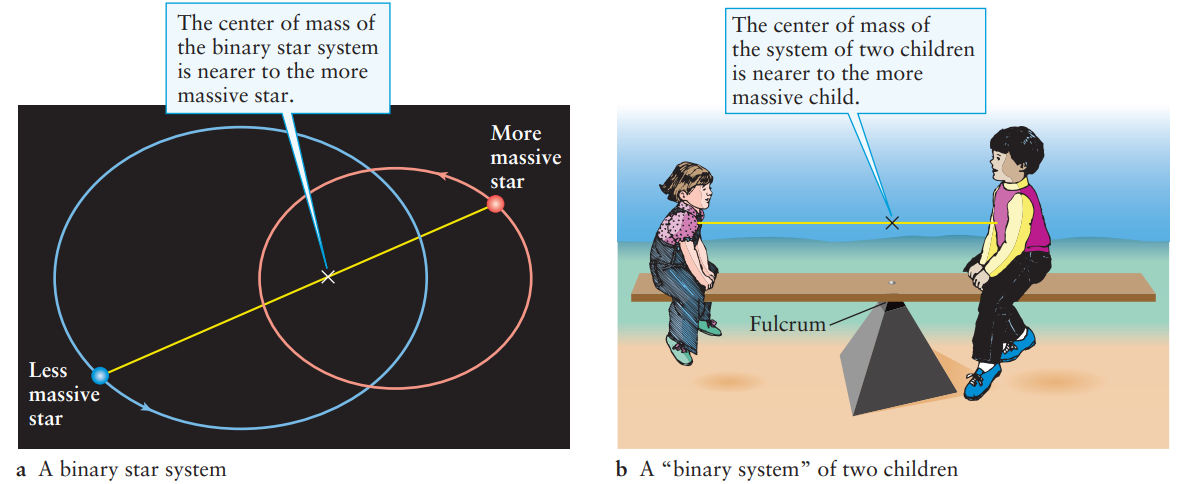
For Visual Binaries:
The center of mass can be located as the common focus of their elliptical orbits, observed against background stars.
The main challenge is determining the plane of orbit.
For Eclipsing Binary Systems:
Stars periodically block each other, implying their orbital plane is nearly parallel to our line of sight.
This allows for the comparison of their orbit sizes around the center of mass.
This comparison yields the mass ratio .
Calculating Individual Masses:
Combine the mass ratio with the total mass (derived from Newton's rewritten Kepler’s third law).
This system of two equations with two unknowns allows for the calculation of the individual masses of both stars.
Characteristics of Binary Stars and Eclipses
Eclipsing Binary Detection and Analysis
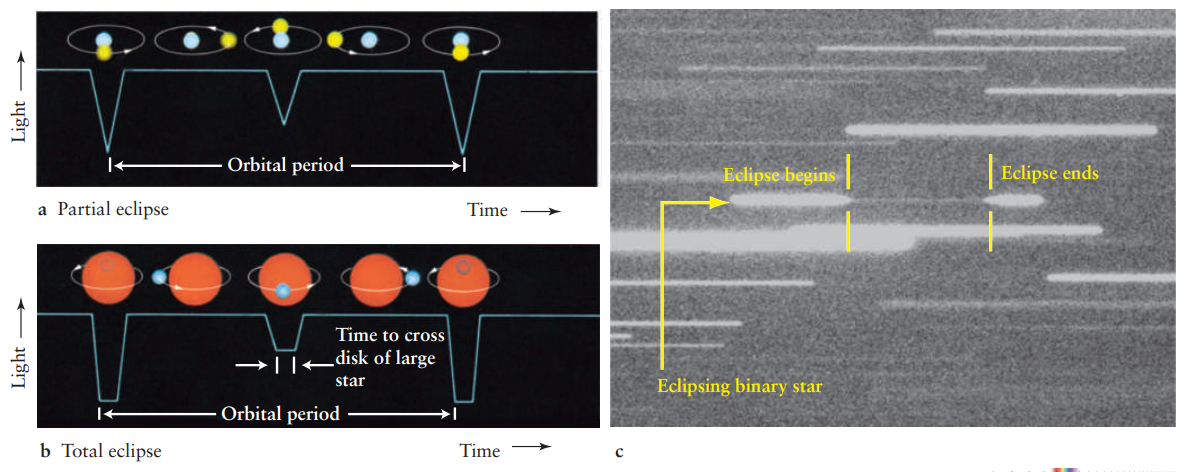
Eclipsing binaries can be detected even if their individual stars cannot be visually resolved in a telescope.
Their detection relies on changes in apparent magnitude:
The image dims each time one star partially or fully blocks the other.
Astronomers measure light intensity over time to create light curves.
Interpreting Light Curves:
V-shaped trough: Indicates a partial eclipse.
Flat-bottomed trough: Indicates a total eclipse.
Light curves provide information on how close the orbital plane is to being perpendicular to our line of sight.
Utilizing Light Curves to Study Stellar Atmospheres
Light curves can reveal details about stellar atmospheres.
Example: If a tiny white dwarf eclipses a much larger giant star.
By observing the gradual cutoff of the white dwarf’s light as it passes behind the giant, astronomers infer the pressure and density in the giant’s upper atmosphere.
This data is crucial for validating stellar structure models.
Effects of Binary Star Separation
Wide Binary Systems:
Stars are separated by several astronomical units or more.
They behave largely as isolated stars, meaning models for individual stellar evolution generally apply.
Close Binary Systems:
Stars are only a few stellar diameters apart.
The mutual gravitational pull profoundly affects each other's appearance and evolutionary path.
Mass Transfer: If one star is a giant, gas from its outer layers can be stripped and transferred to its more compact companion.
Multiple Star Systems
Beyond binary systems, some gravitationally bound systems consist of three or more stars.
Example: Polaris, the North Star, is part of a triple system where two stars orbit closely, and a third is much farther away.
Mass-Luminosity Relationship of Main-sequence Stars
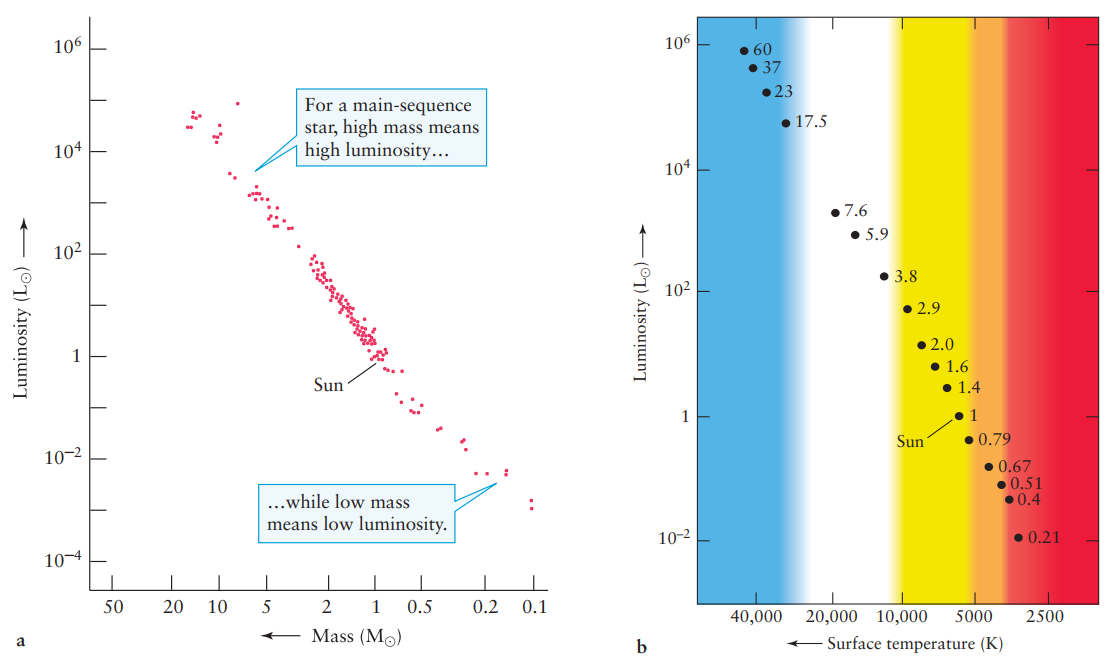
There is a positive correlation between a star’s mass and luminosity on the main sequence.
The more luminous a star is within this sequence, the more massive it generally is, confirming a direct relationship between mass, luminosity, and energy production.
Average circulation around the H-R diagram positions stars by their temperature, mass, and luminosity characteristics.
The importance of mass is evident in stellar evolution and energy generation mechanisms.
Spectroscopic Binary Detection
Spectroscopic binaries are identified when individual stars cannot be visually resolved, but their binary nature is revealed through spectral analysis.
Initial Detection Clues:
Incongruous spectral lines (e.g., both hot (hydrogen) and cool (titanium oxide) absorption lines) from what appears to be a single star indicate a binary system.
Doppler Shift Application:
The movement of stars orbiting each other causes Doppler shifts in their spectral lines.
Approaching sources have shorter (blueshifted) wavelengths; receding sources have longer (redshifted) wavelengths.
The magnitude of the shift is proportional to the star's speed.
Types of Spectroscopic Binaries:
Double-line spectroscopic binary: Both stars' spectral lines are visible and show periodic shifts, allowing for more comprehensive information.
Single-line spectroscopic binary: Only one star's spectral lines are detectable, shifting regularly back and forth while the companion remains unseen or too dim.
Interpreting Spectral Shifts (Example from Figure 12-16 conceptually):
When star A approaches Earth (blueshifted) and star B recedes (redshifted), two offset sets of spectral lines appear.
When neither star moves towards or away from Earth, spectral lines return to their normal positions (no Doppler shift).
The pattern of blueshifts and redshifts periodically reverses as the stars complete their orbits.
Radial-Velocity Curve:
Observations yield a radial-velocity curve, which graphs radial velocity over time, demonstrating velocity changes related to the orbital period.
This curve can also show the overall motion of the binary system relative to Earth.
Combined Data for Comprehensive Analysis:
For rare cases where an eclipsing binary is also a double-line spectroscopic binary, astronomers can combine light curves and radial-velocity curves.
This allows for the calculation of individual masses, diameters, relative brightnesses, speeds, and stellar separation of the stars.
Most spectroscopic binaries do not eclipse from Earth's perspective due to orbital plane tilt.