Scalar and Vector Quantities
Scalar quantities only have magnitude (numbers, no direction)
Vector quantities have both magnitude and direction (north)
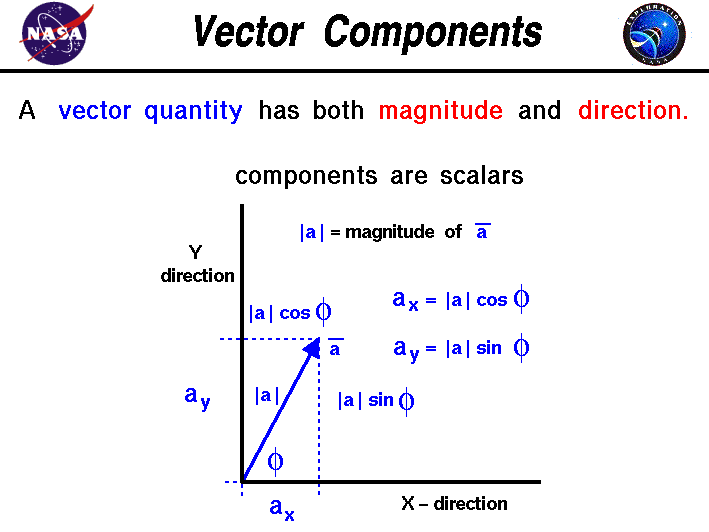
Vectors can be visually modeled using arrows
The length of the arrow indicates the magnitude of the vector
The direction of the arrow represents the direction of the vector
The length of the arrows must be proportional to their magnitudes
Scalar: Distance, speed, mass, energy, temperature, power
Vector: Position, displacement, velocity, acceleration, weight, force, momentum.
Distance
Distance is a measure of how far an object travels with no direction
Therefore, a Scalar quantity.
Displacement
A measure of how far the object travels from its initial position in a given direction.
Speed
Distance traveled per unit time
S=d/t
Scalar quantity
Velocity
The rate of change of displacement
Speed in a given direction
v=d/time
Mass
Measure of the amount of matter in an object
Scalar quantity
Weight
The gravitational force exerted on an object with mass
Vector quantity
Depending on gravity
w=m*g
Vector
Vectors are given a specific notion with an arrow above the symbol
v→=v0+at
v = velocity, m/s
v0=initial velocity
a=accelration
t=time
|v| means the magnitude of a vector quantity, which means there is a value corresponding.
A^→
A vector in one dimension is like the x-axis,
left = negative and right = positive