AP Art History: Lesson 5.02 Notes
Notes on Unification and Cultural Dynamics in Mesopotamia and Egypt
Mesopotamia (SANBAN Cultures)
Cultures Involved: Sumerian, Akkadian, Neo-Sumerian, Babylonian, Assyrian, Neo-Babylonian.
Geography: Centered around the Fertile Crescent in Mesopotamia.
Cultural Dynamics:
Continuous shifts due to invasions aimed at controlling:
Wealth.
Water resources for irrigation.
Agricultural abundance.
Rise and fall of successive societies in the region.
Egypt
Geographic Advantages:
Natural borders:
West: Libyan Desert.
East: Arabian Desert.
Nile River:
Central to Egypt’s sustenance, transportation, and economy.
Supported agriculture with rich soil, a temperate climate, and abundant crops.
Provided fish and wildlife resources.
Initial Division:
Two separate kingdoms:
Upper Egypt: South, near the source of the Nile.
Lower Egypt: North, where the Nile meets the Mediterranean Sea.
Unification:
Around 3100 B.C.E., King Menes (referred to as “Menes king-Menes god”) conquered Lower Egypt.
Unified Upper and Lower Egypt into a single kingdom.
Political Structure:
Rule by pharaohs over nearly 3,000 years.
33 Dynasties categorized into:
Kingdoms: Old, Middle, New.
Periods: Including the Amarna period.
Key Map Features
Displays Egypt and Syria.
Indicates:
Seas in light green.
Land in tan.
Territory boundaries in bold green.
Notes on the Palette of King Narmer
General Description
Material and Design:
A low-relief carving on both sides.
Divided into registers (horizontal sections), similar to the Standard of Ur.
Features a circular depression, likely ceremonial, for grinding pigment (e.g., eye paint).
Primary significance: political propaganda showcasing the unification of Egypt.
Symbolism of Crowns
Crown on Front:
Hedjet (White Crown): Represents Upper Egypt, indicating Narmer’s origins or affiliation.
Later, pharaohs wore a combined crown (Pschent), symbolizing the unification of Upper and Lower Egypt.
Front of the Palette
Top Register:
Narmer’s name is inscribed in an early hieroglyphic form:
"Nar" (horizontal fish).
"Mer" (vertical chisel).
Enclosed within a square representing the palace.
Flanked by two human-faced cow-headed figures, representing Hathor, the king’s divine protector.
Central Scene:
Narmer is shown in hierarchical scale, larger than others to denote his power.
Narmer is depicted raising his arm to strike a foe, symbolizing dominance.
Horus, the falcon god, watches from above, perched on a human-headed block with papyrus plants (symbols of Lower Egypt’s marshes).
Falcon uses its talons to extract the spirit of the marshes, symbolizing Narmer's victory over Lower Egypt.
Lower Register:
Depicts defeated enemies lying in submission, reinforcing Narmer’s dominance.
Political and Cultural Significance
The palette serves as a political statement of Narmer’s conquest and the unification of Egypt, rather than a functional tool.
It visually communicates:
The might and divinity of the king.
The integration of Upper and Lower Egypt under one ruler.
Notes on the Egyptian Mindset
Religious Beliefs
Gods of Nature and Order:
Egyptian gods represented the natural world’s perpetual order, including:
Sun cycles (rising and setting).
Nile River cycles (flooding and receding).
Pharaohs, considered divine, ensured order in the state as extensions of the gods.
Pharaohs were depicted as divine figures in art to emphasize their power and ensure respect in both life and death.
Concepts of the Human Being
Ka, Ba, and Akh:
Ka: Life force shared by all humans.
Ba: Unique qualities or "soul" of an individual.
Akh: Transcendent spirit state achieved post-death.
To achieve Akh, the ba had to reunite with the ka, which required the body to remain intact, leading to mummification practices.
Views on Mortal Life and Afterlife
Life was seen as preparation for the afterlife:
Comparable to farming cycles (spring planting → autumn harvest).
Significant focus on preserving the body and building tombs for a successful journey to the afterlife.
Architecture and Structures
Everyday Structures:
Made of ephemeral materials (palm trunks, mud-bricks).
Few examples survive today.
Tomb Evolution:
Built to protect the preserved remains of the deceased.
Designed to ensure a smooth transition to the afterlife.
Egyptian Art and Values
Egyptian art reflects key cultural values:
Order, stability, perpetuity, and obsession with immortality.
These values mirror:
The natural environment.
Political and religious systems.
The overarching Egyptian worldview.
Notes on Egyptian Art and Its Context
Artistic Conventions
Composite View:
Figures represented in a composite form, combining profile and frontal perspectives.
Motionless depictions, similar to Ancient Near Eastern art (e.g., Sargon II and dignitary).
Hierarchical Scale:
Used to indicate power and importance:
Palette of King Narmer: Pharaoh is the largest figure.
Wall plaque from Oba’s Palace: Larger figures represent warriors; smaller ones are attendants.
Stylistic Canon
Developed by the end of the Old Kingdom:
Unique, stylized conventions remained unchanged for nearly 3,000 years.
Mathematical ratios ensured order and consistency, especially for royalty.
Important figures (royalty, wealthy individuals) were idealized—young, powerful, beautiful.
Workers and low-status individuals depicted more naturally.
Examples:
Menkaure Triad Statue:
Pharaoh strides forward assertively, emphasizing superiority.
Flanked by Hathor and Nome goddess Anput, who take smaller or no steps, reinforcing their subordinate roles.
Seated Scribe:
Lifelike and attentive; soft body reflects sedentary lifestyle.
Contrasts with idealized depictions of pharaohs.
Material and Technique
Statues often carved with the subtractive method:
Durable materials like gneiss, granite, or limestone.
Designed to house the ka and ensure immortality.
Example:
King Djoser’s statue: Bilaterally symmetrical, balanced, and idealized for eternity.
Khafre’s statue: Gneiss emits a celestial glow in sunlight, symbolizing divinity.
Tomb Art and Painting
Tomb art aimed to empower the deceased's ka in the afterlife:
Organized using registers and ground lines.
Ti Watching a Hippopotamus Hunt:
Composite view shows Ti in a commanding stance.
Success in the hunt symbolizes triumph over evil.
Decorative conventions (e.g., marsh plants, birds) replace modern perspective.
Paintings served as symbolic narratives for eternal life, not realistic depictions.
Hieroglyphic Writing
Developed late 4th millennium B.C.E.:
A pictorial script used for religious and monumental texts.
Deciphered using the Rosetta Stone (1799 C.E.):
Hieroglyphs were compared to Greek and Demotic scripts.
Cartouches around hieroglyphs indicated names of royalty.
Key Statues and Examples
King Djoser:
Sculpted for his funerary complex at Saqqara.
Damaged by robbers but exemplifies permanence and divine representation.
Khafre’s Statue:
Radiates divinity with celestial light and symbolic throne elements.
Lions, lotus, and papyrus plants signify control over Upper and Lower Egypt.
Horus falcon symbolically protects and legitimizes the king.
Cultural Significance
Egyptian art reflects a culture centered on:
Order, stability, and immortality.
Art served religious, political, and practical purposes, ensuring the divine legacy and successful afterlife of the pharaohs and elites.
Notes on the Architecture of the Afterlife
Egyptian Beliefs About Death and the Afterlife
Transition to Eternity:
Death viewed as a passage from temporal life to an eternal realm.
Complex funerary rituals supported the transition.
Role of the Living:
Ritual offerings and prayers by the living were essential to maintain the deceased's journey in the afterlife.
Positioning of Tombs and Bodies:
Tombs built on the western bank of the Nile:
Symbolically faced west, associated with the afterlife and the setting sun.
Funerary Spaces
Tombs:
Domain of the dead, designed to house and protect the deceased's physical remains and ka.
Temples:
Located adjacent to tombs for the living to conduct worship and maintain the connection between the mortal world and the divine.
Mastabas and Necropolises
Mastabas:
Early tomb structures with flat roofs and sloping sides.
Served as burial sites for multiple individuals in a necropolis.
Included chapels, storerooms, and other functional spaces.
Necropolis:
Large complexes of mastabas formed a city of the dead.
Monumental Architecture with Funerary Functions
Egyptian Focus:
Tombs served as eternal dwelling places for the deceased's soul.
Examples: Pyramids and mastaba complexes.
Comparison with Other Cultures:
Great Stupa at Sanchi (India):
Served as a memorial, housing Buddhist relics.
Taj Mahal (India):
Functioned as a mausoleum and a symbol of love and remembrance, not as a dwelling for the soul.
Notes on the Evolution and Significance of the Stepped Pyramid
Development of the Stepped Pyramid
Transition from Mastaba to Pyramid:
Derived from the mastaba, the stepped pyramid was constructed by stacking six mastabas of equal height but diminishing size.
Larger stone blocks replaced the smaller mud-bricks of earlier mastabas.
Architectural Significance:
Imhotep, the earliest known architect, designed the Stepped Pyramid of Pharaoh Djoser (2630–2611 B.C.E.).
Nearly 200 feet high, it was the centerpiece of a vast funerary complex.
Functions of the Stepped Pyramid
Protection and Representation:
Protected the deceased king’s tomb and possessions.
Advertised the pharaoh’s power and divinity.
Symbolism:
Served as a stairway to the sun god Ra.
Represented the pharaoh’s journey to unite with the gods in the afterlife.
Features of Djoser’s Funerary Complex
Layout and Structures:
Enclosed by a 35-foot-high wall, a mile in perimeter.
Contained courtyards, a temple and chapel, palaces, and sham or "dummy" buildings for the king’s ka.
Ceremonial Path:
Rituals commenced in a pavilion near the entrance, followed by ceremonies in the courtyard.
The king’s ka symbolically traveled to the South and North Palaces, representing Egypt’s unification.
The king was ceremonially crowned again in the afterlife as the ruler of united Egypt.
Architectural Innovations by Imhotep
Stone Replication of Wooden Designs:
Columns with vertical ribs (flutes) mimicked tied palm branches.
Capitals styled like palm leaves or papyrus stalks in bloom.
Column Support:
Engaged columns (attached to walls) were used instead of freestanding ones, as the walls bore most of the structural weight.
Legacy:
Egyptian columns—with base, shaft, and capital—became the model for later Greek and Roman architecture.
Religious and Ritual Functionality
Ka Statue and the Serdab:
A serdab housed the king’s ka statue, which had peepholes to observe post-entombment rites.
Sham Structures:
Symbolized places where the king could continue the rituals of his reign in the afterlife.

Notes on the Great Pyramid of Giza and Its Context
Significance and Construction of the Giza Pyramids
Symbolic Importance:
Created as grander successors to Djoser’s Step Pyramid.
Became iconic representations of Egyptian civilization.
Timeline and Workforce:
Built during the Old Kingdom.
Construction of the Great Pyramid of Giza (honoring Pharaoh Khufu) took about 20 years with approximately 14,000 workers.
Size and Scale:
Khufu’s pyramid:
Nearly the height of a 15-story building.
Covers 13 acres at its base.
Composed of over 2 million granite blocks weighing ~2.5 tons each.
Precision Construction:
Blocks were fitted without mortar.
The pyramidion at the top mirrored the pyramid’s overall shape and may have been gilded to reflect sunlight.
Orientation and Design
Astronomical Alignment:
Pyramids oriented to the cardinal points of the compass.
Positioned toward the east, facing the rising sun.
Aligned along diagonal axes, showcasing the architects’ mathematical expertise.
Surrounding Complex:
No walled enclosure (unlike Djoser’s complex).
Each pyramid included:
A funerary temple.
A causeway connecting it to a valley temple by the Nile.
Smaller pyramids for queens and family members and mastabas for court officials surrounded the main pyramids.
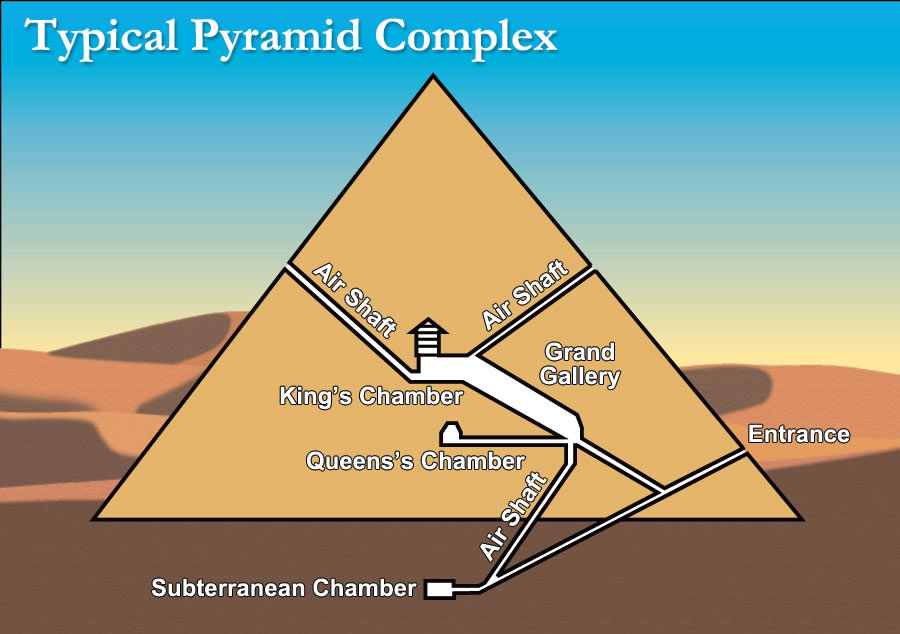
Interior Features
Protective Design:
Passageways, storerooms, and dead ends safeguarded the king’s sarcophagus and treasures.
Key Spaces and Their Purposes:
Subterranean Chamber:
Carved from bedrock; connected by a sloping passage from the entrance.
Queen’s Chamber:
Likely served as a serdab for the ka statue, despite the name.
Grand Gallery:
Connected to the King’s Chamber, which housed the royal sarcophagus.
Air Shafts:
Symbolic passages aligned with stars to facilitate the king’s spirit’s ascension to the heavens.
Notes on the Great Sphinx
Description and Significance
Location and Orientation:
Situated near Khufu’s valley temple, aligned with Khafre’s tomb (300 feet west).
Faces due east, symbolically toward the rising sun.
Symbolism:
Combines a lion’s body with a human head, representing royal power.
The face is a portrait of Pharaoh Khafre, symbolizing him as an incarnation of the sun god, Ra.
A beard, emblematic of pharaohs, originally adorned its chin.
Physical Dimensions:
Length: 240 feet.
Height: 66 feet.
Carved in situ from solid limestone.
Historical Context and Features
Associated Structures:
A chapel located between its front paws, discovered in 1816 C.E.
Passages connect the Sphinx to Khafre’s tomb.
Conservation Efforts:
Initial conservation occurred around 1400 B.C.E., during the reign of Thutmose IV.
According to legend, Thutmose IV was inspired by a dream where the Sphinx promised him the crown of Upper and Lower Egypt if he cleared the sand covering it.
Restoration of paws and chest continued during the Ptolemaic period (after 300 B.C.E.).
Entirely excavated from surrounding sand in 1925 C.E.
Erosion and Damage
The Sphinx has endured significant erosion over centuries and has been subject to multiple, often damaging, restoration efforts.
Notes on the Middle Kingdom
Historical Context
Decline of the Old Kingdom:
Ended with the death of Pharaoh Pepi II (~2125 B.C.E.).
Fragmentation led to a city-state model reminiscent of the Predynastic period.
Faith in divine rule was shaken.
Reunification:
Pharaoh Mentuhotep I of Upper Egypt reunified Egypt (~1975 B.C.E.), establishing the 11th Dynasty.
Marked the beginning of the Middle Kingdom, a time of recovery.
Shift in Governance:
Emphasis shifted from the pharaoh’s divine right to rule to their ability to ensure Egypt’s prosperity and order.
Artistic and Cultural Developments
Departure from Old Kingdom Traditions:
Art became smaller in scale and embraced a growing naturalism.
The monumental and rigid forms of the Old Kingdom gave way to more expressive and individualized representations.
Impact of Disillusionment:
A diminished confidence in the divine led to less stylized perfection in art.
Representations depicted a natural and flawed world.
Key Example: Statue of Senwosret III
Artistic Features:
Expressive and individualized, showing a wise but aging man.
Features include lined, sagging cheeks and sunken eyes.
Depicts the human burdens of leadership rather than divine perfection.
Symbolism:
Reflects the ruler’s humanity and the weight of responsibility during a transitional period.
A stark contrast to the idealized and static depictions of the Old Kingdom.
Comparative Art History:
The shift toward naturalism mirrors similar developments in the Hellenistic period of Greece.
Notes on the Transition to the New Kingdom
Collapse of the Middle Kingdom
Invasion by the Hyksos:
Asiatic people called the Hyksos ("shepherd kings") invaded Egypt’s northern regions.
Their rule marked the decline of the Middle Kingdom.
Reunification and the New Kingdom:
Ahmose, a prince from Thebes, expelled the Hyksos and proclaimed himself pharaoh.
This began the New Kingdom, a period of vast empire and absolute pharaonic power.
New Kingdom Characteristics
Transformation of the Pharaoh’s Image:
The humanized depiction of pharaohs from the Middle Kingdom gave way to a divine, idealized image.
Pharaohs were linked to Amun-Re, the combined deity of Amun (Theban god) and Ra (sun god).
Supported by a powerful priestly class.
Imperial Wealth and Building Projects:
Wealth from war spoils, taxes, and tributes of conquered peoples funded massive construction efforts.
Notable architectural achievements included:
Temples (e.g., Karnak and Luxor) to honor pharaohs and gods.
Rock-cut tombs in the Valley of the Kings.
Shift in focus:
Old Kingdom’s pyramids → New Kingdom’s monumental temples.
Art and Architecture:
Defined by colossal scale, splendor, and perfection.
Returned to traditional Old Kingdom forms and canons.
Emphasis on overwhelming magnificence to express aspirations for Egypt’s eternal glory.