1. Cognitive Psychology
1. Introduction to Cognitive Psychology
Definition
Cognitive psychology: The study of how cognitive processes influence human behaviour.
Studies mental processes, including:
Perception
Memory
Attention
Language
Problem-solving
Purpose: To understand how we view, interpret and respond to the world around us.
The Computer Analogy
The development of computers helped establish the cognitive approach.
Cognitivists use the computer analogy to explain how the human brain processes information.
The brain is compared to a computer:
Input: Receives information from the environment.
Processing: Processes and stores information.
Output: Produces a response or behaviour.
Hardware: Comparable to the physical structures of the brain.
Software: Comparable to the information and experiences processed by the brain.
Branches of Cognitive Psychology
Branch | Definition |
|---|---|
Experimental cognitive psychology | Studies mental processes through controlled laboratory experiments and tests. |
Cognitive science | Attempts to model human cognition using computer programs and simulations. |
Cognitive neuropsychology | Studies people with brain damage to understand how damage affects cognitive abilities and functioning. |
Note: Cognitive neuropsychology has been particularly important in understanding memory.
2. The Multi-Store Model of Memory (MSM) - (Atkinson & Shiffrin, 1968)
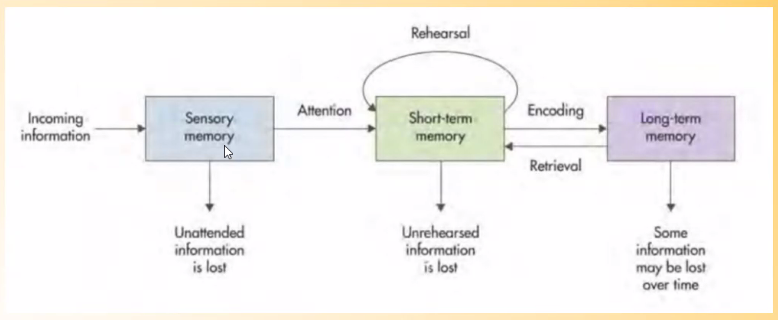
Atkinson and Shiffrin (1968) proposed a theoretical model explaining how human memory works.
The model distinguishes between two components:
1. Structural features (memory stores)
Permanent features of memory that cannot be changed.
Comparable to a computer's hardware.
Consist of three memory stores:
sensory register
short-term memory (STM)
long-term memory (LTM)
2. Control processes
Processes that determine how information is handled within memory.
Comparable to a computer's software.
Include:
Encoding: Converting information into a form that can be stored.
Rehearsal: Repeating information to maintain it or transfer it into LTM.
Retrieval: Accessing stored information when needed.
Key distinction: Structural features are the memory stores themselves, whereas control processes determine how information is encoded, rehearsed and retrieved.
3. Wider Issues and Debates: Reductionism
Reductionism: Explaining a complex behaviour or process by breaking it down into simpler components.
The Multi-Store Model is criticised for being reductionist because it divides memory into three separate stores:
Sensory register
Short-term memory (STM)
Long-term memory (LTM)
This oversimplifies memory by potentially ignoring the interconnections and interactions between the different memory systems.
However, separating memory into distinct stores makes it easier to study memory scientifically through experiments.
Exam takeaway: The MSM is reductionist because it simplifies a complex, interconnected memory system into three separate stores.
4. The Three Memory Stores
I. Sensory Register (SR)
Receives information through the five senses; each sensory modality has its own register.
Capacity: Limited.
Duration: A few hundred milliseconds.
Attended information transfers to STM; unattended information is lost.
Sperling (1960, 1963)
Presented participants with an array of letters using a tachistoscope.
Participants recalled an average of 4.2 letters.
Supports the brief duration and limited accessible capacity of sensory memory.
II. Short-Term Store (STS)
Feature | Description |
|---|---|
Capacity | 5–9 items (Miller, 1956) |
Duration | Approximately 15–30 seconds |
Encoding | Primarily acoustic |
Duration – Peterson & Peterson (1959)
Participants remembered three-consonant trigrams while counting backwards in threes to prevent rehearsal.
Recall decreased rapidly after 15–18 seconds.
Conclusion: STM duration is approximately 20 seconds without rehearsal.
Capacity – Miller (1956)
- Proposed the magical number 7 ± 2: STM holds approximately 5–9 items.
Forgetting
Decay: Memory traces fade over time without rehearsal.
Displacement: New information replaces older information when capacity is full.
Encoding – Conrad & Hull (1964)
Similar-sounding letters were harder to recall than dissimilar-sounding letters.
Phonological similarity effect: Supports acoustic encoding in STM.
Rehearsal
Maintenance rehearsal: Repeating information to maintain it in STM and transfer it to LTM.
Elaborative rehearsal: Processing the meaning of information to support transfer into LTM.
III. Long-Term Store (LTS)
Feature | Description |
|---|---|
Capacity | Potentially unlimited |
Duration | Potentially lifelong |
Encoding | Primarily semantic (meaning-based) |
Baddeley (1966b)
Participants recalled fewer semantically similar words than unrelated words.
Supports semantic encoding in LTM because similar meanings cause confusion.
Evaluation of the Multi-Store Model
Strength: Evidence from brain-damaged patients
Henry Molaison (HM): Severe LTM impairment following brain surgery for epilepsy, but STM remained largely intact.
Clive Wearing: Severe LTM impairment following encephalitis, but STM remained largely intact.
Conclusion: Supports separate STM and LTM stores because they can be affected independently.
Limitation: Case studies involve unique individuals, limiting generalisability.
Weakness: Oversimplifies LTM
The model presents LTM as one single store.
Clive Wearing could not recall autobiographical events but retained procedural skills, such as playing the piano.
Suggests LTM contains different systems:
Episodic – personal experiences.
Semantic – facts and knowledge.
Procedural – skills and abilities.
Wider Issues and Debates
I. Application to education – Butler & Roediger (2007)
Participants watched three lectures; some completed recall tests after each lecture.
One month later, the tested group remembered more.
Application: Retrieval practice and regular testing can improve long-term learning.
II. Alternative theory – Craik & Lockhart (1972)
Levels of Processing approach: Memory depends on how deeply information is processed.
Processing meaning (deep processing) produces stronger memories than simply repeating information (shallow processing).
III. Ethical issues – Brain-damaged patients
Privacy: Anonymisation protects identities (e.g. HM), but public cases such as Clive Wearing are harder to anonymise.
Consent: Brain damage may affect a patient's ability to remember giving consent.
Right to withdraw: Raises questions about whether patients can meaningfully withdraw consent if they cannot remember agreeing to participate.
5. Serial Position Effect
Glanzer & Cunitz (1966)
Investigated whether the position of a word in a list affects recall.
Participants recalled more words from the:
Beginning (primacy effect): Words are rehearsed and transferred to LTM.
End (recency effect): Words remain in STM.
Fewer words from the middle were recalled because STM capacity becomes full and newer words displace older ones.
Conclusion: Supports the existence of separate STM and LTM stores.
Alternative Explanations of the Multi Store Model
Weakness: Oversimplifies STM
The model assumes STM is a single store with a fixed capacity.
Dual-task experiments: People perform poorly when completing two similar tasks (e.g. two verbal tasks), but better when completing different tasks (e.g. one verbal and one visual task).
Baddeley & Hitch (1974): Proposed the Working Memory Model, which explains how STM can process different types of information simultaneously.
Evaluation: Suggests STM is more complex and dynamic than the MSM proposes.
Weakness: Overemphasises Rehearsal
The model suggests rehearsal is essential for transferring information into LTM.
However, people can form long-term memories without conscious rehearsal.
For example, imagery can create strong memory traces.
Evaluation: Rehearsal is not the only way information enters LTM.
Weakness: Oversimplifies LTM
Tulving (1972) proposed three types of LTM:
Memory type | Definition |
|---|---|
Episodic | Memory of personal experiences and events. |
Semantic | Memory of facts and general knowledge. |
Procedural | Memory of skills and abilities (e.g. riding a bicycle). |
Evidence from brain-damaged patients suggests these memory types can be affected differently.
Evaluation: LTM is not one single store, as suggested by the MSM.
Strength: Contribution to Psychological Research
Despite its limitations, the MSM provided an important framework for understanding memory.
It stimulated further research and the development of more detailed memory theories.
Evaluation: Its influence helped advance psychological understanding of memory.
6. Wider Issues and Debates
Development of Psychological Knowledge
The MSM (Atkinson & Shiffrin, 1968) provided an important framework for understanding memory.
Despite its limitations, it stimulated further research and the development of more detailed theories, such as the Working Memory Model and Levels of Processing approach.
Exam technique: Evaluating the MSM
When using research evidence, always explain how it supports or challenges the model.
For example:
Point: Clive Wearing suffered severe LTM impairment, while his STM remained largely intact.
Link: This supports the MSM because it suggests STM and LTM are separate stores that can be independently affected.
Important: When comparing memory stores, use both qualitative and quantitative differences.
Quantitative: Differences in capacity and duration.
Qualitative: Differences in encoding (acoustic in STM vs semantic in LTM).