MAXILLARY CANINE
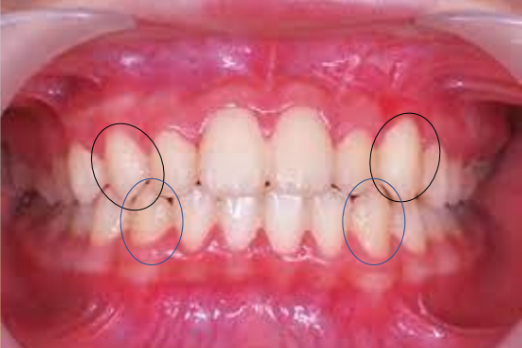
Introduction to Maxillary Canine
Number and Position: Four in total; each arch contains a pair located third from the midline on both the maxillary and mandibular arches.
Development and Replacement: Maxillary canines replace the deciduous canines and function alongside the incisors and premolars.
Naming and Tooth Numbering: Often called cuspids, they serve as cornerstones in the dental arch due to their position. The FDI numbering system lists them as 13, 23 (maxillary) and 33, 43 (mandibular).
General Morphology
Location: Positioned distal to lateral incisors and mesial to first premolars.
Nickname: Known as “cornerstones” of the arches for their stabilizing role.
Dimensions: Longest teeth in the permanent dentition, featuring large, pointed cusps that have distinct mesial and distal cusp ridges.
Functional Roles of Canine
Mastication: Specializes in tearing and shearing food, complementing the functions of other teeth.
Lip Support: Provides structural support to the lips.
Auxiliary Role in Chewing: Assists incisors and premolars in breaking down food.
Guidance for Jaw Movement: Guides other teeth during occlusion by directing jaw movements, helping to avoid excessive wear and fractures on other teeth.
Developmental Chronology
Calcification: Begins at 4–5 months.
Crown Completion: Achieved by 6–7 years.
Eruption: Occurs around 11–12 years.
Root Completion: Finalizes between 13–15 years.
Detailed Anatomical Characteristics
1. Labial Aspect
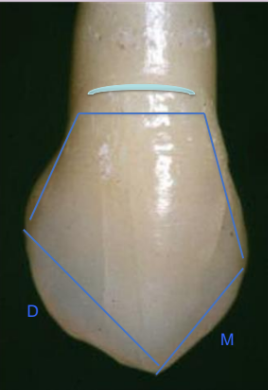
Crown Shape: Mesiodistally narrower than the central incisor, giving it a more tapered, pentagonal shape.
Cusp and Slopes: The incisal outline features a distinct pointed cusp tip. The mesial slope of the cusp is shorter than the distal slope.
Cervical Line: The cervical line is convex toward the root.
Contact Points:
Mesial Contact: Located near the junction of the incisal and middle thirds, closer to the cusp tip.
Distal Contact: Situated in the middle of the middle third, positioned more cervically than the mesial contact.
Elevations:
Cusp: Centrally aligned with the root axis.
Labial Ridge: A prominent vertical ridge that runs down the middle of the labial surface.
Depressions:
Two shallow longitudinal grooves flank the labial ridge, creating a more contoured labial surface.
2. Cusps and Ridges
The primary cusp has two ridges:
Mesial Cusp Ridge: Shorter than the distal ridge.
Distal Cusp Ridge: Longer and slightly more sloped.
3. Root Characteristics
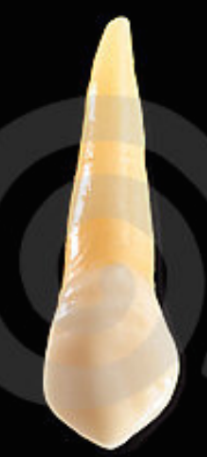
Shape and Size: The root is a single, long, slender, conical structure with a pointed apex.
Surface: Smooth and convex on the labial side, typically curving distally in the apical third.
Curvature: In most cases, the root's apical portion curves slightly in a distal direction.
4. Lingual Aspect
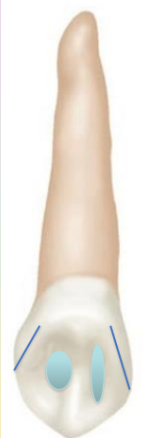
Narrower Crown: The crown narrows towards the lingual side.
Elevations:
Cingulum: Large and sometimes resembles a cusp in the center of the lingual surface.
Lingual Ridge: A prominent vertical ridge that extends from the cusp tip down to the cingulum. This ridge is unique to the canines.
Marginal Ridges: The mesial marginal ridge is longer than the distal due to the shorter mesial cusp slope and the location of the mesial contact area.
Depressions:
Lingual Fossae: Two shallow fossae flank the lingual ridge on the mesial and distal sides, adding texture and character to the lingual surface.
5. Mesial Aspect
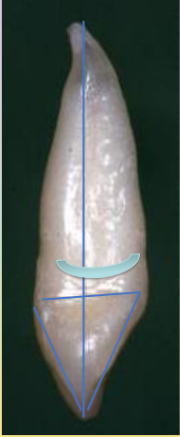
Shape: The crown has a wedge-shaped (triangular) outline.
Cervical Line: Curves toward the cusp, showing a less pronounced convexity compared to the incisors.
Cusp Tip Position: Slightly labial to the root's axis.
Root Characteristics:
Form: Conical with a tapered or blunt apex that may curve slightly labially.
Surfaces: The mesial surface of the root is broad with a shallow longitudinal depression that runs the length, adding stability.
6. Distal Aspect
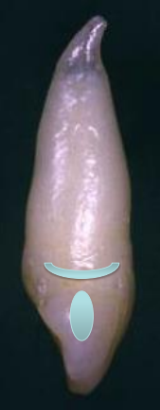
Crown Shape: Similar to the mesial view but with a few differences:
The cervical line has a reduced curvature toward the cusp.
The distal surface is slightly concave below the contact area.
Root: The distal root depression is more pronounced than on the mesial surface, a feature helpful in identifying the tooth's orientation.
7. Incisal Aspect
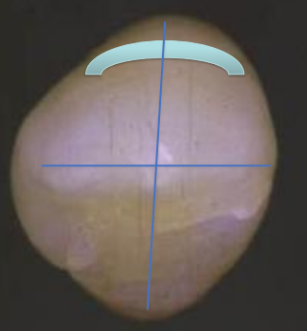
Dimensions: The labiolingual dimension is slightly greater than the mesiodistal dimension.
Contour: The labial surface is more convex than that of the incisors, enhancing the tooth's strength and stability in the arch.