Unit 1 - Basic Economic Concepts
Economics: a social science that studies the way people and societies allocate scarce resources in order to satisfy unlimited needs and wants.
allocation: distribution
scarce: unlimited wants > limited resources
resources: service or asset used to produce goods and services
Economic Problem: how to arrange our limited resources to satisfy as many of our wants as possible
Macro Level: considers the big picture - nation’s economy as a whole
→ “bigger” scale
Micro Level: filters the scope to individuals in an economy
→ “smaller” scale
i.e → countries/businesses/etc. (macro) & individuals (micro)
Factors of Production: resources that are scarce; broken down into four categories (doesn’t include money):
land: natural resources and raw material
ex. water, oil, minerals
labor: physical labor devoted to a task where workers are paid
capital: liquid asset or monetary value
physical capital: tools and equipment used to produce
ex. machinery
most commonly used
human capital: education/trining and individual has/uses to produce
entrepreneurship: ability of an individual to coordinate the other categories of resources to produce a good or service
The study of economics can be broken down into two more ways:
positive economics: based on facts and figures
→ theories to understand behavior are proved via hypothesis & testing
normative economics: based on assumptions
→ economic behaviors are analyzed and evaluated by researcher’s opinions
Fundamental Economic Reality
everyone faces trade-offs
we want more than what is freely available. When we are forced to choose one thing over something else, we must make a trade-off
in our decision making, we must weigh the costs and benefits of each option
Opportunity Cost: costs we sacrifice when opting for another choice
potential benefits missed when choosing one alternative over another
implicit cost: non-monetary costs
explicit cost: costs involving monetary payment
Trade-offs: giving up something to receive something in exchange
*opportunity cost ≠ trade-off
Marginal: having a little bit more or a little bit less
Thinking on the margin means to compare the marginal cost with the marginal benefit.
Sunk Costs are past costs that are irrelevant to decision making.
Marginal Analysis and Consumer Choice:
utility: the measure of personal satisfaction (units → util)
marginal utility: added utility a consumer gets from having one more of something
total benefits and costs: used when decisions can’t be taken with margins
→ total net benefits: difference between total benefit and total cost, maximized at optimal choice
Three Big Economic Questions:
what goods and services will be produced?
→ decision making of what is needed to properly allocate resources
how will goods and services be produced?
→ how businesses will go about producing these goods and services
for whom will the goods and services be produced?
→ who will be able to consume these goods and services
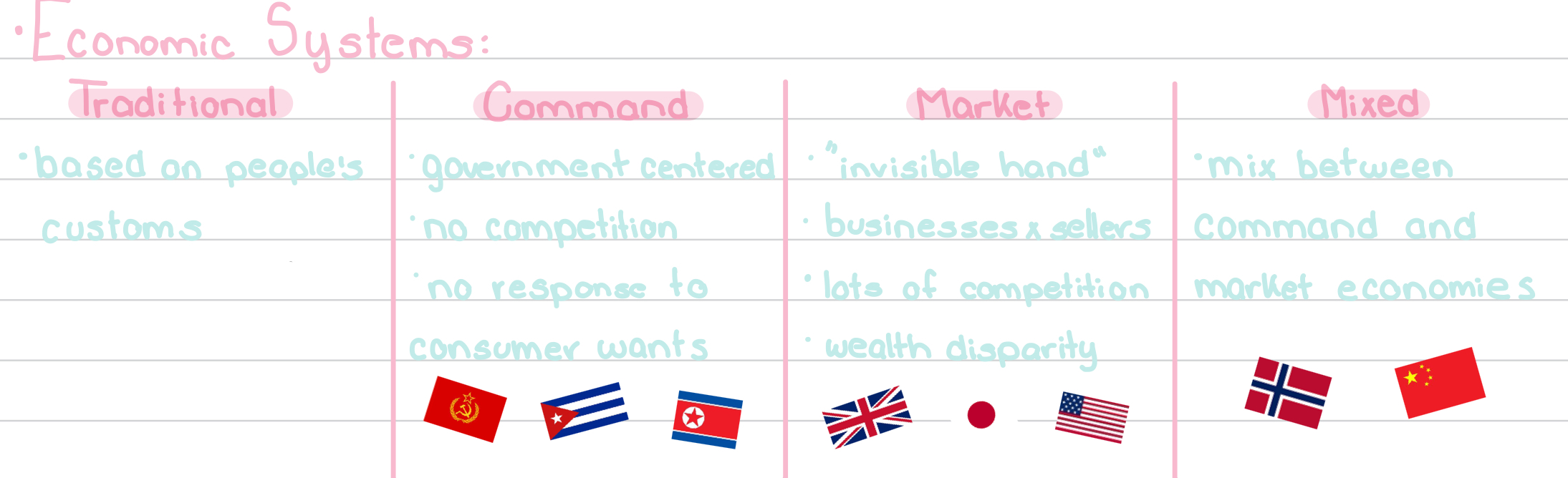
Economic Systems: