3.8 The Constitutional Convention and Debates Over Ratification
LEARNING OBJECTIVE: Explain the differing ideologial positions on structure and function of the federal government.
INTRODUCTION
Skepticism surrounded the Constitution
Delegates debated over if the consititution could establish a central government stong enough to hold 13 states together in union.
- Several problems led to a convention that wrote a new consititution (followed by intense debates on whether to ratift the new plans of gov)
THE ANNAPOLIS CONVENTION
George Washington hosted a conference at his home in Mount Vernon
Was held to review what could be done about country’s inability to overcome critical problems
- Representatives agreed that problems were serious enough to hold futher discussions at Annapolis, Maryland.
Only 5 states sent delegates to the Annapolis convention
- Discussed ways to improve commerical relations among states
- James Madison and Alexander Hamilton persuaded others that another convention should be held to revise AOC.
DRAFTING THE CONSTITUTION AT PHILADELPHIA
Congress consented to give its approval to the meeting in Philadelphia.
Called upon 13 states to send delgates for the sole and express purpose of revising the AOC
- Rhode Island did not send delegates (did not trust other states).
THE DELEGATES
55 delegates attented the convention in Philadelphia
- All were relatively young, white, college-educated males.
- Wealthier than the average American of their day.
- Were all aquainted with issues of law and politics (many were practicing lawyers and helped write their state’s constitutions).
- Shared the common goal of wanting to strengthen the young nation.
First order of business was to elect a presiding officer and decide whether or not to communicate with the public
- Delegates voted to conduct their meeting in secret
- George Washington was elected as chairperson
- Bejamin Franklin provided calming and unifying influence
- James Madison, Alexander Hamilton, Gouverneur Morris, and John Dickinson fashioned specific articles of the Constitution.
Several major leaders in the American Revolution were not at the convention
- John Jay, Thomas Jefferson, Thomas Paine and John Adams (diplomatic business)
- Samuel Adams and John Hancock were not chosen as delegates.
- Patrick Henry opposed all growth in federal power.
KEY ISSUES AT THE CONVENTION
Convention opened with delegates disagreeing on the convention’s fundamental purpose.
Some wanted to revise the articles
Others wanted to draft an entirely new document
- Nationalist such as Madison and Hamilton argued stongly for this
- Argued that the confederate government model, in which states were loosely united under a weak central government, was unworkable
- Believed in federalism (system with stong but limited central government)
- Quickly took control of the convention
Americans distrusted government and feared that officials would seize opportunity to abuse their powers (even if they were popularly elected)
Madison and other delegates believed in separation of powers (dividing power among different branches of government)
- Also wanted constitution to be based on a system of checks and balances (power of each branch would be limited by the others).
REPRESENTATION
Debates arose over whether bigger states should have more representatives than smaller states in congress.
Virginia Plan (favored large states) & New Jersey Plan (favored small states)—→ The Great Compromise/Conecticut Plan
Created a bicameral (two-house) congress
- Senate: States had equal representation (2 senators per state)
- House of Representatives: States would be represented according to it’s population size.
SLAVERY
There were arguements over whether slaves should be counted as part of the population not
Southerns argued that they should, Northers argued that they did not have the rights of citizens so they shouldn’t —→ 3/5th’s Compromise
Counted each slave as 3/5th’s of a person
- For the purposes of determing a state’s level of taxation and representation.
Another arguement debated if the slave trade should be allowed
Some delegates wanted to ban it for humanitarian reaons, others wanted labor
- Delegates decided to guarantee slaves could be imported for 20 years longer (congress to could vote to abolish it after the 20 years).
TRADE
Northern states wanted central government to regulate interstate commerce and foreign trade, Southern states were afriad that export taxes would be placed on agricultural products such as tobacco and rice—→ The Commercial Compromise.
Allowed congress to regulate interstate and foreign commerce, including placing tariffs, but prohibited taxes on exports.
THE PRESIDENCY
Delegates debated over the president’s term of office
Delegates limited the president’s term to four years but with no limit on the number of terms.
Delegates also debated method for electing president.
Electoral College System was instituted rather than having voters elect directly.
- Delegates feared too much democracy might lead to mob rule.
- Delegates decided to assign each state a number of electors equal to the total of that state’s representatives and senators
Delegates debated on what powers to give the president.
Decided to grant president considerable power, including power to veto acts of congress
RATIFICATION PROCEDURE
After 17 weeks of debate, the Philadelphia convention approved draft to submit to states for ratification.
Delegates specified in article VII that 9/13 states had to approve for required ratification.
- Each state would hold popularly elected conventuons to debate and vote on proposed constitution.
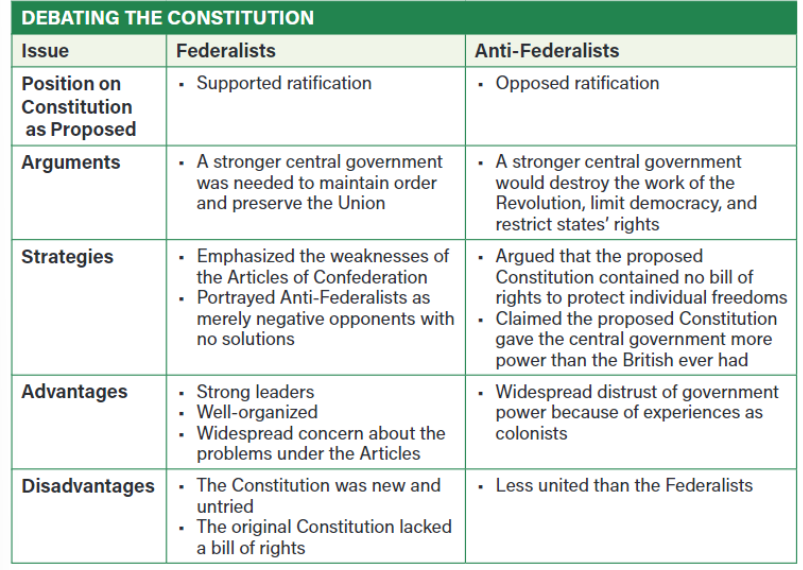
FEDERALIST AND ANTI-FEDERALIST
Ratification was debated for almost a year—→ Federalist and Anti-Federalist
Federalist
Supporters of constitution and its stong federal government
- Most common along the Atlantic Coast in large cities
Anti-Federalist
Opponents of the constitution who feared the new govenment would be too strong
- Most common along the western frontier, tended to be small farmers.
THE FEDERALIST PAPERS
Key element in the federalist campaign were the Federalist Papers
A series of highly persuasive essays written for the New York newspaper by James Madison, Alexander Hamilton, and John Jay.
- Were originally 85 essays, that presented cogent reasons for believeing the practicality of the constitution.
THE PATH TO RATIFICATION
The federalist won early victories in the state conventions of Delaware, New Jersey, and Pennsylvania, however the federalist were not confident of victory in enough other states for ratification.
DEBATE ON A BILL OF RIGHTS
One of the main objections expressed by Anti-federalist was the lack of specific rights the federal government could not violate.
Argued that Americans had fought in the revolutionary war to escape tyrannical gov in Britian
- Thought strong central gov could act similar.
- Wanted a bill of rights that could protect Americans.
Federalist responsed that since members of congress would be elected by the people, they didn’t need to be protected against themselves
Also argued that people should assumed all rights were protected rather than making a list of limited rights
Promised to add a bill of rights to win the support of the constitution.
RATIFICATION ACHIEVED
With the promise of a bill of right, federalist were able to win-over anti-federalist
Federalist won the necessary 9 votes to achieve ratification, however Large states (Virginia and New York) have not acted yet
- Failure to ratify would jepardize national unity and strength.
FINAL STATES
Virginia was the most populous of the original 13 states
Anti-federalist rallied behind two strong leaders: Patrick Henry and George Mason
- Viewed the constitution and stong central gov as threats to Americans’ hard-won liberty
Federalist led by Washington, Madison, and John Marshall, managed to prevail by a close vote only after promising bill of rights.
Virginia’s vote influenced New York (combined with Hamilton’s efforts)
North Carolina and Rhode Island reversed their earlier rejections and became the last two states to ratify the constution as “supreme law of the land.”