skeletal system
Section 1: Bone
==function: support, protection, movement, storage of minerals and fats, blood cell formation (hematopoiesis)==
at birth we are born with 300 bones, but they fuse over time; as an adult, we have 206 bones
osteocytes = bone cells
- osteoBlasts = bone-forming cells, makes lamellae/matrix (Blasts Build Bones)
- osteoClasts = break down lamellae/matrix for remodeling (Clasts Cut)
ossification: formation of bones
- embryonic bones are made of hyaline cartilage; osteoblasts create the bone matrix, then cartilage is digested away
- bones are joined by fibrous membranes, then replaced with bones within 2 years of birth (sutures)
- ==new cartilage grows and is eventually replaced by bone== (cartilage in nose, ears, and ribs persist for life)
- epiphyseal plates = cartilage in plate/on heads of bone grows and is then ossified to make new bone
- to widen the bone, osteoblasts add bone tissue to the outside of the diaphysis
- bone growth is controlled by growth and sex hormones
==calcium== is needed for neurotransmitter release, relieving blood clots, and creating/strengthening bones + muscles (stronger bones are needed to support large muscles, and vice versa)
Section 1.5: Bone Types
Long Bone
- has a long longitudinal axis and expanded ends; supports the weight of the body
- femur, humerus, tibia, fibula, carpals/tarsals, radius, ulna, etc
Flat Bone
- platelike structures with broad surfaces
- skull plates, thoracic cage, pelvis
Short Bone
- have roughly equal widths and lengths
- carpals, tarsals, bones of ankles
Irregular Bone
- variety of shapes, most are connected to several other bones
- spinal cord, some bones in the skull, ossicles, cervical vertebrae
Compact Bone
- homogenous (smooth and solid)
Spongy Bone
- small needle-like pieces of bone, short/irregular/flat bone
Section 2: Long / Compact Bone Anatomy (done)
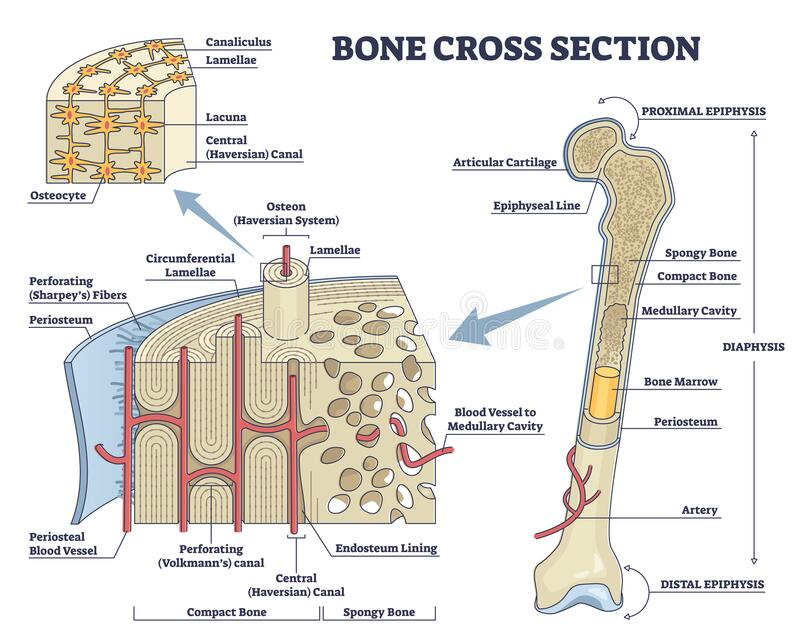
diaphysis = shaft/middle, composed of compact bone
(distal/proximal) epiphysis = ends/heads of the bone, composed of mostly spongy bone
epiphyseal line = where diaphysis & epiphysis meet, made of cartilage
periosteum = outside lining of the diaphysis, made of fibrous connective tissue
perforating fibers = secure periosteum to the underlying bone
medullary cavity = cavity of the shaft; contains yellow marrow (mostly fat) in adults
- the spongy bone of epiphysis contains red marrow (for hematopoiesis) in infants
{{osteon = a unit of bone{{
{{central canal = opening in the center of an osteon, carries blood vessels + nerves to bone cells{{
{{perforating canal = canal is perpendicular to the central canal{{
{{lacunae = cavity containing bone cells, arranged in rings{{
{{lamellae = rings around the central canal, sites of lacunae{{
{{canaliculi = tiny canals that radiate from the central canal to lacunae, forms a transport system for bone cells to share nutrients & information{{
Section 3: Joints
based on ==FUNCTION + STRUCTURE==:
- {{Fibrous = generally immovable; sutures of the skull{{
- {{united by fibrous tissue{{
- {{Cartilaginous = immovable or slightly moveable (with fibrocartilage); ribs to sternum, pubic symphysis{{
- {{bones connected by cartilage{{
- {{Synovial = freely moveable; hips, knee, jaw…{{
- {{separated by a joint cavity (lined with synovial membrane); ligaments reinforce the joint{{
based on ==SHAPE==: (all are SYNOVIAL)
- Plane/Gliding = bones glide along each other; between carpals & tarsals
- Hinge = open/close movement; in knees, elbows, jaw…
- Pivot = rotational movement; radius against ulna on the proximal end
- Condyloid = rocking motion; proximal phalanges/metacarpals
- Saddle = flexion + extension; thumb & carpals below
- Ball and Socket = many different types of movement; hips/shoulders
Section 4: Skeleton
largest bone = femur
smallest bone = ossicles in ear (malleus, incus, stapes)
categories: bones, joints, cartilage, ligaments, bone marrow (red, yellow)
- ==MAJOR parts of skeletal system = bones, ligaments, cartilage==
==AXIAL (flat & irregular) – cranium, vertebral column, bony thorax==
- skull:
- cranium (8 large flat bones) = part that surrounds the brain
- held together via sutures
- 2 sets of paired bones: parietal and temporal
- 4 single bones: frontal, occipital, sphenoid, ethmoid
- facial bones
- 12 sets of paired bones: maxillary, palatine, zygomatic, nasal, lacrimal
- 2 single bones: mandible, vomer
- paranasal sinuses: around nose cavity, hollow space
- hyoid bone:
- above the larynx, a moveable base for the tongue (muscles help for swallowing/speech)
- does not join with another bone
- vertebral column:
- 26 irregular bones
- intervertebral discs = made of cartilage, provides cushion + shock absorption
- cervical (neck) = first 7, thoracic (rib cage) = next 12, lumbar (lower back) = last 5, sacrum + coccyx (tailbone) = 2 fused
- thorax:
- forms a cage to protect major organs
- sternum, ribs, thoracic vertebrae
- true ribs (bone to bone) = first 7, false ribs = next 5 (bone to cartilage to bone), floating ribs = last 2 (hanging, bone)
- costal cartilage connects ribs to the sternum
==appendicular (long & short) – shoulder girdle, arms, pelvic girdle, legs==
- ==pectoral girdle = bones that make up the shoulder joint==
- clavicle and scapula = allow upper limbs to have free movement
- upper arm = humerus (long bone, rounded head fits into scapula)
- forearm = ==radius (thumb side), ulna (pinky side)==
- hand = carpals (wrist), metacarpals (palm), phalanges (fingers)
- ==carpals = short bones, metacarpals + phalanges = long bones==
- ==pelvic girdle = bones that make up the hip joint==
- hip bones = ilium, ischium, pubic bone - the place where all fuses = acetabulum
- protects several organs
- false pelvis = iliac crest to iliac crest
- true pelvis = opening inside pelvic girdle
- ==male pelvis < female pelvis==
- thigh = femur (deep socket joint, several ligaments reinforce this joint)
- lower leg = fibula, tibia
- foot = tarsals (heel and ankle), metatarsals (sole of foot), phalanges (toes)
- ==tarsals = short bones, metatarsals + phalanges = long bones==
Section 5: Fractures
- Open/Compound = broken bone penetrates through the skin
- Closed/Simple = broken bone doesn’t penetrate through the skin
- Displaced = a gap from the pieces of the bone is formed around the fracture
- Non-displaced = bone breaks but doesn’t move out of place
- Pathologic = fracture due to disease
- Stable = minimal damage done, easiest to repair
- Transverse = bone is broken at a right angle to the bone’s axis
- Spiral = one part of the bone has been twisted at the breaking point
- Comminuted = bone breaks into several pieces, hardest to repair
- Stress = hairline fracture
- Buckled = one side of the bone bends, but the other side doesn’t break
- Greenstick = incomplete fracture, bone is bent
fracture treatment:
- reduction = realignment (closed = manual manipulation; open = surgery using rods/metal)
- immobilized = allows for bone repair (cast/traction)
- normally repairs in 6-8 weeks