1st Semester Exam
Continental Drift Theory
- Alfred Wegener proposed Continental Drift Theory in 1912.
- According to Wegener, all of the continents were one supercontinent called Pangaea.
- Pangaea then began to split into two big continents called Gondwanaland and Laurasia.
- Later, Gondwanaland and Laurasia continued to split up into several smaller continents that exist today.
Continental Drift Evidence
- Matching of Continents (Jig-Saw Puzzle)
- The coastlines of South America and Africa look like they used to be connected.
- Rocks of the same Age
- Rock and mountain formation pick up on separate continents in the same pattern.
- Ancient rock belts on the coast of Brazil match with those found in Western Africa.
- Fossils
- Mesosaurus fossils were found in South America and Africa
- Climate Evidence
- The presence of glacier deposits along the Ghana coast in Africa
- Widespread glacial sediments in South America, Africa, Madagascar Arabia, India, Antarctica, and Australia
Regardless of all the evidence that proves that the continents were once closer together, Alfred Wegener’s Theory of Continental Drift was rejected due to not explaining HOW the continents moved.
It was not until 30 years after his death that Harry Hess, used sonar technology to examine the ocean floor which led to Hess’ theory of seafloor spreading
Seafloor Spreading
Seafloor Spreading is a geologic process in which tectonic plates split apart from each other.
This is a result of convection currents in the mantle (asthenosphere)
Convection Current is a force inside of the asthensphere that moves the lithospheric plates right above it.
==Hot material rises and cool material sinks==
Plate Tectonic Theory
Plate tectonic theory is when Earth’s outer shell is divided into several lithospheric plates that glide over the asthenosphere.
These plates have 3 different motions: convergent, divergent, and transform
Types of Plate Tectonics
| Type of Plate Boundary | Definition | Landform |
|---|---|---|
| Convergent (Land vs Land) | 2 continental plates collide or move towards each other | mountains earthquakes |
| Convergent (Land vs Ocean) | an oceanic plate move towards and subduct under a continental plate | volcanoes trenches subduction zones earthquakes |
| Convergent (Ocean vs Ocean) | 2 oceanic plates collide or move towards each other | island arcs subduction zones earthquakes |
| Divergent | plates move away or drift away from each other | mid-ocean ridges rift valleys earthquakes |
| Transform | plates slide past or scrap each other | faults earthquakes |
Earthquakes
Sudden and violent shaking of the ground. The result of plate movement of Earth’s lithospheric crust.
Earthquake Waves
Seismograms are used to measure earthquake seismic waves
Primary Waves (P waves) - first wave, compressional, fast
Secondary Waves (S waves) - second wave, transverse, slower
Types of Rock
Rocks are made up of one or more minerals. They are found in nature show many different characteristics.
There are three types of rocks:
- Igneous
- Sedimentary
- Metamorphic
| Type of Rock | How it is Formed | Examples |
|---|---|---|
| Igneous | Melting and cooling of rock | basalt granite diorite obsidian |
| Sedimentary | compaction and cementation of sediments | conglomerate shale limestone sandstone |
| Metamorphic | intense heat and pressure | marble gneiss slate quartzite |
Igneous Rock
- intrusive igneous rock
when rocks cool slowly below or ==inside== Earth’s surface
- extrusive igneous rock
- when rocks cool quickly ==outside== on Earth’s surface
Sedimentary Rock
- Clastic sedimentary rock
- formed from ==mechanical weathering==
- Chemical sedimentary rock
- formed from ==dissolved materials== or ==precipitates==
- Organic sedimentary rock
- formed from accumulation of ==plant and animal debris== or ==decomposition==
Metamorphic Rock
- Foliated metamorphic rock
- exposure to heat and pressure which makes them appear ==layered==
- Non-foliated metamorphic rock
- these ==do not== show layers
The Rock Cycle
Rocks never remain the same and are always changing. The rock cycle is nothing but a process by which rocks of one type with certain characteristics change into rocks of another kind.
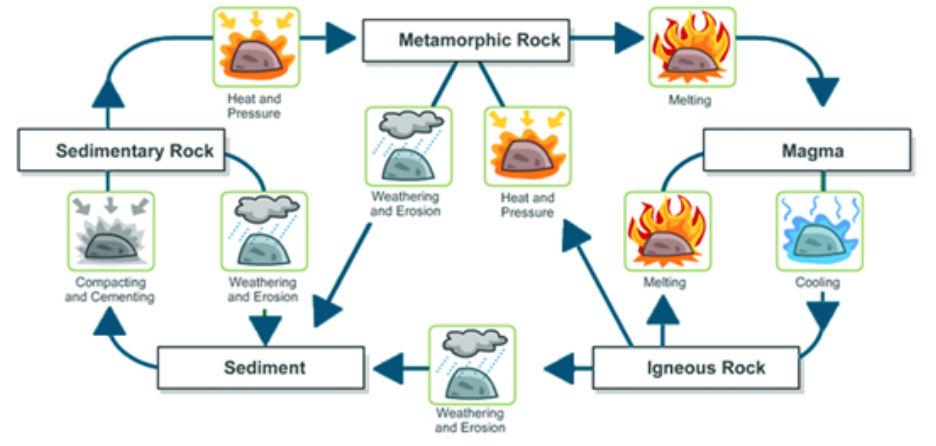
Rock Cycle: Transition to Igneous
Melting of rock → ==Magma== → Cooling of rock (Crystallization) → Igneous rock
Rock Cycle: Transition to Metamorphic
Exposure to intense heat and pressure. Can apply to igneous, sedimentary, or other metamorphic rock
Rock Cycle: Transition to Sedimentary
Weathering and erosion of rock → ==Sediment== → Compaction and Cementation → Sedimentary Rock