2. Proprietary Rights in Land Law
Freehold Covenants
These are promises exchanged and/or transferred by deed, but are equitable proprietary interests = potentially enforceable against third parties
Covenantor (burdened by covenant) and covenantee (enjoys benefit of covenant)
Land that enjoys benefit = dominant land;
Land subject to burden = servient land
Freehold covenants must affect the use of the land in some way, this involves:
Positive covenants – an obligation on someone to perform an action on the land, which requires the expenditure of money (e.g., repairing a fence or contribute to road maintenance; or
Restrictive covenants – restrictions that prevent the owner from doing something on the land (e.g. not build above a certain height, not use land for business); does not require expenditure of money
Covenants must benefit the land – it cannot be personal
Passing the Benefit and Burden
A freehold covenant creates two distinct relationships: a contractual relationship between covenantor and covenantee, and a proprietary interest in the land
Issue: When selling their land, there is no longer a contractual relationship between the new owners. The benefit and burden must be "passed" to ensure enforcement.
Benefit of the covenant can pass to successors of the covenantee.
Burden of the covenant – different rules for positive vs. restrictive covenants.
Burdens and benefits may be passed through either Common Law or Equity
"No Mixing" Rule: common law and equity rules cannot be combined
For a covenant to be enforced between two successors, both the benefit and the burden must pass under the same system

Summary → Benefits of both PC and RC can pass at law or equity
burden of PC cannot pass at law (except under mutual benefit) or equity
burden of RC can pass in equity if notice requirements are met (i.e. registration)
Methods of Terminating Covenants
Express release (by deed)
Merger (if one person owns both benefited and burdened land)
Discharge/modification if:
covenant is obsolete,
impedes reasonable use of land, or
parties consent
Easements
For an easement to exist, it must meet the following requirements:
|
|
Methods of Creating Easements
Express Grant/Reservation
Created by deed and registered
Express Grant: Where ST grants a right over their land for the benefit DT
Reservation: DT sells or transfers land (in whole or in part) but reserves a right for the benefit of the land they are keeping
Reserved land becomes DT while the land sold becomes ST
Implied Grants
Easements can arise without express wording in four main ways:
Necessity — arises when the easement is strictly necessary, not just convenient – the land would otherwise be landlocked
Exception: If alternative access is available, however inconvenient, no necessity easement will be implied
Common Intention — arises where land is sold for a particular purpose known to both parties, and an easement is essential to achieve that purpose
Quasi Easement (Wheeldon v Burrows) — a right one part of land uses over another while under the same owner, which can “spring into life” as an easement when the land is divided and sold
On sale/transfer, the buyer acquires a quasi-easement if, while owned by the seller, that right was:
o Continuous and apparent (obvious: e.g. visible path, pipes, drains)
o Necessary for reasonable enjoyment of the land sold; and
o In use by the seller at the time of sale (contributes to the comfortable and
convenient use of the property as it was used before the division)
Rule in Wheeldon v Burrows
s.62 LP A 1925 – Automatically converts informal rights/permissions into legal easements upon the conveyance (by deed) of land.
Turns licenses/quasi-easements into legal easements when land is sold or leased
Works automatically — unless excluded in the deed
Alice owns a house and a nearby garage (on the same land).
o While she owns both, she always walks across the yard to reach the garage.
o Alice sells the house to Bob but keeps the garage.
s.62 steps in → Bob automatically gains a legal right of way (easement) to keep crossing the yard to the garage.
NOTE: s62 requires a deed to operate while Wheeldon v Burrows does not
Example
Prescription
Easements acquired via prescription are legal (even if not registered or contained in a deed)
Prescription is acquisition of easement through long, uninterrupted use of a right
Use must be without force, secrecy, or permission (nec vi, nec clam, nec precario)
Three methods of getting easement by prescription:
Doctrine of Lost Modern Grant – easement was in continuous use for at least 20 years (it can be interrupted provided that there was continuous an uninterrupted use for 20 years prior to the interruption)
Prescription Act 1832 – provides statutory timeframes of either 20 years (for qualified rights) or 40 years (absolute right)
Applies to easements and profits-à-prendre; if:
20 years continuous uninterrupted use = qualified right
oral consent granted + 40 years continuous uninterrupted use = absolute right
Proprietary Estoppel
Where a claimant relies to their detriment on a representation that they could use a right, and it would be unconscionable to revoke it.
Mortgages
Security for a loan where the borrower (mortgagor) grants proprietary rights to the lender (mortgagee) – such loan may be secured or unsecured:
Unsecured loan: lender only has a contractual remedy to sue the borrower
If borrower is bankrupt, suing them will be pointless so lender must petition for bankruptcy
Secured loan: lender has proprietary rights over the property (security)
If payment is overdue, lender can take possession of the asset and sell it to get back money
A secured lender usually takes priority over unsecured lenders in a debtor’s insolvency

Equitable Right of Redemption
Mortgagor’s right to pay off debt and free the land of the security - the following protections apply:
Redemption right is permanent and it cannot be restricted or removed
This right exists even after the contractual repayment date has passed
The lender (bank) can delay it but cannot completely remove it or make it impossible to use – Any clause that blocks or unreasonably delays this right is void
Invalid Clauses
Option to Purchase: A lender cannot insert a clause allowing them to buy the property from the borrower, because this blocks the borrower’s right to redeem.
Collateral Advantages: Lenders can’t demand extra benefits beyond normal repayment unless it’s a unique and fair business arrangement (like selling a pub’s beer in return for a lower mortgage rate)
Protection Against Unfair Terms
Unconscionable Terms: Courts can strike out clauses that exploit individuals—like super high interest rates, especially if legal advice wasn’t given or if the borrower had no bargaining power
FCA Supervision: The Financial Conduct Authority can also step in if loan terms are unfair
Consumer Rights Act 2015: If the terms of a mortgage are very harsh and unfair to the borrower, they may be challenged and removed
Protection of Third Parties and Undue Influence
Equitable Interest via Actual Occupation: If a borrower lives with a spouse or partner, that person may have an equitable interest in the home if they are in actual occupation
A bank may therefore be subject to that equitable interest in a mortgage
Question: Does the mortgage override the beneficiaries, or do the beneficiaries’ interests bind the bank?
Overreaching (the Bank’s Shield)
To avoid being bound by equitable interest, the bank can:
Get the spouse/partner to sign the mortgage deed (and pay money to two trustees), or
Obtain express written consent from them
The same applies to co-owners: Where the property is co-owned (joint tenants or tenants in common), all owners must sign
Undue Influence Risk
Banks must ensure that any signature or consent is freely given
If a spouse signs under pressure or deception, the mortgage is voidable (i.e., it can be cancelled)
Banks will be treated as having “notice” of undue influence if:
There is evidence of actual undue influence, or
There is constructive notice of undue influence i.e. a presumed relationship of trust (e.g. between spouses, solicitor-client, trustee-beneficiary)
If banks have notice, they must:
Ensure the party at risk (e.g. spouse) gets independent legal advice (with written confirmation by the solicitors that advice was provided);
Confirm that they understand the transaction and its risks;
Provide the advising solicitor with any info about undue influence or the borrower’s finances.
Overriding Interest (Beneficiary’s Claim)
A beneficiary’s reliance on actual occupation to claim overriding interest may be limited by overreaching and the Cann Principle
The Cann Principle: Purchase + mortgage treated as one indivisible transaction.
No “scintilla temporis” (tiny gap) in which beneficiary’s interest can arise to override.
Practical effect: Mortgagee’s rights usually take priority over beneficiary’s.
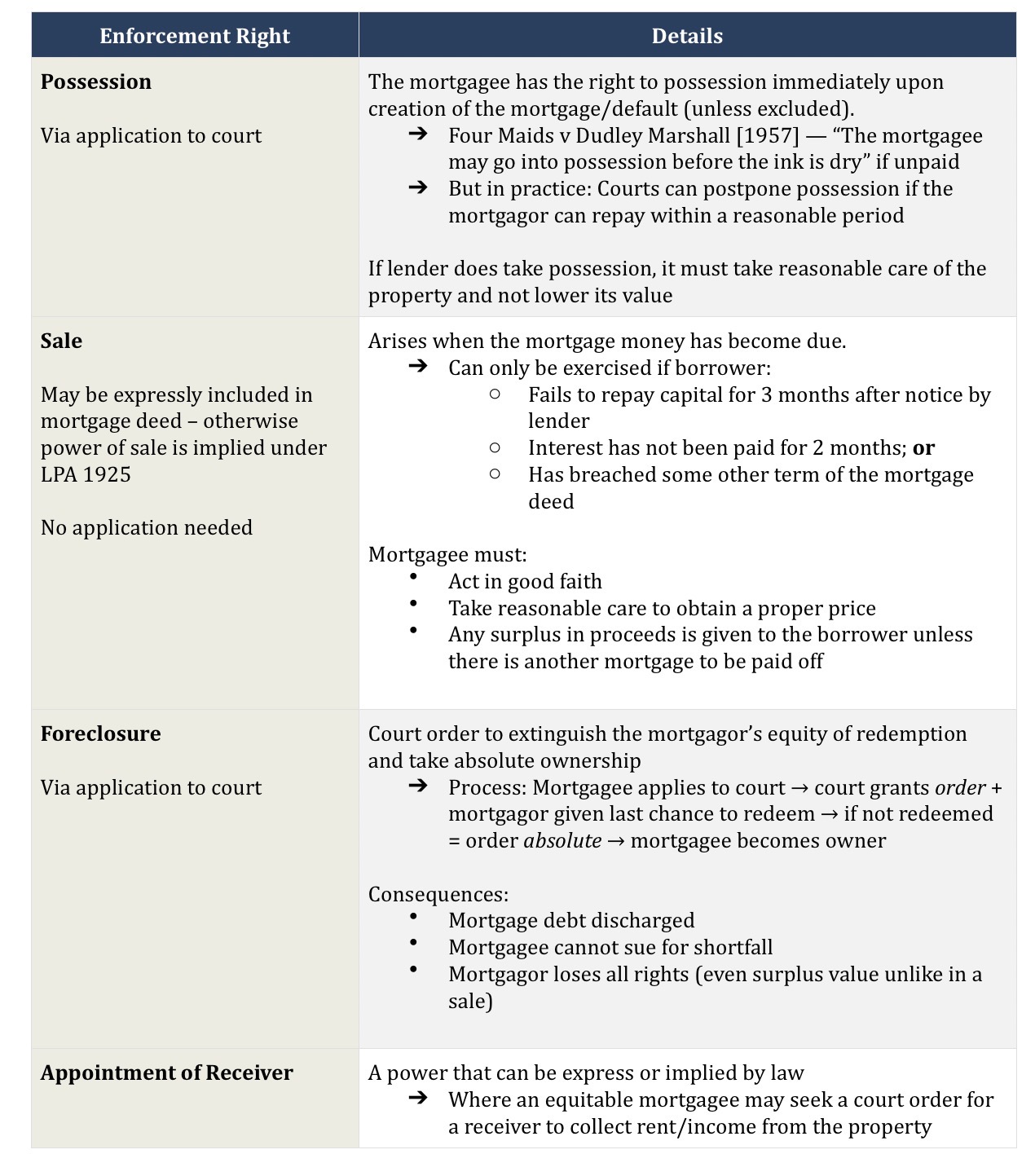
Enforcing Legal Mortgages
Priority of Mortgages
Registered Land → Priority determined by the order of registration, not creation
A registered legal mortgage takes priority over unregistered equitable interests (unless they are overriding, such as a beneficiary in actual occupation).
On simultaneous registrations, priority is decided by the registrar — exceptions:
Priority can be varied by agreement btw charge holders via a deed of priority or subordination agreement
An overriding interest can trump a registered charge in certain cases
Unregistered Land → A new legal mortgage triggers first registration
On registration, the mortgage takes effect but will be subject to any earlier registered mortgages or equitable interests noted at the Land Charges Registry
Equitable mortgages take priority between themselves based on the date of creation