PSYC 162 Week 2 (lec. 4-8)
Lie Detection
People vs. Instruments
Can people tell when others are lying?
The average person is not very good at detecting lies
Certain professional groups are noticeably better (e.g. Secret Service agents)
Can instruments detect lies?
Polygraph (i.e., lie-detector test)
fMRI
People, in general, are poor lie detectors
People fare only slightly better than a coin toss at detecting lied
A meta-analysis of 253 studies showing that overall accuracy was approx. only 53%
Dr. Paul Ekman, one of the foremost experts on deception detection
Emotions show on our faces
Paul Ekman’s Approach to Studying Lie Detection
His theory is universal, all facial expressions are the same regardless of culture
Assumption: any ability to detect a lie requires that the lie arouse emotion (i.e., the liar has to be lying about something important)
“Low stakes” lies (e.g., lying about visiting a museum or about whether or not you like the taste of a drink) do not elicit emotion, so the lies would be hard to detect
Nothing to detect
It doesn’t matter
“High stakes” lies arouse emotions that create facial expressions that “leak through” attempts to mask them (potentially detectable)
Lies that are important
Hard to conceal your emotions, they’ll leak through and show on your face, those small movements are
Micro-expressions
Do facial expressions differ in any measurable way when someone is lying compared to when they are telling the truth?
Many studies using low stakes lies say “no”
Using high stakes lies, Ekman, Friesen & O’Sullivan (1988) found measurable differences using the Facial Action Coding System
Subtle facial movements associated with being happy occurred more often in the truthful condition
Subtle facial movements associated with negative emotions occurred more often in the lying condition
When you’re lying about something important, your facial expressions are different than if you’re telling the truth about something important
A general approach to studying whether or not people can detect when someone is lying
Ten confederates either lie or tell the truth in each condition (the lies are important, not trivial, and the liars are motivated to deceive) - they are high stakes lies
Five confederates are lying and five are telling the truth
Test-takers watch each person on tape and indicate whether or not the person on the tape is lying
Guilty trials - 5 guilty of lying
Innocent trials - 5 telling the truth
They could’ve interrogated people, could’ve used the false evidence ploy
Three categories of high-stakes lies in this study
Emotion Deception Judgment Task
A confederate talks about watching a nature video while watching an upsetting video (lying) - 5 lying
A confederate talks about watching a nature video while watching a nature video (telling the truth) - 5 telling truth
Opinion Deception Judgment Task
Express an opinion (e.g., about the death penalty) that goes against your strong beliefs (lying)
Express an opinion that agrees with your strong beliefs (telling the truth)
Crime Deception Judgment Task
Deny stealing $50 (lying)
Deny stealing $50 (telling the truth)
Secret service agents were better at detecting lies
Facial Action Coding System
Facial motion movements associated with emotions
Ex: face of anger
Eyebrows pulled down and together
Eyes opened wide, staring hard
Margins of lips rolled inward, pressed together
Wizards of Lie Detection
O’Sullivan & Ekman (2004)
They found 50 individuals (out 20,000 screened) who performed very well on all three high-stakes lie detection tests (opinions, a mock crime, and emotion)
A concern is that, when so many people are tested, some will perform well merely due to random chance, not because they are good at detecting lies (Bond & Uysal, 2007)
Whether or not that is true, some “wizards” made the most of their special status
Some of these “wizards” make a career out of it
Teaching people how to find liars
Ekman in Later Years
Trained law enforcement and TSA in lie detection
Stopped publishing scientific research on lie detection (to keep the information from hostile nations and terrorists)
In the absence of new science, skeptics doubt his body of work
His work has been the most influential and left a lasting legacy
Who killed my relative? Police officers’ ability to detect real-life high-stake lies
The police officers in the study correctly detected lying 50% of the time (i.e. hit rate = .50)
At random chance if the false alarm rate is 50%
False alarm rate is important!!
Follow up study they actually have the false alarm rate but they focus more on the accuracy of liars and those who tell the truth
Wright Whelan, Wagstaff & Wheatcroft (2015)
Participants:
70 police officers & 37 undergraduates
Stimuli:
Videos of people making public appeals for help with missing relatives (high stakes)
18 were honest, 18 deceptive
Participants decided if they were telling the truth or lying
Results:
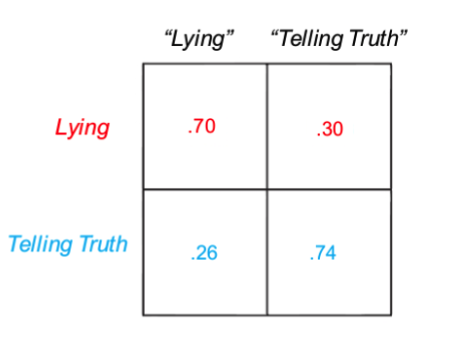
Anytime hit rate = false alarm rate it = chance, there’s no information
This study is consistent with Paul’s idea that they have to be high-stakes lies to detect liars
Undergrads had a lower hit rate and a higher false alarm rate than police officers
If you were asked which is better police have hit rate of .70 and false alarm rate of .26, or the undergrads having hit rate of .60 and false alarm rate of .20
You shouldn’t be able to tell easily which is better
You just see one false and hit alarm rate for the police officers and one for the undergrads
You want to plot them on the ROC and then you’ll see which one is higher and which one is better
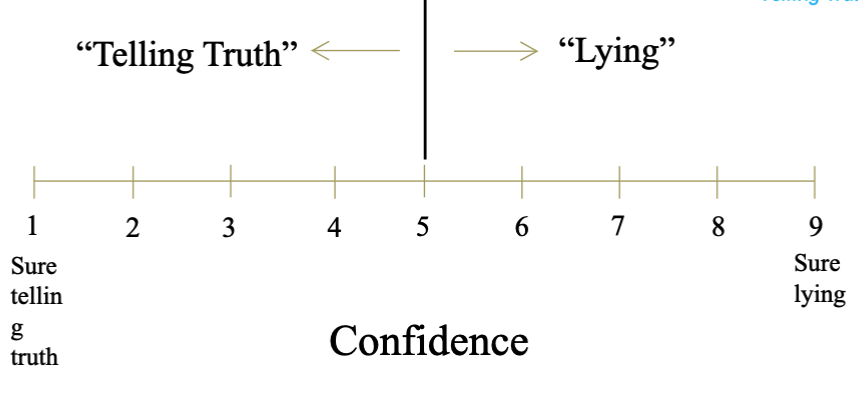
Hidden false alarm and hit rates/ Confidence scale
What’s hidden is that there’s an arbitrary decision that has been made in order to call things hits and false alarms
Okay to thing of the underlying thing as confidence
You’re picking an arbitrary point on a confidence scale
Ex: when you’re watching a video, you automatically make the decision if they’re lying or telling the truth
You have some degree of confidence
The farther you are from an arbitrary threshold, the more confident you are
Matters because there is nothing special about that point, if you move it, it changes both your false alarm and hit rates
Continous scale - can be 1 to whatever
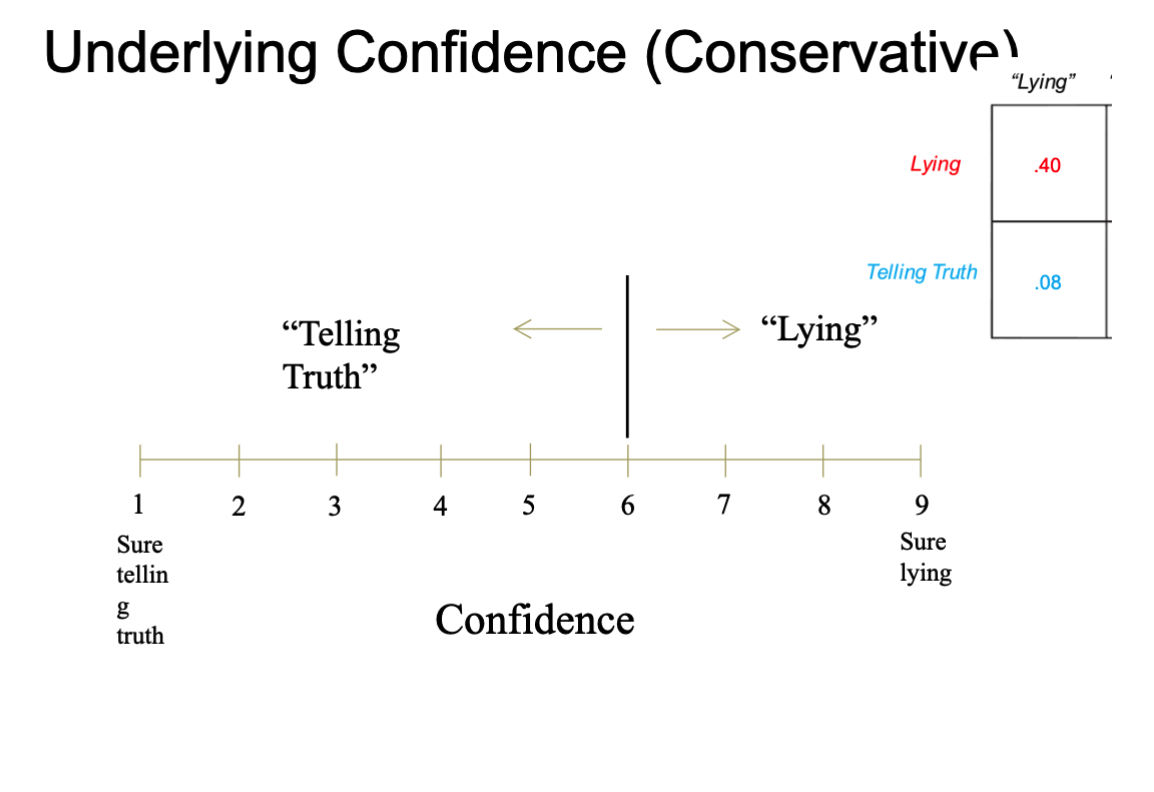
Those who previously ended in 5.1, 5.2, etc. were previously called liars, but now that the threshold changed, you call them truth-tellers because you changed your standard to require more confidence to call them liars
You’ll have fewer hits and fewer false alarms, both rates will go down
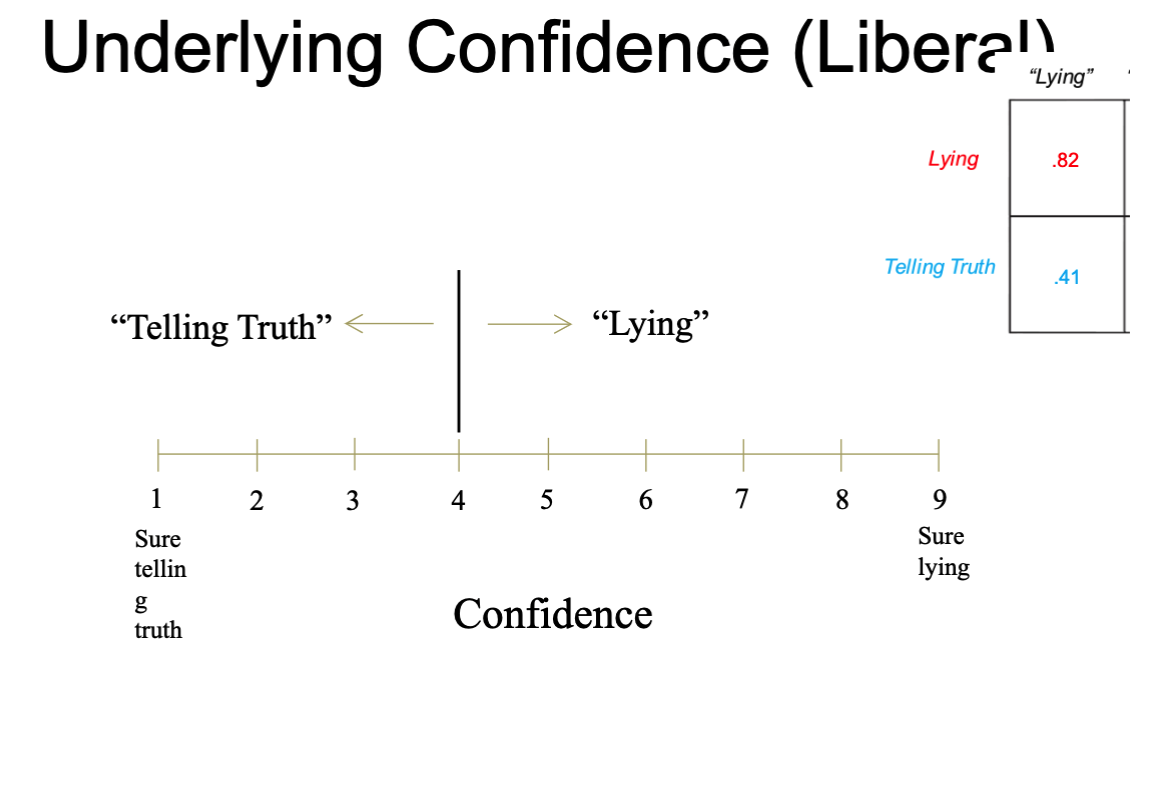
Calling more people liars
False alarm and hit rates both go up
ROC Analysis
Plot hit and false alarm rate
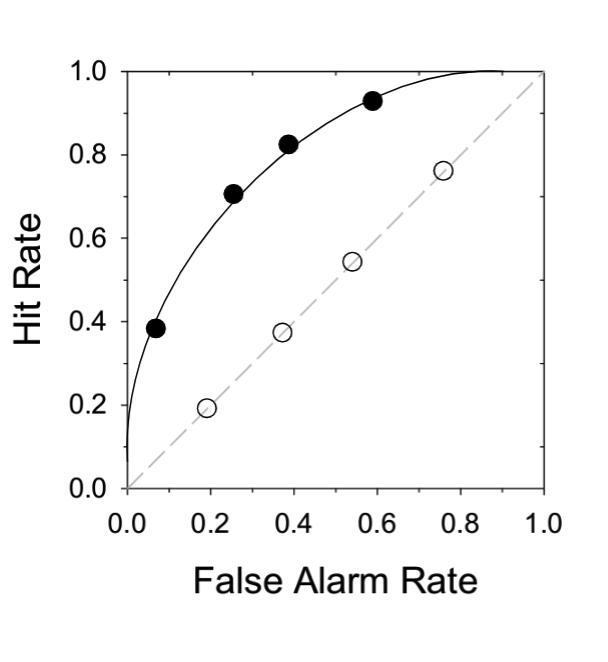
The black points more down to the left is conservative
The black points more up and to the right are more liberal
To get these points, you split the people into four groups, but have the same scale as before, some being more liberal and others more conservative
Four groups and you tell them how conservative or liberal they should be about calling someone a liar
You give the same instructions, and get 4 ROC points again, but before you do you run them through a Paul Ekman training to get better at detecting liars
If the training is effective you’ll see a higher ROC
Higher ROC is objectively better
Actively Prompting Information to Detect Lies
In most deception-deception experiments, all judges have to go on is “sender“ demeanor, which makes sense because theories posit that deception is detectable based on demeanor (e.g. microexpressions of emotion)
However, police do not merely passively watch demeanor, but instead actively and strategically question a suspect (e.g. they compare what the person says to what is known about the crime)
In short, what makes an expert adept at lie detection is not the passive observation of sender demeanor, but the active prompting of diagnostic information (i.e. interrogation)
Tested by using a confederate to induce some participants to cheat on a test involving answering hard trivia questions
You induce some people to cheat - guilty group
Don’t induce others to cheat - innocent group
Try to figure out when they deny cheating if they are lying or if they are telling the truth
The interviewers were five federal agents with substantial polygraph and interrogation experience
The interviews (3-18 minutes) were completely unscripted and varied substantially in style and substance from expert to expert
The hit rate was 39/40 = .98 and the false alarm rate was 1/49 = .02
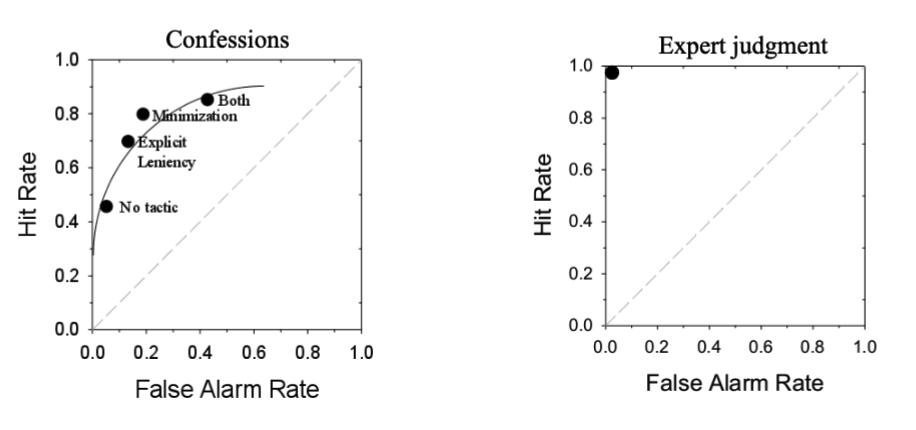
Criticism of Levine et al. (2014)
The trivia questions were almost impossible for anyone to answer
Therefore, if someone answered several of them correctly, it was already easy to tell that they were probably cheating
Too easy to tell the liars
The fact that they were cheating would quickly become obvious if you asked them what else they knew about the trivia question (nothing)
They only knew the answer to the question, asked them something similar and they wouldn’t get it
Study didn’t accomplish getting on a higher ROC
A Cognitive Approach to Lie Detection
Vrij, Fisher, & Blank (2017)
Method to pass lie detection in a police interrogation
Impose cognitive load (because lying is more mentally demanding than truth-telling), such as asking interviewee to tell their story in reverse order
Harder to tell a lie than to tell the truth
Make interviewee engage in more mental labor
Encourage interviewee to say more (because liars tend to “weave a tangled web” the more they talk)
Harder to talk for a liar
Ask unexpected questions (because liars prepare themselves for anticipated interviews), such as general opening questions (expected) versus spatial questions (unexpected)
They think it’ll start with the beginning of the story
Results
Better overall accuracy for the cognitive vs. the standard approach
Standard approach: hit rate = .47, false alarm rate = .43
Almost equal means nothing, chance
Cognitive approach: hit rate = .67, false alarm rate = .33
Don’t need ROC analysis because hit rate is a good amount larger
Summary
Passive lie-detection is really hard
High-stakes lies are necessary for it to be possible (so that emotion leaks through in the form of microexpressions)
Using videos of high-stakes expressions of true or false claims about missing relatives, people are not bad at detecting lies (and police are a little better than that)
Lie-detection may be much better for an interviewer who is able to actively question the individual (though more work is needed to verify these controversial new findings)
The Polygraph
A polygraph (poly = many, graph = write) is an instrument that simultaneously records changes in physiological processes such as heart rate, blood pressure, respiration and electrical resistance of the skin (galvanic skin response)
The underlying theory of the polygraph is that when people lie they also get measurably nervous about lying. Heart rate increases, blood pressure goes up, breathing rhythms change, perspiration increases, etc
History of Polygraph
William Moulton Marston (1893-1947)
Student of Hugo Münsterberg at Harvard
Discovered correlation between blood pressure and arousal during lying
Invented Wonder Woman
John Augustus Larson
Rookie police officer in the Berkeley, CA, police department
Ph.D. in physiology from UC
Read Marston’s article “Physiological Possibilities of the Deception Test”
Improved Marston’s test through continuous recording of blood pressure
First real-world application
Berkeley sorority house - 1921
Money and an expensive ring had been stolen from rooms
Larson asked suspects questions while hooked up
“Are you interested in math?”
“Did you steal the money?”
“The test shows you stole it. Did you spend it?”
Suspect = a woman named Helen Graham
Her record showed a large change in blood pressure, skipped heartbeats and a halt in her breathing
She was arrested but later convinced Larson she was innocent
How to Question Suspect Taking Polygraph Test
Relevant/Irrelevant Test
Ask some irrelevant questions (“Are you interested in math?”)
Ask questions relevant to the crime (“Did you steal the money?”)
If arousal(relevant ) > arousal(irrelevant ) = guilty of lying
Comparison Question (control question) Test
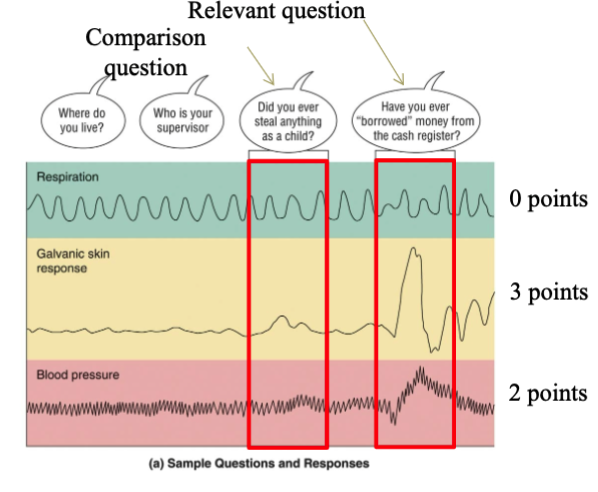
Add a probable-lie comparison question (“Have you ever stolen anything?”)
Arousal(relevant ) > Arousal(comparison) = guilty of lying
Concealed Information (i.e., Guilty Knowledge) Test
Present one true and several false details of an incident that has not been publicized, so the true answer would be known only to the perpetrator
Innocent suspects will not be more aroused in response to the true item, but guilty suspects will be
Arousal(true detail) > Arousal(false details) = guilty of lying
Some people believe this approach is the best
Comparison Question Test
Imagine that the examiner rates the difference on each physiological measure using a 0 → 3 scale (summed range 0 → 9)
Further imagine that the examiner concludes that a subject is lying whenever the summed score across three measures is 5 or more
This test-taker gets a score of 0 + 3 + 2 = 5 and is judged to be guilty of lying
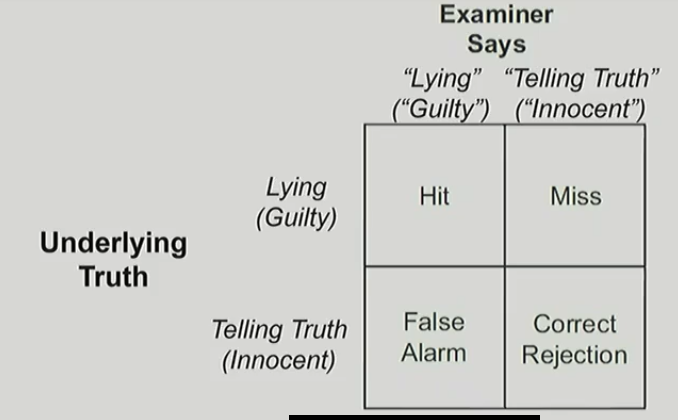
Is it a hit or a false alarm?
Example of Guilty Knowledge Test
Carmel et al. (2003)
Participants were instructed to enter the office of a named TA in Psychology and steal a CD with a red case containing an exam
Told to convince the examiner that they are innocent
Hooked up to polygraph and given “guilty knowledge“ questions
Color of the CD case (blue, green, red, purple) +1
Name of TA (name 1, name 2, name 3, name 4) +3
Subject of the exam (Anthro, Psych, Bio, Physics) +2
Scoring
For each question, if the “guilty knowledge” item elicits the largest response, +3 points; if 2nd largest response, +2 points; if 3rd largest response, +1 point, otherwise 0
Values are then summed up across all questions to produce a single score between 0 and 9 (this test-taker gets a score of 1 + 3 + 2 =6)
Decision rule: if score > 5 → “guilty of lying“, so this test-taker is judged guilty
Is it a hit or a false alarm?
Remember hit or false alarm rate involves an arbitrary criterion that is hidden from you
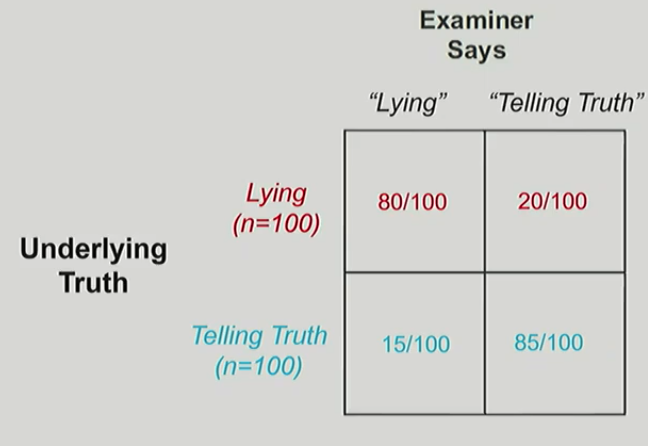
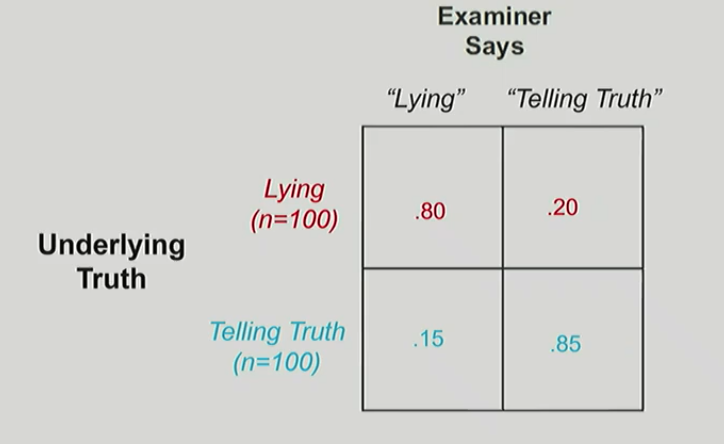
To find out if guilty knowledge or comparison question test, do the process for the ROC analysis for both
Look at the other false and hit rates
Split into conservative, liberal, and neutral groups
Plot the points
Higher ROC is better
More conservative → hit and false alarm rates go down
More liberal → hit and false alarm rates go up
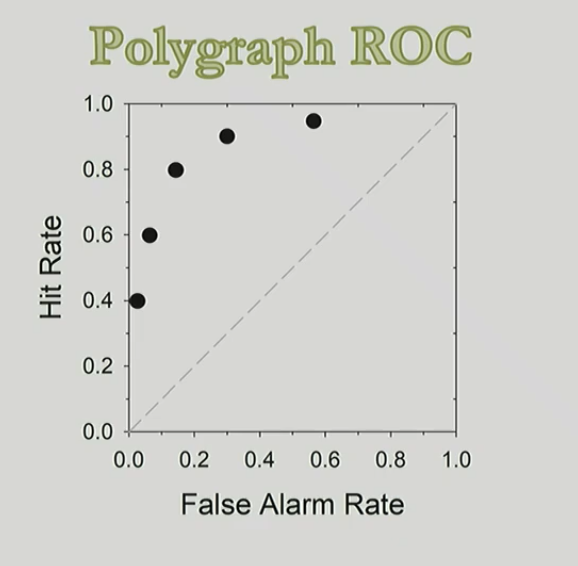
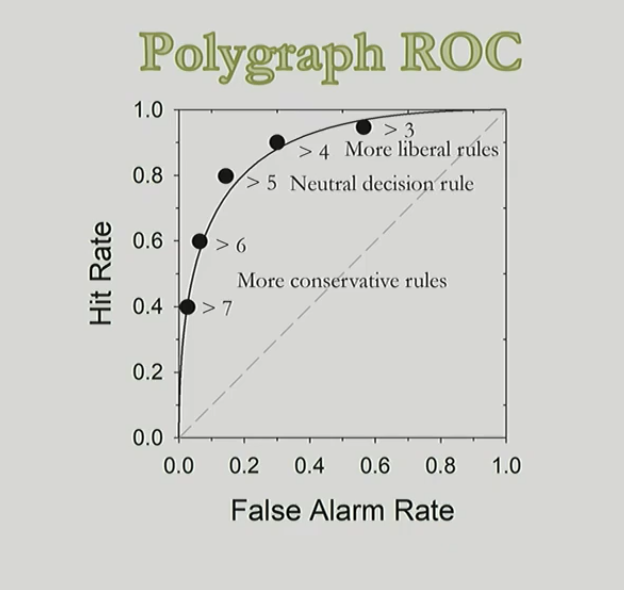
Polygraph Accuracy
Many believe it is worst for the relevant-irrelevant method and best for the guilty knowledge method
The data suggest that all methods are about equally effective
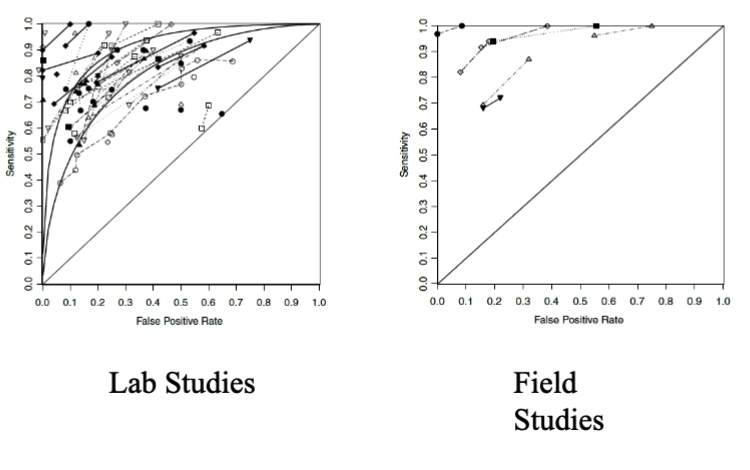
Polygraph Accuracy Might be Lower in Practice
Analogy: medical tests seldom perform as well in general field use as their performance in initial evaluations seem to promise
Initial evaluations are typically conducted on people whose disease status is uncomplicated by other conditions that might interfere with test accuracy
Samples are drawn, tests conducted, and results analyzed under optimal conditions
Similar issues could pose problems for regular use of the polygraph
In experimental tests, polygraph instrumentation and maintenance and examiner training and proficiency are typically well above field situations
Testing is undertaken soon after the crime, so limited forgetting or “emotional distracting“ occurs
Countermeasures might be more of a problem (e.g. biting one’s tongue)
If polygraph examiners have preexisting knowledge of evidence against the suspect (e.g. fingerprint evidence), it can bias the interpretation of their lie-detection test
The Green River Killer
On July 15, 1982, the body of Wendy Lee Coffield was found in the Green River in a rural area of the City of Kent in King County, Washington. Another body was found in the river within a month. While surveying the riverbank near two bodies on August 15th, detectives discovered another body.
Thus began one of the longest and largest serial murder investigations in United States history. Eventually, the deaths of at least 48 women would be linked the Green River killer.
In the early months of 1987, investigators had a new suspect in relation to the Green River murders. Previously known to police, the newest suspect had been picked up for attempting to solicit an undercover police officer posing as a prostitute in May 1984. However, the man was released after he successfully passed a lie detector test.
They might’ve been to conservative with the ROC and that’s why they think he wasn’t guilty/he passed the test
That’s why it’s so important going on a higher ROC
They ended up catching him because of DNA
A World of Difference
Polygraph testing applied to a suspect in a criminal investigation
vs.
Polygraph testing used for screening purposes (e.g., screening applicants for a job in law enforcement)
Lie Detection in Connection with a Single Incident vs. Mass Screening
Polygraph testing has been used as a general screening device (e.g., for CIA applicants)
A much more problematic use of the polygraph
No specific incident, so only general questions can be asked (“have you ever had any unauthorized foreign contacts?” “Have you ever smoked marijuana?”)
Base rate of guilt (i.e., percent of examinees who are lying) is very low → more false alarms than hits
Base Rate Problem
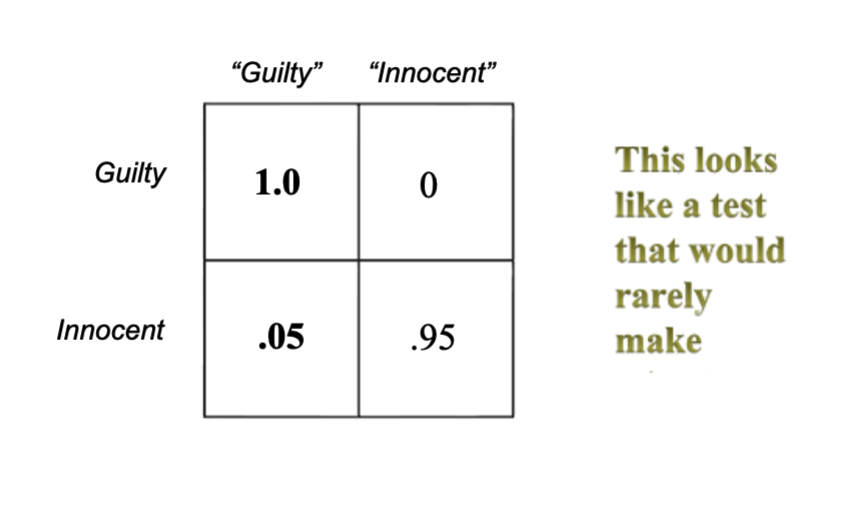
this is what a good test looks like because the hit rate is way higher than the false alarm rate
Even though it’s a good test but if you test a lot of innocent people, people are still going to fail
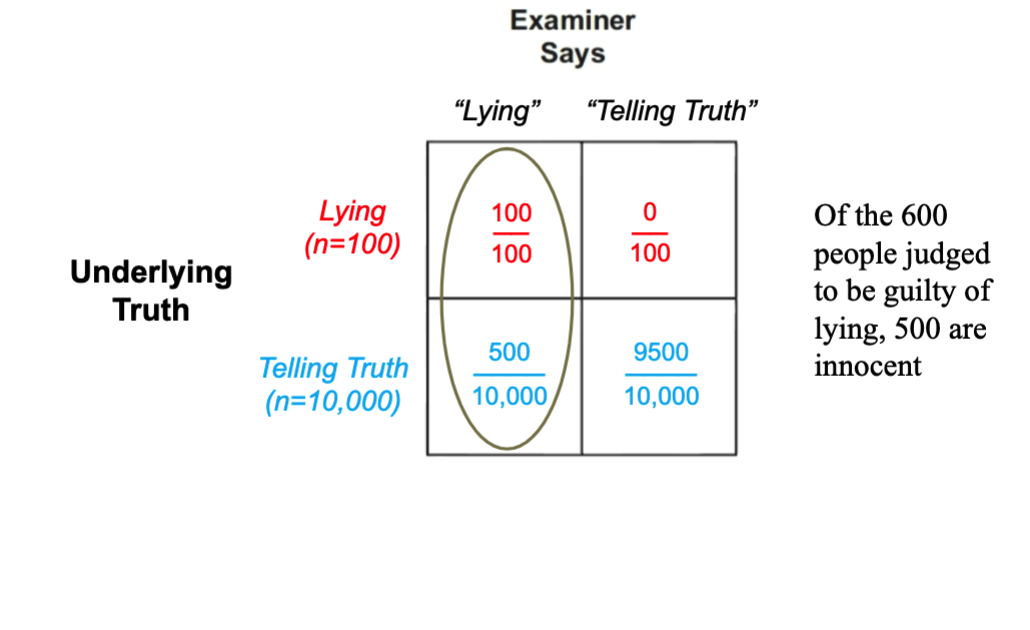
Using a polygraph test in the "probable cause" scenario
The police already have reason to suspect a particular person of a crime (e.g., Gary Ridgeway)
For every 200 suspects given a polygraph, ~100 will be innocent and ~100 will be guilty
Using a polygraph test to search for a suspect (screening)
Almost everyone tested will be innocent
For every 200 employees given a polygraph, ~198 will be innocent and ~2 will be guilty
What’s the problem with screening?
Far more of the examinees are innocent than guilty (i.e., base rate of innocent far exceeds base rate of guilty)
Therefore, even a good test (high hit rate, low false alarm rate) will wrongly identify far more innocent people than guilty people
Legal Status of the Polygraph
Polygraph results are sometimes admissible in court
1993 Supreme Court decision (Daubert v. Merrell Dow Pharmaceuticals)
Admissibility of scientific evidence determined case-by-case based on evidentiary hearings
Judge makes the call (after considering if there is a scientific consensus, will the jury understand the results, etc.)
1998 Justice Clarence Thomas expressed concerns about polygraph testing
Lack of consensus about scientific validity and reliability
Concern that polygraph evidence usurps jury role
Polygraph as Coercion
Polygraphs are not used only to detect lies
Used to induce confessions
Presented as opportunity to prove innocence
“The results of a lie detector are not admissible in court, but if you confess during the course of interrogation, that’s admissible. The lie detector is essentially used in practice as a way to get people to confess to crimes” (Ken Alder, professor of history at Northwestern University and author of The Lie Detectors: The History of an American Obsession).
Even the lie detector’s harshest critics concede it can be a useful interrogation tool
Jurors and the Polygraph
Jurors generally find results persuasive
Results can change outcome of a trial
Experts are more skeptical than general public
Lies in the Brain
Functional magnetic resonance imaging (fMRI) detects “where” lying occurs in the brain
Does not measure physiological arousal, so it might even be able to detect low-stakes lies
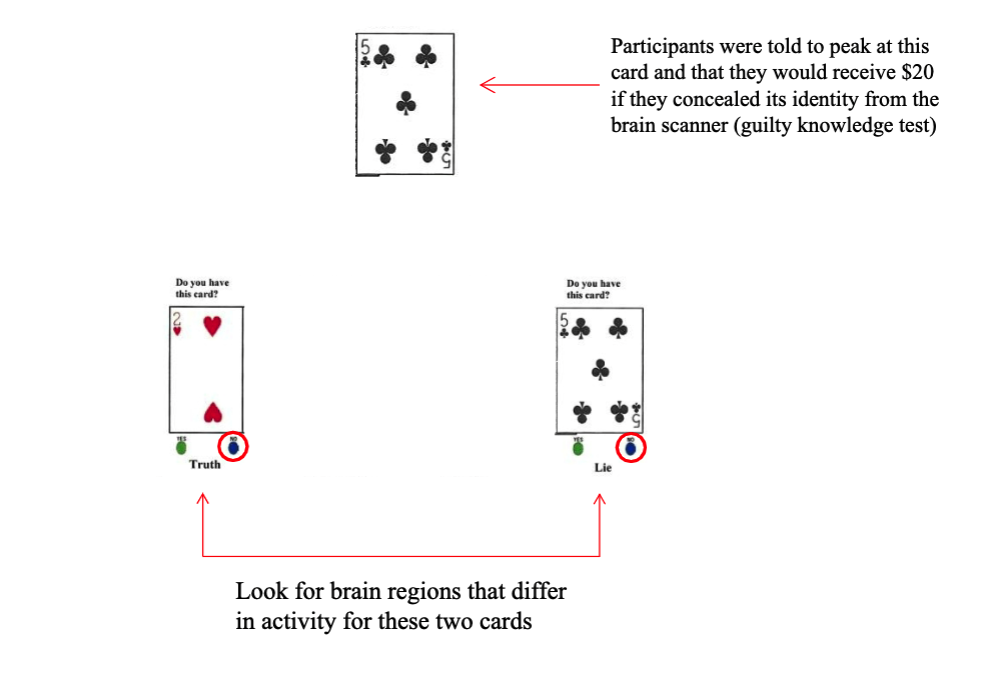
Some areas of the brain began to light up when you told more low stake lies
fMRI shows you group differences but nothing about the individual that’s why it doesn’t help you