Lecture 7 - Neuromuscular Junction
🧠 DETAILED MULTI-PARAGRAPH SUMMARY (Neuromuscular Junction & Synaptic Transmission)
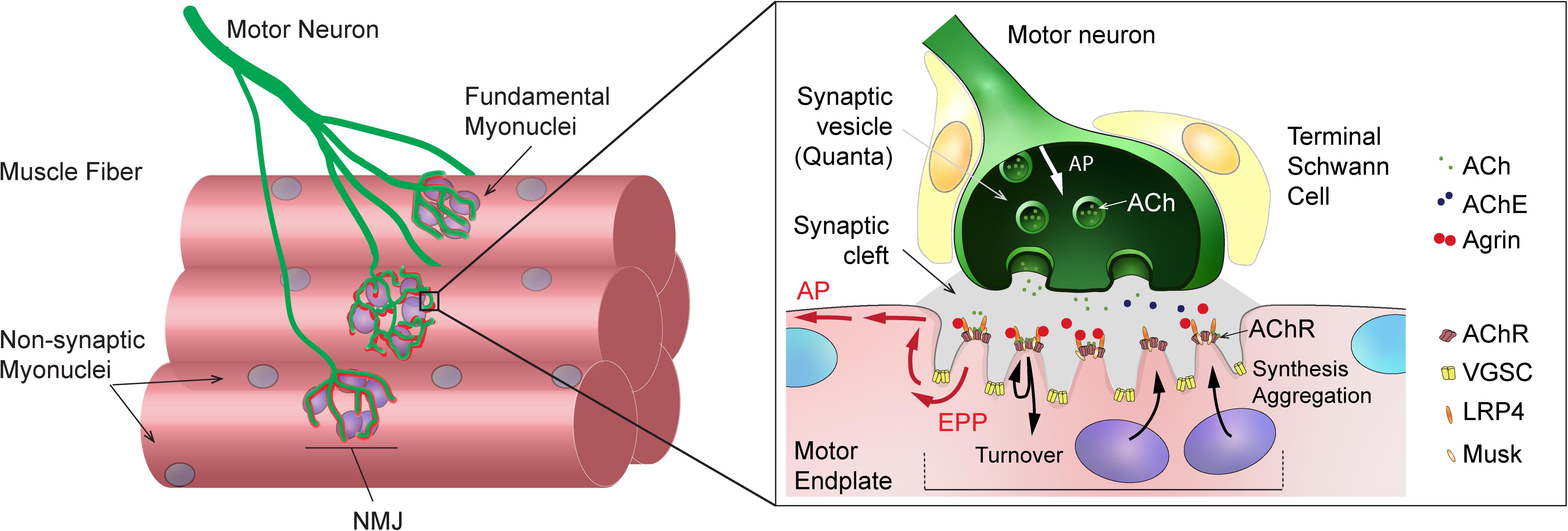
The neuromuscular junction (NMJ) is a specialised example of a chemical synapse, where communication occurs between a motor neuron and a skeletal muscle fibre. A motor neuron originates in the ventral horn of the spinal cord and extends a myelinated axon toward muscle tissue. As the axon approaches the muscle, it branches extensively and loses its myelin sheath, forming multiple synaptic terminals. Each terminal forms an NMJ with a muscle fibre, and together with all the fibres it innervates, constitutes a motor unit. Importantly, each muscle fibre is innervated by only one motor neuron, ensuring precise control.
At the NMJ, communication is mediated by the neurotransmitter acetylcholine (ACh). When an action potential reaches the presynaptic terminal, it causes depolarization, opening voltage-gated calcium (Ca²⁺) channels. The influx of Ca²⁺ triggers synaptic vesicles—each containing ~5000 ACh molecules—to fuse with the presynaptic membrane and release ACh into the synaptic cleft. ACh then diffuses across the cleft and binds to nicotinic acetylcholine receptors (nAChRs) on the postsynaptic muscle membrane (motor end plate). These receptors are ligand-gated ion channels composed of five subunits and require binding of two ACh molecules to activate.
Activation of nAChRs opens the channel, allowing mainly sodium (Na⁺) ions to enter and some potassium (K⁺) to exit. Due to a stronger electrochemical gradient for Na⁺, there is a net influx of positive charge, resulting in depolarisation known as the end plate potential (EPP). The EPP is not an action potential itself but is large enough to bring adjacent regions of the muscle membrane to threshold, triggering voltage-gated Na⁺ channels and generating a muscle action potential. This leads to muscle contraction, making the NMJ highly efficient and reliable.
Termination of the signal is equally critical. The enzyme acetylcholinesterase (AChE), located in the synaptic cleft, rapidly breaks down ACh into choline and acetate. Choline is partially recycled back into the presynaptic terminal for resynthesis of ACh. This rapid degradation ensures that muscle contraction is brief and controlled rather than continuous.
Several diseases and toxins can disrupt NMJ function. Myasthenia gravis is an autoimmune disease where antibodies target nAChRs, reducing receptor availability and causing muscle weakness. Botulinum toxin, produced by Clostridium botulinum, blocks ACh release, leading to paralysis. In contrast, tetanus toxin inhibits inhibitory interneurons, causing excessive muscle contraction and spasms. Curare acts as a competitive antagonist at nAChRs, preventing ACh binding and resulting in paralysis. Other agents like organophosphates inhibit AChE, causing prolonged stimulation and potentially fatal respiratory failure.
📌 BULLET POINT SUMMARY
NMJ = synapse between motor neuron and muscle fibre
Motor unit = one motor neuron + all muscle fibres it innervates
Axon loses myelin near the muscle → forms terminal branches
Neurotransmitter = acetylcholine (ACh) (excitatory)
Action potential → opens voltage-gated Ca²⁺ channels
Ca²⁺ influx → vesicle fusion → ACh release
ACh binds nicotinic receptors (nAChRs) (ligand-gated ion channels)
Channel opens → Na⁺ influx > K⁺ efflux → depolarization
Depolarization = End Plate Potential (EPP)
EPP triggers muscle action potential → contraction
ACh broken down by acetylcholinesterase (AChE)
Choline recycled for ACh synthesis
Clinical/Pharmacology:
Myasthenia gravis → ↓ receptors (autoimmune) produces antibodies against its own motor end palte nACh receptors, not all molecules can find functioing recpetors site to bind to → muscle weakeness
Botulinum toxin → blcoks ACh release - paralysis
Tetanus toxin → ↑ muscle contraction (inhibition blocked(blocks VAMPS))
Black Widow Spider Venom - explosive release of ACh
Curare → receptor antagonist (competitively - binds to ACh receptors on the motor end plate, - muscle paralysis
Organophosphates → inhibit AChE (dangerous overstimulation)
✏ FILL-IN-THE-BLANK SUMMARY
Fill in:
The neuromuscular junction is a type of ___chemical______ synapse.
A motor unit consists of a motor neuron and __muscle fibre it innvervates______.
The neurotransmitter at the NMJ is ___ach_______.
Voltage-gated ___ca+2______ channels open in response to depolarization in the presynaptic terminal.
Calcium influx causes vesicles to ___fuse______ with the membrane.
ACh binds to __nicotinic__acetylchline______ receptors on the muscle membrane.
These receptors are ___ligand_______-gated ion channels.
The main ion entering the cell is ___na+_______.
The resulting depolarization is called __end plate potential_______.
The EPP triggers a ___action potential_______ in the muscle fibre.
ACh is broken down by the enzyme __acytlcholinertase________.
___myasthenia_____ gravis is an autoimmune disease affecting NMJ receptors.
Botulinum toxin blocks __release__ of ACh.
Curare acts as a _competitive__ antagonist.
Organophosphates inhibit _acytlychlinersterase___.
✅ Answers:
Chemical
Muscle fibres it innervates
Acetylcholine
Calcium
Fuse
Nicotinic acetylcholine
Ligand
Sodium
End plate potential
Action potential
Acetylcholinesterase
Myasthenia
Release
Competitive
Acetylcholinesterase
📝 40 EXAM-STYLE MCQs
Questions
The NMJ is an example of:
a) Electrical synapse
b) Chemical synapse
c) Gap junction
d) Hormonal junction
e) NoneThe neurotransmitter at NMJ is:
a) Dopamine
b) GABA
c) Acetylcholine
d) Glutamate
e) SerotoninMotor neuron cell bodies are located in:
a) Dorsal horn
b) Ventral horn
c) Brainstem only
d) Cortex
e) CerebellumA motor unit includes:
a) Multiple neurons
b) One neuron + many fibres
c) One fibre only
d) CNS synapses
e) Only axonCa²⁺ influx triggers:
a) Channel closure
b) Vesicle fusion
c) Repolarization
d) Hyperpolarization
e) K⁺ influxnAChRs are:
a) GPCRs
b) Ionotropic receptors
c) Enzymes
d) Pumps
e) TransportersACh binds to:
a) One site
b) Two alpha subunits
c) Beta subunits
d) All subunits
e) NoneThe main ion entering is:
a) K⁺
b) Cl⁻
c) Na⁺
d) Ca²⁺
e) Mg²⁺EPP is:
a) Action potential
b) Resting potential
c) Synaptic potential
d) Threshold
e) HyperpolarizationEPP leads to:
a) Nothing
b) Muscle relaxation
c) Muscle AP
d) Inhibition
e) K⁺ block
🔑 MCQ ANSWERS (1–40)
b
c
b
b
b
b
b
c
c
📝 MCQs (10–40 Continued)
10. The end plate potential (EPP) directly causes:
a) Neurotransmitter release
b) Opening of Ca²⁺ channels in neuron
c) Muscle action potential
d) Hyperpolarization
e) Inhibition
11. Acetylcholinesterase is located in:
a) Presynaptic vesicles
b) Synaptic cleft
c) Axon hillock
d) Nucleus
e) Cytoplasm
12. The function of acetylcholinesterase is to:
a) Synthesize ACh
b) Break down ACh
c) Transport Na⁺
d) Open ion channels
e) Activate receptors
13. Choline is:
a) Destroyed completely
b) Recycled into the presynaptic neuron
c) Converted to ATP
d) Excreted immediately
e) Stored in muscle
14. Myasthenia gravis is caused by:
a) Excess ACh
b) Autoimmune destruction of nAChRs
c) Lack of Ca²⁺
d) Excess K⁺
e) Increased AChE activity
15. Myasthenia gravis results in:
a) Muscle rigidity
b) Muscle weakness
c) Increased contraction
d) Hyperactivity
e) No effect
16. Botulinum toxin acts by:
a) Increasing ACh release
b) Blocking ACh release
c) Blocking receptors
d) Increasing Ca²⁺
e) Inhibiting Na⁺ channels
17. Tetanus toxin primarily affects:
a) Muscle fibres directly
b) Inhibitory interneurons
c) ACh receptors
d) Synaptic vesicles
e) Sodium channels
18. Curare acts as a:
a) Enzyme
b) Competitive antagonist
c) Agonist
d) Ion channel
e) Pump
19. Curare causes:
a) Spasms
b) Paralysis
c) Increased ACh
d) Hyperpolarization
e) Ca²⁺ influx
20. Organophosphates inhibit:
a) ACh synthesis
b) ACh release
c) Acetylcholinesterase
d) Na⁺ channels
e) Ca²⁺ channels
21. Inhibition of AChE leads to:
a) Reduced ACh
b) Increased ACh accumulation
c) No change
d) Reduced Ca²⁺
e) Reduced Na⁺
22. Nicotinic receptors are:
a) Slow acting
b) Fast acting
c) Hormonal
d) Enzymatic
e) Passive
23. The NMJ is highly efficient because:
a) Few receptors
b) Small surface area
c) Large number of ion channels
d) Low ACh release
e) Slow transmission
24. Each muscle fibre is innervated by:
a) Multiple neurons
b) One neuron
c) No neurons
d) CNS only
e) Sensory neurons
25. Voltage-gated Ca²⁺ channels open in:
a) Muscle fibre
b) Presynaptic terminal
c) Synaptic cleft
d) Nucleus
e) Mitochondria
26. Vesicles contain approximately how many ACh molecules?
a) 50
b) 500
c) 5000
d) 50,000
e) 500,000
27. ACh synthesis requires:
a) Glucose + ATP
b) Choline + Acetyl-CoA
c) Na⁺ + K⁺
d) Ca²⁺ + Cl⁻
e) DNA + RNA
28. The enzyme for ACh synthesis is:
a) AChE
b) ChAT
c) ATPase
d) Kinase
e) Protease
29. The motor end plate is located on:
a) Neuron
b) Muscle fibre
c) Synaptic cleft
d) Spine
e) Brain
30. EPP is similar to:
a) IPSP
b) EPSP
c) Resting potential
d) Threshold
e) Action potential
31. Compared to EPSP, EPP is:
a) Smaller
b) Larger
c) Equal
d) Slower
e) Inhibitory
32. Black widow spider venom causes:
a) Blocked ACh release
b) Explosive ACh release
c) Receptor blockade
d) ACh breakdown
e) Ca²⁺ inhibition
33. Tetanus causes:
a) Paralysis
b) Flaccidity
c) Spastic contraction
d) No effect
e) Muscle wasting
34. Botulinum toxin leads to:
a) Spasms
b) Paralysis
c) Hyperactivity
d) Pain
e) Increased reflexes
35. The synaptic cleft is:
a) Inside neuron
b) Gap between cells
c) Organelle
d) Channel
e) Enzyme
36. The driving force for Na⁺ entry is:
a) Low extracellular Na⁺
b) Electrochemical gradient
c) ATP
d) Diffusion only
e) Osmosis
37. More Na⁺ enters than K⁺ leaves because:
a) Equal gradients
b) Stronger Na⁺ gradient
c) Weak Na⁺ gradient
d) No K⁺ movement
e) Active transport
38. Muscle contraction is triggered by:
a) EPP only
b) Muscle action potential
c) ACh breakdown
d) K⁺ exit
e) Cl⁻ entry
39. ACh is removed by:
a) Diffusion only
b) Enzymatic breakdown
c) Filtration
d) Active pumping
e) Storage
40. Failure of NMJ transmission leads to:
a) Increased contraction
b) Muscle weakness or paralysis
c) Faster reflexes
d) Increased ATP
e) Hyperpolarization
🔑 ANSWER KEY (10–40)
c
b
b
b
b
b
b
b
b
b
c
b
b
c
b
b
c
b
b
b
b
b
b
c
b
b
b
b
b
b
b