Lesson 19
Lesson 19: Neural Control of Ventilation
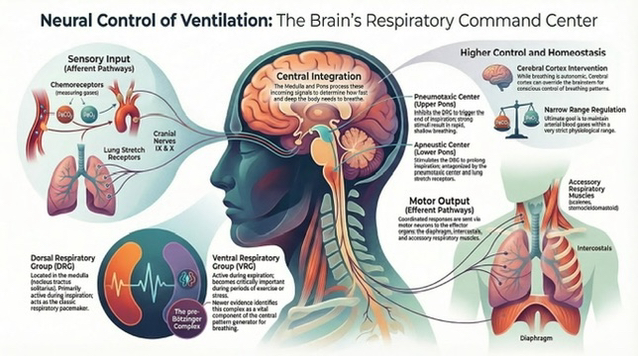
Location of Respiratory Center: Reticular activating system in medulla and pons.
Primary Function: Regulates speed and depth of breathing to maintain PaCO2 and PaO2.
Input Sources
Receives signals from:
Central and peripheral chemoreceptors
Lung stretch receptors
Integration and Response
Integrates incoming signals and regulates:
Diaphragm
Intercostals
Accessory muscles
Cerebral Cortex Role: Modifies respiratory responses.
Medullary Respiratory Centers
Dorsal Respiratory Group (DRG):
Active during inspiration
Considered the primary respiratory pacemaker (traditional view).
Ventral Respiratory Group (VRG):
Active during expiration
Contains pre-Bötzinger complex.
Pontine Respiratory Centers
Pneumotaxic Center (Upper Pons): Inhibits DRG, controls inspiration duration.
Apneustic Center (Lower Pons): Stimulates DRG, promotes inspiration.
Regulation Factors
Respiratory Rate and Pattern Determination:
Neural control (medulla)
Chemical control (central and peripheral chemoreceptors)
Baroreceptors (lungs)
Summary of Components
Breath regulation involves a reflex arc comprising:
Sensors
Afferent pathways
Control centers (medulla and pons)
Efferent pathways
Effector organs (respiratory muscles)
Key Takeaways
DRG: Primary pacemaker (traditional) vs. Central pattern generator (new understanding).
Understand the roles of the medullary and pontine centers in breathing control.