Nucleic Acids
- Nucleic acids serve as the ==assembly instructions== for all proteins in living organisms
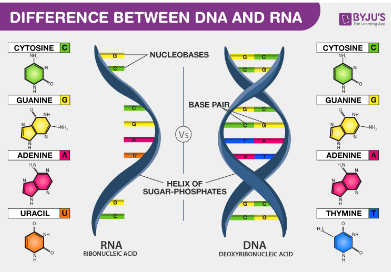
- Two types of nucleic acid exists: * DNA - deoxyribonucleic acid * RNA - ribonucleic acid
DNA - Deoxyribonucleic Acid
- Stores ==hereditary information== that’s responsible for ==inherited traits== in all ==eukaryotes== and ==prokaryotes== and in ==many viruses==
RNA - Ribonucleic Acid
- There are diff forms of RNA involved in ==protein synthesis== in all cells
Nucleotides
- All nucleic acids are ==polymers== of units called ==nucleotides (monomers)==
- A nucleotide consists of 3 components: * Pentose sugar - 5 carbond ring-shaped sugar * Phosphate group (PO4 3-) * Nitrogenous base - ring of carbon and nitrogen atoms
- Each nitrogenous base links covalently to a pentose, either deoxyribose or ribose
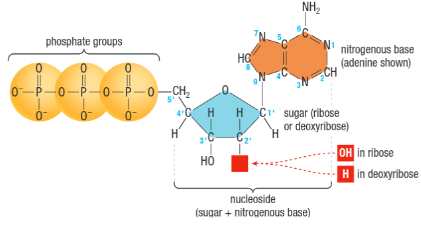
- The two sugars differ only in the ==chemical group== that’s bound to the 2 carbon * Deoxyribose has an -H and ribose has an -OH group
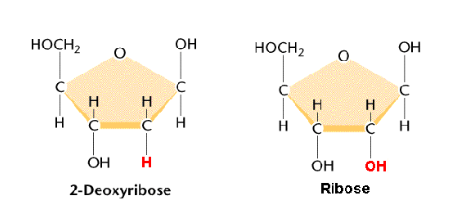
- Dna contains ==deoxyribose sugar==
- RNA contains ==ribose sugar==
Nucleic Acid
- There are two general types of nitrogenous base: * Pyrimidine bases * Purines bases
Pyrimidine Bases
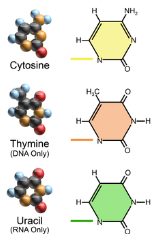
- ==Single organic rings==
- The three pyrimidine bases are ==uracil (U)==, ==thymine (T)==, and ==cytosine (C)==
Purines Bases
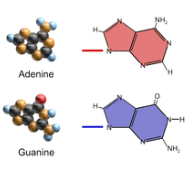
- ==Two-ringed organic structures==
- The two purine bases are ==adenine (A)== and ==guanine (G)==
From Nucleotides into Polymers
Phosphate-Sugar Backbone
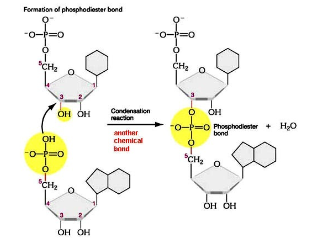
- Nucleotides are linked together by ==covalent bonds== between ==phosphate of one nucleotide== and ==sugar of next==
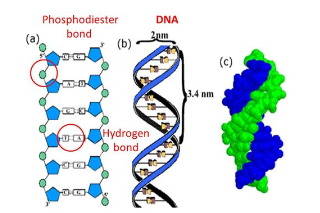
- These monomers that are linked through ==phosphodiester bonds== become the ==phosphate-sugar backbone of nucleic acid==
The Nucleic Acid Ladder
- Hydrogen bonds form between ==specifc nitrogenous bases== forming the ==double-stranded DNA molecule==
- The nitrogen bases form the stairs and are attached to the ==backbone==
Base Pairing in DNA
- ==Guanine== forms ==3 hydrogen bonds== w ==cytosine==
- ==Adenine== forms ==2 hydrogen bonds== w ==thymine==
Antiparallel Strands in DNA
- DNA strands run ==antiparallel== to each other, meaning they are ==oriented in the opposite direction relative to the sugar phosphate backbone==
- 5 Prime (5’end) * The phosphate end
- 3 Prime (3’end) * The deoxyribose sugar end
DNA
- In a DNA chain, each nucleotide contains: * Deoxyribose * Phosphate group * Nitrogenous bases (A, T, G or C)
- Double stranded
- Found in the ==nucleus== of the cell
- Stores ==hereditary info==
RNA
- In an RNA chain, each nucleotide contains: * Ribose * Phosphate * Nitrogenous bases (A, U, G or C)
- Single stranded
- Integral part of ==protein synthesis== (transfers DNA msg outside of nucleus)
- Usually in the ==cytoplasm==
- DNA → RNA → Protein (central dogma) * The process by which the instructions in DNA are converted into a ==functional product==
\