Energy Requirements and Nutritional Status
- ]]Explain the difference between basal metabolic rate (BMR) and resting metabolic rate (RMR).]] * ==BMR== - metabolic activity necessary to sustain life (i.e. respiration, body temperature, heart beat, etc.) * Also known as %%basal energy expenditure (BEE)%% * Measured after a 12hr fast and restful sleep * Before any physical activity; in a comfortable setting * Expressed as kcal/kg body weight/hr * ==RMR== * Measured after a 5 hr fast * Allowed some movement before testing (i.e. showering, dressing, walking) prior to testing * Requires a rest period of 20 mins prior to testing - results are only 10% higher than BMR
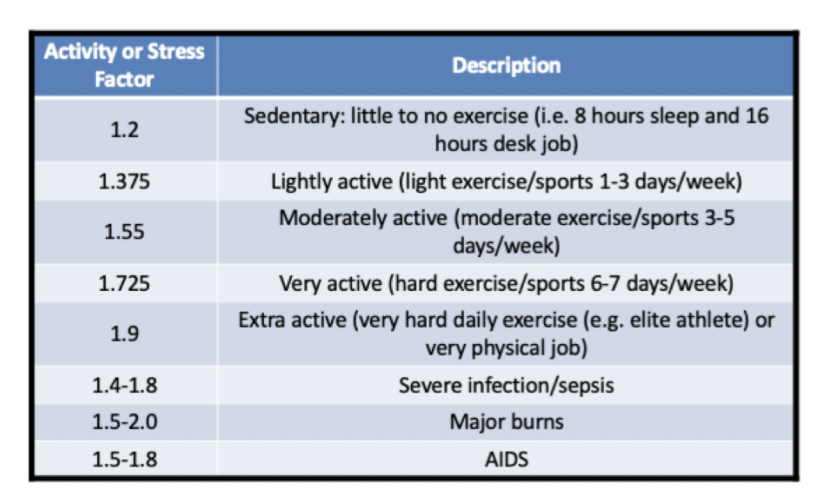
- ]]Calculate the energy requirements of a person given a predictive equation.]] * Determining Energy expenditure: * Metabolic cart - measures RMR * Predictive equations - BMR * Provides estimates when RMR is not possible * %%Harris-Benedict - Total Energy Expenditure (TEE)%% * %%Rough Estimate: 25-35 kcal/kg%% * Harris-Benedict Equation * * * Total Energy Expenditure (TEE) * AKA Estimated Energy Requirement (EER) * Incorporates BEE *
 * Rough Estimate
* Most frequently used in hospital setting
* Uses rough estimate of
* Stress factors will help to select the low or high end of the range
* Rough Estimate
* Most frequently used in hospital setting
* Uses rough estimate of
* Stress factors will help to select the low or high end of the range
- ]]Identify factors that may increase or decrease BMR.]] * Increase: * height * growth * greater lean tissue * fever * illnesses * environment * hormones (e.g. thyroid) * nicotine * caffeine * Decrease: * increased age * fasting/starvation/dieting * malnutrition * sleep
- ]]Define nutrition assessment and its 4 components.]] * A comprehensive analysis of a person’s nutrition status that uses the following information: * Historical (health status, medication history, socioeconomic status and diet history) * Anthropometric Measurements (e.g. height and weight) * Physical exams * Lab tests (urine and blood) * Informs us about malnutrition * Complications of malnutrition: * Poor wound healing, compromised immune status and function, impaired organ function, increased mortality, increased health care spending/usage * Screening - process to identify a person who is malnourished or at risk of becoming malnourished * Assessment - comprehensive evaluation. To make a diagnosis of malnutrition syndrome associated with: starvation, chronic disease or organ failure, acute disease or injury * done by a dietician
\