Semester 1 notes
Crusades: Happened between 1100 and 1300. New technology and trade are exchanged. Europeans see the wealth spreading in other locations and want in.
Reconquista: Ferdinand and Isabella conquer the Moors (Islamic peoples who lived in Spain and were expelled) and unite Spain. However, they’re in a financial struggle. So with that ambition, they decide that now they are free to compete in Europe in the world.
Europeans want new sources of wealth. GOD, GOLD, GLORY. All in competition. There’s economic competition due to mercantilism.
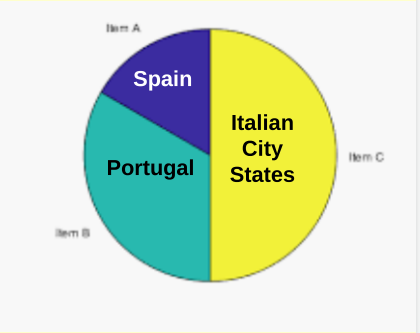
At first, the Portuguese explored. They establish trading empires around the coast of Africa, and end up being a later slave-trade-power. Their initial exploration caused more competition in the exploration market.
Christopher Columbus (1492 he sailed the ocean blue): He expected to sail west of Europe to find a direct route to Asia for trade, aiming to access valuable spices and goods. However, he ends up landing in America instead. He’s looking for the three g’s, but inadvertently becomes a catalyst for the exchange of cultures and resources between the Old and New Worlds, and gets nothing he truly wanted.
The first phase of Spanish conquerors was the Spanish conquistadores. They’re looking to conquer and make easy wealth via a settled area of natives whom they can take the wealth. They destroyed large-scale civilizations with guns, germs, steel, animals, and crops. It ruined the native populations, especially with diseases.
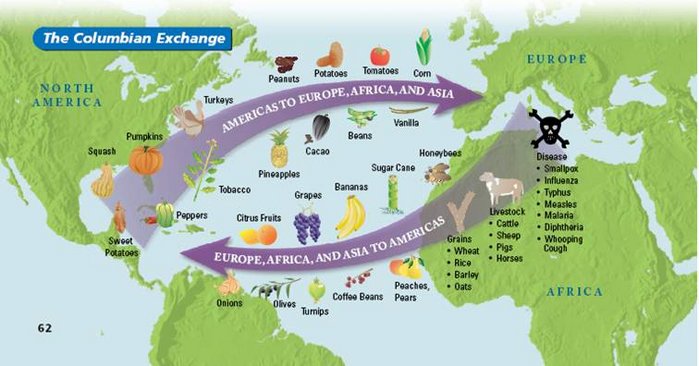
The Columbian Exchange: This exchange led to a significant increase in population, the spread of foods, animals, and ideas across continents, and also caused substantial social and environmental changes in both the Old and New Worlds. It’s one of the most important trades and general events within world history. Overall, there’s a diversification in diet, leading to the biggest change. A boom in population. And slowly, as this trade grows, the world shifts more from feudalism to capitalism.
The second phase: Before contact with Europeans, the Natives lived in small villages and gave tributes to the Aztecs. Once the Spanish show up, they have to start paying a labor tax to the Spanish (enslavement). There weren’t enough Spanish people in the New World to farm and exploit the resources, so they created the Encomienda system. Spanish overlords rule over a hacienda, and any native who lives on that land now belongs to them. Essentially, it becomes feudalism in the New World.
Mining: Before contact, the Incan Empire required natives to provide labor tax (Mita) in mines. After contact, the system is continued by the Spanish.
Sugar Plantations: The Spanish imported sugar and used native labor to produce more. However, very quickly, they switch to African Slave Labor. This is because Natives die too much and too fast due to diseases introduced by Europeans, leading to a drastic reduction in their population and availability for labor. Along with that, the natives who survived could easily run away because of their knowledge of the land. Plus, there was already a slave system in existence that they could exploit. The slave trades were created and managed mostly by the Portuguese, who transported millions of Africans (with the help of Native Slave Catchers (African’s complicit in the slave trade)) to the Americas to work on sugar plantations, significantly impacting the demographics and economies of the regions involved. The area where the slaves were transported was labeled as the middle passage.
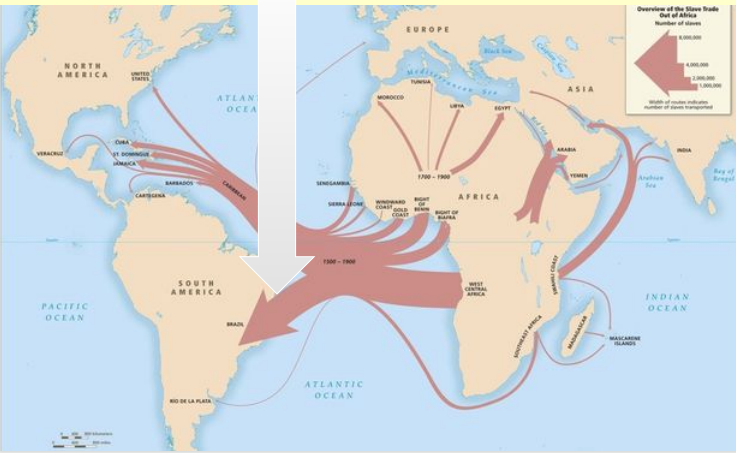
Impact of the slave diffusion: African and European cultural diffusion led to the blending of traditions, languages, and religious practices—for example, the creation of a synthetic religion such as Vodun, and the creole language. This also led to Maroon communities, made up of those who ran away from slavery.
Society: Society becomes strictly controlled. Few families or women come from Europe. This results in the Spanish Caste System.
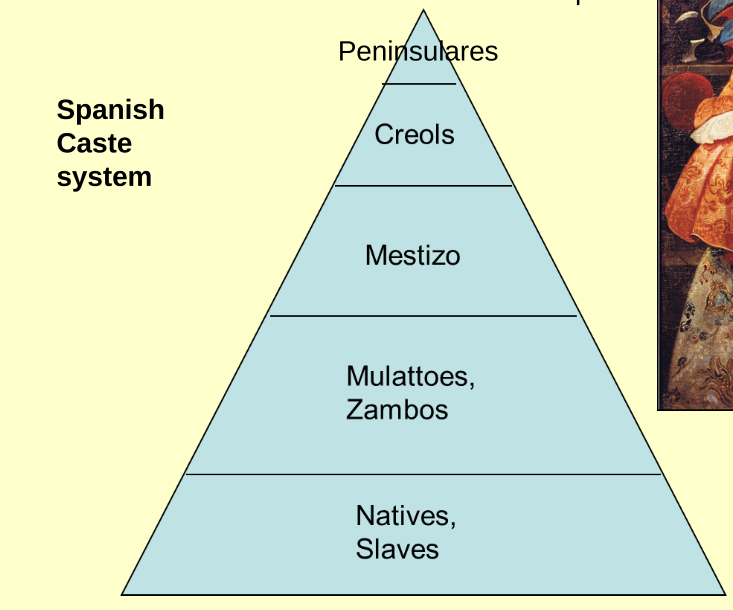
Penninsulares: Directly pure-bred from Spain.
Creols: People born in New Spain.
Mestizo: A person of mixed race between a Spaniard and a Native American.
Mulattoes: A person born between a Spanish person and an African Slave.
Zambos: A person born between Africans and Native Americans.
Slaves and Natives: Self explanatory.
New Spain is strictly controlled by the crown through the Viceroys.
The Black Legend: the idea that the Spanish Empire was only out for its own gain, and tells us that during this time, the Spanish were power-hungry conquerors and had little concern for the natives. The natives are argued to have gained nothing while the Spanish gained everything. This propaganda is spread by the French, English, and Dutch.
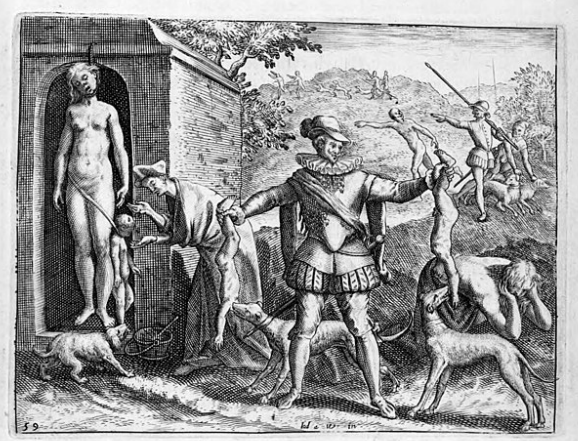
Religion: There’s a major conversion to Catholicism. The goal was to get the natives to change from polytheism to monotheism. This was done by those who owned the Haciendas. They built towns using their profit, forced those they “owned” to live in these towns, called Pueblos, and placed a Chruch right in the middle. Next to this Chruch is a Presidio (a fort to store soldiers) to help solidify the force for Natives to listen and convert.
Pueblo Revolt: The attempts to change Native Americans’ beliefs led to conflict. This revolt in 1680 led to hundreds of Spanish colonists dying and Catholic areas being destroyed.
End Goal: None of these wealthy people actually wanted to live in New Spain. They wanted to go, convert, exploit resources, get rich, and go home. New Spain was set up to be much smaller than other new lands.
Debating Spanish Colonization: Debates occurred over how Native Americans should be treated and how “civilized” they were in comparison to European standards. Juan De Sepulveda wrote “Just causes for war against the indians” that justified Spanish colonization of the Americas. Bartolome De Las Casas published in 1552 “A short account of the destruction of the Indies,” which criticized Spanish treatment of the indigenous people.
French Colonization: They want to try and duplicate the Spanish successes. They can’t go to New Spain and overrun the Spanish due to the Spaniard’s new wealth. They have the same motivations, such as the pursuit of economic gain, spreading Christianity, and exploiting natural resources.
Colonization is limited: They don’t find gold, but they find pelts. And it’s just as lucrative. This leads to a focus on trade and alliances with Native American tribes, which becomes crucial for their survival and success in the region. The group that ends up allying with the Natives, who also aided in trapping and fur trading, is named Couriers de Bouis. They establish friendly relations with Natives, in contrast to the Spanish. However, this new bloom of trust creates competition between tribes for these relations. It increases Native conflict and makes Native Tribes reliant on Europeans in the pure necessity for guns, metal tools, the French language, and Alcohol.
Virginia: Virginia was originally a piece of land bought by a joint stock company funded by the king. They wanted to make gold to gain wealth and needed to farm for it. In comes Indentured Servants (poor men who voluntarily do labor for small amounts of money/trade).
Jamestown Struggles: They were looking for gold, not work. They attacked the Indians for food (causing trouble), 40% of them died, and the colony struggled to survive due to a lack of food. Cpt. John Smith takes over, forces them to work hard, but eventually leaves them in a state of starvation.
Tobacco saves the colony: Tobacco is an economic success, fills the need for labor (indentured servants), has the head right system, causes the population to surge, and eventually falls to African slaves for labor.
Anglo-Powhatan Wars: As the colony (as tobacco) grows, peace becomes impossible. They either kill the natives or move them west.
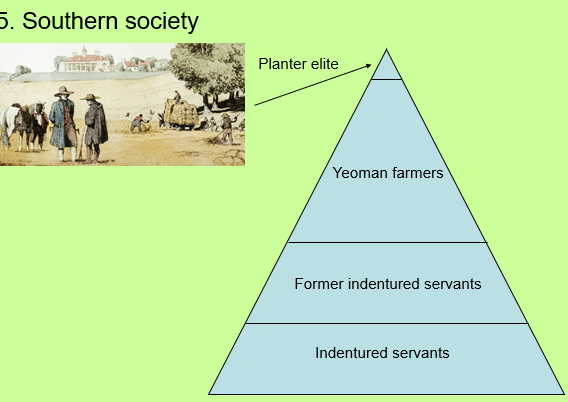
Southern Society: Planter elite at the top, Yeoman Farmers lower, former indentured servants, then the current servants.
House of Burgesses: The Colony established local government that allowed colonists to make their own laws and manage their affairs, serving as a model for representative government in America. It’s led by the planter elite.
Class conflict: Former Indentured servants are forced west due to their no longer being needed or because they have bought land. They begin to resent the farmer elite due to a lack of good land and a lack of women. Also, they lack political power. This resentment eventually leads to open rebellion, notably exemplified by Bacon's Rebellion in 1676, where these former servants united against the colonial government in pursuit of land and better representation. They marched into Jamestown and burned its buildings in a dramatic display of their anger and frustration toward the ruling class. This event caused a switch from indentured servitude to African Slaves.
Southern Slavery: Slavery expanded after the 1670s. The conditions in Europe become better, leading to fewer servants, and some are forced to turn to Slavery. Beyond this, there was already a round of slave trading going through the Triangle Trade.
The Middle Passage: A harrowing voyage that enslaved Africans endured as they were transported across the Atlantic Ocean to the Americas, characterized by inhumane conditions, overcrowding, and high mortality rates, resulting in significant loss of life.
Slave Life: It was forced separation and dehumanization of African’s. There’s communal living, desperate attempts to preserve culture, and the emergence of new languages. Often, they’d play dumb, work slowly, or run away to form Maroon communities.
Barbados Slave Code: Slaves outnumber whites = so they feel they must have strict control over slaves. This establishes chattel slavery in perpetuity. It outlaws interracial relationships, making it illegal for slaves to gather in groups or be educated. Ideas of codes moved to the southern colonies after the rebellions.
Maryland: Founded by Lord Baltimore as a haven for Catholics seeking refuge from Protestant persecution, it also allowed for some degree of religious tolerance and was marked by the Act of Toleration in 1649, which granted freedom of worship to all Christians. They made money via plantations that primarily produced tobacco, which became a lucrative cash crop in the region and led to an increased demand for slave labor. Poor protestants move in to grow tobacco, and soon outnumber catholics.
Carolinas: The king gives the colony to his supporters, sets up an experiment in new government, and John Locke writes the company charter. The Southern part of the colony is tied to the West Indies and produces mainly Rice and lumber to send down to the Caribbean. The northern part of the colony held pirates. They had nothing to grow, no reason for slaves, and nothing else to do.
Georgia: Founded by James Oglethorpe for Philanthropy— benevolence and charity. Second chance colony. It’s also created as a buffer state. They thought that, if they threw the prisoners down there, they’d lose less if they were attacked. They eventually move on to be the powerhouse of cotton.
New York: New Amsterdam was established by the Dutch West India Company (similar to Jamestown). They traded for Furs and treated the Natives very similarly to the French; friendly and welcoming. It’s established as a trading port. Patroons, similar to landlords, established large land areas next to the Hudson River to attract more trade for wealth. This patroon system is very similar to the headright system of the English, which was a land grant program. New Amsterdam falls, and the Duke of York comes in and takes it. Now named New York, it became a significant economic and cultural center, reflecting a blend of Dutch and English influences as it continued to grow under new governance. As New York developed, it also became a melting pot of diverse cultures and communities, attracting immigrants from various backgrounds who sought opportunities and contributed to its vibrant social fabric.
Pennsylvania: William Penn established Pennsylvania as a haven for Quakers (a religion where there’s a very emotional charge between them and god) and other religious minorities. Its framework promoted religious freedom and attracted settlers looking for a more tolerant society. These Quakers also had very unique social beliefs. They won’t take oaths, don’t believe in violence, don’t recognize the king as the head, and see women as equals due to a lack of leadership/patriarchy. William Penn was quite a wealthy man to whom the king owed a favor.
Penn establishes Pennsylvania as a liberal/reformed colony. There’s no official tax-supported church; it is very religiously free and provides a welcoming environment for various religious groups to coexist peacefully. However, only Quakers had the right to vote and hold office. They treated natives in a fair manner, established treaties with them, and sought to maintain peaceful relations, contrasting sharply with the approaches of other colonies that often led to conflict and displacement. They had a representative assembly (influence of English) and had suffrage for all property-owning white males. Penn advertises the colony and has a large migration. Most immigrants come from Western and Northern Europe. Germans come along, attracted to religious freedom and cheap land that resembles their homeland. Along with the Germans, Scots-Irish came to escape poverty and harassment from the English.
They grow cereal crops as one of their main sources for good economy. These crops are sold to England, the West Indies and provide food for many of the colonies. Large families come with their indentured servants. There are very few slaves due to the lack of economic need for them.
Background on the Anglicans: Brought up by Henry the Eighth. Puritans make the church more protestant, while the Pilgrims/separatists are more radical. Pilgrims are also persecuted in England.
The Mayflower Compact: A foundational document for self-governance, created by the Pilgrims upon their arrival in America; it established a framework for social order and emphasized the importance of majority rule. It creates community and democracy within the group.
Success?: Conflicts with the natives between the pilgrims were rare. They’re helped by Squanto, an Indigenous leader who served as an intermediary who traveled to France and England, teaching them vital agricultural techniques and establishing important trade relationships that support their survival and integration into the New World. This all turns into a friendly relationship between the Pilgrims and the Native Americans, fostering collaboration and mutual assistance as they navigate the challenges of the new environment. There are few separatists, few resources, and it is eventually absorbed by the Massachusetts Bay Colony.
Massachusetts Bay Colony: Charles the First persecutes Puritans (Non-Catholics) due to their challenging his authority over the church. The Puritan merchant class resents the king’s taxes. Eventually, these Puritans are granted a charter from the king (he wants them out) to the new world. This causes the Great Migration. Puritans moved in large groups and with their families, creating large communities.
Jonathan Winthrop: First governor of the Massachusetts Bay Colony, known for his vision of a "city upon a hill" that would serve as a model of Christian charity and a beacon of hope.
New England Towns: Very communal. The colonies are too poor and too far away for Parliament to supervise. Representative democracy blooms from the inspiration of parliament. Towns elected representatives for the colonial legislature = Education is very important here.
Religious Dissent: Roger Williams (who founded Rhode Island) challenged religious leadership, despised blue laws, and, as a result, was banished to Long Island. He moved to found Rhode Island, a place where everyone had religious freedom (no blue laws) and had universal white male suffrage. Anne Hutchison (founded Hartford—later Connecticut) challenged the rules too, and was banished to Long Island.
New England mixed economy: Short growing season and thin rocky soil with subsistence farming and no cash crops. They rely on large family farms with occasional slavery and indentured servants. Besides farming, others are fishers, some work with wood, and others help with joint stock companies. They supplied the motherland with raw materials for the production of finished goods.
English Civil War: Era of benign neglect begins. England experienced political turmoil during this period, leading to a shift in power dynamics between the monarchy and Parliament. The king was more interested in the West Indies than the founding colonies. Colonies began to ignore British trade laws. They were used to making their own laws through assemblies. The actual civil war erupted in 1642, pitting Royalists against Parliamentarians, and resulted in significant military and social upheaval that would ultimately define the future of English governance. The conflict revealed deep divisions in English society and highlighted the growing desire for parliamentary authority over absolute monarchy, ending with the king getting his head being chopped. Colonies must defend themselves alone. As tensions escalated, it became increasingly clear that colonists would need to organize and develop their own systems of defense, leading to early forms of self-governance and cooperative agreements among the colonies. This leads to the New England Confederation, which provided united protection against the indians, French, and Dutch. This is the first attempt at colonial unity.
Restoration: The king returns. He needs money but knows he can’t ask Parliament. So, he goes to the colonies for it. He creates the Dominion of New England. This changes English Colonial policy. The king is broke, and starts to raise taxes so the colonies would give him money. Navigation acts are created to enforce mercantilism, requiring that trade between England and its colonies be conducted on English ships and that certain goods could only be shipped to England or English colonies.
Mercantilism: A theory of wealth. Fight for what you need. Benefit yourself, harm others.
The Glorious rebellion: The Glorious Revolution of 1688 was a significant event in English history where James II was overthrown and William of Orange ascended to the throne, leading to the strengthening of parliamentary authority and the rise of constitutional monarchy.
Salutary Neglect: Weak monarchs are content to leave the colonies, allowing them to go back to the old times of producing for their own.
Anglo Indian Contact: The Fur trade brings finished goods to the Natives. There are deadlier conflicts, inter-tribal conflicts, and massive waves of disease. Some natives convert to protestantism and live in praying towns. The Pequot War is between the English (plus their native allies) and the Dutch (plus their native allies), resulting in a violent conflict that showcased the tensions between European settlers and Native American tribes over land and resources, ultimately leading to significant territorial gains for the English. Another war is King Phillip’s War. Chief Metacom leads Natives against settlers. They lose, and the increased English population moves west as the remaining Indians are sold into lsavery.
The New England Experience Changes: Communal experiences and compacts decline. After the first wave, wealth increases and wealth divisions form. With population pressure, distance increases. As the communal experience declines, religious zeal wanes. They don’t want to go through the process of becoming a visual saint. They’re scared back into being in church, but it doesn’t last forever.
The great awakening: Causes include loss of community on frontiers, harsh lives, resentment of the eastern elite, and rejection of ideas that you must be elite for god to love you. English preachers come to the colonies to stress the importance of emotion and salvation over intellectualism and class. This message was embraced by mostly poor people on the frontier in every colony. It hits with the young and women, and causes the poor to question the authority of the wealthy and religious figures. The impacts include Old Lights and New Lights, creating new denominations of Christianity, and creating new universities like Yale.
George Washington: He was working on selling land in Ohio to make money, but when the French settled a fort across the river from him, he ended up challenging their claims and led a military expedition, which marked the beginning of conflicts that escalated into the French and Indian War. Gorilla warfare is shown here.
Albany Congress (1754): Seven of the colonies showed up to the call that was originally set up by England. They wanted to get a mutual defense agreement with the colonies and the Iroquois. Benjamin Franklin proposed a united colonial government with a king-appointed president and an Elected Grand Council.
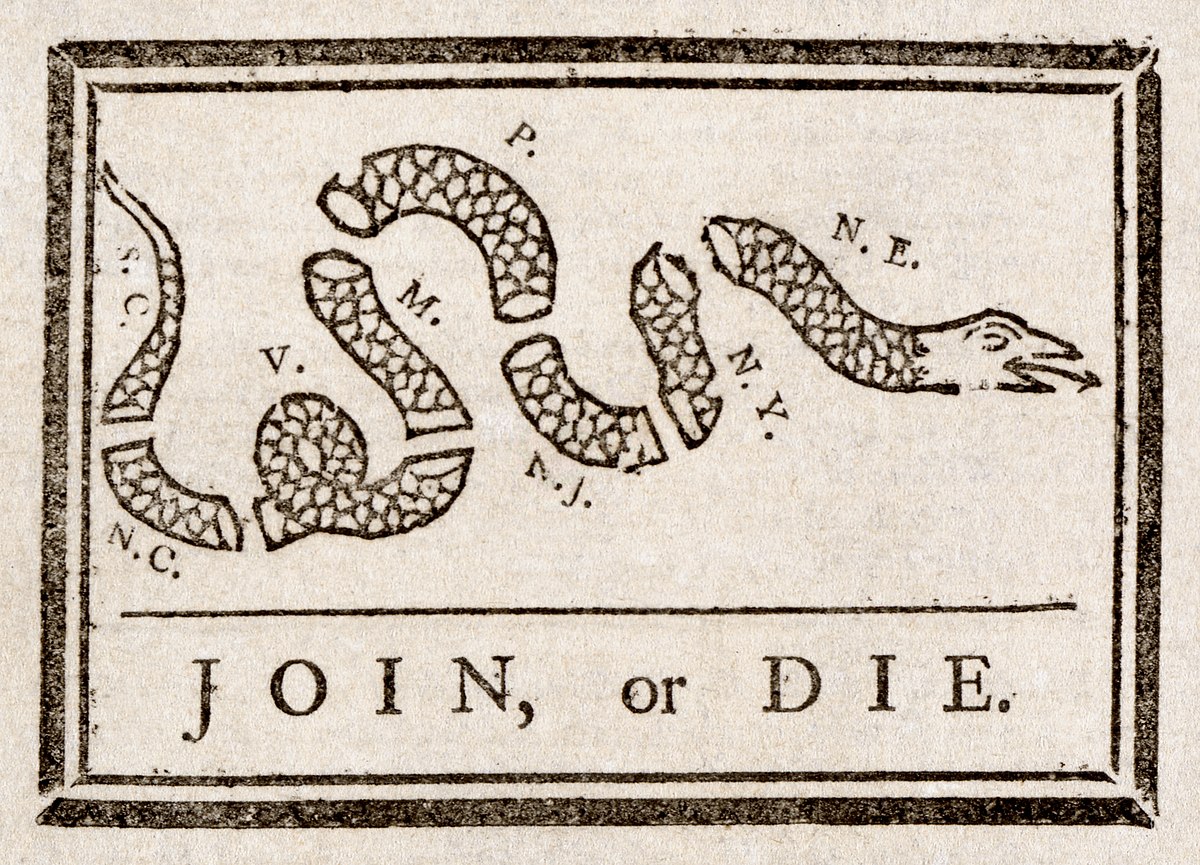
This fails. The colonies fear losing local autonomy due to their diversity and differing interests, leading to a lack of consensus on participating in a centralized government. England also fears too much unity due to a possible path of independence. This causes the English shortcomings to be revealed. English struggle on the frontier, colonists realize the motherland people aren’t as good as they thought they were, and there’s a lack of respect from both sides. There’s severe punishment for the colonist militia who tried to defend and function in their own homes rather than fight with the red coats.
William Pitt’s new strategy: He believes we shouldn’t be fighting on the land of Ohio, but rather focus on broader military campaigns that directly target key French locations in North America, allowing us to cut off their supply lines and weaken their overall position. Attack the French forts that supply any on the frontier.
Treaty of Paris: This treaty, signed in 1763, marked the end of the French and Indian War and resulted in significant territorial gains for the British, including Canada and all lands east of the Mississippi River, reshaping the political landscape of North America. However, the British are still unhappy. The colonists didn’t do as told, and they’re in serious debt. So, they gain money via taxes.
Proclamation of 1763: This proclamation prohibited American colonists from settling west of the Appalachian Mountains, aiming to stabilize relations with Native Americans by preventing encroachment on their lands.
Changing Colonial attitudes: The colonists begin to realize that their goals don’t align with the motherland’s. So, they ignore the proclamation. They ignore the “line” and push further west. They believe that the natives who allied against them didn’t have the resources to fight back. They used the native’s tactics and knowledge of the terrain to navigate unfamiliar landscapes and establish new settlements, plus get their revenge, ultimately embedding themselves deeper into contested territories.
Changing Native attitudes: They’ve lost their French Allies, the British aren’t policing their own colonists, and they have to do something to protect their land and way of life. Resources are dwindling, and the ongoing encroachment from settlers compels them to form new alliances and strategies for resistance. This leads to the Pontiac rebellion. This rebellion is for continued independence. They’re free, and they want to maintain their sovereignty by resisting colonial expansion, fostering unity among tribes, and reclaiming control over their ancestral lands. However, it fails.
The response: The colonials think the best idea would be military force. But at first, they meet at Fort Michilimackinac. They offer blankets as peace… those are infected with smallpox.
England changes its colonial policy: It starts with debt. They tax the hell out of the colonists rather than their own citizens to ensure there isn’t another English Civil War. Consequently, this leads to increasing tensions as the colonists feel the burden of taxation without representation, sparking protests and fostering a sense of unity among the disparate colonial groups. William Pitt was switched with George Grenville was a Prime Minister. He’s heavily focused on mercantilism, aiming to consolidate British economic power by controlling colonial trade and resources, which further exacerbates the discontent among the colonists.
The Currency Act: Colonial flat money is removed, the British ensure that gold and silver aren’t used in the colonies, and try to ensure that all solid money is brought back to England. This is an economic disaster. This forces the colonies to go back to bartering.
The Sugar Act: This act puts heavy taxes on sugar. This is the first time Parliament has passed a tax for revenue and not to control trade. Most don’t protest due to the easy ways of getting around it, which resulted in the admiralty courts.
The Stamp Act: This act imposed direct taxes on a wide range of printed materials, including newspapers, legal documents, and licenses, leading to widespread dissent and organized resistance among the colonies.
Opposition to the Stamp Act: The opposition was largely fueled by the belief that taxation without representation was unjust, prompting the formation of the Virginia Resolves. Opposition groups start to form, such as the Sons of Liberty, which organized protests and boycotts against British goods, rallying support from various colonies to challenge the legitimacy of Parliament's taxation policies.
The Declaratory Act: The English Parliament repeals the Stamp Act, but says that all the grievances of the colonists are to be ignored.
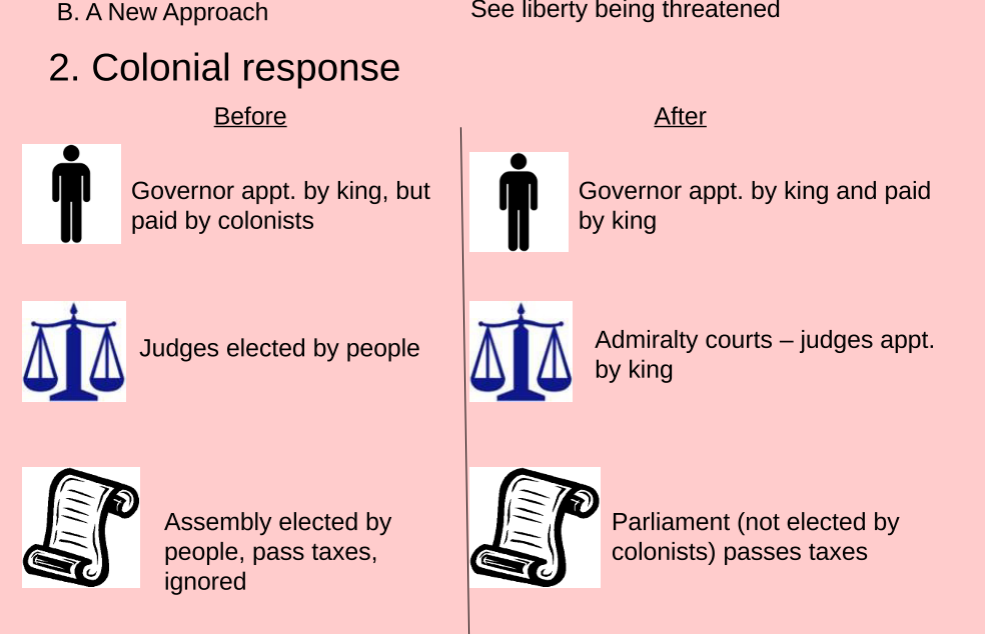
A new approach: Charles Townshed promises to pluck the feathers of the colonial goose without too much squawking. He taxes literally everything. And the merchants who collect taxes are paid based on how much they can collect.
Colonial Response:
Daughters of Liberty: A group of women who played a crucial role in the boycott of British goods, they crafted homemade textiles and encouraged others to do the same, demonstrating their commitment to the colonial cause.
Boston Massacre: England sends in troops to enforce the new policies, which causes friction with locals. These soldiers also go out and party, take jobs, and one night, this boils over. The Sons of Liberty and a mob “demonstrate” in front of the soldiers, leading to escalating tensions that ultimately result in the tragic confrontation, where eight colonists are killed, further igniting the call for independence.
Committee of Correspondence: Created by Sam Adams. He wanted to keep in touch, inform each other on troop movements, and possibly plan for coordinated actions among the colonies, enhancing their shared efforts against British oppression.
Boston Tea Party: In December 1773, a group of colonists, frustrated by British taxation without representation, disguised themselves as Mohawk Indians and boarded three British ships in Boston Harbor, where they proceeded to dump 342 chests of tea into the water as a protest against the Tea Act, a significant act of defiance that escalated tensions between Britain and the American colonies.
The Intolerable Acts: In response to the Boston Tea Party, the British government enacted the Intolerable Acts in 1774, aimed at punishing the Massachusetts colony, closing Boston Harbor, revoking the Massachusetts Charter, and implementing new restrictions on town meetings, ultimately uniting the colonies in opposition to British rule.
1st Continental Congress: This was established to present a united response to the Intolerable Acts, gathering representatives from 12 of the 13 colonies to discuss collective measures, advocate for colonial rights, and foster a greater sense of unity among the colonies in their struggle for independence. They don’t really do anything, though…
Review of Post-Salutary Neglect and Early American Revolution
Example of how salutary neglect ends (1763):
The mid-18th century saw increasing imperial struggles that impacted the American colonies.
New British government efforts introduced taxation measures without direct representation from the colonies, which began uniting colonists against these perceived constraints on economic and political rights.
The American Revolution
A. Reaction to Lexington and Concord
Minute Men Volunteers:
Approximately 20,000 Minute Men (militia) volunteer, forming a temporary army around Boston.
Mission: Keep British troops “bottled up”.
B. 2nd Continental Congress (1775-1781)
Location: Philadelphia
Colonial Unity: The 13 colonies are finally united, aiming for reconciliation.
Limitations of Power: The Congress does not hold power.
Actions Taken by Congress:
Boycotts
Petitions (letters to the King)
Olive Branch Petition
Continues to organize and fill the army.
C. Notable Events in Rebellion
1. Fort Ticonderoga (May 1775)
Leaders: Ethan Allen and Benedict Arnold
Outcome: Successful capture of the British fort which secured artillery crucial for future battles.
2. Bunker Hill (June 1775)
Geographical Advantage: Colonists hold the high ground.
Perceived Result: Although the British claimed victory, the heavy losses inflicted on them were notable.
D. Reluctant Revolutionaries
1. Olive Branch Petition (July 1775)
Purpose: A last-ditch attempt for peace with the King.
Outcome: Rejected by the King who declares the colonies in a state of rebellion.
King’s Actions: Hires Hessians leading to irreversible conflict; troops burn cities such as Norfolk and Falmouth.
2. Reasons for Reluctance
Disadvantages in Comparing England and America:
Population: England 7.5 million vs. Colonies 2.5 million
Money: England has tax revenue; colonies struggle with no taxes and reliance on paper money.
Government: England has a strong centralized government; American colonies are decentralized.
Military: England boasts a large, organized navy and army with mercenaries; meanwhile, colonies rely on a militia.
Manufacturing Capability: England is experiencing the onset of the Industrial Revolution, whereas the colonies have none.
Distance: The vast ocean makes military logistics difficult.
3. Consequential Implications of Resistance
Death Sentences for Rebels: A historical quote details brutal consequences for Irish rebels, illustrating potential fates for the American rebels.
E. The Shift Towards Revolt
1. „Common Sense“ (Jan. 1776)
Author: Thomas Paine
Style: Utilizes everyday language for broader appeal.
Main Arguments:
People can govern themselves independent of a king.
The king is depicted as a tyrant, counter to divine representation.
The call for immediate independence emphasizes individual merit over hereditary privilege.
2. The Declaration of Independence (July 1776)
Proposer: Richard Henry Lee (VA)
Committee of Five: Tasked with drafting the document.
Content Overview:
Justifies rebellion by listing grievances and stating the ideology of a new nation.
Key Excerpt:
> “When in the Course of human events, it becomes necessary for one people to dissolve… to assume among the powers of the earth, the separate and equal station to which the Laws of Nature and of Nature's God entitle them…”Assertion of equality:
> “…that all men are created equal, that they are endowed by their Creator with certain unalienable Rights…”Right of the people to alter or abolish destructive government.
Noteworthy quote: “If men were angels…”.
3. Differentiation of Sides
a. Loyalists (Tories)
Characteristics:
Comprises royal employees, elderly persons, Anglicans (especially from the South), aristocrats in New York, and neutral Quakers.
b. Patriots
Profile:
Typically liberals, New Englanders, wealthy Southern planters, and Scots-Irish individuals.
Notable involvement of women advocating for rights through “Republican Motherhood” during the revolution.
Contribution: Running businesses and farms during the absence of husbands; notable quote referencing women’s rights.
c. Treatment of Loyalists
Consequences:
Harassment and loss of property.
Many fled to Canada and England (estimated 180,000) while some remained to fight or spy in support of the King.
4. Geographic and Social Considerations
Loyalist Concentration: Mostly in urban areas due to their connection to British governance.
Backcountry Contention: Regions become contested due to conflicting local allegiances.
Indigenous Loyalty: Some Native Americans align with Loyalists, influencing the complexity of warfare.
F. Military Engagements
1. Appointment of General Washington
Post-Bunker Hill, the Continental Congress appoints George Washington as the commander of the colonial army, critical for garnering Virginia’s support due to his military experience.
2. New York and New Jersey Campaigns (1776)
Key Battles:
Battles of Trenton and Princeton: Washington’s crossing of the Delaware leads to the defeat of Hessians, which boosts colonial morale despite not being strategically pivotal.
Battle of Long Island: Washington’s forced retreat leads to British control of New York for the remainder of the war.
3. Historic Turning Point: Saratoga (1777)
Commanders Involved: Generals Howe and Burgoyne make missteps.
Strategic Impact: France enters the war on the side of the American colonists, turning the conflict into a more widespread war involving Europe and the Caribbean.
4. Hardship at Valley Forge (1777-1778)
Conditions:
Harsh winter leads to dwindling supplies and low morale as Congress lacks power to provide adequately.
5. War in the Southern Colonies (1780-1781)
British Strategy: Lord Cornwallis aims to gain control by leveraging loyalist support.
Patriot Response: Nathaniel Greene adopts hit-and-run tactics, leading to a civil war-like environment, indicated by guerrilla warfare methods (e.g., General Francis Marion, “The Swamp Fox”).
6. The War's Conclusion at Yorktown (1781)
Events: British forces find themselves caught with insufficient supplies as the French navy intervenes.
Outcome: British army surrenders, marking the last significant engagement of British forces in the American Revolution.
G. Treaty and Its Implications
1. Public Sentiment Towards Peace
British Perspective: War weariness due to losses in various global conflicts leads to readiness for negotiations, influenced by new leadership promoting peace.
2. Treaty of Paris (1783)
Consequences of the Treaty:
United States independence recognized.
Britain agrees to vacate forts in Ohio.
Territorial gains for America westward.
Americans are obligated to return Loyalist property and repay debts to British merchants.
3. Reflection on American Identity
Absence of Distinct American Culture: Lack of cohesion or unique American identity in the immediate aftermath of the war, along with developments in political literature and architecture.
H. Global Impact of the American Revolution
1. Influence on France
Socio-Political Dynamics: Conflict in France arises from debts incurred during the American Revolution, culminating in widespread civil unrest leading to the French Revolution.
Clash between absolutism and Enlightenment principles was significant.
2. Domino Effect of Revolutions
Aftermath:
Napoleon’s rise creates a Europe at war, with broader ramifications from class struggles initiated in France against nobility and church officials—illustrating a turning point in class dynamics.
3. Haitian Revolution (1791-1804)
Connection to American Influence: Black soldiers from Haiti contributed to American victories, and after establishing revolutionary ideas, they organized a successful uprising against French plantation owners amidst France's internal turmoil.
New Governments Created (1776-1787)
The Spirit of 76
Revolutionary Ethos and Enlightenment Impact
Impact of Enlightenment (Liberal) Thinking: The revolutionary ethos was deeply influenced by Enlightenment ideals, emphasizing:
Freedom
Equality
Democracy
Opportunity
No more deference (challenging traditional social hierarchies and submission to authority).
Questions Regarding the Scope of Revolution: The application of these ideals raised critical questions for different groups:
Women?
Slaves?
Poor white men?
Limited Government: A key principle was the establishment of a government with limited powers.
How Revolutionary Was the Revolution?
Before and After the Revolution - Voter Base:
Before:
Elite
Farmers and Artisans
Poor whites
Slaves
Voters (with property requirements)
Loyalists (conservative)
After:
Elite
Farmers and Artisans
Poor whites
Slaves
Property requirements persisted for voting.
Outcome for White Men: The revolution led to more democracy for white men by expanding the electorate for them.
Women: The concept of "Republican Motherhood" emerged, emphasizing women's role in raising virtuous citizens for the new republic rather than direct political participation.
Growth of Democracy and Social Changes
Property Requirements Decrease: Over time, property requirements for voting were reduced, expanding suffrage among white men.
Primogeniture Laws Abolished:
Definition: Primogeniture laws dictated that the entirety of a father's estate was inherited by the eldest son.
Impact of Abolition: This change led to a more equitable distribution of land among heirs.
Consequences of Land Ownership for Voting: The prior system of "no land, no vote" meant that many individuals, including women, were excluded from political participation.
This also highlights that women, regardless of land ownership, were generally disenfranchised.
State Capitals Move Inland: This shift symbolized a move towards greater accessibility for a broader population and away from the established coastal elites.
Established Churches: The separation of church and state began, as many states moved away from funding or officially recognizing a single church.
New State Constitutions: Many states created new constitutions that vested most local power in the legislative branch, often with short terms (e.g., one-year terms) to ensure accountability and reflect the will of the people.
Continued Growth of Democracy and Abolition Movements
Abolition Movements: These movements began to emerge in the middle and northern states.
Quakers: The Quakers established the first anti-slavery society in 1775, based on the principle of "God loves us all."
Benjamin Franklin: Was a proponent of the Quaker anti-slavery stance.
No National Movements in Congress: There were no national abolition movements sanctioned by Congress at this time due to the prevailing belief that slavery was "dying in the South."
This belief proved to be incorrect as slavery became more entrenched in the agricultural economy of the South.
The Articles of Confederation
Creation and Ratification
Created by: The Second Continental Congress.
Timeline:
Written: 1776
Ratified: 1781
Delay in Ratification: The ratification process was significantly delayed by disputes among states over western land claims.
Significance of Land: Land represented a crucial source of money for states to pay off Revolutionary War debts.
Resolution: States eventually ceded their land claims to the central government to facilitate ratification.
Necessity: A central government was urgently needed to manage the ongoing Revolutionary War.
Important Accomplishment: Despite its weaknesses, the creation of the Articles was a significant step towards establishing a unified government.
Makeup and Powers
Unicameral Congress: The government consisted solely of a single legislative body.
Confederation: Designed as a confederation primarily for defense and commerce among the states.
No Executive Branch: There was no president or executive leader.
No Judicial Branch: There was no national court system to resolve disputes.
Mistrust of Central Government: The structure reflected a deep-seated popular mistrust of a strong central government, a reaction to recent experiences with British rule.
Lack of Taxation Power:
The central government had no power to tax, forcing it to rely on requests for funds from the states.
Quote: "The power to tax is the power to destroy" (highlighting the perceived danger of federal taxation power to state sovereignty).
Passing Laws: Required a vote of the states.
Amending the Articles: Required a unanimous vote of all states, making amendments exceedingly difficult.
External Problems Under the Articles
US Credit Drops: The inability to tax meant the US government was "broke" and could not repay its loans, leading to a significant decline in its international creditworthiness.
France: Shut off trade with the West Indies until US loans were repaid, impacting American commerce.
England:
Cut off trade with the British Empire.
Following the war, English goods flooded US markets, raising questions about whether the US was truly economically independent despite being politically independent.
The Articles of Confederation could not enforce a boycott of British goods or raise tariffs to protect American industries.
England maintained western forts on US territory, violating the Treaty of Paris.
Spain: Sought to create a buffer state in the American Southwest, posing a territorial threat.
Mediterranean Trade: The US could not afford to pay for or enforce protection for its merchants in the Mediterranean Sea, where they were vulnerable to piracy.
Internal Problems Under the Articles
State Boundary Disputes: States frequently fought over their boundaries, and the absence of a national judicial branch meant there was no mechanism to peacefully resolve these conflicts.
Economic Stagnation:
States began taxing each other's trade, creating internal barriers to commerce.
Modern Context: This is now prevented by the 'commerce clause' of the US Constitution, which grants the federal government power over interstate commerce.
The US was outside the mercantilist system, meaning it could not freely trade with traditional partners like the British West Indies.
Impact on Farmers: Farmers faced a glut of products, leading to significant drops in prices and economic hardship.
Shays' Rebellion (1786-1787)
Background:
States were obligated to pay back their Revolutionary War debts.
To do so, many states, including Massachusetts, significantly increased taxes on farmers.
Alternatively, states could have printed more paper money, but this option was avoided to protect the financial interests of eastern bankers.
Farmers' "Double Crunch": Farmers faced a severe economic crisis due to:
Increased taxes (to pay state debts).
Inability to sell their goods (due to glut and lack of markets), which meant they had no income to pay the increased taxes.
Daniel Shays' Rebellion:
A revolt led by Daniel Shays, a Revolutionary War veteran, consisting of indebted farmers who protested foreclosures and tax policies.
The rebellion highlighted the weakness of the central government under the Articles of Confederation, as it could not effectively provide aid to Massachusetts to suppress the uprising.
Consequence: Shays' Rebellion created a widespread desire for a stronger, more capable central government.
Accomplishments of the Articles of Confederation
Settlement of Western Land Disputes
Land Ordinance of 1785:
Purpose: Established an orderly system for surveying the Old Northwest Territory.
Structure: Land was divided into townships of miles, which were further divided into 36 sections of 1 square mile (640 acres).
Public Education: Some land sales within each township were specifically reserved for public education, marking an early commitment to public schooling.
War Debt: Land sales were also used to help pay off government war debt.
Bias: The process often favored land speculators, who could afford to buy large tracts, over individual farmers.
Geographic Scope: This ordinance primarily applied to the lands north of the Ohio River and not to the Southern territories.
Northwest Ordinance (1787)
Purpose: Established a clear system of government for the expansion of the United States westward.
Two Stages of Governance:
Territorial Stage: An area was initially under the direct control of Congress and a territorial governor appointed by Congress.
Application for Statehood: A territory could apply for statehood once it reached a population of "white inhabitants."
Requirement: The territory had to submit a republican form of government to Congress for approval.
Preventing East-West Conflict: This ordinance was crucial in establishing a peaceful and orderly process for admitting new states, preventing potential conflicts between older Eastern states and newer Western territories.
Outlawing Slavery: Crucially, the Northwest Ordinance outlawed slavery north of the Ohio River. This was an act of Congress and reflected some of the "Spirit of '76" ideals concerning freedom, though it did not apply universally.
Maryland Line: The successful resolution of land claims (partially influenced by Maryland's insistence on states ceding western lands before ratification) and the subsequent ordinances represented a significant stepping stone even with the weaknesses of the Articles of Confederation.
Bill of Rights: The Bill of Rights was passed, protecting civil liberties, which keeps the federal government in check. The 9th Amendment doesn’t limit rights, and the 10th Amendment claims states have all power not listed in the Constitution.
Alexander Hamilton: Hamilton believed a strong central gov’t was best for America. He was the Secretary of the Treasury and shaped the economy of the new nation.
He wanted the U.S. the grow as an industrial power with less dependency on Europe. He wanted the U.S. economy to mirror the English economy, with close ties to England. He feared democracy would lead to anarchy; power should be in the hands of wealthy citizens. He has a loose idea of the constitution. There are gray areas, so let me do it!
Thomas Jefferson: Jeff believed that a limited gov’t would preserve liberty.
He saw the U.S. as an agrarian nation with active foreign trade to buy manufactured goods. He trusted the common people over the elitist aristocracy. He favored close ties with France, especially when the French Revolution began. He believes in a strict construction of the Constitution. There are gray areas, so nobody does it!
Assumption of the debt “at par”: State governments owe money but can’t pay. So, the federal government proposed to assume these debts to stabilize the nation’s economy and strengthen the financial credibility of the new government. However, this puts the feds above the states when it comes to money. It creates a permanent bond between states and the federal government, and creates a national debt issue. The Room where it Happened!
The Tariff: These were created to generate revenue. Foreign taxes and an excise tax on whiskey begin, but harm farmers in the process. The aim is to protect American manufacturing by making imported goods more expensive, thereby encouraging consumers to purchase domestically produced products, which supports local industries and job growth. European nations return the favor.
National Bank: Federal government—> National Bank (private)—> The Public—> Loan with interest. Halimton thinks we should just tax people.
Foreign Affairs: Revolution in France in 1789. Jefferson supports the continuation of the American Revolution in another place. Hamilton thinks he’s batshit nuts.
Washington’s response: Washington emphasized a policy of neutrality, arguing that involvement in foreign conflicts could jeopardize the young nation's stability and safety. Along with this comes the Notable Policy: This is the first example of US Isolationism. He believed that establishing strong diplomatic ties and focusing on domestic issues were crucial for the nation's growth and survival.
The Jefferson Admin:
Jefferson's victory in the 1800 election: He won with the help of southern and western farmers votes
Burr tries for the presidency = 12th amendment (1804)

The spirit of ‘76 is back: Jefferson believes that the common man has been put back in power. He walked to the inauguration and wore cheaper clothes to try to prove he was a common man.
Jefferson tries to mend fences— “We are all Republicans, we are all federalists”.
He doesn’t go against any of his enemies or repeal their actions. He wants to be viewed as a just leader.
The Changes he made: Naturalization law of 1802, repeals excise tax on whiskey, and reduces the national debt.
Jefferson attacks the judicial branch: he aims to reduce the power of the Federalist-controlled courts by appointing more Democratic-Republican judges and limiting the influence of federal judges through legislation. He unseats judges who were appointed by previous administrations, further aligning the judiciary with his party's values and strengthening his control over the judicial system.
Jacksonian Democracy:
Continuation of the spirit of 76= White Male suffrage
Cheap Land = land requirements are pointless = change in who can vote
Panic of 1819= Market Rev creates ups and downs in the economy. People are more interested in politics than in economic policy
Missouri Compromise= Debate over slavery= people are more interested in politics
Increased sectionalism: North, South, and West develop distinct identities and interests, further fueling tensions around issues such as trade, tariffs, and slavery.
The Election of 1824:
The election of 1824 was a 4-way race among Dem-Republicans:
John Quincy Adams represented the northeast
William Crawford represented the South
Henry Clay and Andrew Jackson represented the West
Jackson won the popular vote but not a majority of electoral votes
The Election of 1828:
Jackson wins and becomes the first president from the West
Helps the spirit of democracy
Increased voter suffrage
Support of the south, west, and the poor in the north
The Spoils system: a political practice where a party in power rewards its supporters with government jobs and appointments, thereby fostering loyalty and further entrenching its influence.
The Nullification Crisis
4 years later, Congress passed the Tariff of 1832. South Carolina invoked nullification and refused to collect tariff duties.
Jackson viewed nullification as a treasonous threat to the union.
He gets Congress to pass the Force Bill: It’s like a referral.
Jackson threatened to “hang Calhoun from the nearest tree”
The Market Revolution:
General overview: Improved transportation, innovation, and a boost to the national economy.
Key developments: The rise of factories and urban areas, advancements in technology, and the expansion of the banking system.
It creates regional specialization, but also drags some areas apart. This period also saw significant social changes, including shifts in labor patterns and the growth of a consumer culture that transformed the daily lives of Americans.
Factory impacts on workers: Low pay and long hours. The need for skilled workers disappears, which cues social change. The Middle class grows due to the growing need for managers.
The Lowell system: a labor-management strategy developed in the early 19th century to employ young, unmarried women in textile mills, providing them with housing, education, and social activities, while simultaneously allowing factory owners to maintain a steady and disciplined workforce.
Impact on women and children:
Poor: Go to work, work for long hours, and often endure harsh working conditions without adequate compensation or safety measures.
Middle and Wealthy: Cult of domesticity. This ideal emphasized women's roles as homemakers and caretakers, limiting their participation in the labor force and reinforcing gender stereotypes prevalent in society. Some, however, disagree with these ideals and will lead to reforms.
Growing population: Doubling every 25 years due to immigration, but declining birthrate.
Immigration: The Irish are pushed by famine (but are disliked due to being Catholic), the Germans are more skilled and have lots of culture.
Nativism (Anti-Immigrants): They want to preserve the white anglo protestant culture. The first people who landed. Also called WASPS.
Effects of Nativism: Led to the formation of groups such as the Know-Nothing Party, which sought to limit immigrant rights and influence.
Immigration helps the antebellum economy:
Antebellum Reform Movements:
The “Common Man” gets religion. They have churches in feilds, the pastors are random dudes, and they do what they feel. No rules, no strict idea. Be free with religion.
Utopian Communities:
New Harmony: Communism
Brook Farm: Advocated for transcendentalism and a better connection to nature as part of a communal living experience.
Oneida: Promoted a perfectionist society where communal living, shared property, and complex marriage were practiced to achieve a higher moral state.
Shakers: Known for their ascetic lifestyle, communal living, and belief in celibacy to maintain spiritual purity.
Fourierism: A social movement advocating for cooperative living and work, aiming to create harmonious communities driven by mutual assistance and shared wealth.
Transcendentalists: Advocated for the inherent goodness of people and nature, emphasizing individual intuition and spirituality as a means to transcend traditional societal constraints.
People to note:
Henry D. Thoreau
Nathaniel Hawthorn
Walt Whitman
Edgar Allen Poe
Herman Melville
Impact of the Mexican-American War:
13000 US lives lost during the war
It leaves a bad impression because the war was fought primarily for power and land, and not justice.
Future civil war generals have significant ties to this conflict, with figures such as Ulysses S. Grant and Robert E. Lee both serving in various capacities, which shaped their military strategies and ideologies in the subsequent Civil War. They fought together in this war, training together.
Wilmonet Proviso: A man named David Wilmont (Penn) proposes that, while this war is occurring, we will obtain new territory. We should add a “proviso” in the upcoming treaty between us and Mexico that this new land will NOT allow slavery. It passes the House, but not the Senate.
This proposal is the beginning of the idea that the debate of slavery is a sectional issue. The South sees this proposition as a direct threat to their way of life and economic interests, which heavily rely on slave labor for agricultural production.
Expansion and division:
The election of 1848: Democrats (Split over Mexico), nominate General Lewis Class. The Whigs (no platform) nominate Zachary Taylor. The Free Soil party (No slavery!) was formed with Van Buren and the Wilmont Proviso.
The Whigs win, but bro dies (like all Whig presidents).

This leads to a crisis within the Whig Party, ultimately resulting in its decline and setting the stage for the emergence of the Republican Party, which firmly opposes the expansion of slavery into new territories.
The Gold Rush (1849): The discovery of gold at Sutter's Mill in California spurs a massive influx of people seeking fortune, leading to rapid population growth. This migration significantly impacts California's economy and accelerates its path to statehood, while also exacerbating tensions over the slavery issue as the new territory was debated in Congress. (1849 —> 49’ERS!) By now, it has enough population to apply for statehood, which brings the contentious issue of slavery to the forefront of political debate.
The Compromise of 1850: A series of legislative measures aimed at resolving the conflicts arising from the Gold Rush and the status of slavery in the newly acquired territories, including California's admission as a free state and the implementation of the Fugitive Slave Act.
In this compromise, the following results occurred: California was admitted as a free state. Abolition of the slave TRADE in D.C., and popular sovereignty (People within these territories get to decide if they will be a slave state or a free state) in the Mexican Cession.
In the South, a new fugitive slave law was passed, and a compromise was reached in Congress. Harriet Tubman, during this time period, helped slaves escape from the South into the North via the underground railroad. However, with this new law, the escaped slaves can be trapped again. Northerners could be charged and jailed if they help, know of, or employ an escaped colored person.
Election of 1852:
Democrats: Franklin Pierce (NH).. doe face. Believes in South ideals.
Whigs: Winfeild Scott… no position. Third strike. —> Dead!
Southern Manifest Destiny & Asia:
Inspiration and Attempts: Mexican-American War, Nicaragua, and Cuba $125 M.
Southern Manifest Destiny: The belief that the United States was destined to expand its territory southward into Mexico, Central America, and the Caribbean, driven by a desire for new lands and resources, as well as the spread of slavery.
Ostend Manifesto: The North is growing stronger, and soon, they will outgrow us southerners. We must grow and threaten now, or we’ll fall. —> Slaveocracy. The South's perception of Manifest Destiny was not merely about expansion, but also about preserving the institution of slavery, which they viewed as essential to their economic prosperity and way of life.
The Railroad debate: We want to connect the coasts! Secure the west, create economic integration, and facilitate the movement of goods and people, which is crucial for our progress and expansion into new territories. Now… which route? Benefit the South or the North?

Kansas - Nebraska Act 1854:
Stephen A. Douglas (III)
From Illinois and wants to run for president. He decides to propose this idea to try and gain support.
The Act aimed to organize the territories of Kansas and Nebraska, allowing settlers to determine if they would allow slavery within their borders, a principle known as popular sovereignty. The North got its railroad, and the South got new possible states.
The start of the republican party
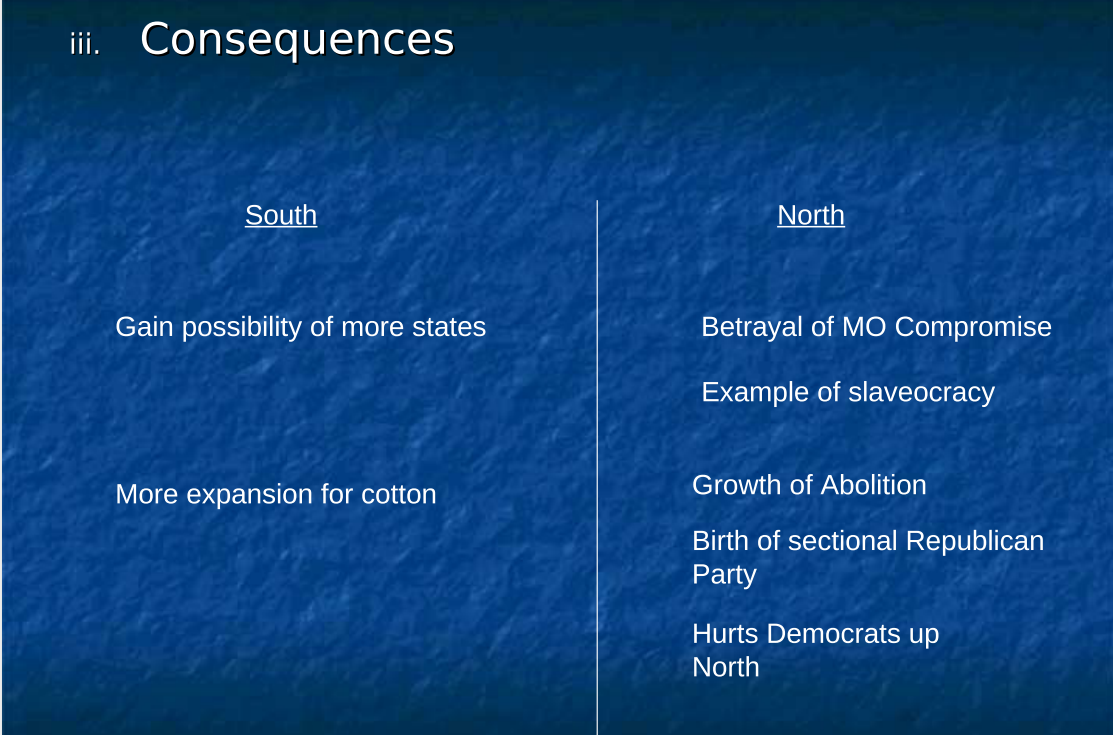
Accelerating Towards Disunion:
Uncle Tom’s Cabin: Written by Harriet Beecher Stowe, this book shows the inhumane treatment of slaves. Abolition grows.
Bleeding Kansas 1854-60: The Kansas territorial government was to be decided by popular sovereignty.
N.E. Emigrant Aid Company “Beecher's Bibles" (It’s a goddamn gun) were sent to Kansas to support anti-slavery settlers and promote the cause of abolition. The violent confrontations that ensued between pro-slavery and anti-slavery forces became known as "Bleeding Kansas," highlighting the deep divisions within the nation.
Additionally, this period was marked by heightened tensions and significant violence, as rival factions clashed over the future of slavery in the territories, leading to events such as the Sack of Lawrence, the beating of Preston Brooks with a cane by Charles Sumner, and the Pottawatomie Massacre.
Pottawatomie Massacre: John Brown. Crazy ass. Radical abolitionist. He slaughters pro-slavery members before disappearing back to his home.
Application for statehood 1857 & Results:
Lecompton Constitution: A pro-slavery constitution proposed for Kansas, which was heavily criticized for being drafted without proper representation from anti-slavery settlers. This led to significant national debate and opposition, ultimately contributing to the ongoing conflict over slavery in the region. Buchanan supports this… now, Kansas is a slave state.
Dred Scott 1857: A landmark Supreme Court decision that ruled African Americans could not be considered citizens, or people at all, and therefore had no standing to sue in federal court. If the Constitution says that nothing can tell you where to take your property, then all states are slave states! Oh shit. This ruling intensified the national debate over slavery and heightened tensions between the North and South.
E. Lincoln-Douglas Debates 1858: A series of seven debates between Abraham Lincoln and Stephen A. Douglas, focusing primarily on the issue of slavery and its expansion into the territories. Lincoln argued against the spread of slavery, while Douglas advocated for popular sovereignty, allowing states to decide the slavery issue themselves. These debates significantly raised Lincoln's national profile and became a pivotal moment in the political landscape leading up to the Civil War. “A house divided against itself will not stand.”
Harpers Ferry: In 1859, John Brown led a raid on the federal arsenal at Harpers Ferry, Virginia, in an attempt to initiate an armed slave revolt. His idea is to capture this arsenal, arm slaves, and lead them down to the south for a revolution. He’s unsuccessful. John Brown is tried and hanged for treason.
Election of 1860:
Candidates: Stephen Douglas, John C. Breckinridge, John Bell of TN, Lincoln
Republican Platform: Remnants of the Free Soil Party—against the expansion of slavery, pro manufacturers, pro immigrant, pro north-west farmers. This is a completely sectional party that is clear about its ignoring of the South. Free soil, free speech, free labor, free men.
Result: Abraham Lincoln won the election. It was viewed as an unacceptable result because not a single one of the southerners voted for him… it seemed way too rigged, which led to significant political and social upheaval, ultimately triggering the secession of Southern states from the Union.
The Deep South (TX, LA., ALA., MS, GA., SC, and FL) all seced due to this election. The Upper South (the remains of Virginia, Tennessee, Arkansas, and North Carolina) had a more complex response, as some states initially hesitated to secede.
Lincoln’s inauguration address emphasized the importance of preserving the Union, stating that he would not interfere with slavery in states where it already existed, but he would take a firm stand against further secession. “I will not interfere with the institution of slavery in the states where it already exists. I believe I have no lawful right to do so.”
Lincoln believed what the Deep South was doing was technically unlawful, and didn’t refer to them as the Confederacy. He just called them his dissatisfied nation.
Fort Sumter: War starts.
7 southern states had already left the union before Lincoln took office in March 1861. In his inaugural address, he pledged not to touch slavery, but he says they can’t just get up and leave. He ends up sending provisions (food, blankets, etc.) to Fort Sumter, which led to the Confederate force's attack, effectively igniting the Civil War. This “battle” also caused the rest of the South to secede. The South has now become the aggressor.
Lincoln is kinda like wtf. He claims he would preserve the Union at all costs, even if it meant going to war with the Confederacy. He doesn’t care about the slaves at this point. He just wants the union to be maintained, believing that the country must stay intact despite the growing division.
Border states: Missouri, Kentucky, Delaware, Maryland
Slave states that remain in the union
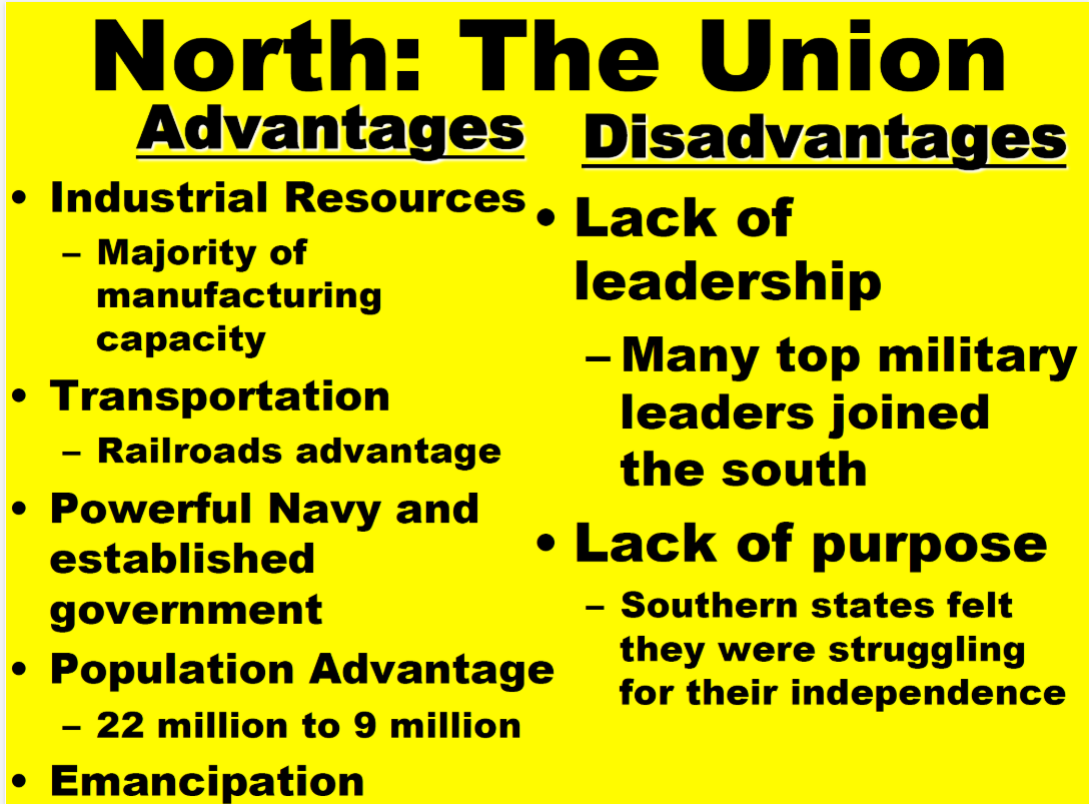
Reconstruction:
The Freedmen— Lincoln administration of 1865— banned slavery and involuntary servitude unless for crime punishment.
The Freedmen’s Bureau: March 1865
Purpose: Help former slaves and poor southern whites
Greatest success was in education (The Bureau taught an estimated 200,000 African Americans how to read)
The success? Planters resent the Bureau as an unwanted middleman. The next president, AJ (southern), won’t support the program.
Note: The Bureau and freedmen do not have the same goal! The Bureau aimed to provide assistance and support, while many freedmen sought true autonomy and independence from former slave owners.
Southern reaction: The white South resented the Freedmen’s Bureau as a meddlesome federal agency
Many former northern abolitionists risked their lives to help southern freedmen.
Defiance with the black codes: The purpose was to guarantee a stable labor supply now that blacks were emancipated. Southerners hoped to restore the pre-emancipation system of race relations and orders
Examples:
Prohibited African Americans from renting land or borrowing money to buy land
African Americans forced to sign labor contracts
African Americans can’t serve on a jury or vote
Many African Americans were forced to become sharecroppers
Allowed to use the land in exchange for giving a percentage of the crop to the owner of the land
Radical Republicans/Congressional Reconstruction
Radical Republicans: Desired to take away land from former Confederates and take away voting rights from them, too
Congressional Reconstruction: Wanted to limit or eliminate the black codes using federal laws… but the president didn’t approve.
Congress Breaks with the President:
Congress prevents Southern congressional delegates from coming back.
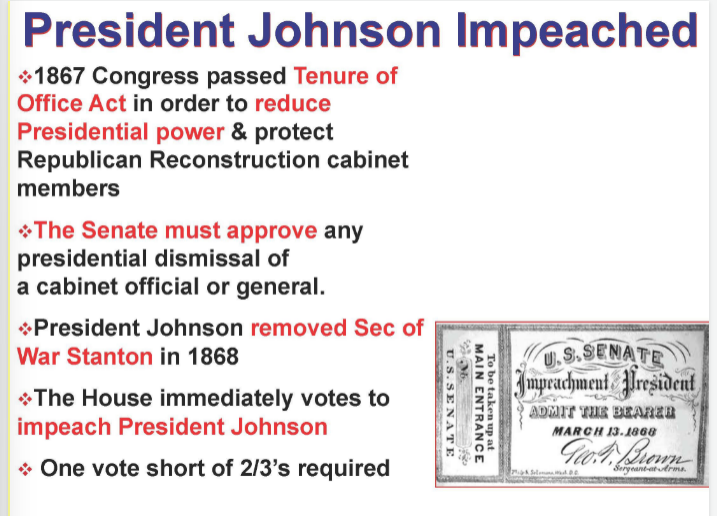
In February 1866, President Johnson vetoed the Freedmen’s Bureau extension - Congress passed!
Republican Republican-controlled Congress passed the Civil Rights Act of 1866. This gave citizenship to African Americans and sought to get rid of the Black Codes that restricted their rights. Johnson vetoes it.
Both bills were passed over the vetoes in Congress for the first time in history!
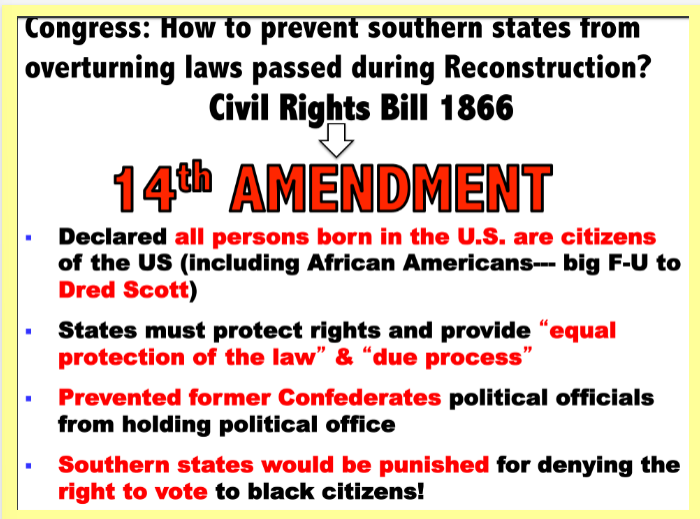
Reconstruction Act of 1867: 5 Military districts —> martial law. Temporarily disenfranchises prominent ex-confederate leaders. New conditions for re-admission in the 14th amendment. Male A-A suffrage in the state constitution.
Important amendments: 13th abolished slavery, 14th granted citizenship, and 15th is universal male suffrage.
Reconstruction Governments:
New electorate in the South as a result of the 15th Amendment and Congressional Reconstruction.
Republican coalition: A-A male voters, Scalawags (Southerners who agreed with the North), Carpetbaggers (Northerners who went south, either looking for profit or to help out freedmen).
The South temporarily experienced a social and political revolution with political members being replaced by A-As.
President Grant (1868-1876):
Civil War hero Ulysses S. Grant won the presidency for the Republican Party in 1868.
Temporary social and political revolution as black voters vote for republican candidates
Corruption during the Grant Administration:
Credit Modifier affair: VP and members of Congress involved in RR stock scandal
Whiskey Ring: 1875- Private Secretary of Grant helped steal 3 million from the fed government in a tax corruption scheme.
Grantism- a term used to describe corruption in politics.
Reconstruction falls apart:
The Ku Klux Klan was established to secure white supremacy and resist the Reconstruction government.
The Force Acts of 1870 and 1871 were intended to stop the resistance
Federal troops are sent in to stop the KKK
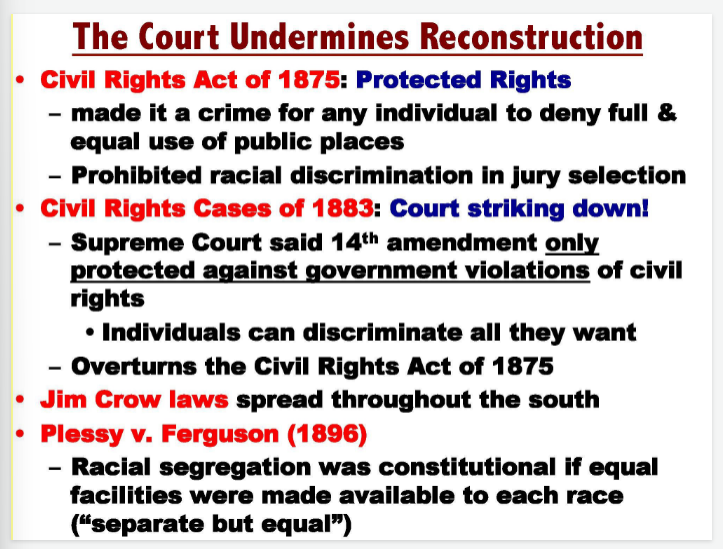
The Civil Rights Act of 1875 guaranteed equal access to public spaces. Protect the right to serve on juries.
Rarely enforced and eventually overturned by the Supreme Court in 1883
By the 1870s, Congress and President Grant would be unwilling to use the federal government to monitor southern society.
Federal intervention in southern society under congressional reconstruction yielded some short-term success.
The reunited Union opened up political opportunities for former slaves and temporarily rearranged the relationships between white and black people in the South
Civil war ended slavery and the idea of a divisible union, BUT left largely unchanged social and economic patterns. Rights might’ve appeared protected, but they were slowly stripped away with things like segregation and violence.
Election of 1876:
Republican Rutherford Hayes vs. Democrat Samuel Tilden.
Political controversy resulted in three southern states being contested.
The Compromise of 1877:
South/Democrats would recognize Hayes as President, Hayes would pull federal troops out of the South, and end Reconstruction
Hayes provided southern political positions (patronage) and federal aid for a transcontinental RR for the South.
Redemption:
Republican governments in the South gradually are replaced
A) White Democrats take the necessary loyalty oaths to amnesty laws —> B) White Democrats regain suffrage —> C) White Democrats regain majority —> Literacy tests, poll taxes, grandfather clauses, intimidation, and sharecropping all led to the A-A voting stop by now.
The Long Night: The Supreme Court and the civil rights cases claim it is legal for private citizens to discriminate. Southern democrats passed a series of laws that segregated all aspects of society (Jim Crow Laws -1890s)