Chemistry - lecture 3 - Molecular Shape, Molecular Forces and Non-Covalent Bonding
Learning Outcomes
Describe and explain the structure of simple molecules.
Apply MO theory to elucidate properties of molecular structures in biomolecules (e.g., peptide bonds, aromatic rings).
Use specific terminology when describing molecules and chemical bonding.
Catalogue different interactions in biomolecules.
Hybrid Orbitals
Definition: Atomic orbitals combine to form hybrid orbitals.
Hybrid orbitals offer better orientation for bonding than standard atomic orbitals.
Describes the orientation of bonding interactions.
Core Concept - Hybridisation:
Mixing of closely energy-aligned atomic orbitals (e.g., 2s and 2p) lowers overall energy.
Hybrid orbitals inherit characteristics of their constituent AOs based on mixing ratio.
Hybrid orbitals are directional, impacting molecular geometry.
Types of Hybridisation
sp3 Hybridisation
Occurs by mixing three p orbitals with one s orbital.
Forms four equivalent sp3 hybrid orbitals, arranged tetrahedrally (e.g., methane, alkyl carbons).
All hybrid orbitals possess the same energy level.
sp2 Hybridisation
Involves mixing two p orbitals with one s orbital.
Creates three sp2 hybrid orbitals arranged in a trigonal planar configuration, with the remaining p orbital perpendicular.
Key examples include C=C double bonds and C=O (carbonyl) groups.
sp Hybridisation
Results from mixing one p orbital with one s orbital.
Forms two sp hybrid orbitals arranged linearly, with two unhybridized p orbitals perpendicular to each other.
Important in triple bonds (e.g., carbon-carbon, cyanide (CN)).
VSEPR Theory
VSEPR = valence shell electron pair repulsion
Core Concept: Electron Pair Repulsion:
Analyzes arrangements of atoms around a central atom by minimizing repulsions among bonding pairs (σ bonds) and lone pairs.
Identification of hybridisation is based on the atom's valency.
Determining Geometry:
Count valence electrons from the periodic table.
Identify the number of bonds (single, double, triple).
Consider formal charges.
Example of methane (CH4):
4 valence electrons, 4 single bonds (AX4 structure).
Example of ammonia (NH3):
5 valence electrons, three bonds leave one lone pair (AX3E structure).
Relevant AXmEn Structures
Coordination number and Geometry:
Coordination (m+n)
No Lone Pair
One Lone Pair
Two Lone Pairs
2
Linear
--
--
3
Trigonal planar
Bent
--
4
Tetrahedral
Trigonal pyramidal
Bent (H2O)
Electron Pair Repulsion and Bond Angles
Influence of Lone Pairs:
Lone pairs exert stronger repulsion, altering bond angles (
e.g., tetrahedral 109.5°, NH3 at 106.8°, and H2O at 104.5°).
Carbonyl Group (sp2 Geometry)
Carbon and oxygen (O) are sp2 hybridised.
Bonding:
C-O double bond comprises a σ-bond and a π-bond, with C forming two additional σ-bonds.
Oxygen retains two lone pairs on its sp2 hybrid orbital.
Orbital energy mismatches lead to polarization in the bond.
Bond Rotations in Saturated Chains
Bond rotations: single bonds allow for free rotation where the bond connects.
Butane:
Demonstrates potential for "free" rotations about sigma bonds; can experience staggered or eclipsed conformations.
Staggered arrangements are lower in energy due to minimized steric clashes.
Restrictions to Rotations:
Steric hindrance, cyclic compounds, and adjacent π-systems limit rotational freedom.
Noteworthy Cases
Ethane
Preferred staggered configuration is attributed not just to sterics but also to hyperconjugation.
Bond Rotations – Multiple Bonds
Double/triple bonds restrict rotation due to presence of π-bonds, maintaining a nodal plane impeding rotation.
Rotation of two atoms and their orbitals will break the bond.
Peptide Bonds and Delocalisation
N typically displays sp3 hybridization but can also engage in sp2 hybridization, allowing resonance.
In peptide bonds, N, C, and O become sp2 centers, creating a planar structure.
Geometry of Peptide Bonds
All atoms connected to sp2 centers lie in the same plane, making the protein backbone a series of interconnected planes.
Ramachandran Plot
Dihedral angles illustrate limitations in configurations due to sterics and interactions.
Core Concept - φ and ψ angles account for the orientation of peptide planes in protein backbones, restricted by atom interactions.
Relative to peptide planes.
Limited by sterics, repulsion, and preferred interactions
Describing Molecular Geometry
Factors include:
Bond Length: Distance between bonded atoms.
Bond Angle: Angle between bonds at a central atom.
Dihedral Angles: Involves angles between planes formed by connected atoms.
Use of xyz coordinates offers insight into connectivity and molecular structure.
Bond Lengths
General trends:
Single > Double > Triple lengths.
Typically of order of one Angström (A) - 0.1 nm
Covalent radius influences the bond lengths so effective charge is significant.
Bond Angles
Defined by repulsions within bonding pairs and lone pairs (VSEPR).
General rules:
Bonds are symmetrically arranged around the central atom.
Lone pairs compress bond angles more than bonding pairs.
Sugar and Ring Conformations
Rings experience restricted motion; e.g., cyclohexane maintains distinct staggered conformations to minimize sterics.
Chair Conformation: Lowest energy state.
Boat Conformation: Higher energy state due to steric interactions and torsional strain, making it less favorable compared to the chair.
Methyl groups prefer equatorial positions to reduce steric repulsion.
Cyclic Sugars
Cyclic forms of sugars have distinct substituents and pucker conformations.
Examples: α-D-glucopyranose, β-D-ribofuranose, leading to characteristic structures due to spatial orientations.
Non-Covalent Interactions
Types of interactions include:
Hydrogen bonds, dipole interactions, dispersion forces, π-π interactions, and hydrophobic effects.
Van der Waals Forces
Collection of distance-dependent interactions between atoms and molecules that are independent of chemical bonding.
Induction (Debye) and dispersion (London) forces
Characteristics:
Weaker than covalent/ionic bonds.
Depend on distance and orientation of molecules.
Short ranged and usually non-directional.
Includes attractive and repulsive forces, some based on electrostatics.
Dipole Interactions
Dipole: two equal and opposite charges separated by some distance, leading to a directional field.
Molecular dipoles arise from geometric arrangements of electronegative atoms (e.g., water displays a net dipole).
Symmetric molecules (e.g., methane) may have canceled dipoles.
Multipoles: spatial distributions of charges that generate electric fields.
Monopole: a single point charge.
Permanent Dipole Interactions
Dipoles that exist due to the molecular geometry.
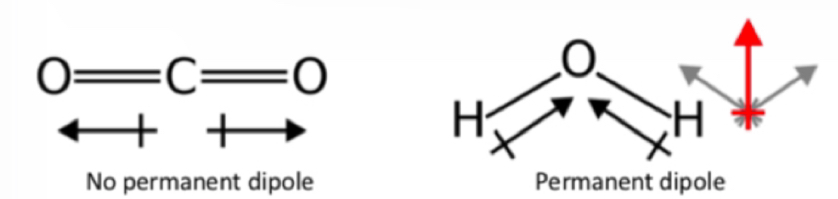
Molecules with permanent dipoles can interact, leading to dipole-dipole interactions (strength varies with distance).
Induced Dipoles
Neutral species can develop dipoles due to nearby charged species (permanent dipoles or ions), leading to Debye forces.
London Dispersion Forces
Caused by transient electron density fluctuations, leading to instantaneous dipoles.
Generally weak but significant in interactions among neutral molecules.
π-Interactions
π systems can interact attractively with other π systems through stacking (e.g., in biomolecule structures).
Aromatic compounds may exhibit quadrupole interactions with charged species.
Hydrogen Bonding
Formed between positively charged H and electronegative atoms, N or O.
Key to determining structural features in biomolecules (e.g., protein secondary structures).
Special Hydrogen Bond Interactions
C-H···O interactions:
Weak hydrogen bonds may form involving C-H groups if coupled with strongly electronegative atoms.
Salt Bridges:
Non-covalent, pH-dependent interactions in proteins between charged side chains.
Hydrophobicity
Hydrophobic regions tend to collapse in aqueous environments, preventing unfavorable interactions.
Hydrophobic behavior arises from minimized interactions with water; essential in biomolecular behavior.