Chapter 10 kai cards
Seven Muscle Functions
Movement of Body
Maintenance of Posture
Respiration
Production of Body Heat
Communication
Constriction of Organs and Vessels
Contraction of the Heart
Muscle Properties
Contractility - ability of a muscle to shorten with force.
Excitability - capacity of a muscle to respond to a stimulus.
Extensibility - muscle can be stretched beyond its normal resting length and still be able to contract.
Elasticity - ability of muscle to recoil to original resting length after stretched.
Define the following terms:
Fascia - a connective tissue that surrounds muscles, providing support and structure while allowing for movement between muscle groups.
Epimysium - a connective tissue that surrounds a whole muscle and has many fascicles.
Perimysium - a loose connective tissue surrounding a group of muscle fibers.
Endomysium - a loose connective tissue separating individual muscle fibers within each fascicle.
Complete Muscle Tetanus - no relaxation between contractions.
Incomplete Muscle Tetanus - partial relaxation between contractions.
Muscle Fatigue - Decreased capacity to work and reduced efficiency of performance.
Isotonic Contractions - change in length but tension constant
Concentric - overcomes opposing resistance and muscle shortens.
Eccentric - tension maintained but the opposing resistance is great enough to cause the muscle to lengthen.
Isometric Contractions - no change in length but tension increases
Known as postural muscles of the body
Motor Unit - A motor neuron and all the muscle fibers it innervates.
Muscle twitch -The response of a muscle fiber to a single action potential along its motor neuron.
Sarcomere - basic functional unit of muscle fiber; shortening causes muscle contraction.
Z disk - attachment point for actin
I band - section of actin from z disk to myosin
A band - entire myosin filament
H zone - region in a band where actin and myosin do not overlap.
M line - middle of h zone; delicate filaments holding myosin in place.
Atrophy - decrease is muscle size.
Hypertrophy - Increase in muscle size
Increase in myofibrils, nuclei, and strength
Fast Twitch Muscle Fibers contract quickly and powerfully but fatigue faster; have fewer mitochondria; associated with sprinter
Slow Twitch Muscle Fibers - contract more slowly, are more fatigue resistant, have more mitochondria, and are better supplied with blood; associated with endurance athletes.
Muscle Fatigue - decreased capacity to work and reduced efficiency of performance.
Sliding Filament Mechanism
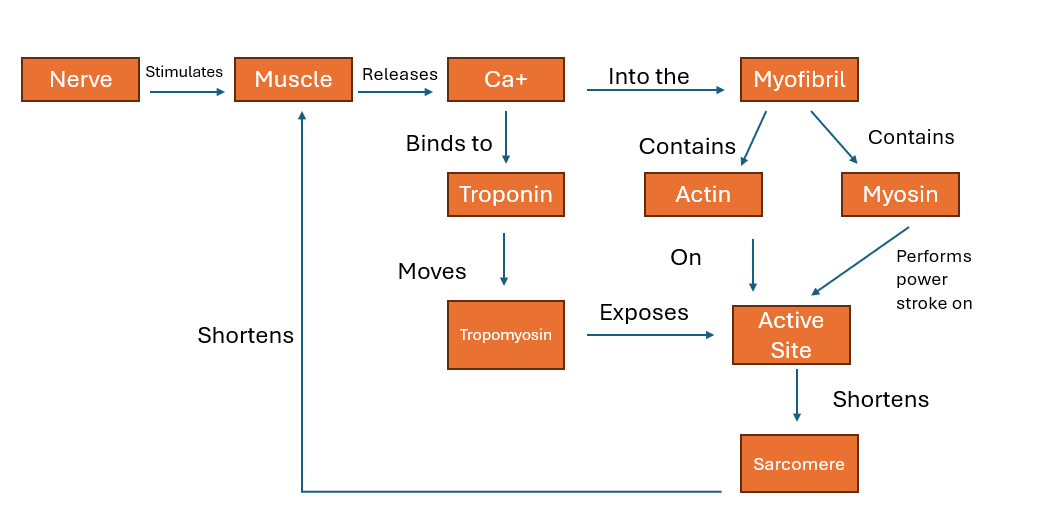
The process by which muscle fibers contract, involving the sliding of actin and myosin filaments past each other, resulting in shortening of the muscle.
During relaxation sarcomeres lengthen because of external force
Actin and Myosin do not change length
Tropomyosin - An elongated protein that winds along the groove of actin; regulates interaction between actin and myosin.
Troponin - attaches to the actin, tropomyosin, and calcium ions
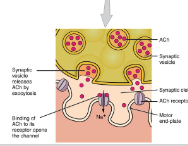
How are Muscle fibers stimulated to contract (NMJ)?
Motor neurons carry electrical signals called action potentials to stimulate muscle fiber action potentials followed by muscle contraction.
Points of contact between motor neuron and muscle fibers is the NMJ (aka synapse)
The NMJ consists of:
Presynaptic terminal - axon terminal with synaptic vesicles containing acetylcholine.
Synaptic cleft - space
Postsynaptic membrane (aka motor end plate)
Muscle twitch myogram and events occurring during three phases:
Muscle twitch is the response of a muscle fiber to a single action potential along its motor neuron.
Phases
Lag - from the stimulus to the beginning of the contraction.
Contraction - calcium is released and myosin performs the power stroke on actin.
Relaxation - calcium returns to the sarcoplasmic reticulum, and muscle fibers return to their precontraction state.
Motor Unit Summation and Wave Summation
Motor Unit Summation - the process by which multiple motor units are activated to produce a stronger muscle contraction, allowing for graded responses to varying levels of stimulation.
Wave Summation: muscle tension increases as contraction frequencies increase.
Muscle Fatigue Types
Psychological - depends on emotional state of individual.
Muscular - results from ATP depletion.
Synaptic - Occurs in NMJ due to lack of acetylcholine.
ATP Regeneration
Creatine Phosphate - a rapid, short term energy source where creatine phosphate donates a phosphate group to ADP to form ATP. Can support 10-15 seconds of high intensity activity.
Glycolysis - Glucose is broken down without requiring oxygen to produce ATP producing quick energy with lactic acid as a byproduct. Can support 1-2 minutes of activity.
Cellular Respiration - The most efficient and long-acting energy source. Oxygen is used to completely oxidize glucose, fatty acids, or amino acids in the mitochondria. Supports steady state, prolonged activities.