The French Revolution
Causes of the French Revolution
Social classes & inequality
1st estate: clergymen (church)
10% land ownership
No taxes
1% of the population
2nd estate: nobility (government and military)
wealthy, few taxes
owned country estates, used peasant workers
peasants had to pay taxes just to be able to work.
2% of the population
3rd estate: everyone else.
Bourgeoise professionals
merchants, factories, professionals.
Often enlightened by the ideas of the Enlightenment, thereby feeding the revolution. Desired better social status and political power.
Artisans & workers
shoemakers, carpenters, bricklayers, dress makers, laborers
sans coulottes (no knee bridges)
Always out of work, hungry.
peasantry
farmers
miserable & poor
unpaid labour
had to pay a 10% income tax to the church in addition to many other taxes.
→ resentment of the 1st and second estate.
International causes
Enlightenment
Philosophers promoted new ideas, people became enlightened.
Locke, Montesquieu, Rousseau
The bourgeoise took enlightenment ideas and thought about applications of them in France.
Ideas of life, liberty and prosperity became liberte, egalite, fraternite, (equality, liberty and brotherhood)
American Revolution
The French aided in America’s successful rebellion against the British monarchy, which was also inspired by enlightenment.
Great Britain
Great Britain also limited the power of its monarch through the House of Commons and House of Lords.
Famine & Financial Crisis
Debt & Borrowing
Due to the American Revolution, the French borrowed money like crazy. Most taxes and dues went to paying back the debt.
The King’s lavish lifestyle was not helping in optics and debt repayment. Thereby, driving up anger.
Louis XIV denied reforms to the financial structure.
Marie Antoinette became Madam Deficit because of gambling.
1787: Louis applies additional taxes to the 2nd estate but they refuse to pay.
France goes bankrupt; 50% of taxes were dedicated to debt repayment. Banks refused to lend money to France.
Famine
Weather events such as hailstorms and droughts ruined the harvest. A brutal winter in 1788 froze rivers and drove up the cost of bread.
Food scarcity → hunger → misery → anger
Revolution: a major change, such as the overthrow of one kind of government in favour of a different kind.
Republic: a form of government in which citizens, not a monarch or dictator hold the power to govern.
As a result of the French revolution, French people changed their country from an absolute monarchy to a republic. France was originally a nation state, however it was not a nation because nobody had belonging.
The Old Order - Ancien Regime
Estates: social classes. 3rd estate made up 97% of people in France.
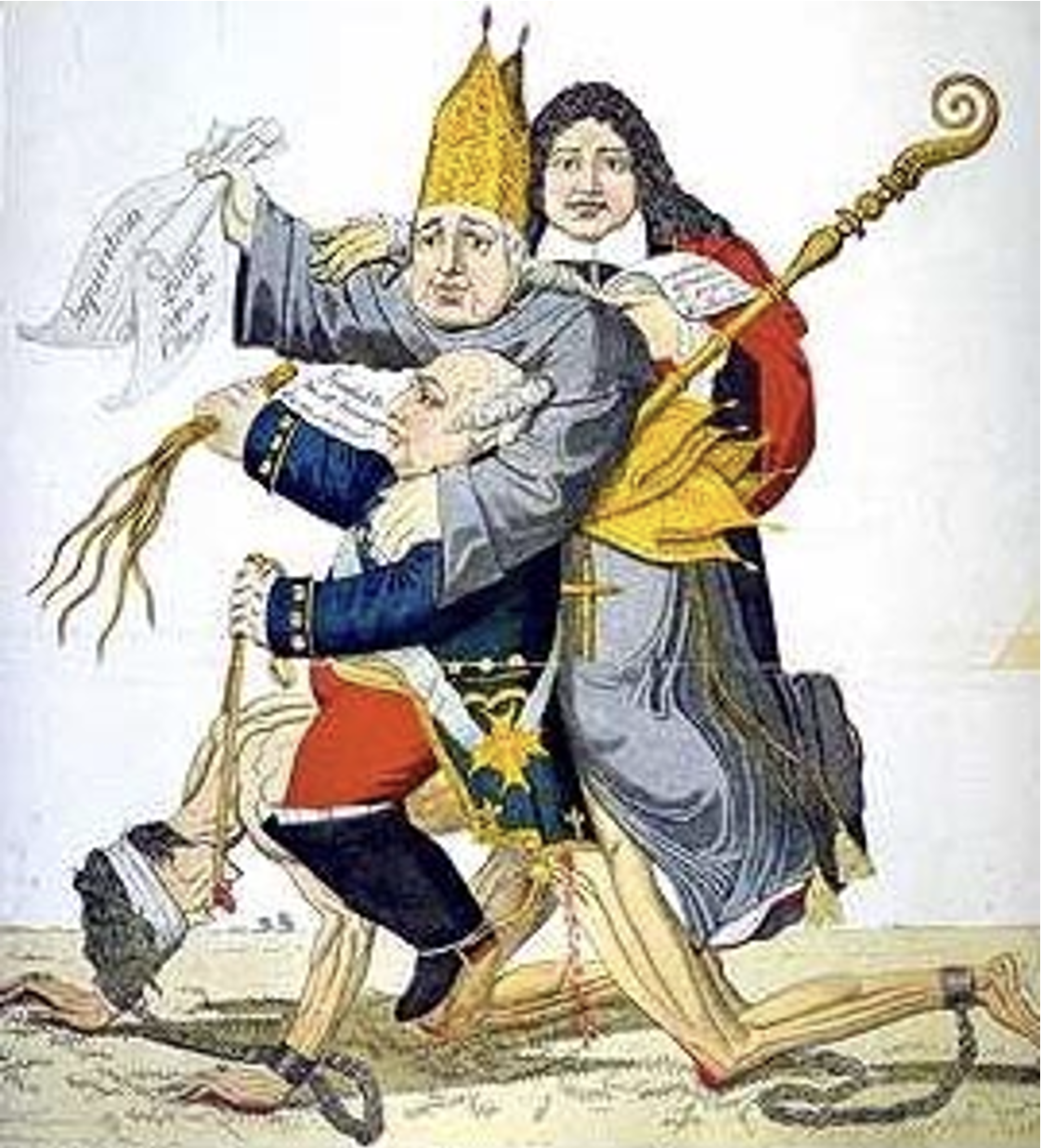 Often, there were depictions of the 1st and 2nd estate trampling upon the 3rd estate, who was bound by shackles.
Enlightenment Ideas
New ideas about power and government spread.
The American revolution inspired the 3rd estate
Questioned the absolute monarchy and the lack of equality.
Began to demand equality, liberty and democracy.
Voltaire
the worth of reason
social progress could be achieved through reason and that no authority should be immune to challenge by reason.
tolerance, including religious tolerance.
Locke
everyone are free and equal peoples, therefore rulers need consent to govern.
society is a social contract, government secures rights to life, liberty and property.
citizens cannot fully give up their authority, so citizens must retain the right to determine whether government is infringing on rights.
Forces of Change
Economic issues
high 3rd estate taxes
high cost of living, crop failures → bread price doubles and is equal to a month’s pay
the debt crisis due to the American revolution
made worse by lavish lifestyles.
1786: banks refused to lend money to the King.
weak leadership.
Dawn of the REVOLUTION - June 1789
the Estates General meets for the first time since 1614.
in the Estates General, each estate receives 1 vote, thereby increasing inequality.
the National Assembly is urged to reform laws in the name of French people.
June 17, 1789: the National Assembly is formed: the first deliberate act of the revolution.
The Tennis Court Oath
the Tennis Court Oath: an oath taken by the bourgeoise and other social classes when delegates were locked out of their meeting room.
to continually meet until a new constitution is formed.
in response, Louis XIV stations the Swiss Guard around the palace.
The Storming of the Bastille - July 1789
Rumours spread that the king will use military force to dismantle the national assembly and that foreign troops would be used to massacre French citizens.
Citizens search for weapons at the Bastille.
The mob overwhelms prison personnel and are successfully able to steal gunpowder. Prison personnel are knocked dead, heads paraded around on sticks.
the Fall of Bastille becomes the great symbolic act of revolution.
A national French holiday, in which France believes it became a nation.
The Great Fear - July 1789
Rebellion spreads to the French countryside. Rumour circulates that nobles will hire outlaws to terrorize peasants.
Panic spread, thereby creating the Great Fear.
Peasants became outlaws, breaking into Noble residences and burning records and homes.
August 4th, 1789: intimidated by the Great Fear, noblemen declared their love of liberty and equality, joining together with the National Assembly to abolish feudalism. THE DEATH OF THE ANCIEN REGIME.
Declaration of Rights & Man
Embodied principles of the US and Canadian constitutions, from enlightenment ideas.
All men equal under law
Outlined the purpose of government
Outlined natural rights
Outlined freedoms of religion & speech
Ended feudal privileges
Developed a fairer tax system.
Civil Constitution of the Clergy
National Assembly voted to confiscate all church lands. Catholic Church was put under state control.
Bishops & priests became elected and salaried officials.
Papal authority & monasteries dissolved.
alienated peasants
condemned by Rome
when the government punished the church, a huge gulf emerged.
New Constitution
For two years, the Nat’l Assembly argued over a new constitution. Finally, in September 1791, a new constitution was formed.
It limited constitutional monarchy.
Officially developed the Legislative Assembly.
Legislative Assembly Factions
Jacobins: left wing radicals. Abolish ALL monarchy.
Girondists: centrists, moderates.
Conservatives: right wing, constitutional monarchy.
Outside France
Reactionaries: royalists
Sans culottes: urban workers who wanted a republic
Emigres: royalists that fled France.
Louis XVI’s attempted escape (1791)
Advisors warned Louis to escape France. He attempted to do so through the Austrian Netherlands but was apprehended at the border.
The escape increased the influence of radicals in the government.
Foreign Powers
Other monarchs around Europe felt threatened by the “French Plague” and Emigre horrors.
Therefore, they set the objective to restore the French monarchy and halt the revolution.
Brunswick Manifesto: harm the royal family and Paris would be burnt down.
This convinced French people that the king colluded with the rest of Europe and the National Assembly declares war.
War & the September Massacres
France declares war against other European nations. Begins poorly.
The Brunswick Manifesto backfires upon those European nations.
Mobs invaded the Tuileries Palace.
Formation of a New Government
Due to the war, the radicals took over the Legislative Assembly in a coup.
They dissolved/set aside the new constitution and called for a new government.
The National Convention & The Reign of Terror
Therefore, the national convention was formed.
Accomplished objectives were to abolish the monarchy, dissolve the assembly and establish a republic.
A radical group known as the Jacobins dominated the National Assembly.
Jean-Paul Marat called for the execution of anyone who supported the King.
George Danton, leader of the uprising against the king & a professional orator demanded death.
Maximilien Robespierre
A Bourgeoise who turned into a radical Jacobin.
Desired to create a “republic of virtue” based on reason, wiping out every trace of France’s past.
New calendar, no sundays, churches closed in Paris.
Notre Dame cathedral became a temple of reason.
Dechristianization of France
Convention believed that the church promoted superstition.
Saints removed from street names.
Churches pillaged for valuables.
New calendar formed, 10 months, 30 days, every 10th day a day off.
Calendar began with September 22nd - the first day of the republic.
Months were renamed with agric themes.
Committee of Public Safety
Implemented to protect the revolution from it’s enemies and implement the revolution’s ideals.
Enemies:
anyone who challenged his leadership or were less radical.
18 - 40,000 executed
85% were peasants, members of the urban poor or middle class who the revolution was waged for.
Robespierre became a dictator.
Any reactionaries or counterrevolutionaries were killed by guillotine.
Justified the use of terror ideologically.
Execution of Louis XVI
King Louis was executed because the Brunswick Manifesto was very provocative against French peoples.
It leant credence to suspicions that the king was actively involved in counter-revolutionary activities, thereby acting against the revolution.
Ending the Reign of Terror
The National Convention had realized that the revolution had run amuck.
Members of the National Convention developed fear for their lives and turned on Robespierre who was then executed.
The radical phase of the Reign of Terror ended on July 28, 1794
Moderates then drafted a new form of government for France: The Directory
A two-assembly chamber
Power concentrated into 5 men known as the Directory.
Napoleon Bonaparte then overthrows them.