Minerals
A mineral is:
naturally occuring
solid crystal substance
inorganic
Specific chemical composition
Minerals are formed by geologic processes like:
liquid magma into solid material
“Building blocks” of rocks
Naturally occuring
| Ordered internal Structure
|
Inorganic
|
Examples of Minerals
Pyrite, Kyanite, Ice
Cube Zirconia and glass atoms aren’t minerals
Elements, Minerals, and Rocks
Crust is made of various rock types
Rocks are made up of bonded material (minerals usually)
Minerals are made up of elements
Elements are made of atoms
Atoms
Consist of subatomic particles (protons, neutrons, electons)
Protons/neutrons in nucleus, electons orbit
Ionic Bonding
Transferring of electrons
Covalent Bonding
Sharing of electrons
The atoms and how they are arranged determine the mineral’s shape
Ex. Silicate Mineral Structures
How do Minerals Form?
Minerals From Magma
Liquid rock made up of atoms with many different elements
Magma cools, atoms bond together forming repeating networks of multiple elements (Crystallization)
From Precipitation Out of Water
Minerals “undissolve” out of water
When ions that form in water becomes too concentrated, atoms increase and bond together
Crystallization and form new minerals (think of rock candy growing
Since minerals are solid, they collect on the waters bottom
From Increased Pressure and Temperature
Pressure and temperature increases to a point where original bonds become unstable, then atoms rearrange to form stable new bonds
Mineral Groups
Silicates
Most abundant minerals in Earth’s crust (making up of most rocks)
Fall into 2 categories: without iron (Fe) & magnesium (Mg) or with both
Ferromagnesian silicates – Olivine Family
Dense, dark-colored ferromagnesian (mafic) silicate
Contain iron, magnesium, or both combined with other elements
Iron (Fe) and magnesium (Mg) can freely substitute for each other in the crystal structure.
Because of this substitution, olivine is a mineral family
Ferromagnesian silicates – Pyroxene
Typically black or dark green,
Have a complex chemical composition that includes iron, magnesium, and aluminum.
Ferromagnesian silicates – Amphiboles
Composed of iron, magnesium, aluminum, and other cations bonded with silica tetrahedra
The most common amphibole, hornblende, is usually black but can vary in color.
Nonferromagnesian silicates
Lack iron and magnesium; may contain aluminum, calcium, potassium and/or sodium
Often light colored (white, light gray, or pink)
The most common examples: Quartz and feldspar group
Quartz
Made of a three-dimensional framework of pure silica tetrahedra, with no other elements present in its ideal form.
Feldspar
The most abundant mineral group in the Earth's crust (~50%)
Like quartz, it has a three-dimensional framework structure.
Two main types: One containing potassium found in continental crust rocks (alkali feldspar or orthoclase feldspar.
The other with sodium and calcium common in oceanic crust rocks (plagioclase feldspar).
Carbonates
Contain both carbon and oxygen
Examples: Calcite, Dolomite
Abundant in Earth’s crust, common in limestone and Dolomite
Forms with ionic bonds and acids break them apart
Forma ions, water molecules, and CO2 gas
Oxides
Ores of many important metals
Compounds of oxygen anion and metallic cations
Examples: Hematite and Magnetite
Sulfides
Ores of many important materials
Chalcopyrite– Source of about half of our copper–One of the most important industrial metals
Compounds of sulfide anion and metallic cations
Pyrite–Fe2S
Sulfates
Compounds of sulfate anion and metallic cations
Gypsum– Ca sulfate + water
Precipitation out of water
Native Metals
Metals
Occur in nature
How do I Know What Mineral It Is?
Minerals: Diagnostic Properties
To identify minerals we rely on physical, observable properties:
Color
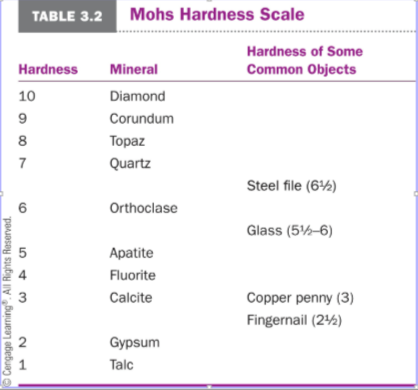
Hardness – Indication of chemical bond strength
Cleavage - Planes of weakness
Fracture – no preferred planes of weakness
Luster – ability to reflect light
Streak – color of powder
Crystal shape (habit)
Transparency
Density - Mass per volume (g/cm3), Atomic weights of atoms, Packing
Reaction to acid
Even taste!
How Do We ID Minerals?
Color
Luster (Light reflection)
Streak (Color showing when rubbing a mineral on a surface)
Hardness
Cleavage (Breaking into flat surfaces along planes of weak bonding
Fracture (no plane or weakness)
Specific Gravity and Density
Specific gravity - ratio of weight of material to equal amount of volume
SG = Density of substance/Density of water