Endocrine System
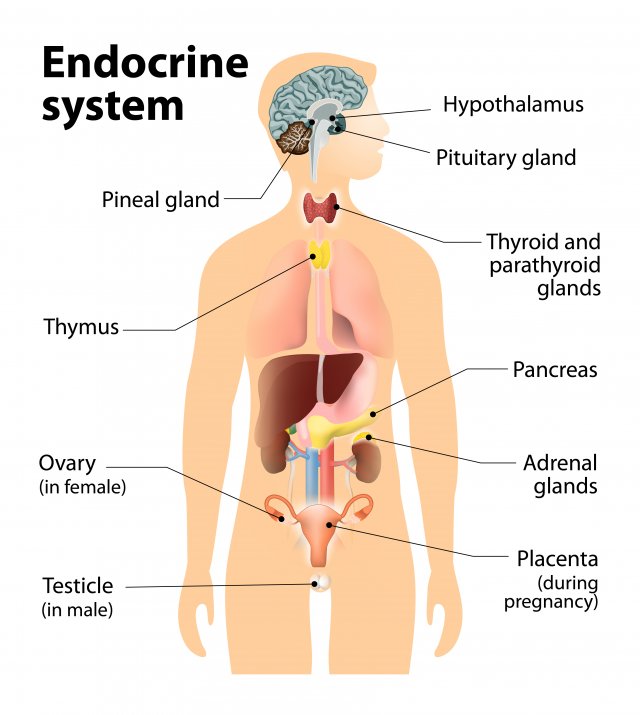
Hormone
Hormone: a chemical messenger that is produced in one region of the body, an endocrine gland, and affects a different body region, its target tissue.
Endocrine gland: secretes a substance directly into the bloodstream for distribution around the body (e.g., pancreas, thyroid gland).
Exocrine gland: secretes a substance through a duct into a cavity for use in a specific place (e.g., salivary glands & gastric glands).
Hormones bind to a receptor on (or in) their target cell, and cause a chemical reaction to occur inside the cell, which wasn’t happening before.
Deactivate or activate existing enzymes
Cause particular genes to turn on, and thus, initiate the synthesis of an enzyme, which wasn’t present before.
Difference between protein and steroid hormones
Not much, except that protein hormones require a receptor protein to be on the surface of the cell membrane, while steroid hormones pass directly through the cell membrane.
Steroid hormones still bind to a receptor present in the cytoplasm of the cell.
Some endocrine glands
Anterior pituitary | Posterior pituitary |
Thyroid (thyroxin) | Adrenal medulla (adrenaline) |
Pancreas (insulin) | Adrenal cortex (cortisol & aldosterone) |
Testis (testosterone) | Ovary (estrogen and progesterone) |
Pituitary gland
The hypothalamus detects when the homeostatic balance is disturbed.
With the help of the pituitary glands, the hypothalamus regulates heart rate, body temperature, and water balance.
The pituitary gland is divided into 2 lobes: the posterior pituitary and the anterior pituitary.
Posterior pituitary
Stores 2 hormones received from the hypothalamus when the hypothalamus detects a need for these hormones.
Antidiuretic hormone (ADH) causes you to retain more water in the urine.
Oxytocin causes uterine contraction.
Anterior pituitary
Responds to hormones from the hypothalamus that signal the anterior pituitary to release a hormone or stop releasing a hormone.
Hypothalamus produces the hormone TRH (thyroid-releasing hormone).
TRH causes the anterior pituitary to release TSH (thyroid-stimulating hormone).
TSH causes the thyroid gland to release thyroxin.
Thyroxin acts on most of the cells in your body and causes them to make more respiratory enzymes, so they then increase the amount of O₂ taken up and the amount of ATP produced.
Produces growth hormone (acts on bones and muscles) and the gonadal hormones (acts on gonads - testes & ovaries)
The hypothalamus and the anterior pituitary glands control the release of hormones from all of the endocrine glands in the body.
The negative feedback mechanisms control the release of hormones.
Hormones are released until homeostasis is achieved.
At homeostasis, the release of hormones stops.
→ Ex: The release of insulin and glucagon maintains homeostasis in blood sugar levels.