CÁC DẠNG TASK 1
1) BAR CHART
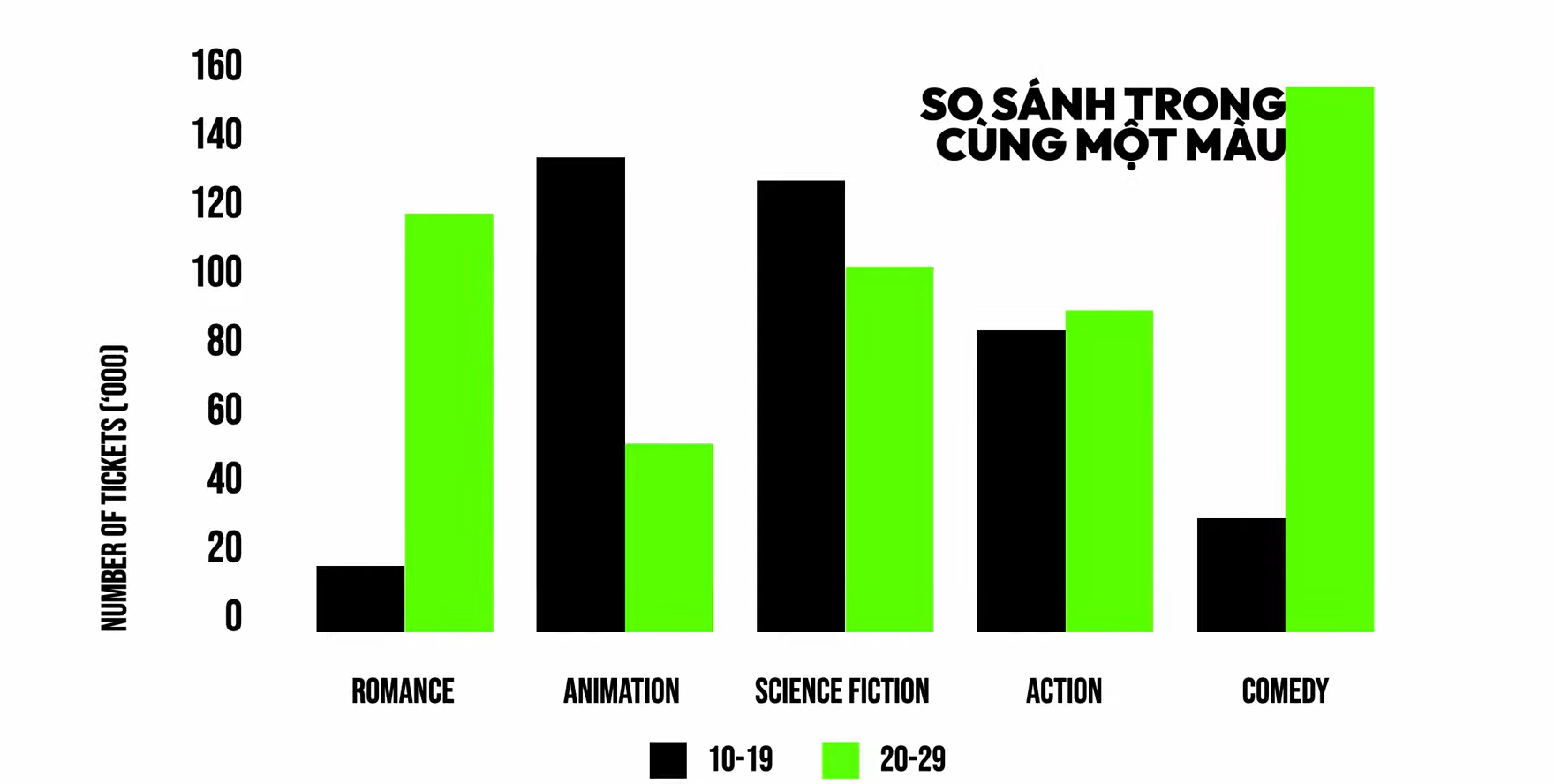
Đề: The bar chart compares the unit sales of tickets between two age cohorts at the August Cinema in 2020.
Bar chart: So sánh cao - thấp.
Line chart: So sánh tăng - giảm.
OVERVIEW
Màu sắc:
So sánh các cột cùng màu - xác định hai cột cao nhất: Đen - Animation; Xanh - Comedy.
So sánh giữa hai màu: 20-29 cao hơn ở 3 nhóm - romance, action, comedy. 10-19 cao hơn ở 2 nhóm - animation, science fiction.
=> Overall, animated films recorded the highest sales among people from 10 to 19 years old, while comedy movies achieved the highest number of sales with the 20-29 group. Additionally, the figure for the 20-29 age bracket was higher than that of the 10-19 age group in most categories, except for animation and science fiction which showed a reverse pattern. (7.0)
=> [Kể chuyện]: Overall, children and teenagers from 10 to 19 years old were more attracted to animated movies, whereas young adults aged 20 to 29 favored comedy. Additionally, the older age bracket generated higher sales across most given genres, except for animation and science fiction which were chosen more by the younger age group. (8.0)
*Giải nghĩa của đề bài theo logic tiếng Việt từ danh thu => sở thích.
BODY
Chia đoạn: Chia theo màu.
Chia đoạn bám theo overview → so sánh (8.0) → topic sentence: giới các categories và lý do tại sao lại chia như vậy.
Báo cáo từ cao xuống thấp: Comedy → action → romance.
Comedy 20-29 có danh thu cách xa nhất so với 10-19 (gấp 5 lần)
Romance, action and comedy appealed more to the 20 to 29 age group. Notably, the largest sales difference between the two cohorts was documented in comedy, where an approximate 150,000 tickets were sold to moviegoers in their twenties, which was around five times the figure for those aged 10-19. Similarly, romantic movies showed a contrast in preferences between the two age groups, with a significant number of roughly 115,000 tickets being sold sold to the older to the older audience, yet only about 15,000 to the younger one. In contrast, action movies were the genre that exhibited the most balanced admissions, with 80,000 and around 85,000 tickets for both groups, with sales in the 20 to 29 bracket being slightly higher.
Animation and science fiction movie sessions were purchased more by those aged 10 to 19. Although the highest sales in this cohort were recorded for animation at approximately 130,000 tickets, this type of movie experienced the lowest seats sold to the 20-29-year-olds at around 50,000. Lastly, science fiction movies attracted a relatively high number of both the younger and older cohorts, with their respective sales reaching a total of roughly 125,000 and 100,000 tickets.
2) TỪ VỰNG
Ổn định | a plateau | plateau |
a steadiness | remain steady | |
Giao động | a fluctuation | fluctuate |
Cao nhất | a peak | peak at, reach a peak of |
Thấp nhất | lowest point | hit the lowest |
Nhanh | dramatic | dramatically |
rapid | rapidly | |
significant | significantly | |
Trung bình | Noticeable | Noticeably |
Moderate | Moderately | |
Chậm | Gradual | Gradually |
slight | slightly | |
while Group | whereas, meanwhile Cohort, bracket, category |
3) PIE CHART
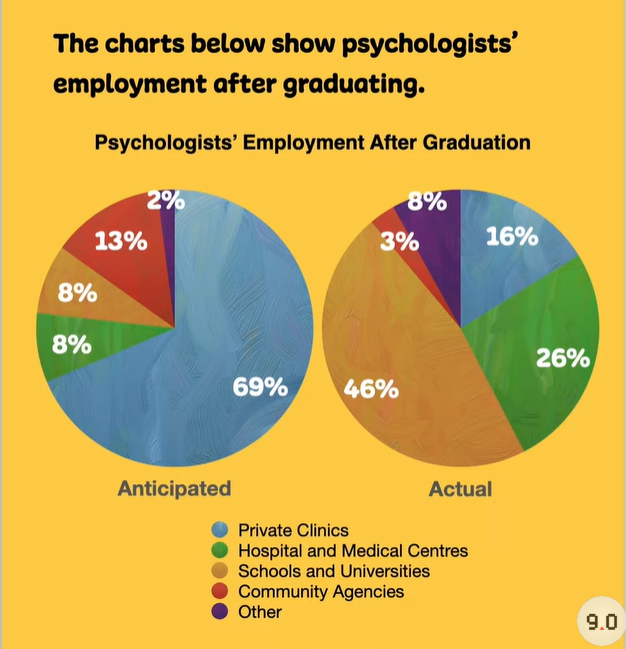
Pie charts tĩnh (trong một thời kì), trên biểu đồ không có năm → dùng hiện tại.
Introduction: The pie graphs illustrate the expected and factual working agencies of psychology learners after course completion
→ Giới thiệu dạng biểu đồ, giới thiệu thông tin trên câu hỏi, cung cấp thêm thông tin không được nhắn đến trong câu hỏi (factual, expected).
CƠ BẢN: BÁO CÁO SỐ LIỆU
Overview:
account for, comprise, make up, represent, consists of, is
primary, major, largest, highest
proportion, share, rate, percentage
Số lớn nhất của từng chart
Overall, private clinics represent the major expectation, while psychologists are primarily employed in schools and universities.
Body:
Regarding, in terms of, concerning, as for
báo cáo số liệu từ cao xuống thấp, nên nhóm các số liệu
100%: every, all - 75%: three quarters - 50%: a half - 33%: about a third - 25%: a quarter - 0%: no, none
unidentified/ other categories
Regarding expectation, 69% and 13% of future psychologists predict that private clinics and community agencies will be their working sectors, respectively; which are the highest results. This is followed by comparable percentages of hospitals or medical centers and schools or universities at 8%. Moreover, an insignificant share of 2% of potential psychologists forecast that they will pursue other lines of work.
In reality, educational institutions are the workplaces of nearly half of psychologists, whereas slightly over a quarter are hired by hospitals and medical centers. The figure for private clinics is 16&, which is precisely double that of the unnamed employers. Finally, only 3% actually work for community agencies, representing the lowest figure.
NÂNG CAO: PHIÊN DỊCH SỐ LIỆU
→ Kể ra tình hình biểu đồ đang đề cập.
Overview:
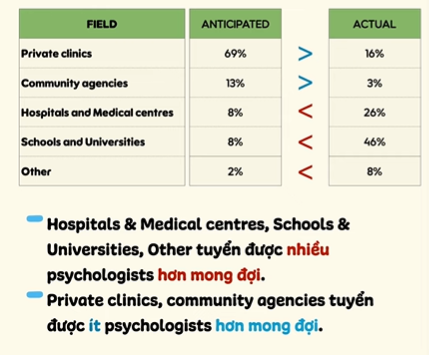
Overall, most sectors receive a higher percentage of psychological employees than expected, except for private clinics and community agencies. Additionally, although private clinics represent the major expectation, psychologists are primarily employed in schools and universities.
Body:
Regarding the two most anticipated categories, 69% of future psychologists expect to work at a private clinic; however, only 16% of them fulfill this expectation. Moreover, only 3% work for community agencies, despite the fact that these facilities are predicted sectors of 13% surveyed individuals.
Concerning the remaining categories, educational institutions and hospitals or medical centers each represent the future workplaces for 8% of psychologists’ expectations. In practice, a high of nearly half are hired in schools and universities, whereas a quarter joined medical facilities. Finally, an insignificant share of 2% of potential psychologists forecast that other lines of work will be their future career, meanwhile, this figure increases to 8% in reality.
4) MAP
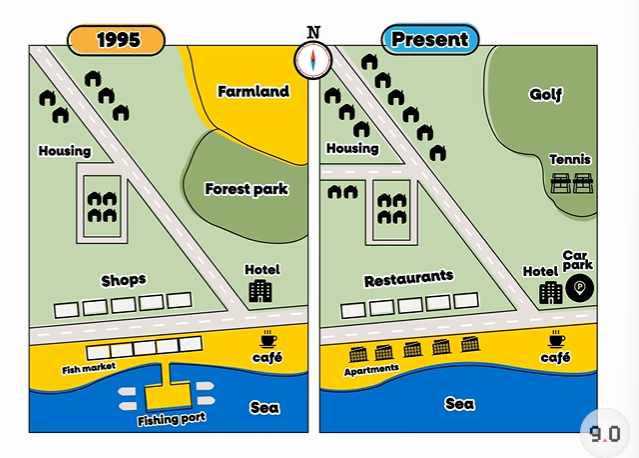
The map below shows the development of the village of Ryemouth between 1995 and present.
Introduction:
Chú ý paraphrase từ của đề bài “development” danh từ → động từ và ngược lại.
development = change = transformation…/ has developed = has changed = has transformed…
Đề để “present”
→ The two maps illustrate how Ryemouth village has changed over the past thirty years.
Overview:
Tổng quan - Nhìn mục đích của khu vực: Dân cư, nông nghiệp, công nghiệp, giải trí, nghỉ dưỡng, giáo dục, đa chức năng,… → có sự thay đổi mục đích giữa hai bản đồ → so sánh sự khác nhau của hai mục đích → chuyển đổi, tăng cường mục đích, vừa tăng cường vừa bổ sung thêm mục đích.
Chi tiết hơn: dân cư, tiện nghi, thêm bớt tiện ích.
predominantly = mainly = mostly
→ Overall, the area has shifted from a predominantly rural and fishing-based settlement to a more urbanized and recreational-orented region. The key changes include the expansion of housing, the introduction of new amenities, and the complete elimination of all farming and fishing activities.
Body:
Miêu tả cảnh: vị trí quá khứ, thay đổi ở hiện tại.
Chia đoạn
Thời gian: Đoạn 1 - vị trí quá khứ, đoạn 2 - thay đổi hiện tại.
Khu vực: Khu vực 1 - quá khứ hiện tại, khu vực 2 - quá khứ hiện tại.
Vật thể + vị trí cụ thể.
in | nơi rộng lớn | the dorm is in the north of the campus |
from | chạy từ đâu tới đâu | the dorm stretches from the north to the east of the campus |
to | ở hướng nào so với | the dorm is to the south of the campus |
at | vị trí cụ thể | the dorm is at the western gate of the campus |
on | ở ranh giới | the dorm is on the northern edge of the campus |
dominated: bao phủ
feature
bisect: divided into 2 equal parts
whilst: when; while
located at = situated at
converted into
replace
completely removed
The two maps illustrate how Ryemouth village has developed over the past thirty years.
Overall, the area has shifted from a predominantly rural and fishing-based settlement to a more urbanized and recreational-oriented region. The key changes include the expansion of housing, the introduction of new amenities, and the complete elimination of all farming and fishing activities.
In 1995, the northeastern section was dominated by farmland and a forest park with trees in the east, while the west featured a residential area, with a road from the northwest to the southeast of the village bisecting these two areas. The dwelling area consisted of two distinct zones, one along the road and another enclosed by its own road. To the south of this area, a coastal road runs from the west to the east. A line of shops was located at the western end of the road, whilst a hotel was situated at the other end, all positioned north of this road. The southern side of the village used to feature a fish market and a cafe across the coastal road, positioned opposite the shops and the hotel, respectively. Finally, The fishing port is in the sea to the south.
In the present, the residential area has expanded with more houses, with a new road leading to the west outside the village. The farmland and the forest park have been converted into a golf course and tennis courts. Moreover, restaurants have been opened to replace the shopping area, while the hotel has been equipped with a new car park to its east. There has been a conversion of the fish market into seafront apartments, and the fishing port in the sea has been completely removed.
5) PROCESS
The diagram show how a biofuel called ethanol is produced.
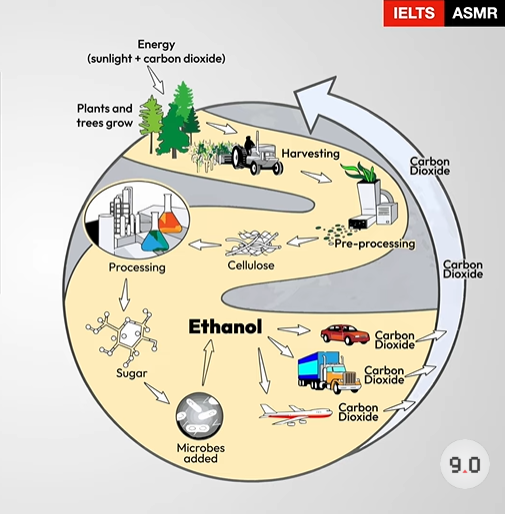
Introduction: Process lặp lại.
produce: manufacture
→ The illustration demonstrates the cycle of manufacturing ethanol.
Overview:
Chia process thành 3 phần: đầu giữa cuối.
Overall, the process begins with ĐẦU, followed by GIỮA, and ending with CUỐI.
Giữa: Lúc nguyên liệu gốc biến đổi.
sequence: dãy → which have a particular order and which lead to a particular result.
Đầu: energy → trees
Giữa: trees → cellulose
Cuối: ethanol → vehicles
Đếm bước.
→ Overall, there nine steps in the sequence, starting with energy being absorbed by vegetation, followed by the conversion of energy into cellulose, and ending with produced ethanol being used by various types of vehicle.
Body:
Đầu → giữa: 1 → 4.
Giữa → cuối: 5 → 9.
____
Regarding the first four steps,…
(Mục tiêu biến đổi nguyên liệu gốc)
The first four steps involve the transformation of the raw substance.
convey: đưa vào.
extract: chiết, a substance that has been obtained.
→ The first four steps involve the transformation of the raw substance. Initially, plants and trees absorb energy which includes sunlight and carbon dioxide from the atmosphere. After this, vegetation is harvested by agricultural machinery and conveyed into a chipping machine. Subsequently, cellulose is extracted, ready for the next stage.
____
Turning to the remaining steps,…
The remaining steps produce a biofuel called ethanol.
undergo: experience
→ The remaining steps produce a biofuel called ethanol. The collected amount of cellulose undergoes a chemical process to create sugars. In the following step, the sugars are combined with microbes, resulting in ethanol, which is utilized to power vehicles including cars, lorries and aircrafts. These vehicles in turn release carbon dioxide into the air as the ethanol combusts in their powertrains, which is absorbed by plants and trees, renewing the cycle.
________________________
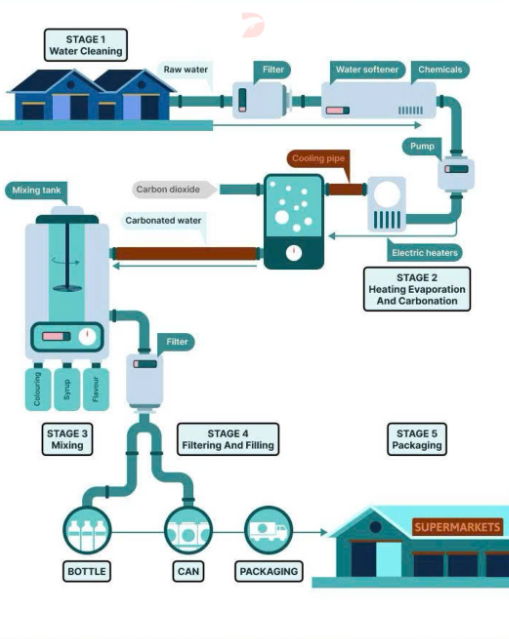
The diagram shows the process of manufacturing bottles and canned water.
Những bài nhiều bước → nhóm các bước chi tiết thành 1 giai đoạn
Câu chủ đề giới thiệu mục đích cuối của giai đoạn
The illustration demonstrates the sequence of producing bottles and canned carbonated water.
Overall, five primary stages are employed in the process, which start with raw water filtration and progress through carbonation, concluding with the distribution of the final products to retail outlets.
The first two main stages aim to produce carbonated water. Initially, raw water is drawn from factories and sent through pipelines to undergo filtration. After this, it arrives at a dual-purpose station that softens and chemically treats the filtered water, before being pumped to electric heaters to evaporate. The temperature is subsequently reduced by a cooling pipe and the treated water flows into a tank, where it is infused with carbon dioxide to produce carbonated water.
Bottles and cans of water are the results of the remaining stages. Carbonated water is conveyed to a mixing tank, where it is stirred with additives including colorants, syrup, and flavour from connected containers. After blending, the mixture undergoes another filtering process, before being packaged into bottles and cans, which are finally boxed and shipped via lorries to supermarkets for consumer purchase.