Multiple stressors
what is a stressor?
stressor → it is anything that causes stress - a physiological or ecological disruption - to an organism, population, or an ecosystem
examples of stressors:
temperature change
pollution
hypoxia
acidification
pathogens
fishing/predation risk
organisms try to maintain homeostasis to combat against these stressors
however stressors push organisms away from homeostasis causing a physiological cost
performance curve
every organism has na optimal range where performance is highest (growth, survival reproduction). Outside this range, both low and high extremes cause stress
drivers → a chemical or biological agent, environmental condition, external stimulus, or an event seen as causing a positive or negative change to an organism.
environmental factor that pushes organism toward optimal range
stressor → a chemical or biological agent, environmental condition, external stimulus, or an event seen as causing stress to an organism
factor that pushes organism away from optimal range
example: temperature
too low = stressor
moderate = driver
too high = stressor
stressors in marine systems
marine organisms face many stressors simultaneously
abiotic stressors:
temperature stress
heatwaves
salinity changes
acidification
hypoxia
nutrient loads
contaminants
microplastics
storms
browning (light reduction)
biotic stressors:
predators
viruses
parasites
bacteria
invasive species
fishing pressure
multiple stressors = abiotic + biotic combined
why multiple stressors matter
stressor interactions produce different outcomes
additive →
A + B = expected sum
if individually reduce performance by 20% and 10%, together it is 30%
synergistic →
A + B = more than expected
20% + 10% = 50% loss
bad news - most common in marine ecosystems
antagonistic →
A + B = less than expected
a strong stressor overshadows the weaker one
sometimes caused by wrong null model (one can only die once)
the role of mechanism of action
if stressors act on similar pathways → likely additive
if stressors act on different pathways but linked pathways → likely synergistic
if one stressor dominates → antagonistic
stressors may interact at physiological, behavioural, and life history level
null models and expectations
a null model is a statistical prediction of what combined stressors should do if they don’t interact
these models matter because
wrong null model → wrong conclusion
antagonism may be misclassified if organism already near max stress
bliss independence model
this is used when stressors act independently
it predicts combined effects using the formula
pAB = pA + pB - (pA x pB)
this tells us if the observed effect is
additive (equal to observed value)
synergistic (lower than observed value)
antagonistic (higher than observed value)
cross tolerance
cross tolerance → exposure to one stressor makes organism more resistant to another stressor
some examples
heat shock → produces heat-shock proteins
these proteins also protect against osmotic shock (salinity)
timing matter; needs recovery period
mechanism must overlap; shared pathways
summary of interactive stressor effects
interactions between stressors can be additive, antagonistic, and synergistic
stressors acting through similar mechanisms may be additive, while those acting through alternative but dependent pathways may be synergistic
sometimes it is difficult to detemrine what your expected null model is
different assumptions can lead to different interaction categories
one can only die oncce
hardly / no cases where one actually gets better from being exposed to more stressors
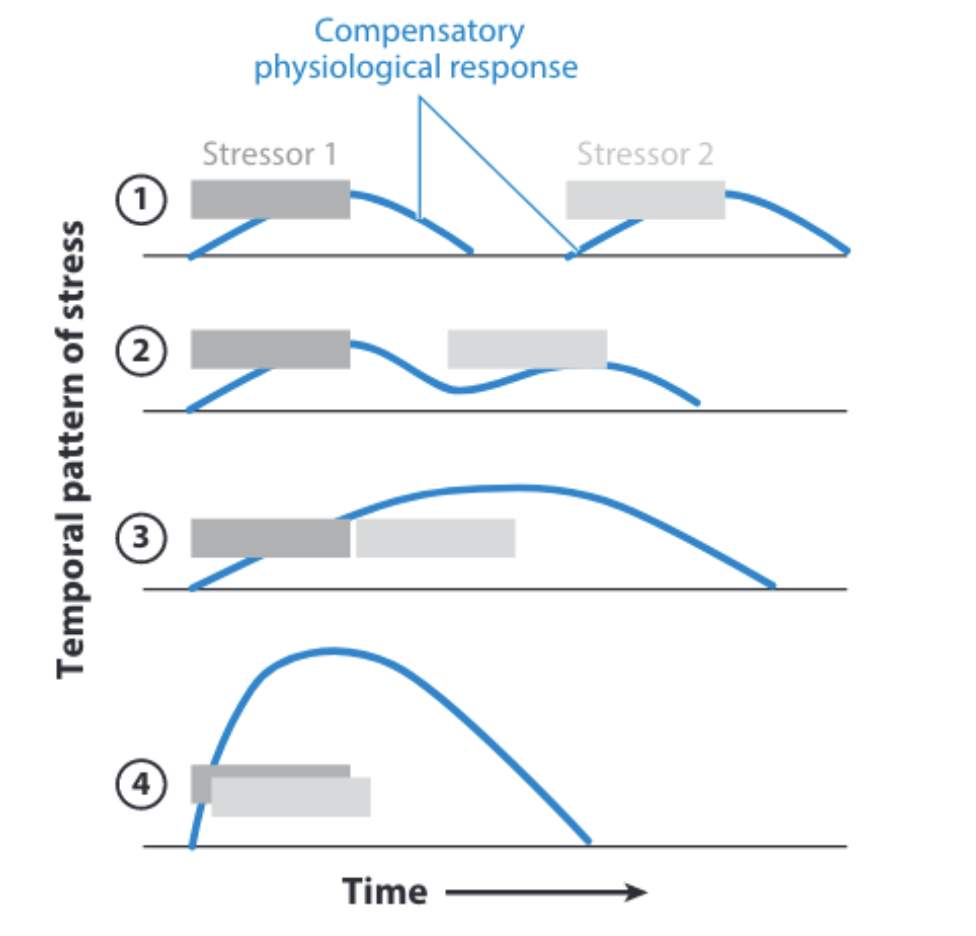
timing of stressors
timing is critical
if stressors act:
sequentially → effects can differ
simultaneously → effects combine
during sensitive windows (embryos, larvae) → stronger effect
levels of biological organisation
stressor effects differ depending on the level:
individual level:
physiology
behaviour
reproduction
survival
population level:
growth rates
abundance
evolutionary tolerance
community level
species interactions food webs
competition predator prey dynamics
ecosystem level:
biodiversity
habitat strucutre
regime shifts
recovery dynamics
real ecosystem examples
coral reefs: bleaching driven by temperature + light + acidification
plankton: warming + nutrient changes alter food webs
metals + predation risk → increased toxicity
contaminats bioamplify differently across trophic levels
studying multiple stressors
experiments
mesocosms
process based models
data driven models
final summary
stressors interact in complex, nonlinear pathways
interactions depend on mechanisms, timing, scaling
stressors can be classified into
abiotic and biotic
physical and chemical
natural and anthropogenic stressors
stressors can directly or indirectly interact
you can only die once → null model assumption matters
real ecosystems = many stressors at once, not isolated
lab experiments struggle to replicate natural complexity
most often the stressors have antagonistic or synergistic effects
the papers
paper 1 - gunderson et al. (2016)
organisms in the ocean are rarely exposed to a single stressor, instead they are exposed to multiple, co-occuring stressors such as
warming, hypoxia, acidification
salinity change
pollution
food availability
predators
the paper argues that because stressors overlap, their combined effects cannot be predicted by single stressor studies
stress and homeostasis
organisms try to maintain homeostasis (internal stability)
stressors push them away from homeostasis causing physical strain
perfomance curves
every organism has →
an optimal range where performance is best
lower/higher extremes where performance drops (stress)
lethal limits (death)
this explains why different levels of the same stressor can help or harm them
there are three types of stressor interactions
additive →
this is where the different stressor effects add up
this is the simplest, but least common
synergistic →
there is a combined effect that is greater than expected
this is the most common effect and dangerous one because the effects multiply rather than add
antagonistic →
the combined effect is less than expected because one stressor dominates; organisms are already near their tolerance limit (one can only die once); or stressors interfere with each other
if stressors act through the same physiological pathways, interactions are often additive
if stressors act on different but connected pathways, interactions are often synergistic
if one stressor overwhelms another, antagonism occurs
interactions can occur at the physiological level, behavioural level, and/or life history level
challenges identified in the paper:
lab studies usally test one stressor at a time, which does not reflect real-life conditions
stressors in nature vary over space and time
organisms may acclimate or adapt to timing, order intensity, and duration matter
null models (what you expect) determines how you classify an interaction
real ecosystems have many stressors, not just two
multiple stressors iteract in complex, often unpredictable ways, and synergistic effects are common, which can amplify marine ecosystem impacts far beyond expectation
prediction requires understanding mechanisms,timing, and biology, not just measuring stressors separately
paper 2 - przeslawski et al. (2015)
the authors reviewd multiple stressor experiments and perfomred a meta analysis to test
how different stressor combination affect early life stages
which combinations are most harmful
which taxa are most vulnerable
findings:
syngeristic effects were more common, meaning early life stages often respond much worse to combined stressors than predicted by single stressor studies
early life stages are extremely vulnerable. This is because they have/consist of/are:
undeveloped immune systems
limited energy reserves
poor acid-base regulation
thin or absent protective structures (shells, exoskeleton)
limited mobility, so they cant escape stress
this makes them bottlenecks for population survival
certain stressors are more harmful in combination. The strongest negative interactions were:
temperature x acidification
temperature x hypoxia
temperature x salinity changes
temperature seemed to always be involved as a synergistic amplifier
different taxa respond differently to stressors
the most sensitive ones were molluscs, and echinoderms (calcifiers) because calcification suffers under low pH
the most tolerant ones were crustacenas as they had a better acid-base and osmoregulatory control
the stressor intensity and timing affected the outcome. Small changes in the timing or intensity can completely change the interaction type
overall, multistressor impacts on embryos and larvae are mostly synergistic, and common stressor combinations (warming + acidification + hypoxia) threaten early life stages and therefore entire marine populations and food webs
ASK JAN ABOUT THE BLISS MODEL INTERACTIONS