Working With Others
INDIVIDUAL PERFORMANCE IN GROUPS
group performance will only be better than individual performance to the extent that the group members are motivated to meet the group goals effectively share information, and efficiently coordinate their efforts
Norman Triplett found that bicycle racers who were competing with other bicyclers on the same track rode significantly faster than bicyclers who were racing alone, against the clock
experiments have shown that the presence of others can increase performance on many types of tasks
social facilitation : the tendency to perform tasks better or faster in the presence of others
social inhibition : the tendency to perform tasks more poorly or more slowly in the presence of others
Robert Zajonc found that when we are with others we experience more arousal than we do when we are alone, this arousal increases the likelihood that we will perform the dominant response, the action that we are most likely to emit in any given situation
Drive-Arousal Model of Social Facilitation
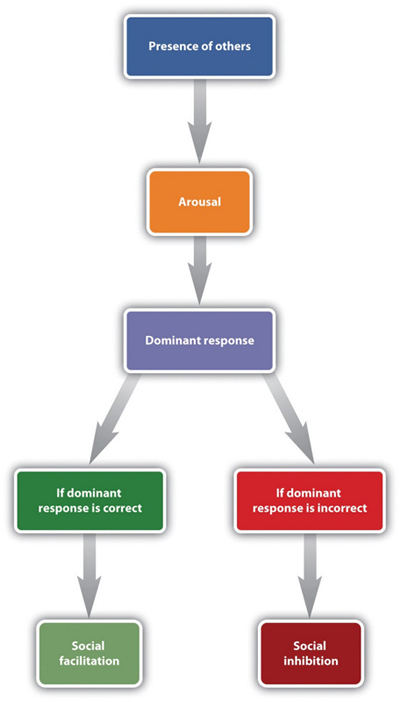
the most important aspect of Zajonc’s theory is that the experience of arousal and the resulting increase in the occurrence of the dominant response could be used to predict whether the presence of others would produce social facilitation or social inhibition
Bond and Titus found that the presence of others significantly increased the rate of performing on simple tasks and also decreased both rate and quality of performance on complex tasks
Strube, Miles, and Finch found that the presence of spectators increased joggers’ speed only when the spectators were facing the joggers
group process : the events that occur while the group is working on the task
when the outcome of group performance is better than we would expect given the individuals who form the group, we call the outcome a group process gain, and when the group outcome is worse than we would have expected given the individuals who form the group, we call the outcome a group process loss
social loafing : a group process loss that occurs when people do not work as hard in a group as they do when they are working
IN SUMMARY :
Robert Zajonc proposed a theory that would explain both the social facilitation and the social inhibition study results. His theory has three components :
First, the mere presence of others makes a person more aroused.
Second, arousal tends to make a person more likely to make the response that they are most inclined to make. That is, it makes a person more likely to make a dominant response.
The third component of Zajonc’s theory suggests that for easy or well-learned tasks, the dominant response is the correct response, leading to social facilitation. In contrast for difficult or novel tasks, the dominant response is unlikely to be the correct response. Under these circumstances, the presence of others facilitates an incorrect response, resulting in social inhibition.
EXAMPLES :
Jason is exceptionally good at ping-pong. According to the research, good players such as Jason, who know they are being watched when they play, perform better than good players who do not know they are being watched.
Shannon is trying to memorize lines for a school play. Based on research, under what conditions will the presence of others detract from her ability to learn the lines?
If Shannon finds the task difficult.
On which of the following tasks would the presence of others be most likely to lead to improved performance?
raking up fallen leaves
Imagine you are just learning how to play the piano, so you are not very good. You are practicing by yourself when suddenly your mother and her friends walk into the room to listen. You notice that your performance has changed. Research on social facilitation is most relevant to predicting how your performance will change in this situation. Specifically this research suggests that your performance will worsen.
According to Ringlemann’s research, people were observed to pull harder on a rope when they thought they were pulling alone than when they thought three others were pulling with them on the same rope. Their effort was even less with eight people. This best illustrates social loafing.
THE EFFECTS OF GROUPTHINK
group process can also occur when group members conform to each other rather than expressing their own divergent ideas
groupthink : a phenomenon that occurs when a group made up of members who may be very competent and thus quite capable of making excellent decisions nevertheless ends up, as a result of flawed group process and strong conformity pressures, making a poor decision.
groupthink is more likely to occur in groups whose members feel a strong group identity, when there is a strong and directive leader, and when the group needs to make an important decision quickly
groups suffering from groupthink become unwilling to seek out or discuss discrepant or unsettling information about the topic at hand, and the group members do not express contradictory opinions
because the group members are afraid to express opinions that contradict those of the leader, the group is prevented from making a fully informed decision
Causes and Outcomes of Groupthink

jury members with higher status occupations and education,, males rather than females, and those who talk first are more likely be chosen as the foreman, and these individuals also contribute more to the jury discussion
conformity pressures have a strong impact on jury decision making
the strong influence of the majority is probably due to both informational conformity and normative conformity
illusion of group productivity : the tendency for group members to overvalue the productivity of the groups they work in
EXAMPLES :
Imagine a group of corporate managers are experiencing groupthink, what is a symptom of this phenomenon?
when reaching a consensus is valued over critically evaluating the facts
Michelle’s staff all graduated from the same university. Nicole’s company frequently brings in outside consultants for advice. Samantha’s boss is a person with strong opinions. Holly’s office is a highly cohesive group. The group least vulnerable to groupthink is Nicole’s.
The ill-fated decision of President John F. Kennedy and his advisors to commit U.S forces to help invade Cuba and overthrow Fidel Castro in 1962 best illustrates the dangers of groupthink.