Maya Heinz - Classical China Guided Reading vocab
Name: Date:
Global History and Geography Honors 9 - Parrella Period:
Directions: Please record answers in BLUE. PDFs of the textbook are attached to the assignment. If you need a definition checked, please let me know. Good luck! Work together!!
Classical China
Pacing
Vocabulary | Complete by beginning of class on Tuesday, October 17th (Quiz on Tuesday, October 24th) |
|---|---|
Part 1 | Complete by beginning of class on Thursday, October 19th |
Part 2 | Complete by beginning of class on Friday, October 20th |
Part 3 | Complete by beginning of class on Tuesday, October 24th |
Completed Guided Reading due Wednesday, October 25th Please beware of frequent check-ins! | |
Vocabulary
Please use the link below to an online textbook as well as the textbook scans posted on Google Classroom. (The scans are attached to the Classical China Guided Reading)
TERM | DEFINITION |
|---|---|
| Deposits of fine-grained, yellowish, windblown soil. |
| Priests scratched questions asked by the rulers on these bones. The bones were then cracked by heated metal rods. The way in which the Oracle would break was the answer to that question. |
| The practice of burning replicas of physical objects to accompany the dead on their journey to the next world. |
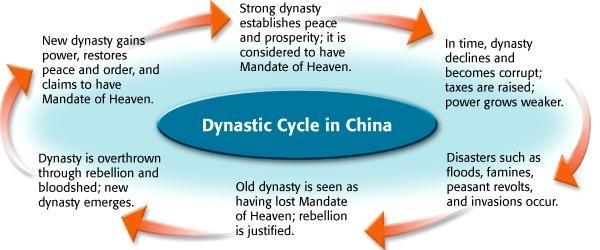
| The King ruled based on this mandate from heaven. The Mandate would end when some sort of disaster struck. |
| The cycle that each Dynasty goes through. The new Dynasty restores peace and keeps peace until the new Dynasty becomes the old dynasty. The dynasty becomes corrupt and is eventually struck by disaster from the Mandate of Heaven. |
| Social hierarchy that divided people into three groups: emperors, nobles, and commoners. |
| A type of government where the people who make decisions are officials. Each territory was governed by an official. |
| Uniform structure; China was unified during certain periods. |
| Another name for the Kingdom of ancient China. They called iit the Middle Kingdom because China was united. |
| One of the Emperors for China During the Qin Dynasty. He united the country with his strict and autocratic ruling. |
| Terracotta soldiers that were built to protect Shi Huangdi in the afterlife.T here was also other military objects in there as well. |
| A belief that humans were evil by nature; as well as the belief that a strong ruler was required to create an orderly society |
| One of the emperors for China during the Han Dynasty. He expanded China's territory. |
| First emperor of the Han Dynasty. He had a strong rule and quickly established the empire. |
15.Xiongnu | The Qin Empire's main concern. A group of nomadic people near the Gobi Desert. They were organized loosely into tribes. |
16. Civil Service Examination | A regular system to select officials, people were trained for the exam in a school and taught Confucism, law, and history In order to take the exam. |
17. Scholar-Gentry | Term describing China's wealthiest landowning families. |
18. Confucius | Confucius was known as the first teacher. He was tired of decaying morals and violence. He asked some people to spread his message and the people who liked his message called him a teacher. |
19. Filial Piety | The duty of members of the family to subordinate their needs and desires to those of the male head of the family. |
20. Five Relationships | the five fundamental relationships in Confucianism: ruler and subject, father and son, elder brother and younger brother, husband and wife, and friend and friend. |
21. Pax Sinica | Peace periods in central, Northeast, Southeast, and East parts of Asia, all led by China. |
22. Silk Roads | Trade system linking China with the West. |
23. Yellow Turban Rebellion | A peasant revolt during the Han Dynasty. |
Part 1
Shang and Zhou: China’s First Civilizations
Shang and Zhou Dynasties | Practice SAQ (Spill the T.E.A) |
|---|---|
How did the geography of China contribute to its success as an early river valley civilization? The two rivers, Huang He and Yangtze contributed to the early river valley civilization's success. What crops were a staple of early life in China? Millie and soybeans were staple crops of early life in China. How did Yu bring order to the region around 2100 BCE? Yu created roads in the region to encourage trade, drained swamps to create farmland, and created ditches to control flooding.. What marked the beginning of the Shang Dynasty? When a local leader named Tang overthrew the Xia king, it marked the beginning of the Shang Dynasty. What were the major economies of the Shang? Agriculture and crafting were the major economies of the Shang. What were the religious practices of the Shang? The religious beliefs of the chain were polytheistic, and they would inscribe questions on Oracle bones for the gods. What made the Zhou Dynasty “China’s First Golden Age”? The Zhou Dynasty was considered China's first golden age because it had a lot of technological advancement. What role did the Mandate of Heaven play in legitimizing the Zhou leaders? The Mandate of Heaven made Wu revolt against the Shang Dynasty with his own army, starting the Zhou dynasty. How did the Zhou organize the kingdom? Why did this eventually fail? The Zhou organized areas into city-states, this eventually failed because people who ran the city-states started disobeying the king. What technological achievements came about during the Zhou Period? Crossbows, iron swords and plows were all technological advancements that came from the Zhou Period. | Identify and explain one geographic feature that aided in the development of China. One geographic feature that aided the development of China was the Huang He River. The Huang He River deposited loess every time it flooded, which spreaded out into the land. This made the little farming land that China had very fertile. Identify and explain one technological advancement made during the Zhou period. One technological advancement that was made during the Zhou period was the crossbow. The crossbow strengthened the Zhou military and It became a useful defensive weapon. During the Zhou Dynasty, there were still Warring States, and when the Zhou needed to fight the Warring States, they would use crossbows and other weapons. |
Part 2
Qin Dynasty in China
The Qin Dynasty | Practice SAQ (Spill the T.E.A) |
|---|---|
How did Shi Huangdi gain and consolidate what was left of the Zhou regions? Qin Shi Huangdi gained and consolidated what was left of the Zhou regions by creating his own army and Defeated the remainder of the Zhou leaders. How did Shi Huangdi change the nature of leadership in China? Shi Huangdi created a very centralized government where he was in control of everything. What were 3 major achievements of the Qin? The Qin Dynasty expanded and unified China, gave peasants the right to own land, and standardized Chinese script. | Identify one policy or institution that helped consolidate China under one system during the Qin Dynasty. One policy that consolidate China during the Qin Dynasty was the strong, autocratic, legalist government. Shi Huangdi was a strict emperor who jailed or executed people that did not agree with his specific beliefs. These specific beliefs that one was supposed to follow made China United during the Qin Dynasty. |
Part 3
Han Dynasty in China
The Han Dynasty | Practice SAQ (Spill the T.E.A) |
|---|---|
What are two new territories into which Han China expanded? The Han expanded into Korea and Northern Vietnam. How did the defeat of the Xiongnu help secure the Han Dynasty? After the defeat of the Xiongnu, Wudi created agricultural colonies With relocated Chinese farmers. Why was Confucianism useful to the Han Dynasty? Confucianism was the basis of the civil service exam which helped the government choose the officials. How did the government set up a “pipeline” of well-educated professionals? The government used the civil service exam to set up a "pipeline" of well-educated professionals. Where was silk traded along the Silk Roads? Roman Empire, Mesopotamia, Persia, and india were places where silk was traded on the Silk Roads What religion traveled along the Silk Roads into China? Buddhism traveled along the Silk Roads into China. What technological innovations occurred under the Han? Invention of paper, calculated how many days a year was, improved iron plow, invented a yoke that did not put pressure on animals, created windpipes,which all made farming more productive. What were the negatives of the Silk Roads? diseases spread along the Silk Roads as well as economic issues, such as farming land getting taken away. How did the issue of land contribute to the decline of the Han? Since small farm owners were getting their land taken away from large landowners, and it caused small farmers to revolt, weakening the Han. Confucius emphasized the role of education in creating an educated ruling class (scholar-gentry) and a social structure that would create and maintain a durable, stable society. Examine the graphic below demonstrating the social class positions in Confucian China. Merchants, while likely the wealthiest in society, were at the bottom of the social class structure. 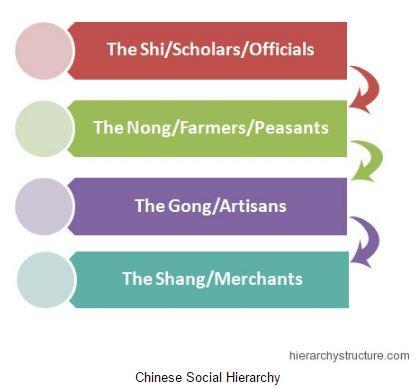 Why were merchants beneath the uneducated peasant class? Merchants were seen as greedy, selfish, and only gaining personal wealth. How was their status a reflection of Confucian ideology? a merchant status is a reflection of Confucian ideology because family is very important in Confucianism. Merchants would only gain money for themselves according to the social hierarchy.. | Identify one policy or institution that helped consolidate China under one system during the Han Dynasty. One policy or institution that helped consolidate China under one system during the Han Dynasty is the Civil Service Exam. The people were trained in a school meant for future government officials. This made choosing officials easier and consolidated China. Identify and explain one political benefit to the Civil Service Exam. One political benefit to the Civil Service Exam is that it allowed the government to choose the best officials quickly. To run the immensely populated country, many civil servants were needed. The civil service exam helped China govern its people. Identify and explain one social benefit to the Civil Service Exam. One social benefit to the Civil Service Exam is that it did not have emphasis on family connections. It did not matter if a person had a powerful family member or friend's recommendation, instead, it depended on how well a person did on the Civil Service Exam. This made it easier to get a Civil Service job If a person had no powerful family members. |