Urban Spaces
Future of Urban Green Spaces
New Zealand’s larger cities look set to grow in population for some time. Accommodating that growth will inevitably lead to changes in the shape and texture of the urban landscape. That is to be expected. Change can be an important part of what makes cities such vibrant human ecosystems.
But urban growth and development also come with risks – a continuation of the largely irreversible loss of green space being a prominent one. As our cities grow, they will also increasingly feel the effects of climate change. That will mean increased heat and more frequent extreme rainfall events. Parks, yards, vegetated berms and trees can help to mitigate the impacts of both, but only to the extent that they remain healthy and functioning in what is likely to be a more challenging environment.
Climate change will make the environmental services provided by green space more important in future. At the same time, the ongoing shift towards townhouse and apartment living – and associated reduction in the size of sections and yards – will make the recreational offering provided by public parks and reserves more sought after. The reality is that, at the very time that urban green space is likely to be in greater demand, there is likely to be less of it available.
Any future-gazing involves a degree of uncertainty. But based on modelling of climate, population growth and the impacts of current policies, we can develop a plausible understanding of how our cities may look in 20 years’ time.
Population Pressure
The population of urban New Zealand is forecast to grow considerably in the coming decades.
Stats NZ projects the populations of Auckland, Hamilton, and Tauranga to all grow by more than a third by 2043 (i.e. by 553,000, 57,900 and 49,300 people, respectively). Christchurch and Greater
Household occupancy rates are also projected to decline slightly or remain static. For Auckland, this means the average number of people per household is expected to decline from 3.0 in 2018 to 2.9 by 2043. While this is a proportionally small effect, having fewer people per household implies an increasing number of dwellings would be required to house even a static population.
The combined effect means that by 2043 an extra 208,100 households are expected to be needed in Auckland, 22,000.
How might changes to the built form affect private green space
Not all of the development will take place in private yards and gardens. Some of it will involve the demolition of existing buildings and site redevelopment, with less impact on pre-existing green space as a result.
Any further reduction in the amount of green space in our cities will likely result in the loss of ecosystem services like cooling, stormwater regulation and habitat provision. At the same time, the ability of green space to provide these services may well be compromised by climate change
Extreme rainfall events are expected to increase in frequency all around the country. More intense rain events are already occurring more often in New Zealand because of climate change, placing strain on existing stormwater infrastructure
Even more intense rain events can be expected. Much of this can be put down to the fact that a warmer atmosphere can hold more water. For each degree of regional warming in New Zealand, extreme precipitation is expected to increase by between 5 and 12%.22 Councils are already requiring that developers factor in increased flows due to climate change when calculating stormwater requirements for new developments. NIWA has developed an online tool that helps them do this.
At the other extreme, more dry days can be expected in the North Island and inland South Island. Droughts will be more common. Overall, in terms of water, extremes of one kind or the other – floods or severe droughts (with increased fire risks) – can be expected in most areas of the country in future
In 20 years what our city looks like
While the general trends suggest that the benefits provided by urban green spaces will be eroding in the future, this section outlines what city life may be like in a typical Auckland suburb 20 years from now.
Today, around 30% of Auckland’s urban area is private green space. Expected population growth and intensification have the potential to reduce this area by 5–10 percentage points over the next 20 years or so (Figure 4.3). This equates to losing around 3,000 hectares of Auckland’s existing private green space.
If current trends continue, existing parks and reserves are likely to remain relatively untouched by future development. Instead, continued intensification will see more lawns and private gardens replaced by new dwellings, and much of the remaining green spaces covered with impermeable surfaces for vehicle access and parking. Street trees may or may not survive. This will depend on if they are in the way of development, if they are protected or not, and if councils continue to maintain them in a healthy state.
Overall, there will be fewer large trees or diverse patches of bush in private gardens. The suburbs will feel hotter and harder, and there will be more artificial noise (from the activities of more people) and less birdsong (as biodiversity declines).
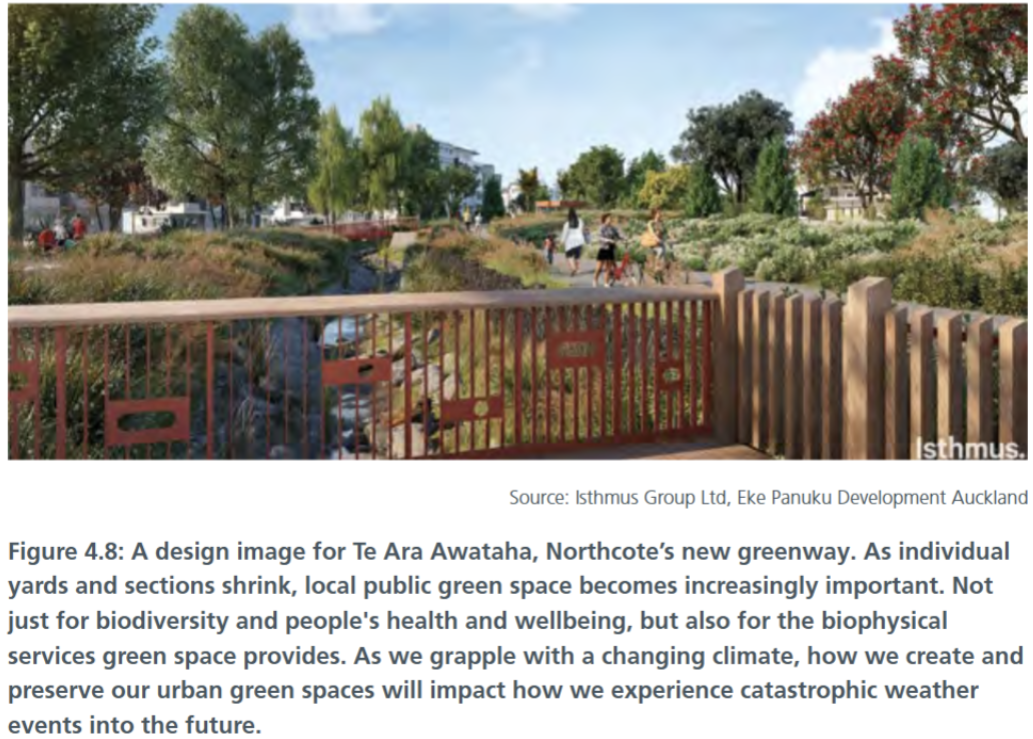
It may be tempting to think such losses on primarily private land are purely the concern of individual landowners. They are not. A large tree in the front garden of an existing section will provide shade and cooling benefits to pedestrians and nearby houses, and help regulate stormwater flows originating from the section. At the same time, the tree will support biodiversity while also filtering noise and particulate pollution.
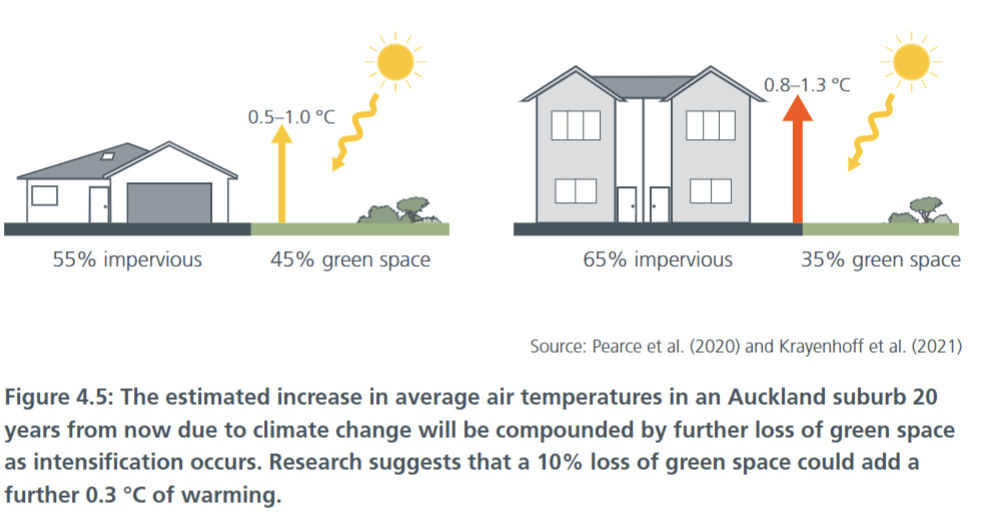
Climate change will mean the pattern of rainfall received by a typical Auckland suburb will be quite different 20 years from now. Increased atmospheric heat will mean that extreme rainfall events will occur with increasing frequency and intensity.31
An increase in impermeable surfaces will considerably change how this water moves through the city. Remaining green spaces will help to regulate rain events to some degree, but their capacity to buffer extreme events will be more limited
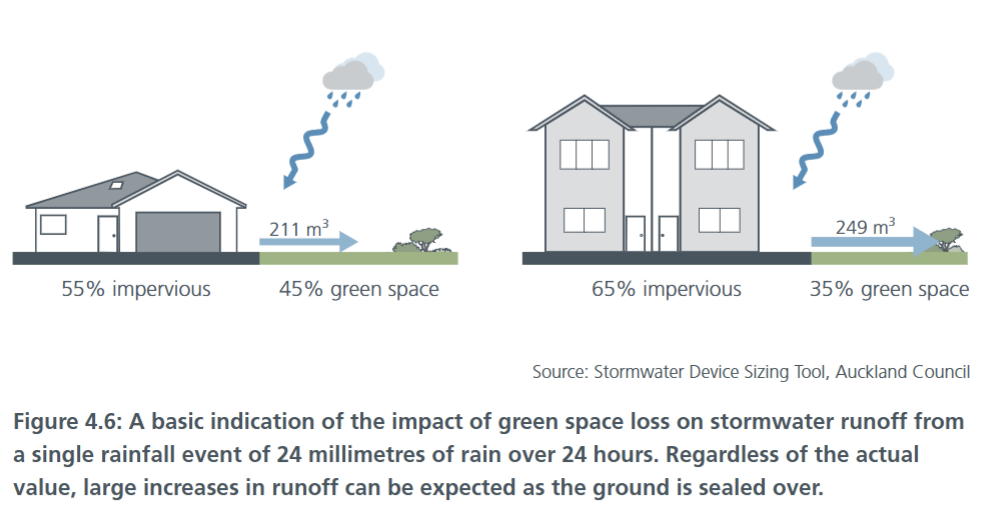
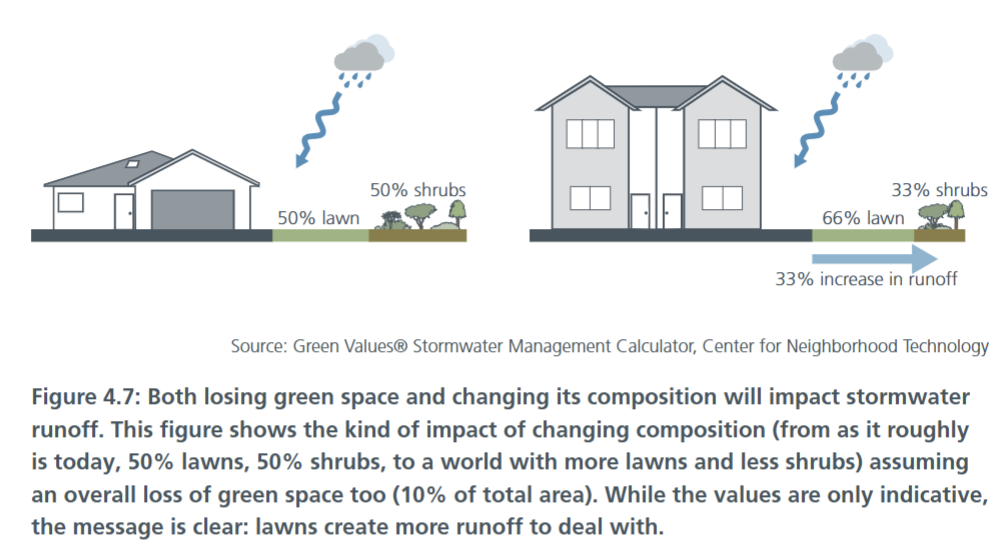
The future Auckland suburb will also likely produce much higher peak flows into its receiving environment because water will move faster over the increased proportion of impermeable surfaces. With fewer green spaces available to filter the water and air, more pollution can be expected to be deposited in these environments too. It remains unclear what condition many remaining green spaces will be in in 20 years’ time. However, the combined impact of climate change and increased fragmentation does not bode well for their structure or function, with biodiversity being one likely loser.
In summary, intensification and climate change will mean that a typical Auckland suburb will be hotter and more prone to flooding in future. Neither of those problems is intractable. They can be solved by existing engineering options: air conditioning is increasingly being used around the world to offer respite during hot periods, and the capacity of traditional stormwater infrastructure can be upgraded to mitigate flooding risk. These engineered solutions come with costs. But more importantly, they provide none of the biodiversity, recreational and cultural co-benefits that make green space such an important element of a healthy, liveable city. Before building or sealing over more, it would be worth considering whether a future largely devoid of backyard nature is really one we want to live in. Or, if that is to be the outcome of urban planning, whether significant new areas of public green space need to be created. This, like engineered solutions, will be costly – and difficult to achieve in inner-city areas
How we should go about this?
Our urban centres are becoming denser. Packing more people into them will almost certainly increase the demand for green space for the recreational, wellbeing and environmental services they provide. But the way we are building more houses to accommodate a growing population places existing green space at risk and makes the provision of new green space more difficult within existing urban boundaries and more costly everywhere.
Our climate is changing. The environmental services urban green spaces provide will be more important in a warmer, more extreme world. Unfortunately, the ecosystems providing those services will be under increasing heat and water stress.
Even if our ‘typical’ Auckland suburb does not grow over the next 20 years, climate change means our green spaces will have to help mitigate between 0.5 and 1 °C of additional warming and have to deal with more weather extremes too. If ongoing intensification and infill development result in a continued loss of green space, then increasingly stressed ecosystems will be asked to do even more than they do now to help mitigate up to 1.3 °C of additional warming.
This outcome is not preordained. But the choices we make today about how we want to manage population growth, urban form and green spaces will be ones we live with forever.
Recommendations on what we need to know to assist us in making those choices form the substance of the next chapter
Options
This report has found that private green space in existing suburbs is declining. In addition, some councils are struggling to retrofit new areas of public green space into existing suburbs. Looking forward, the net effect is likely to be more people relying more heavily on a substantially smaller network of green space.
This dynamic is occurring against the backdrop of a changing climate that is likely to make urban spaces hotter and having to withstand more extreme rainfall events. Improving the quality of existing areas of green space in existing suburbs is one way that councils could respond to these challenges. This could include increasing canopy cover, replacing grass with shrubs and trees and replacing asphalt or concrete with some form of vegetation.
Road corridors represent an obvious area for improvement. These are publicly owned, account for 15–20% of the surface of our cities and provide a network that parks and reserves cannot. The analysis undertaken for this report found that somewhere between 30 and 40% of the road corridor can already be characterised as ‘green’. But much of this is little more than grass, which offers limited benefits on its own. Known barriers to revegetating the road corridor include competing claims for this space (such as car parking and driveways), concern over vegetation interfering with utilities and even issues with street safety.
Even acknowledging those problems, the generous width of the road corridor in many existing suburbs and the prevalence of grass berms mean there is still much potential for improvement.
One action that could be employed in the short term is to plant some of the existing grass berms with more diverse vegetation. There will be room to plant appropriately sized tree species in some existing grass berms even with the current configuration of underground infrastructure to look out for. Simple tree pits or trenches might be able to be added to provide soil volume.
In other areas, smaller shrubs and plants that have shallower roots might be added. It may also be possible to allow grasses and tussocks to grow without being mown so regularly too. The scope for such simple upgrades of the grassy berms would appear to be considerable and should be further explored.
Another short-term strategy could be to replace concrete or asphalt footpaths with permeable paving solutions
There will be potential to provide more green space on other publicly owned land too. For example, trees and gardens could be added to car parks, or buildings might be retrofitted with green walls or roofs (underlying structure allowing). Some of these options are occurring – Auckland’s central library has recently had a green roof fitted
The recently promulgated MDRS require 20% of the area of a section to be retained as “landscaped area”. However, there is little standing in the way of developers meeting that requirement by planting narrow strips of grass along the periphery of a lot.
Urban Soil
Residential development often involves the almost complete removal of soil from the site in question. Depending on how pervasive that practice is, it could have long-lasting consequences for the permeability of ground in urban areas, how much water it can store, and what types of vegetation will grow in it. It is a matter of concern if the amount of soil left after development can support nothing more than grass or low shrubs. An increase in hot days and extreme weather events will place a premium on shade and water retention.