Liking, Love & Other Close Relationships
Definition (#f7aeae)
Important (#edcae9)
Extra (#fffe9d)
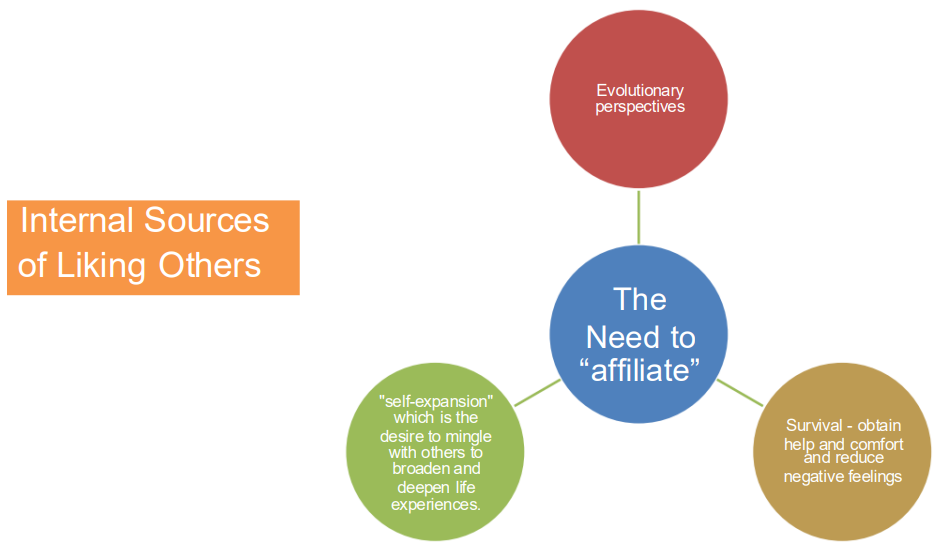
Internal sources of liking others:
The Importance of Affiliation in Human Existence: The Need to Belong
Importance of affiliation in human existence.
Individual differences in the need to affiliate.
Are there people who don’t need other people?
Situational influences.
Role of Affect:
Positive affect: Leads to positive evaluations of other people; feeling of liking them.
Negative affect: often leads to negative evaluations; Disliking them.
Direct effect: When another person says or does something that makes you feel good or bad.
Associated effect: Liking or disliking someone you meet is influenced by unrelated events or people in your life, i.e. conditioning.
Internal sources of liking others:
Role of affect:
Direct effect of emotions on attraction.
Positive affect leads to positive evaluations of other people (liking).
Negative affect leads to negative evaluation (dislike).
Associated effect of emotions on attraction.
Another person is present during emotional arousal.
The affect-attraction relationship and social influence.
Influence behavior.
External sources of attraction:
The effects of proximity, familiarity, and physical beauty.
The power of proximity: Unplanned Contacts.
Physical closeness of two people: residence, office etc.
Physical closeness leads to positive feelings and mutual attraction.
Why is proximity important:
Repeated exposure effect.
Evolution- initially cautious but eventually safe when no harmful effects.
Intense initial dislike, repeated exposure will increase dislike.
Social media.
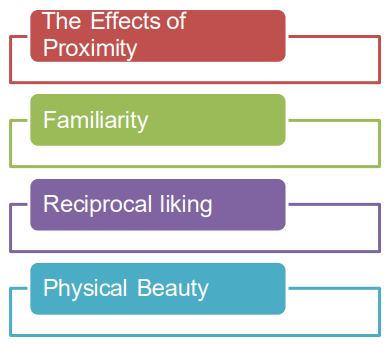
The Propinquity Effect:
The more we see and interact with others, the more likely they are to be our friends.
One of the simplest determinants of interpersonal attraction is proximity (propinquity).
The propinquity effect occurs because of mere exposure (re-exposure).
Mere Exposure Effect: The more exposure we have to a stimulus, the more we tend to like it.
We often see certain people, and the closer they are, the more friendships develop.
Internet: Long distance propinquity
The researchers found that strangers who met on the Internet were more interested in each other than those who met in person.
People on the Internet are attracted to each other to a large extent determined by the level and quality of their conversations, while face-to-face meetings depend also on other variables such as physical attractiveness.
Research found that the quality of offline friendship is higher than online friendships for relationships that have existed for up to one year.
However, when friendship has been around for more than a year, online and offline relationships are very similar.
Proximity effect: The role of physical proximity in social relationship
Similarity: Shared interests, attitudes, values, backgrounds, or personalities with the interests of others.
Opinions and Personality.
Interest and Experiences.
Appearance.
Genetics.
Reciprocal Liking:
Knowing that someone who likes us strengthen our interest in that person.
Occurs because of the effect of self-fulfilling prophecy: "When we expect people to like us, we elicit more favorable behavior from them and show more to them.”
The concept of "liking" is so powerful that it can even make up for the lack of similarity.
Physcial attractiveness:
High attractiveness ratings (beauty standards) are associated with female faces with:
Large eyes, small nose, small chin, prominent cheekbones, large pupils, big smile.
Handsomeness standard:
In women’s ratings of male beauty, they gave the highest attractiveness ratings to men’s faces with:
Large eyes, prominent cheekbones, large chin, big smile.
Physical Attraction & Attribution:
The "What beautiful is good" stereotype is relatively narrow, affecting people's judgment about someone only in certain fields.
Study revealed that physical attractiveness has the greatest effect on the attribution of men and women when they assess social competence.
Halo Effect: Attractive people are associated with positive qualities.
Beautiful people are considered more: Sociable, extraverted, popular, happy, assertive.
Interpersonal Attraction Theory:
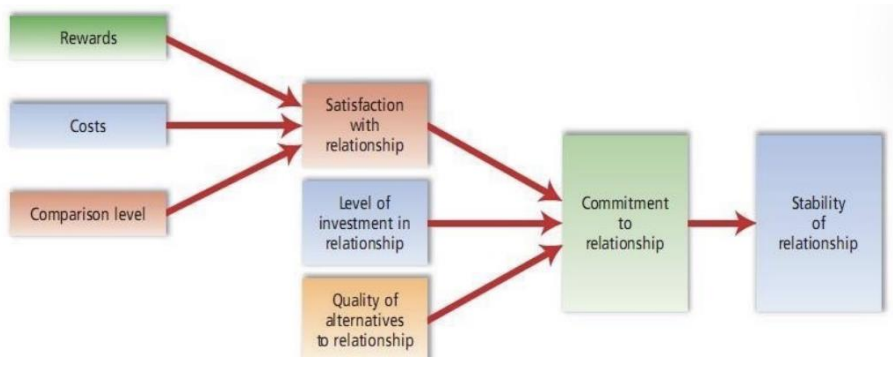
Social exchange theory: The idea that people’s feelings about a relationship depend on perceptions of rewards and costs, the kind of relationship they deserve, and their chances for having a better relationship with someone else.
Social exchange theory states that how people feel (positive/negative) about their relationship depends on:
Their perception of gifts they receive from relationships.
Their perception of the costs they incur.
Their perception of what kind of relationship they deserve and the probability that they can have a better relationship with others.
Investment model:
The theory that people’s commitment to a relationship depends not only on their satisfaction with the relationship, but also on how much they have invested in the relationship that would be lost by ending it.
Equity theory: The idea that people are happiest with relationships in which rewards and costs experienced and both parties’ contributions are roughly equal.
Critics of social exchange theory → ignores important variables in relations - the notion of justice.
Exchange theory: Relationships governed by the need for equity.
Communal relationship: Relationships in which people’s primary concern is being responsive to the other person’s needs.
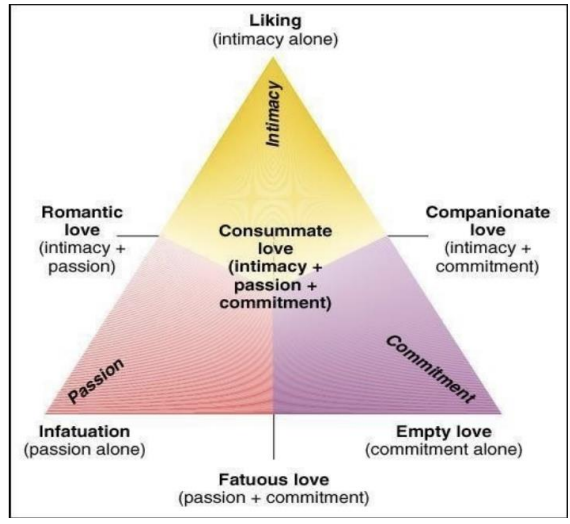
Defining love:
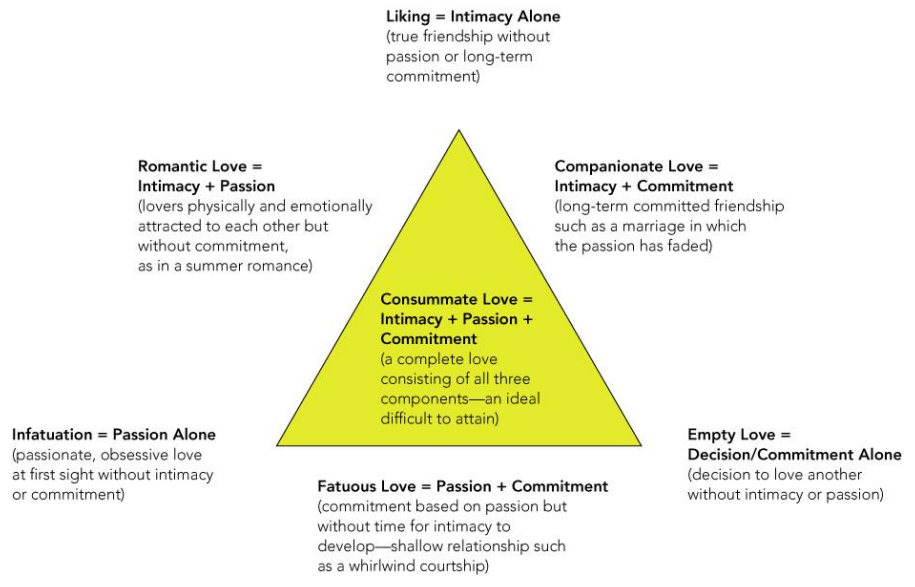
Companionate love: The intimacy and affection we feel when we care deeply for a person but do not experience passion or arousal in the person’s presence.
Passionate love: An intense longing we feel for a person, accompanied by physiological arousal; when our love is reciprocated, we feel great fulfillment and ecstasy, but when it is not, we feel sadness and despair.
Close relationship:
Companionate Love:
People can experience companion love in non-sexual relationships, close friendships, or in sexual relationships, experiencing intense feelings of intimacy (companion love), but not as much heat and passion as they may have felt.
Passionate Love:
Passionate love involves intense longing for others.
Characterized by: experience of physiological arousal, shortness of breath, and palpitations in the presence of loved ones.
How does someone fall in love:
A close relationship or closeness can be understood from the interdependence model: the relationship between one person and another is an increased process.
Zero contact: 2 people are completely unaware of each other’s presence.
Realizing stage: Begin to learn about each other, but have not been in direct contact. Forms an impression about the person. We take the initiative to connect.
Surface contact: Both have been actively interacting. The conversation is short & shallow. Beginning of interdependence.
Mutualistic stage: Is a continuum of interdependence. From introductions to develop into closer friends.
Relationship with family:
Lasting Importance of parent-child interaction: Role of Attachment Style
Attachment style: How secure one feels in their relationships. Infants adopt self-esteem and interpersonal trust.
4 attachment styles:
Secure attachment style: Involves high self-esteem and high interpersonal trust. This style is the most desirable and leads to very positive outcomes, including enduring and rewarding relationships throughout life.
Fearful-avoidant attachment style: Involves low self-esteem and low interpersonal trust. This is the “least adaptive” style in that relationships are either avoided or are unhappy.
Preoccupied attachment style: Involves low self-esteem and high interpersonal trust. This style leads to a very strong motive to establish relationships coupled with a fear of rejection.
Dismissing attachment style: Involves high self-esteem and low interpersonal trust. This is a conflicted style in that an individual feels deserving of a good relationship but is suspicious of possible partners.