Cognitive development
I. Cognition
It is a general term referring to aspects of higher mental processes
It is synonymous with thinking- but also includes mental processes such as attention, memory, forgetting, reason, decision-making, language, creativity, and problem-solving
II. Jean Piaget
Theorized stages of cognitive development through observing his baby
Popularized the notion of schema (plural; schemata)
Schema
Our mental representations of ideas, objects, and stimuli
 How our cognition forms
Ex. Our schema for an elephant
 Although a pink elephant does not exist in real life, because we have a schema of what an elephant is and what pink is, we can make a schema of what a pink elephant is
Formation of schema
1. Adaptation
The process of building mental representations of stimuli when one is exposed directly to it
Assimilation – the process of fitting new information into existing mental frameworks
Accommodation – the process of changing existing information to fit a new one
2. Equilibration
The process of changing existing information to fit a new one
Successful adaptation
Jean Piaget’s Stages of cognitive development
1. Sensorimotor Stage
Happens from birth to 2 years of age
Infants learn their relationship with the world; they can now sense it, and they can move it
They can discover that they can manipulate (move) objects in their environment
They still cannot form mental representations of the objects around them
Object permanence
Our ability to know that something exists even if it is not in sight
Already develop around 4-7 months of age
2. Preoperational Stage
Happens around 2-6 years of age
Children at this stage can now form mental representations
Language can now be communicated via words
Play is central to the child’s activity during this stage
Children at this stage engage in the:
Make-believe plays – children take the role of others in their behavior
Logical thinking – starting to develop (not that developed)
Magical thinking – the belief that one’s ideas or beliefs, no matter how irrational, can influence real phenomena
Egocentrism – the difficulty seeing the viewpoint of others
Centration – the capacity to only focus on one salient aspect of information at a time
Animism – they believe that certain things can behave like human beings
3. Concrete Operational Stage
Happens around 7-11 years of age
At this stage, children can now manipulate the information presented to them
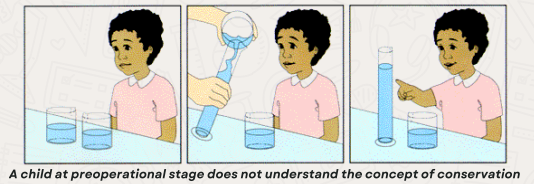
Conservation
The opposite of centration
The ability of a child to recognize that features of a stimulus remain the same despite changing a feature of that stimulus
Seriation
The ability to arrange objects in an ordered sequence
4. Formal Operational Stage
Develops during adolescence until adulthood
Individuals can now think of abstract concepts and form hypotheses
Hypothetico-deductive reasoning
Important ability
The ability of a person to form theories (what-ifs) to questions posed to them
Adults can now experiment with certain ideas and thoughts
They can also evaluate and critique the validity of one’s thoughts. Can now think about thinking (metacognition)
Metacognition
Reflective thinking (other term)
If sobra = anxiety
Criticisms of Piaget’s theory
Underestimates children’s abilities
Some say that a child can perform concrete thinking
Overestimates the capacity of adolescents in formal operational thinking
Some adolescents stay egocentric when they get old
Vague explanation of how individuals move from one stage to another
Does not address cultural differences
III. Lev Vygotsky
In his sociocultural theory of cognitive development, he emphasized the role of cultural shaping one’s mental capacities
America (west) | Analytical thinking
|
Asian (east) | Holistic
|
Zone of proximal development
The difference between what a child can do on his own and what can be accomplished with assistance
Scaffolding
The process of cognitive development is best developed through this
Assisting or guiding in learning behaviors that we cannot do on our own
IV. Language development
1. B. F. Skinner
Believes that language develops when children imitate the vocabulary of their parents
When parents reward the language that children use, they will retain these words and use it more often
When parents punish children with the language they used, they will try to suppress using this language
Pinanganak tayong wala tayong capacity to learn language but we learn through reinforcement and punishment
2. Noam Chomsky
Believes that learning language is an innate skill, and is not dependent on the environment
Humans are born with the ability to learn language
Language Acquisition Device
He calls our innate ability to learn language as this
V. Cognitive development in adolescence
a. Imaginary audience
The tendency of adolescents to think that others are enthusiastically watching their lives
b. Personal Fable
The tendency of adolescents to think that their personal lives and stories are special and unique
VI. Cognitive development and aging
Raymond Cattel two types of intelligence
1. Crystallized intelligence
Those aspects that are previously leaned in school and other settings (facts)
Ability to use experience and learned knowledge in different situations
Generally, increases across the lifespan
Tumatanda = well developed (adults have wider vocabulary)
2. Fluid intelligence
Includes the ability to solve novel problems, use logic and reason, and generate ideas
Ability to think abstractly
Increases in the early 20s but gradually declines
people in 20s and 30s outperform individuals in the middle and old age in terms of problem solving skills
other culture gives more importance in wisdom or creativity
a. Wisdom
The capacity to have insight and proper judgement on many practical matters about life and its problems
Tumatanda = tumataas
b. Creativity
The capacity of a person to produce novel works, thoughts, or objects
The central element of strategizing in problem solving
Two types of strategies when solving problems
1. Algorithm – step-by-step problem-solving strategy that gives a guaranteed solution to a problem
2. Heuristic – a rule-of-thumb method of generating solutions to testing problems
Used in real life situation
Barriers to problem solving
Mental set
a tendency to solve problems and respond to it in a given way
We think inside the box
Intelligence ≠ creativity
Functional fixedness – individual cannot find new use for an object
Creative problem solving
1. Divergent thinking – thinking of unique and innovative solutions to problems
More related to creativity
2. Convergent thinking – requires the use of one’s existing knowledge and trimming down the options to arrive at the best possible solution
VII. Intelligence
Capacity to learn from experience
The ability to adapt to the surrounding environment
There is no definite meaning of this
Intelligence according to psychologists
David Wechsler - “Intelligence is the global capacity of a person to act purposefully, to think rationally, and to deal effectively with his environment”
Robert Stenberg - “Intelligence is the mental activity directed toward purposive adaptation, selection, and shaping of real-world environments relevant to one’s life”
James Flynn - “The ability to think abstractly, and to learn readily from experience”
Theories of intelligence
1. Charles Spearman
One of the first to study intelligence
Two-factor theory of intelligence
he claimed that intelligence can be presented by a score
The first factor as g, referring to our overall intellectual capacities
He called domain-specific intelligence as s.
Became the basis of IQ test (most influential theory because of this)
2. L. L. Thurstone
Claimed the intelligence is made up of many separate abilities
Identified seven primary mental abilities (measures the cognitive processes): verbal comprehension, word fluency, number calculation, spatial reasoning, associative memory, perceptual speed, and general reasoning
Believes that there is no ”g”
3. Raymond Cattel
Crystallized and fluid intelligence
4. Robert Stenberg
Claimed that there exist three intelligences that are distinct but also coexist with each other
Triarchic theory of intelligence
Based on information processing models
1. Analytical/componential intelligence
Book smart
People think critically and usually excel in academic tasks
2. Creative/experiential intelligence
Ability to synthesize information and provide novel insights and new ideas
They are the inventors and creative minds
3. Practical/contextual intelligence
Street smart, and are able to solve real life problems with solutions that take into account the demands of the environment
VIII. Psychological Test
Is an objective, standardized measure of a sample of a behavior
a. Reliability – it is to measure the consistently measure what is supposed to measure
b. Validity – it is the ability of a test to accurately measure what it is supposed to measure
History of Psychological Test
Alfred Binet
A French psychologist
Developed the first standardized IQ test (1905) termed it as the Binet-Simon Scale
Binet-Simon Scale
The scale, developed together with Theodore Simon, contained 56 items
The test was used to separate normal children from those needing special assistance
Lewis Terman
A psychologist from Stanford University
Popularized IQ test
Revised and improved Binet’s scale in 1916, he called this version as Stanford-Binet Test
Stanford-Binet Test
The most famous IQ tests in the history of psychology
It measures g, represented by IQ
David Wechsler
Provides one of the most comprehensive definitions of intelligence
He developed the Wechsler Adult Intelligence Scale, one of the most widely used and one of the most comprehensive IQ tests today.
Giftedness
A condition in which an individual typically demonstrates high achievement and aptitude in areas of functioning such as intellectual thinking, creative thinking, performing arts, etc.
Savant syndrome – a condition in which a person suffers from general decline in intellectual functioning but is excessively excellent in one area. this is called having Splinter Skills (obsessive preoccupation with flags, numbers, trivia, maps, historical figures, etc.)
Intellectual disability
It was formerly called as mental retardation
intellectual disability ≠ learning disability
A condition that is marked by
1. Deficits in intellectual functioning
2. Impairments in adaptive functioning (being able to carry out everyday skills such as eating; taking a bath, purring clothes)
IQ 70-50 mild
IQ 49-35 moderate
IQ 34-21 severe
IQ below 20 profound
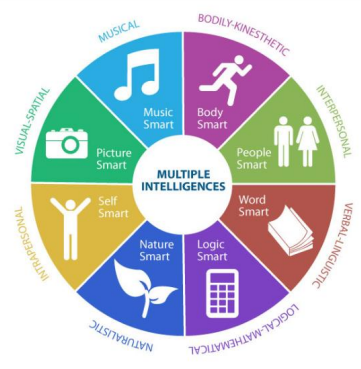
Howard Gardner
Believed that each of us has different strengths and weaknesses
Listed different forms of intelligence
Each of us has a preferable mode of showing our intelligence, which he called as multiple intelligences