The end of the cold war and the unbanning of political movements
Summary:
South Africa was a battlefield for the Cold War during the struggle against apartheid, with the USSR supporting the ANC and the USA providing support to prevent ANC victory. Britain, a capitalist country, also supported the apartheid government against the ANC. In 1985, Mikhail Gorbachev introduced new policies, such as glasnost and perestroika, which led to increased interaction with the West and a shift in industrial production. The end of the Cold War in 1990 marked the end of communism as a threat to the capitalist world. South Africa became increasingly "ungovernable" due to internal resistance, economic isolation, and a weak NP government.
The End of the Cold War
During the struggle against apartheid, South Africa was – in its own way – a battlefield for the Cold War between the superpowers, the USSR and the USA.
On the one hand, the USSR, possibly in its desire to spread communism throughout the world, supported the ANC. It gave the ANC money and trained its soldiers.
On the other hand, the USA, which wanted the apartheid government to end apartheid, nonetheless provided the apartheid government with support to prevent ANC victory, because it thought that ANC victory would result in communism in South Africa. Britain, as a capitalist country, was also against communism and – although wanting apartheid to end – also supported the apartheid government against the ANC.
However, in 1985, the USSR elected a new head of state, Mikhail Gorbachev. Because the USSR economy was declining due to its communist policies, Gorbachev introduced new policies, such as glasnost and perestroika. These policies led to more interaction with the West and a change in industrial production from weapons to consumer goods. Ultimately, these policies resulted at the end of the Cold War in 1990 after the fall of the Berlin Wall in 1989. Therefore, communism was no longer a threat to the capitalist world.
💭 How did the end of the Cold War in 1990 bring about change in South Africa? Give your own suggestions.
What was happening in South Africa during this time?
♦︎ The country was becoming increasingly "ungovernable" due to internal resistance.
♦︎ The country was facing economic isolation and vulnerability, not to mention the very weak economy and debt crisis of the NP government.
♦︎ The apartheid government said that it was worried about a communist takeover of the country and so refused to make political changes.
BUT the end of the Cold War changed the situation drastically.
♦︎ There could now be no fear, or justification, of “Total Onslaught”…the threat of a communist take over was gone.
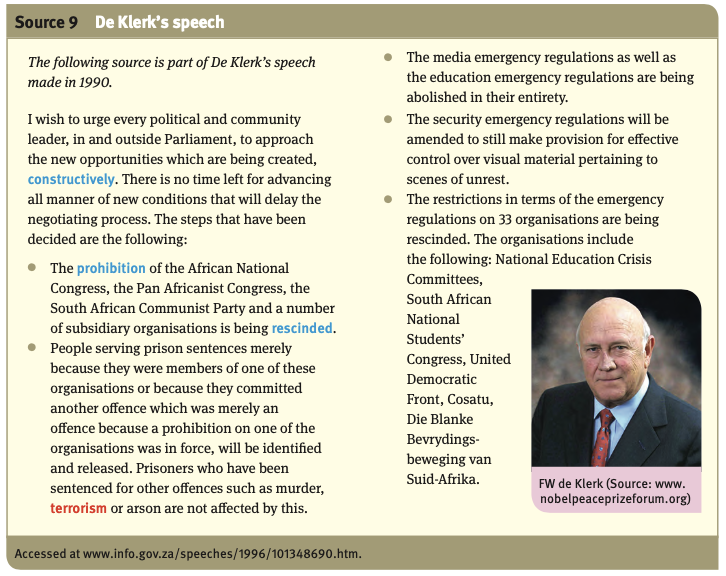
♦︎ The apartheid government then said that it was now possible to make political changes, which it did when FW de Klerk announced the unbanning of the ANC and the release of Nelson Mandela in February 1990.