APLIT Book Blueprints
AP English Literature: Review
Book Blueprints
Title/Author/Genre | Death of A Salesman / Arthur Miller / modern tragedy/dramatic stage play |
|---|---|
Primary Topics | The danger of blind faith in the American Dream; skewed morals; the exaggeration and distortion of the past; the relationship between father and son; the effects of abandonment and betrayal; and complex family dynamics |
Setting/Context | New York and Boston in the late 1940s + late 1920s, takes place after the Great Depression and economic reform is taking place |
Conflicts | Willy struggles with the person he wants to be versus his actual self; Happy follows his dad and tries to act as though he is someone more than he really is, causing distress; Linda is disrespected by her husband, but still remains married to him |
Characters | Willy Loman (main character), Linda (Willy’s wife), Biff (Willy’s son), Happy (Willy’s son), Ben (Willy’s deceased brother - the adventurer and got rich quick), Charley (neighbor), Bernard (Charley’s son), Howard (Willy’s boss), the Woman (Willy’s mistress) |
Pivotal Scenes | Biff finds out about Willy’s affair with a woman in Boston; Willy is fired by Howard after he tries to compromise with his boss but fails; Biff and Happy leave Willy alone as he goes into one of his delusions at the restaurant; Willy commits suicide at the end, and only his family and Charley attend--he was not truly admired by as many people as he bragged about |
Symbols/Motifs | Woman’s stockings (Willy’s guilt); seeds (Willy’s desire for growth and something permanent); the jungle (the ruthless nature of the business world); theft/lying/cheating (decay of morals and values) |
Title/Author/Genre | A Separate Peace / John Knowles / Bildungsroman |
|---|---|
Primary Topics | War/rivalry; jealousy/envy; friends/enemies; coming of age |
Setting/Context | Published in 1960 in the U.S.: takes place at Devon Academy (private military academy in NH in 1942 at the beginning of WWII), boys are training to enlist |
Conflicts | Gene forms his identity around Finny versus forming his own; idealism of war being (they are doing a service to their country) versus reality of war (Leper is traumatized after war); Hadley holds a trial for the boys to see if Gene had really pushed Finny off the branch, causing disagreement and Finny’s second fall off the staircase (which breaks his leg) |
Characters | Gene Forrester, Finny (Phineas), Brinker Hadley, Lepellier (Leper), Dr. Stanpole, Mr. Ludsbury, Mr. Prudhomme |
Pivotal Scenes | Finny comes back to Devon school and recalls all of the things that happened, Finny saves Gene, then Gene doesn’t save Finny and he breaks his leg, Finny cannot heal from his leg injury and cannot play sports anymore, Dr. Stanpole tells Gene that Finny died during heart, surgery because his marrow went to his heart |
Symbols/Motifs | The tree (loss of innocence and transition to adulthood), the marble stairs (harshness of reality), summer v. winter sessions (childhood vs adulthood), sports/athletics (youthful innocence), doubles/binaries (blending of opposites), war (loss of innocence) |
Title/Author/Genre | Wuthering Heights / Emily Brontë / Gothic fiction romance |
|---|---|
Primary Topics | Supernatural; nature and civilization; love and passion; masculinity and femininity; social class; revenge |
Setting/Context | Wuthering Heights, Thrushcross Grange, the Moors |
Conflicts | Heathcliff and Catherine’s toxic relationship, Heathcliff vs society, cycle of revenge, Wuthering Heights vs Thrushcross Grange, |
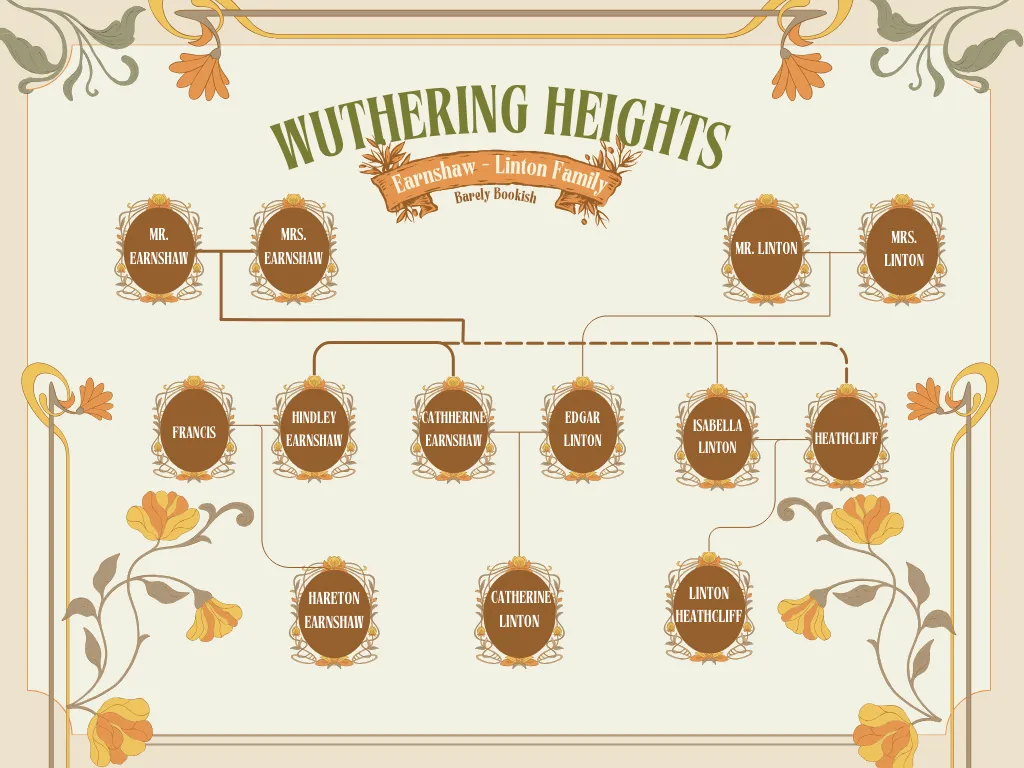
Characters | Catherine Earnshaw, Cathy Linton, Heathcliff, Mr. Lockwood, Nelly, Edgar Linton, Hareton Earnshaw, Hindley Earnshaw, Linton Heathcliff, Isabella Linton, Joseph |
Pivotal Scenes | Any of the characters’ deaths (Catherine, Heathcliff, Mr. Linton), Cathy and Heathcliff in the Moors, Hindley dangling Hareton, Heathcliff overhearing Catherine (I am Heathcliff - Catherine), Heathcliff’s return, Lockwood’s return after Heathcliff’s death |
Symbols/Motifs | Duality/doubles (Cathy and Catherine → fall in love with opposite types of men), houses contrast (light + elegant Thrushcross Grange vs. evil and worn Wuthering Heights house), windows (past inferring with present → Mr. Lockwood hears Catherine wanting to be let in and see Heathcliff), class separation (Edgar and Isabella live at fancy Thrushcross Grange while Heathcliff and Catherine live at more poor Wuthering Heights household), ghosts, weather (conveys implied mood/foreshading the environment of the story), the moors (freedom/haven away from social constraints for Heathcliff and Catherine), sickness (shows emotional + such transformations, , storms |
Title/Author/Genre | The Awakening/ Kate Chopin/ bildungsroman |
|---|---|
Primary Topics | Individuality vs. conformity; solitude; convention vs. defiance; self-expression; gender and familial roles; reflection and action. |
Setting/Context | Grand Isle and New Orleans in the late 19th century |
Conflicts | Edna loves her children, but she values her independence more. |
Characters | Edna Pontellier, Léonce Pontellier (Edna’s husband), Mademoiselle Reisz (talented pianist, little woman, homely), Adèle Ratignolle (ideal mother-woman), Robert Lebrun (flirt and mom owns the cottages at Grand Isle where he works, moves to Mexico), and Alcée Arobin (Edna has an affair with him) |
Pivotal Scenes | Robert is moving to Mexico; Edna smashes a vase and tries to destroy her wedding ring. Edna swims out into the ocean, gets scared, and returns to the shore and her husband (hesitation to be free or in safety) Edna moves to the Pigeon House. Dr. Mandelet tells Léonce to leave Edna alone. Edna does not want to go to her sister’s wedding. The love affair with Arobin is not an emotional one; Edna is still seeking freedom from male dominance. Edna is Mademoiselle Reisz’s protege and visits her constantly. Robert returns to New Orleans, declaring love, but cannot pursue it. Final scene of Edna stripping her clothes and drowning in the ocean. |
Symbols/Motifs | Wedding ring (tied to institution of marriage/roles as a mother in the relationship), the ocean (freedom/going off on her own), birds (different types portray her as different things: pigeon → little bird, powerless; parrot at beginning → crying to get out + can’t act freely), music, houses |
Title/Author/Genre | Their Eyes Were Watching God / Zora Neale Hurston / Bildungsroman |
|---|---|
Primary Topics | Race; culture; identity; relationships (human vs. nature); prejudice; voice and language; and independence |
Setting/Context | Eatonville, Everglades/ the Muck, Southern Florida |
Conflicts | Janie’s journey for independence and identity, the storm, Janie vs her husbands, Janie vs. society (porch). Janie vs. Nanny (differing views on the purpose and meaning of love) |
Characters | Janie, Tea Cake (husband 3), Jody (husband 2), Logan (husband 1), Nanny, Pheoby (Janie’s best friend), porchsitters |
Pivotal Scenes | 16-year-old Janie kills Jonny Taylor (described as the end of her childhood) - Nanny decided she needed to get married to Logan Killicks. Nanny’s value of love is protection and material safety. Rape cycle in Janie’s family. Joe Starks is improving the town (street light, post office, town store, and becoming mayor). Abusing the mule and giving it a funeral (symbol for the mistreatment of Janie herself). Burning her headrags after Joe died (voice, independence, freedom). Meeting Tea Cake and him giving her voice and teaching her how to play checkers. Janie killed Tea Cake. |
Symbols/Motifs | Janie’s hair (her individuality and independence), nature (self discovery and emotional growth), the horizon (, the porch/community, the hurricane, finding individuality, the pear tree, gender and race in society, |
Title/Author/Genre | 1984 / George Orwell / Dystopian cautionary tale |
|---|---|
Primary Topics | Destruction of individuality, propaganda, totalitarian control, surveillance and privacy, illusion of reality, truth and historical manipulation, class structure |
Setting/Context | Oceania’s London, Winston’s home, Charrington’s shop, the woods, Ministry Truth, Ministry of Love, Room 101 |
Conflicts | Winston vs environment & Winston vs self |
Characters | Winston, Julia, O’Brien, Mr. Charrington, Emmanuel Goldstein, Parsons family, Katherine (his separated wife) |
Pivotal Scenes | 2 minute hate, walking to Charrington’s, Julia’s note, confronting O’Brien, room 101, Chestnut Tree Cafe, Julia and Winston meet again |
Symbols/Motifs | The paperweight, big brother, telescreen/security, Julia’s sash, rats, room 101, newspeak, doublethink |