4.2 The Rise of Political Parties and the Era of Jefferson
LEARNING OBJECTIVE: Explain the causes and effects of policy debates in the early republic
INTRODUCTION
Despite Washington’s warning against political parties two groups emerged in New Republic
Federalist
- following visions of Alexander Hamilton
Democratic-Republicans
- following visions of Thomas Jefferson
Both competed for public approval and control of government
THE ELECTION OF 1800
Federalist lost popularity during Adams’s presidency
People disliked Alien and Sedition Acts
- further complaied abt new taxes imposed to pay for possible war against France
- Adams avoided war but built up navy for nation’s defense
ESTABLISHMENT OF POLITICAL PARTIES
Presidential election of 1800 was first election w clear choice between political parties
Federalist party
- stood for stonger national government
- leaned towards Britian in european affairs
Democratic-Republican party
- emphasized the powers reserved to states
- leaned towards France
Both parties supported tarrifs on imports as a way of revenue
tariffs became largest source of revenue for federal gov
Tariffs broke down regional lines
- Northern industrialist wanted tariffs to protect their companies from foreign competition
- Southerns wanted lower tariffs to encourage their trade of cotton and other crops
ELECTION RESULTS
Determining winner of election of 1800 was complicated
Constitution listed that each member of electoral college cast two votes for president (winner would be president, 2nd place would be vice president)
- majority of presidental electors cast their ballots for two democratic-republicans (Thomas Jefferson and Aaron Burr)
- Both tied for presidency
- House of Representatives voted to choose the winner, each state allowed one vote
- Debated and voted for days before majority voted for Jefferson (Hamilton urged followers to support Jefferson who he thought was less dangerous and better than Burr).
Democratic-republican lawmakers elected in 1800 took control of house and senate—→
Federalist had been swept from power (both executive and legislative)
A PEACEFUL REVOLUTION
Passing of power between political parties was accomplished w/o violence
Demonstrated US constitutional system would endure vartious strains
- Federalist quietly accepted their deafeat and gave up control to Democratic-reublicans
- Change of control is known as the Revolution of 1800
JEFFERSON’S PRESIDENCY
Jefferson attempted to win allegiance and trust of Federalist opponents
Maintained national bank and debt-repayment plan of Hamiltion
Jefferson carried on neutrality policies of Washington and Adams
Jefferson retained loyality of Democratic-Republicans
Adhered to his party’s principle of limited central gov
- reduced size of military
- eliminated federal jobs
- replaced excise taxes (taxes on certain goods and commodities such as whiskey)
- lowered national debt
Appointed only democratic-republicans to his cabinet
- wanted to avoid internal divisions
Jefferson’s first four years were free of discord
THE LOUISIANA PURCHASE
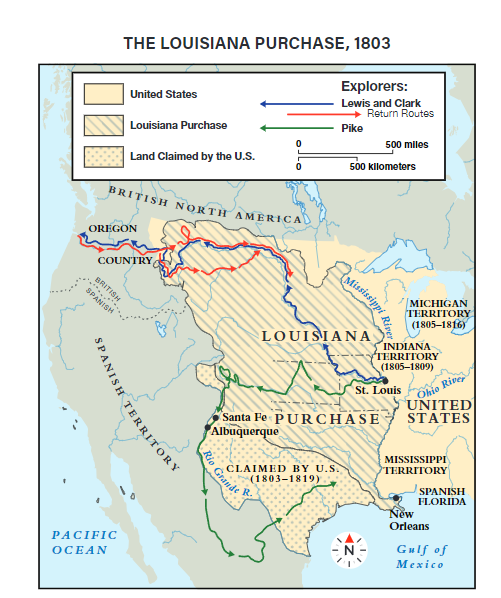
Most important acheivement of Jefferson’s first administration was the purchase of western land known as the Louisiana Territory
Region encompassed large tract of western land
- passed through the Mississipi and Missouri river
- land was barely explored by Europeans
- territory most valueable property in terms of commerce laid in the mouth of the Mississipi River (port of New Orleans)
Lousiana territory was once claimed by France
Lost claim to Spain but gained it back
- Napoleon secretly forced Spain to give Louisiana territory back to France
- Napoleon hoped to restore French Empire in the Americas but lost interest (wanted to concentrate resources on fighting Britian, rebellion by Toussaint Louvertyre against France resultued in heavy French losses)
U.S. INTEREST IN THE MISSISSIPPI RIVER
Western frontier extended beyond Ohio and Kentucky into Indiana territory
Settlers in this region depended on transporting goods on rivers that flowed westaward into the Mississipi river (good for their economic existence)
- Spanish closed New Orleans to Americans (alarmed settlers)
- Spanish revoked right of deposit granted in the Pinckney Treaty which had allowed MAerican farmers tax-fee use of the port
- People on the frontier clamored for government action
- Jefferson was troubled by it’s consequences on foreign policy (feared that US risked entanglement in European affairs as foreign powers controlled the river at New Orleans).
NEGOTIATIONS
Jefferson sent minsters to France and offered $10 mil for New Orleans and strip of land extending from that port eastward to Florida
If negotiation failed, minsters would begin discussion for alliance w Britian
- Napoleon offered to sell entire New Orleans territory for $15 mil (sought funds for war against Britian)
- Opportunity surprised American minister and quickly accepted French offer
CONSTITUTIONAL PREDICAMENT
Jefferson and many Americans approved of Lousiana purchase
Constitutional problem troubled president
- Jefferson committed to strict interpretation of constitution and rejected Hamilton’s arguement that certain powers were implied.
- No clause in the constitution stated that a president could purchase foreign land.
- Jefferson determined to set aside his idealism for country’s good
- submitted purchase agreement to senate (agrued that lands could be added to US as an application of the president’s power to make treaties)
- Federalist senators criticized treaty, but democratic-republican majority in senate quickly ratified purchase
CONSEQUENCES
Louisiana purchase doubled the size of the US, removed a european presence, extended western fronter from beyond mississipi
Acquisition of millions of acres strengthend Jefferson’s hopes of future based on agrarian society of independent farms (instead of Hamilton’s view of urban industrial society)
- Louisiana purchase increased Jefferson’s popularity and showed Federalist as a weak and complaining sectionalist party
LEWIS AND CLARK EXPEDITION
Before Louisiana was purchased, Jefferson persuaded congress to fund scientific exploration of the trans-mississipi west, led by Lewis and Clark
Louisana purchase greatly increased importance of the expedition
- Lewis and Clark set out from St. Louis in 1804, crossed the rockies, and reached the Oregon coast on the pacififc ocean and turned back and complted the expedition in 1806.
- expedition allowed for greater geographic and scientific knowledge of the reigion, stonger claims to Oregon territory, better relations with Natives, and more accurate maps and land routes for fur trappers and future settlers
JUDIDCIAL IMPEACHMENTS
Jefferson tried various methods for overturning Federalist measures and appointments
He suspended the alien and sedition acts, and released those jailed under them
- Federalist appointments to the court (appointed by Adams and Washington) were not subject to the recall or removal except by impeachment
- Federalist judges continued in their office, to the annoyance of the democratic-republican president
Jefferson supported a campaign of impeachment to remove the judges
- Judge of one district was mentally unbalaned (house voted for his immpeachment and senate voted to remove him)
- House also impeached supreme court justrice Samuel Chase (senate acquitted him after finding no evidence of high crimes).
JEFFERSON’S REELECTION
Jefferson would reelection by an overwhelming margin in 1804
His 2nd term was marked with growing difficulties
- Jefferson faced a plot by his former VP, Aaron Burr
- Democratic-Republican party split, with a faction accusing him of abandoning party’s principles
- Foreign troubles came from the Napoleonic wars in Europe
AARON BURR
Democratric-Republican closed meeting in 1804 nominated Aaron Burr for second term as Vp
Burr embarked on a series of ventures
- one threated break up of union
- another resultred in the death of Alexander Hamilton
FEDERALIST CONSPIRACY
Burr planned to win the governorship of New York, unite the New England states, and then lead group of states to secede from nation
Burr secretly formed a political pact with radical New England Federalist to execute this plan
- Most federalist followed Hamilton in opposing burr—→
- Burr defeated in New York election (conspiricy failed).
DUEL WITH HAMILTON
Burr challenged Hamilton to a duel and fatally shot him
Hamilton’s death deprived Federalist of their last great leader
- Burr earned the enmity of many
TRIAL FOR TREASON
Burr’s intrigues turned westward with a plan to take Mexico from Spain and unite it with Louisiana under his rule—→
Jefferson ordered Burr’s arrest and trial for treason
- Cheif Justice, John Marshall presided at the trial
- Jury acquitted Burr (Marshall’s narrow defintion of treason and lack of witnesses to overt act by Burr).
JOHN MARSHALL’S SUPREME COURT AND FEDERAL POWER
John Marshall was a federalist who continued to have major influence throughout the years of democratic-republican ascendancy
His decisions favored central government and rights of propertu against advocated of states’ rights
JOHN MARSHALL
Federalist judge who caused Jefferson the most grief was John Marshall
Marshall had been appointed cheif justice of the Supreme court during the final months of Adams’ presidency
- Held post for 34 years and exerted strong influence on the Supreme court
- Even democratric-republican appointed judges agreed with Marshall (persuaded that the constitution had created a federal gov with stong and flexible powers).
INFLUENTIAL CASES
Several of Marshall’s decisions became landmarks that defined the relationship between central and state government
Maybury v. Madison (1803)
- established the priniple of judicial view
MARBURY V. MADISON (1803)
First major case decided by Marshall—→ direct conflict with Jefferson
Adams made several “midnight appointments” of Federalist as Judges during his time in office (Comissions were not formally delivered before Jefferson took office)
- Jefferson wanted to block these appointments (ordered new secretary of states, James Madison, not to deliver comissions)
- William Marbury sued for his commission—→
Case went to the supreme court
- Marshall ruled that Marbury had a right to his comssion according to the judiciary act passed by congress
- However, Marshall said the judiciary act had given the court greater power than the consititution allowed—→ law was uncosntitutional and Marbury would not receive his commission (ruled federal law unconstitutional for the first time).
- Marshall sacrificed what would have been a small federalist gain (appointment of Marbury) for larger long-term judicial victory
By ruling law of congress unconstitional, Marshall established judicial review
- Supreme court would be able to exercise the power to decide whether an act by other powers was unconstiutional or not.
- Supreme court could now overrule actions of other two branches of federal gov.
FLETCHER V. PECK (1810)
Case regarding case of land fraud in Georgia
Marshall concluded that a state could not pass legislation invalidating a contract
- First time supreme court declared state law to be unconstitutional and invalid.
MARTIN V. HUNTER’S LEASE (1816)
Supreme court established jurisdiction over state courts in cases involving constitutional rights.
DARTMOUTH COLLEGE V. WOODWARD (1819)
Case regarding a law of New Hampshire that changed Dartmouth from private to public insitution
Marshall struck down the state law as unconstitutional
- argued that a contract for a private corportation could not be alterd by the state
MCCULLOH V. MARYLAND (1819)
Maryland attempted to tax the second bank of the US (locared in Maryland)
Marshall ruled that a state could not tax a federal institution
- “the power to tax is the power to destroy”
Also ruled that federal laws are supreme over state laws
Settled the long-running debate over the constitutionality of the national bank
- Marshall ruled that even though no clause in consitution mentions national bank, consitution gave federal gov implied power to create one.
COHENS V. VIRGINIA (1821)
Pair of brothers named Cohen were convicted in Virginia of illegally selling tickets for a lottery authorized by congress for Washington DC.
Marshall and court upheld the conviction
- established principle that supreme court could review a state court’s decision involving any power of the federal gov
GIBBONS V. OGDEN (1821)
Case regarding state of New York granting a monopoly to a steamboat company (conflicted with a charter authorized by congress)
Marshall ruled that the monopoly was unconstitutional
- established the federal government’s broad control of interstate commerce.
MADISON’S PRESIDENCY
Jefferson believed strongly in Washington’s 2-year tradition
Supported James Madison for his party’s nomination as the next president.
THE ELECTION OF 1808
Madison was viewed widely as a brilliant thinker (since the effort to write and ratify the constiution)
Worked tirelessly with Jefferson to develop democratic-republican party
- Madison was nominated for president by caucus of congressional democratic-republicans (backed by Jefferson)
- other factions nominated two other candidates
Jefferson also possessed many weaknesses
- weak public speaker, stubborn temperament, lacked Jefferson’s political skills
Madison was able to win majority of electoral votes to defeat his opponents and the federalist candidate (Charles Pinckney).