AP WH
Important people:
Adam Smith - Scottish economist whose ideas on capitalism and free markets were influential during the Enlightenment.
Chiang Kai-Shek - Nationalist Chinese leader who fought against the Communists during the Chinese Civil War.
Fidel Castro - Cuban revolutionary who led the Cuban Revolution and established a communist regime in Cuba.
Genghis Khan - Founder and first Great Khan of the Mongol Empire, known for his military conquests.
Ho Chi Minh - Vietnamese communist revolutionary leader who led the struggle for Vietnamese independence from French colonial rule.
Ignatius of Loyola - Spanish priest who founded the Jesuit order, a key part of the Catholic Counter-Reformation.
Ibn Battuta - Moroccan explorer who traveled extensively throughout the Afro-Eurasian landmass in the 14th century.
Marco Polo - Venetian merchant and explorer who traveled the Silk Road and documented his experiences in Asia.
Zheng He - Chinese admiral who led major maritime voyages throughout Southeast Asia, South Asia, and East Africa in the 15th century.
Siddhartha Gautama (Buddha) - Founder of Buddhism, a major world religion that originated in ancient India.
Confucius - Chinese philosopher whose teachings on ethics, social harmony, and government became the basis of Confucianism.
Muhammad - The prophet and founder of Islam, a major world religion.
Charlemagne - King of the Franks who united much of Western Europe and was crowned Holy Roman Emperor.
Martin Luther - German priest whose 95 Theses sparked the Protestant Reformation, a major religious and political upheaval in Europe.
Henry VIII - English king who broke from the Catholic Church and established the Church of England.
Galileo Galilei - Italian astronomer and physicist whose observations and theories helped establish the scientific revolution.
Isaac Newton - English mathematician and physicist who developed laws of motion and gravity, key to the scientific revolution.
Voltaire - French Enlightenment philosopher known for his advocacy of civil liberties, freedom of religion, and free trade.
Jean-Jacques Rousseau - Influential Enlightenment philosopher who argued for social contract theory and direct democracy.
Napoleon Bonaparte - French military leader who rose to power during the French Revolution and established the French Empire.
Karl Marx - German philosopher and economist whose ideas on socialism and communism were highly influential.
Charles Darwin - English naturalist whose theory of evolution by natural selection transformed biology.
Mohandas Gandhi - Indian independence leader who pioneered the use of nonviolent civil disobedience to achieve political goals.
Vladimir Lenin - Russian revolutionary and the first leader of the Soviet Union after the Bolshevik Revolution.
Mao Zedong - Chinese communist revolutionary who founded the People's Republic of China and implemented socialist policies.
Winston Churchill - British prime minister who led the UK during World War II and was a key figure in the Allied victory.
Franklin D. Roosevelt - American president whose New Deal policies helped the US recover from the Great Depression.
Adolf Hitler - German dictator whose Nazi regime was responsible for the Holocaust and started World War II in Europe.
Hirohito - Emperor of Japan during World War II, who oversaw the country's militaristic expansion and eventual defeat.
Jawaharlal Nehru - First prime minister of independent India, who played a key role in the Indian independence movement.
Simón Bolívar - Venezuelan military and political leader who played a key role in the independence of several South American countries.
Important terms:
Austronesian - A language family that originated in Taiwan and spread throughout the Pacific and Indian Oceans.
Caravel - A small, highly maneuverable sailing ship developed in the 15th century, used for exploration and trade.
Griot - A West African historian, storyteller, praise singer, poet, or musician who maintains a tradition of oral history.
Kamikaze - The Japanese term for "divine wind," referring to the typhoons that destroyed Mongol invasion fleets in the 13th century.
Khan - A title used by Mongol and Turkic rulers, meaning "sovereign" or "ruler."
Lateen sail - A triangular sail set on a long yard mounted at an angle on the mast, used extensively in the Mediterranean and Indian Ocean.
Malay sailors - Seafaring people of the Malay Archipelago who were skilled navigators and traders.
Maori - The indigenous Polynesian people of New Zealand.
Metropolitan - Relating to a large, important city that is the center of a region.
Middle Kingdom - A period in ancient Egyptian history characterized by a strong centralized government and cultural achievements.
Ming Dynasty - The ruling dynasty of China from 1368 to 1644, known for its economic and cultural prosperity.
Mongol Peace - A period of relative peace and stability across Eurasia under the Mongol Empire in the 13th and 14th centuries.
Stateless society - A society without a centralized political authority or government.
Steppe diplomacy - The diplomatic practices and strategies used by nomadic peoples of the Eurasian steppe.
Syncretism - The blending of different religious or cultural traditions.
Anasazi - The ancestral Puebloan people who lived in the Southwestern United States from the 12th to 14th centuries.
Nationalism - A political ideology that promotes the interests of a particular nation or ethnic group.
Extremism - The holding of radical political or religious views that are far outside the mainstream.
Yugoslav Wars - A series of ethnic conflicts and wars in the Balkans in the 1990s following the breakup of Yugoslavia.
Hutu-Tutsi conflict - A long-standing ethnic conflict in Central Africa, particularly in Rwanda and Burundi.
East Timor - A country in Southeast Asia that gained independence from Indonesia in 2002 after a long struggle.
Environmentalism - A social and political movement focused on protecting the natural environment.
Green Movement - A political and social movement that advocates for environmental protection and sustainability.
Global Warming - The long-term rise in the Earth's average surface temperature due to increased greenhouse gas emissions.
Age set - A system of social organization in which people of the same age group are considered to have the same status and responsibilities.
Tribute - A payment made by one state or ruler to another in acknowledgment of submission or as the price of protection.
Slash and burn - A method of clearing land for agriculture by cutting down and burning vegetation.
Deforestation - The permanent destruction of forests and woodlands, often for the purpose of converting the land to other uses.
Specialization of labor - The division of a production process into multiple tasks, with workers focusing on specific tasks.
Desertification - The process by which fertile land becomes desert, often due to human activities or climate change.
Diaspora - The dispersion of a people from their original homeland.
Crusades - A series of religious wars fought between Christians and Muslims for control of the Holy Land.
Sikhism - A monotheistic religion that originated in the Punjab region of the Indian subcontinent.
Sufi - A Muslim mystic who seeks to attain a close relationship with God through spiritual practices.
Sheikh - A title of respect used for an elder, nobleman, or religious leader in the Islamic world.
5 Pillars - The five core practices of Islam, including the shahada, salat, zakat, sawm, and hajj.
Sharia - The religious law of Islam, derived from the religious precepts of Islam, particularly the Quran and the Hadith.
Jihad - A spiritual struggle to follow the teachings of Islam, or a war or struggle against the enemies of Islam.
Sunni - The largest branch of Islam, characterized by a focus on the Sunnah (the teachings and practices of Muhammad).
Shi'ite - A branch of Islam that believes the leadership of the Muslim community should have passed directly from Muhammad to his son-in-law, Ali, and his descendants.
Sultan - A title used by certain Muslim rulers, typically denoting a sovereign or monarch.
Coptic - The indigenous Egyptian Christians, as well as their language and culture.
Savanna - A grassland ecosystem with scattered trees, found in tropical and subtropical regions.
Berbers - The indigenous people of North Africa, who have a distinct language and culture.
Bantu - A large ethno-linguistic group of people who originated in West Africa and spread throughout much of the continent.
Swahili - A Bantu language that serves as a lingua franca in East Africa, as well as the people and culture associated with it.
Mogadishu - The capital and largest city of Somalia, an important trading hub in the Indian Ocean region.
Mombasa - A major port city in Kenya, historically an important center of trade and commerce.
Mansa - A title used by the rulers of the Mali Empire in West Africa.
Timbuktu - A historic city in Mali that was an important center of trade, scholarship, and Islamic culture in the medieval period.
Matrilineal - A social system in which descent and inheritance are traced through the female line.
Pantheism - The belief that the universe and God are one and the same, with God being present in all things.
Grand Council - The highest governing body in the Ming and Qing dynasties of China.
Scholar-gentry - The educated elite class in traditional Chinese society, who held important government and cultural roles.
Footbinding - A practice in imperial China of tightly binding the feet of young girls, resulting in small "lotus feet."
White Lotus - A Chinese Buddhist-Taoist syncretic movement that periodically led rebellions against imperial rule.
Grand Canal - A vast network of canals and rivers in China that connected the Yellow River and Yangtze River basins.
Neo-Confucianism - A revived and expanded form of Confucianism that became the dominant philosophy in imperial China.
Song Taizu - The founding emperor of the Song Dynasty, who established a centralized bureaucratic state.
Hangzhou - The capital of the Southern Song Dynasty, a major center of commerce and culture.
Jurchen - A Tungusic ethnic group that founded the Jin Dynasty and later the Qing Dynasty in China.
Genghis Khan - The founder and first Great Khan of the Mongol Empire, known for his military conquests.
Khanates - The regional divisions of the Mongol Empire, each ruled by a khan.
Beijing - The capital of China since the Ming Dynasty, a major political, economic, and cultural center.
Kublai Khan - The grandson of Genghis Khan and the first Mongol emperor of China, ruling the Yuan Dynasty.
Marco Polo - A Venetian merchant and explorer who traveled extensively in Asia and documented his experiences.
Pax Mongolica - A period of relative peace and stability across Eurasia under Mongol rule in the 13th and 14th centuries.
Yuan Dynasty - The Mongol-led dynasty that ruled China from 1271 to 1368.
Song Dynasty - A Chinese imperial dynasty that ruled from 960 to 1279, known for its cultural and economic achievements.
Tang Dynasty - A Chinese imperial dynasty that ruled from 618 to 907, considered a golden age of Chinese civilization.
Golden Horde - One of the four major khanates of the Mongol Empire, which controlled parts of Eastern Europe and Central Asia.
Taika Reforms - A series of political and administrative reforms implemented in Japan in the 7th century CE.
Samurai - The warrior class of pre-modern Japan, known for their strict code of honor and military prowess.
Bushido - The ethical code of the samurai, emphasizing virtues such as loyalty, honor, and martial arts.
Yoritomo-Minamoto - The founder of the Kamakura shogunate, the first shogunate in Japanese history.
Shogunate - A military government led by a shogun, the supreme military commander in feudal Japan.
Daimyo - A powerful feudal lord in pre-modern Japan, who controlled a large fiefdom and maintained a private army of samurai
Important dates:
960-1271 CE - Song Dynasty in China
1054 CE - Split of the Christian Church
1096 CE - First Crusade
12th century CE - Rise of Feudalism in Japan
1200 CE - Rise of the Kingdom of Mali
1206-1227 CE - Reign of Genghis Khan
1271 CE - Founding of the Yuan Dynasty in China
1281 CE - Founding of the Ottoman Empire
1304-1374 CE - Italian Renaissance
1320-1340 CE - Spread of the Bubonic Plague
1325 CE - Rise of the Aztec Empire
1350 CE - Rise of the Inca Empire
1368 CE - Beginning of the Ming Dynasty in China
1400 CE - Swahili states flourish
1405-1433 CE - Voyages of Zheng He
1441 CE - Start of the Atlantic Slave Trade
1453 CE - Ottomans conquer Constantinople
1492 CE - Voyages of Christopher Columbus
1498 CE - Vasco da Gama reaches India
Think as to why this is important. What did it prompt?
16th century CE - Commercial Revolution in Europe
1517 CE - Start of the Protestant Reformation
1524 CE - Cortés conquers the Aztecs
1526 CE - Founding of the Mughal Empire
1533 CE - Pizarro conquers the Inca
Correlate this with #22
1552 CE - Beginning of the Russian Empire
1571 CE - Founding of Manila; global trade system
1600-1690 CE - Scientific Revolution
1603 CE - Founding of the Tokugawa Shogunate in Japan
1607 CE - First British colony in North America
1640s CE - Beginning of Japanese isolation
1643-1715 CE - Reign of Louis XIV in France; absolute monarchy
1644 CE - Founding of the Qing Dynasty in China
1652 CE - Dutch Boers colonize South Africa
1689-1725 CE - Reign of Peter the Great; Westernization of Russia
18th century CE - The Enlightenment
1756-1763 CE - Seven Years' War
1764 CE - British East India Company controls India
1770 CE - Beginning of the Industrial Revolution
1775-1783 CE - American Revolution
1789-1815 CE - French Revolution and Napoleonic Era
1792 CE - Mary Wollstonecraft; rise of feminism
1792-1804 CE - Haitian Revolution
1805-1849 CE - Muhammad Ali rules Egypt
1808-1825 CE - Latin American Wars of Independence
1823 CE - Monroe Doctrine
1833 CE - Britain abolishes slavery
1839-1841 CE - Opium Wars
1839-1876 CE - Tanzimat reforms in the Ottoman Empire
1848 CE - Communist Manifesto; rise of Marxism
How did this effect Russian revolution?
1858 CE - British Raj established in India
1861 CE - Emancipation of serfs in Russia
1868-1914 CE - Meiji Restoration; industrialization of Japan
1871 CE - Unification of Germany
1871-1914 CE - Height of European imperialism
1880s CE - Demographic transition in the West
1884-1914 CE - Russian industrialization
1884-1885 CE - Berlin Conference
1885 CE - Founding of the Indian National Congress
1888 CE - Abolition of slavery in Brazil and Cuba
1890s CE - European spheres of influence in China
1910-1920 CE - Mexican Revolution
1912 CE - Chinese Revolution
1914-1919 CE - World War I and Versailles Conference
1917 CE - Russian Revolution
1929 CE - Start of the Great Depression
1931-1947 CE - Gandhi's resistance movement in India
1933 CE - Hitler rises to power in Germany
1936 CE - Japan invades China
1939-1945 CE - World War II
Unit 1: The Global Tapestry (c.1200-1450)
This unit examines the diverse societies and civilizations that existed around the world during the 13th-15th centuries. It focuses on the political, economic, social, and cultural developments in major regions like China, the Islamic world, Africa, the Americas, and Europe. Key topics include the rise of the Mongol Empire, the spread of Islam, the flourishing of the Song, Yuan, and Ming dynasties in China, the growth of the Songhai and Mali empires in West Africa, and the emergence of the Aztec and Inca civilizations in the Americas. Students analyze how these societies interacted through trade networks, cultural exchanges, and the spread of religions and technologies, and how environmental factors, technological innovations, and demographic changes shaped their trajectories.
The Renaissance was a period of great cultural change and achievement in Europe that spanned from the 14th to the 17th century. It marked a shift in thinking and culture, moving society from the medieval to the modern era. Some key aspects of the Renaissance relevant to AP World History include:
The Renaissance first began in Italy in the 15th century and later spread across Europe. This was driven by factors like growing national consciousness, political centralization, an urban economy based on commerce and capitalism, and a growing control of secular thought and culture.
The rise of city-states in Italy, like Venice, became prominent during this period. These city-states controlled the political and economic life of the surrounding countryside. This led to the emergence of a new urban rich social class.
The Renaissance saw the development of new political systems, including the rise of despots who used absolute power, often in cruel ways, to maintain control. This also led to the development of diplomacy and the use of ambassadors between states.
The spread of the printing press in the 15th century had a major impact, allowing the dissemination of new ideas, theories, and ideologies that challenged the authority of the Catholic Church and traditional institutions. This promoted more individualistic approaches to religion and scholarship.
The Renaissance was characterized by a renewed interest in classical Greco-Roman learning, as well as new developments in philosophy, science, and the arts. This included the emergence of "Renaissance man" ideals and new techniques in painting, sculpture, and other artistic forms
the key differences between the Italian Renaissance and the Northern Renaissance that are relevant to the AP World History course:
Differences
Focus on Classical Antiquity: The Italian Renaissance was heavily focused on reviving the art, literature, and philosophy of classical Greco-Roman antiquity. This led to an emphasis on pagan themes and a more secular, individualistic outlook.
4
Relationship to Religion: The Northern Renaissance had a closer connection to Christianity and the Protestant Reformation. Art and literature often had more religious themes and a focus on pious, simple living.
4
Patronage and Commissions: The Italian Renaissance was driven by commissions from wealthy merchant families and city-states, leading to more elaborate, upper-class art. The Northern Renaissance had less wealthy merchant patronage, with more art focused on daily peasant life.
Political Context: Italy was dominated by competing city-states, while Northern Europe had more centralized nation-states. This influenced the political dynamics and spread of the Renaissance movements.
Similarities
Humanist Philosophy: Both the Italian and Northern Renaissance movements were influenced by humanist ideals that emphasized the study of classical texts and the value of individualism and education.
4
Artistic Techniques: Renaissance artists in both regions developed new techniques like oil painting, linear perspective, and naturalistic representation of the human form.
Unit 2: Networks of Exchange (c.1200-1450)
This unit explores the extensive trade networks and cultural exchanges that connected the major civilizations of Eurasia, Africa, and the Americas during the 13th-15th centuries. It examines the growth of overland trade routes like the Silk Roads and maritime trade networks in the Indian Ocean and the Atlantic. Key topics include the role of Islam in facilitating trade, the impact of the Mongol Empire on cross-cultural exchange, the rise of city-states and empires controlling major trade hubs, and the exchange of goods, technologies, and ideas across these networks. Students analyze how these networks of exchange transformed economies, societies, and cultures across the Eastern Hemisphere, and how environmental factors and technological innovations enabled their expansion.
key points about the Silk Road trade routes
The Silk Road was not a single road, but a network of overland trade routes connecting Asia and Europe during the 2nd century BCE to the 15th century CE.
The Silk Road trade routes facilitated the exchange of goods, technologies, ideas, and diseases between the major civilizations of Eurasia, including China, India, Persia, the Byzantine Empire, and the Islamic world.
The Silk Road trade was enabled by the political unification and expansion of large empires like the Han Dynasty in China, the Roman Empire, and the Mongol Empire, which helped secure the trade routes.
Key commodities traded along the Silk Road included Chinese silk, spices from Southeast Asia, glassware from the Mediterranean, and furs from Central Asia. Silk became a highly prized luxury good and was even used as a currency in parts of Central Asia.
Environmental factors like the monsoon wind patterns in the Indian Ocean and the harsh terrain of the Eurasian landmass influenced the development and operation of the Silk Road trade networks. Merchants and sailors had to adapt to these environmental conditions.
The exchange of ideas and technologies along the Silk Road had significant cultural impacts, such as the spread of Buddhism from India to China and the transmission of innovations like the magnetic compass and astrolabe.
The Silk Road also facilitated the spread of diseases, like the Antonine Plague that devastated the Roman Empire in the 2nd century CE, as pathogens traveled along the trade routes.
Unit 3: Land-Based Empires (c.1450-1750)
This unit explores the rise and fall of major land-based empires in Asia, Africa, and the Americas during the 15th-18th centuries. It examines the political, economic, social, and cultural developments within empires like the Ottomans, Safavids, Mughals, Qing, and Russian empires, as well as the Songhai, Ashanti, and Aztec empires. Key topics include the use of gunpowder technologies, the centralization of political authority, the expansion of bureaucratic systems, the growth of commerce and urban centers, and the interactions between imperial powers and local populations. Students analyze how these empires expanded their territories, consolidated their control, and responded to internal and external challenges, as well as how they shaped regional and global dynamics.
Mughal Empire
The Mughal Empire was founded in 1526 by Babur, a descendant of Genghis Khan, and ruled much of the Indian subcontinent until the mid-19th century. The Mughals were known for their military might, use of gunpowder weapons, and patronage of art and architecture, including the Taj Mahal. They consolidated their power through a combination of religious, political, and economic strategies. The Mughals promoted religious tolerance, allowing Hindus to hold high positions, and they developed a sophisticated administrative system that collected taxes and maintained control over a diverse population. The empire reached its peak under Akbar, Jahangir, and Shah Jahan, who expanded the territory, promoted cultural achievements, and developed a centralized bureaucracy. However, the empire declined in the late 17th and 18th centuries due to challenges from regional powers, economic issues, and the growing influence of the British East India Company.
Ottoman Empire
The Ottoman Empire was a major Islamic gunpowder empire that originated in Anatolia and expanded to control much of Southeastern Europe, Western Asia, and North Africa from the 14th to 20th centuries. The Ottomans used a variety of methods to legitimize and consolidate their power, including religious, political, and economic policies. They promoted Islam as the state religion, with the sultan also serving as the caliph, the supreme religious and political leader of the Muslim world. The Ottomans also developed a highly centralized administrative system, a powerful military force, and an extensive trade network. However, the empire faced increasing challenges in the 18th and 19th centuries, including nationalist movements, economic decline, and military defeats, leading to its eventual collapse after World War I.
Safavid Empire
The Safavid Empire was a Shi'a Muslim dynasty that ruled Persia (modern-day Iran) from the 16th to 18th centuries. The Safavids used Shi'a Islam to help unify and legitimize their rule, and they were in constant conflict with the Sunni Ottoman Empire. They were known for their patronage of art, architecture, and literature, as well as their efforts to centralize political authority and expand their territory. Under Shah Abbas I, the Safavids reformed their military, developed a strong bureaucracy, and promoted trade and commerce. However, the empire faced internal challenges, such as economic decline and power struggles, and was eventually conquered by the Afghans in the early 18th century.
Qing Dynasty
The Qing Dynasty was the last imperial dynasty of China, ruling from 1644 to 1912. The Qing were of Manchu origin and used a combination of military force, administrative reforms, and cultural policies to consolidate their control over China and its tributaries. They expanded the Chinese empire to its largest territorial extent, incorporating regions like Xinjiang, Tibet, and Mongolia. The Qing also promoted Confucian values and the civil service examination system, while suppressing rebellions and maintaining a highly centralized bureaucracy. However, the dynasty faced increasing challenges in the 19th century, including the Opium Wars, the Taiping Rebellion, and the growing influence of Western powers, leading to its eventual downfall.
Russian Empire
The Russian Empire emerged as a major land-based power in the 16th century, eventually becoming one of the largest empires in history by the 18th century. The Russian tsars used a variety of methods, including the expansion of serfdom, the centralization of political authority, and the spread of Orthodox Christianity, to solidify their control over a vast, diverse territory. Under rulers like Ivan the Terrible, Peter the Great, and Catherine the Great, the Russian Empire expanded its borders, modernized its military and economy, and became a major player in European and global affairs. However, the empire also faced internal challenges, such as peasant uprisings and nationalist movements, which contributed to its eventual collapse in the early 20th century.
Mongol Empire
While the Mongol Empire itself declined after the 13th century, various Mongol successor states, such as the Uzbeks and Timurids, continued to play important roles in Central Asia and the Middle East during the 15th-18th centuries. These states maintained the Mongols' military prowess and cultural influence in the region, serving as intermediaries between the major empires of the time, such as the Ottomans, Safavids, and Mughals. The Uzbeks, for example, controlled key trade routes and cities in Central Asia, while the Timurids, led by the conqueror Timur (also known as Tamerlane), briefly established a vast empire that rivaled the Mughals and Ottomans. These Mongol successor states helped shape the political and economic dynamics of the region during this period.
Unit 4: Transoceanic Interconnections (c.1450-1750)
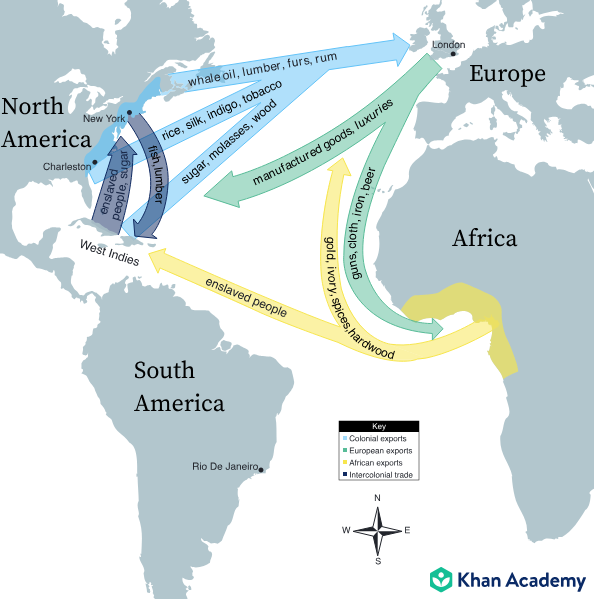
This unit focuses on the increasing global interconnectedness that emerged during the 15th-18th centuries as a result of European maritime exploration and colonization. It examines the political, economic, social, and cultural impacts of the Columbian Exchange, the Atlantic slave trade, the growth of European colonial empires, and the rise of global capitalism. Key topics include the voyages of exploration by Europeans, the establishment of colonial settlements and trading posts, the exploitation of indigenous populations and the transatlantic slave trade, the exchange of crops, diseases, and technologies between the Eastern and Western Hemispheres, and the development of new economic systems and trade networks. Students analyze how these transoceanic connections transformed societies, economies, and power dynamics across the globe.
Unit 5: Revolutions (c.1750-1900)
This unit explores the major political, economic, and social revolutions that occurred around the world during the 18th and 19th centuries. It examines the causes, key events, and impacts of revolutions such as the American Revolution, the French Revolution, the Haitian Revolution, the Latin American independence movements, and the revolutions in Europe and Asia. Key topics include the spread of Enlightenment ideas, the rise of nationalism, the growth of new political ideologies, the transformation of social structures, and the role of technology and industrialization. Students analyze how these revolutions challenged traditional power structures, reshaped political and economic systems, and transformed societies across the globe
The Atlantic Revolutions
The "Atlantic Revolutions" refer to a series of major political upheavals that occurred in the late 18th and early 19th centuries in the Atlantic world, including the American Revolution, the Haitian Revolution, and the Latin American independence movements. The American Revolution (1775-1783) was sparked by the British colonies in North America rebelling against the rule of the British Empire. Inspired by Enlightenment ideas of natural rights and self-governance, the American colonists declared independence and fought a successful war against the British, establishing the United States as a new nation. This revolution had a major impact, inspiring other colonial peoples to seek independence and challenging the legitimacy of European imperial rule. The Haitian Revolution (1791-1804) was the only successful slave revolution in history. Enslaved Africans in the French colony of Saint-Domingue (modern-day Haiti) revolted against their French colonial masters, eventually establishing an independent republic led by the former slave Toussaint Louverture. This revolution had a profound impact, as it demonstrated the potential for colonial subjects to overthrow their European rulers and served as an inspiration for other anti-colonial movements. The Latin American independence movements (1810s-1820s) saw the colonies of Spain and Portugal in the Americas break free from European rule and establish independent nation-states. Inspired by the American and Haitian Revolutions, as well as Enlightenment ideas, leaders like Simón Bolívar and José de San Martín led successful rebellions that resulted in the creation of countries like Mexico, Colombia, Venezuela, and Argentina. These revolutions transformed the political landscape of the Western Hemisphere.
The French Revolution
The French Revolution (1789-1799) was a pivotal event that had a major impact on Europe and the world. Sparked by economic crises, the growing power of the bourgeoisie, and the spread of Enlightenment ideas, the revolution overthrew the French monarchy and aristocratic system, established a republic, and led to the rise of Napoleon Bonaparte. The revolution went through several phases, including the Reign of Terror, the rise of Napoleon, and the eventual restoration of a monarchy. However, it had lasting impacts, such as the establishment of the principles of equality, individual rights, and popular sovereignty. The French Revolution also inspired other revolutionary movements across Europe and the world, contributing to the broader wave of political upheaval during this period.
The key points about the Reign of Terror and the Jacobins' role are:
The Reign of Terror was a period of state-sanctioned violence and mass executions that occurred during the French Revolution, between September 1793 and July 1794.
The Reign of Terror was led by the Jacobins, a political group that had taken control of the French government. Maximilien Robespierre, a prominent Jacobin leader, was a key figure who advocated for the use of terror as a necessary measure to protect the revolution.
The Jacobins justified the Reign of Terror as a way to eliminate enemies of the revolution and consolidate their power. They established revolutionary tribunals that arrested, tried, and executed thousands of people, including members of the aristocracy, clergy, and middle class.
Robespierre argued that "terror is nothing more than speedy, severe and inflexible justice" that was necessary to uphold the "general will" of the people and defend the new French Republic. He believed that the revolution was under threat from both internal and external enemies.
The Reign of Terror ended with the fall of Robespierre and the Jacobins in July 1794, in an event known as the Thermidorian Reaction. This led to a subsequent "White Terror" period of reprisals against former Jacobins.
Other Revolutions
In addition to the Atlantic Revolutions and the French Revolution, the AP World History curriculum also covers other significant revolutionary movements that occurred during this time period, such as:
The Revolutions of 1848 in Europe, which saw widespread uprisings against monarchical rule and the rise of nationalist movements.
The Meiji Restoration in Japan, which transformed the country from a feudal shogunate to a modern, centralized nation-state.
The Taiping Rebellion in China, a massive peasant uprising that challenged the Qing Dynasty.
Unit 6: Consequences of Industrialization (c.1750-1900)
This unit examines the major social, economic, and political consequences of industrialization during the 18th and 19th centuries. It looks at how the Industrial Revolution transformed production methods, transportation, and communication, leading to rapid urbanization, the rise of the middle class, and new ideologies like nationalism and socialism. Key topics include the impact of new technologies, the growth of global trade and investment, the exploitation of workers, the changing role of women, and the environmental consequences of industrialization. Students analyze how these transformations reshaped societies, power dynamics, and the global economy.
Unit 7: Global Conflict (c.1900-present)
This unit explores the major global conflicts of the 20th and 21st centuries, including World War I, World War II, and ongoing regional and ideological conflicts. It examines the causes, key events, and impacts of these conflicts, as well as the development of new military technologies and strategies. Key topics include the rise of nationalism and imperialism, the role of ideology and religion in fueling conflicts, the experiences of soldiers and civilians, the use of genocide and other atrocities, and the establishment of international organizations like the League of Nations and the United Nations. Students analyze how these global conflicts reshaped the international order, transformed societies, and led to decolonization movements.
Unit 8: Cold War and Decolonization (c.1900-present)
This unit focuses on the geopolitical tensions and ideological rivalry between the United States and the Soviet Union during the Cold War, as well as the process of decolonization that occurred around the world. It examines how the Cold War influenced regional conflicts, proxy wars, and the development of new military and surveillance technologies. Key topics include the spread of communism, the nuclear arms race, the space race, the civil rights movement, and the independence struggles of colonized nations in Africa, Asia, and the Middle East. Students analyze how the Cold War and decolonization reshaped global power dynamics, transformed societies, and led to new economic and political systems.
Unit 9: Globalization (c.1900-present)
The final unit explores the increasing interconnectedness of the world in the 20th and 21st centuries, driven by advances in transportation, communication, and technology. It examines the political, economic, social, and cultural impacts of globalization, including the growth of multinational corporations, the spread of popular culture, the rise of global governance institutions, and the challenges posed by issues like climate change and mass migration. Key topics include the liberalization of trade and investment, the spread of democratic and human rights norms, the role of technology in facilitating global integration, and the backlash against globalization. Students analyze how globalization has transformed the world and led to new forms of cooperation and conflict