2_NATO and the Warsaw Pact - The Arms Race
NATO (North Atlantic Treaty Organisation), 1949
Formed in Washington on 4 April 1949 as a military alliance of capitalist countries in the Northern Hemisphere.
Based on collective security: an attack on one member was considered an attack on all.
Founding members: USA, Canada, Britain, France, Belgium, Holland, Luxembourg, Norway, Iceland, Denmark, Italy, Portugal.
Later members: Greece & Turkey (1952), West Germany (1955), Spain (1982).
Created in response to:
Stalin’s establishment of Communist governments in Eastern Europe (buffer zone).
Berlin Blockade (1948) proving the need for coordinated Western defence.
Fear of communism spreading after China (1949) and North Korea (1950) became communist.
Allowed USA to station nuclear weapons in Europe, threatening the USSR and deterring expansion.
Paragraph Summary:
NATO, established in 1949, united capitalist nations under a system of collective security to counter the growing communist influence from the USSR. Triggered by the Berlin Blockade and communist expansion in Asia, NATO enabled the USA to deploy nuclear weapons in Europe, strengthening Western defences and heightening Soviet fears of encirclement.
The Warsaw Pact, 1955
Formed in 1955 as a military alliance of communist states led by the USSR.
Members: USSR, East Germany, Poland, Hungary, Czechoslovakia, Romania, Bulgaria, Albania.
Yugoslavia was communist but remained independent of the Pact.
Created as a response to NATO and West Germany’s entry into NATO (1955).
Gave the USSR control over Eastern Bloc foreign and military policy.
Divided Europe into two armed camps, marking the clear start of the Cold War division.
Paragraph Summary:
The Warsaw Pact was the USSR’s response to NATO, consolidating its dominance over Eastern Europe and formalising the division of Europe. By uniting the Eastern Bloc under Soviet control, the pact established two opposing military alliances, solidifying Cold War tensions.
The Arms Race
I. Causes:
Hiroshima & Nagasaki (1945) showed the power of nuclear weapons.
Truman did not inform Stalin of the atomic bomb, creating mistrust.
Stalin feared the bomb could be used against the USSR.
Ideological rivalry led both sides to compete for military and technological superiority.
Paragraph Summary:
The arms race began after WWII when the US used atomic bombs without informing Stalin. Suspicion and ideological rivalry pushed both powers to outdo each other in nuclear strength and global influence.
II. Events during the Arms Race
Nuclear Development:
Both superpowers sought nuclear superiority and feared a “missile gap”.
USA believed the USSR was ahead, leading to increased spending.
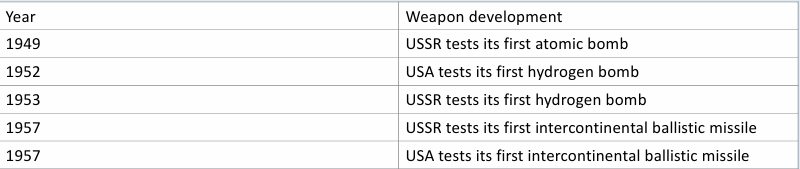
Key milestones:
1949 – USSR tested its first atomic bomb.
1952 – USA tested first hydrogen bomb.
1953 – USSR tested hydrogen bomb.
1957 – Both tested intercontinental ballistic missiles (ICBMs).
Paragraph Summary:
From 1949 onwards, both the USA and USSR rapidly developed atomic and hydrogen bombs, followed by ICBMs in 1957. The constant competition to stay ahead intensified mistrust and global insecurity.
III. Delivery Systems
Bullet Points:
Purpose: not only to outnumber enemy weapons, but also to develop more effective delivery methods.
Early atomic bombs delivered by bombers — slow, vulnerable, needed worldwide airbases.
1960s: missile delivery became practical with ICBMs (Intercontinental Ballistic Missiles) and IRBMs (Intermediate Range Ballistic Missiles).
Both superpowers developed missile and space technology, opening new ways to deploy nuclear weapons.
Paragraph Summary:
The arms race focused not just on accumulating nuclear weapons but also improving delivery. Bombers were initially used but proved slow and vulnerable, so by the 1960s both the USA and USSR developed missiles, including ICBMs and IRBMs, and experimented with space technology to deliver nuclear warheads more effectively.
IV. Defence Against Nuclear Attack
Distance Early Warning Line (DEW)
Series of radar stations across the Northern Hemisphere.
Purpose: detect Soviet missile attacks and provide time for US counter-measures.
Mutually Assured Destruction (MAD)
Both sides understood that any nuclear attack would provoke catastrophic retaliation, destroying both superpowers and allies.
This theory acted as a deterrent against initiating a nuclear war.
By the 1970s, ABMs (Anti-Ballistic Missile systems) were developed to counter ICBMs.
Strategic Defence Initiative (SDI)
Announced in 1983 by Reagan, nicknamed “Star Wars”.
Goal: destroy nuclear missiles from space, giving the USA a First Strike advantage.
USSR viewed SDI as a major threat.
Due to financial and technological limitations, SDI was never fully realized.
Paragraph Summary:
Defensive strategies evolved alongside the arms race. The DEW radar network, MAD, ABMs, and the SDI “Star Wars” initiative were all designed to protect against nuclear attack. MAD ensured that neither side could risk initiating a nuclear war, while SDI, though never fully achieved, heightened tensions by threatening the balance of power.
V. Results of the Arms Race
Financial Impact
By 1953: USA spent $50 billion, USSR spent $25 billion.
US spending doubled each year (1949–1953), showing the fear of falling behind in nuclear capabilities.
International Relations
Escalated tension due to the threat of nuclear annihilation.
Key crises:
U2 Crisis (1960):
May 1: US spy plane shot down over USSR.
Pilot Gary Powers captured.
Paris Summit 13 days later: Khrushchev demanded apology; Eisenhower refused → Khrushchev walked out.
Cuban Missile Crisis (1962):
Triggered by US discovery of Soviet missile bases in Cuba (4,000 km range).
Nearly led to nuclear war, showing the peak of Cold War tensions.
Paragraph Summary:
The arms race had huge financial costs, with billions spent annually on nuclear weapons. It also created extreme tension internationally, exemplified by the U2 Crisis and Cuban Missile Crisis, both of which brought the superpowers close to nuclear conflict and illustrated the global stakes of the Cold War.