october 3rd rise of china
11. Oct 3, Fri: Rise of China
Required Readings (32 pages)
Graham Allison, “The Thucydides Trap: Are the U.S. and China Headed for
War?” The Atlantic, Sep 14, 2015, 14 pages (on Brightspace)
can put opinion of article in paper/psychological perspective through critique of article + implications
video notes= aliance not followed= taiwan in danger NATO would not come
Taiwan economy + tech advancements
leader ordered china’s miitary to be ready to invade Taiwan by 2027
war games in 2023 to predict if war btw U.S and china over taiwan = U.S would win prevent china from occupying Taiwan = huge cost of warships military vessels+ aircraft 27000 deaths in 4 weeks =1/2 of what u.s military death toll in 20yrs in middle east= world GDP would suffer bloomberg report10 trillion loss in world economy
japan does not let U.S use military base w.o japanese support U.S would loose /most Japanese citizens against war/ Japanese support=china’s missiles hit japan bases U.S+China have atomic weapons/nuclear countries= 1969 china attack soviet union 1999 btw Pakistan and India / korean war = china (no nuclear weapons) attack U.s (nuclear weapons)
mutual destruction irrational to shoot nuclear weapons = conventional war
2009 war plan= U.S should attack china mainland = consequences
taiwan = modern day West Berlin
⚖
The Thucydides Trap: US and China Rivalry
1 source
The provided text, an excerpt from Graham Allison’s 2015 article "The Thucydides Trap: Are the U.S. and China Headed for War?," introduces the concept of the Thucydides Trap, which describes the high probability of conflict when a rising power challenges a ruling power. Allison argues that despite contemporary beliefs that war between the United States and China is unlikely, historical analysis shows that 12 of 16 similar rivalries over the past five centuries have resulted in bloodshed. The article draws historical parallels, including the Peloponnesian War (Athens vs. Sparta) and World War I (Germany vs. Britain), to illustrate how a shift in the balance of power creates structural stress and increases the likelihood of war, often triggered by routine crises. Allison emphasizes that China's massive and rapid ascendance presents a unique geostrategic challenge to the U.S.-led international order, citing statistics on China's surpassing the U.S. in numerous economic indicators by 2014. Ultimately, the author concludes that escaping the trap will require radical changes in attitudes and actions from both nations, asserting that war is only inevitable if leaders fail to learn from past mistakes.
---
## Summary of Allison (2015)
Thucydides warned: “It was the rise of Athens, and the fear that this inspired in Sparta, that made war inevitable.”*
* Allison applies this to U.S.–China: China’s rapid rise and America’s fear of losing dominance create structural stress.
History shows: in *12 of 16 past power transitions** (rising vs. ruling powers), outcome = war.
decling powers vs. rising power=more likely to get involved in conflict
However, war is *not inevitable**: 4 transitions avoided war but only through major, difficult adjustments.
* The key danger: not extraordinary crises, but “business as usual” missteps (like 1914) spiraling into war.
---
## Theories / Perspectives on U.S.–China War
### 1. Structural Realism (Power Transition / Thucydides Trap)
* Prediction: War is likely.
* Origins: Structural stress — China’s entitlement & demand for influence vs. America’s fear, insecurity, and resolve to defend status quo.
* Example: Like Athens vs. Sparta or Germany vs. Britain.
---
### 2. Bargaining Model of War
* Prediction: War is possible but avoidable.
* Origins: Failed bargains due to information problems (misjudging resolve, e.g., South China Sea), commitment problems (fearing China will renege on promises once stronger), or indivisible issues (Taiwan, territorial sovereignty).
---
### 3. Globalization & Economic Interdependence
* Prediction: War becomes less likely.
* Origins of peace: Costs of conflict are too high due to trade, finance, and supply-chain ties.
* Origins of war: Would require severe economic decoupling or sanctions spirals where both sides prioritize security over prosperity.
---
### 4. Regime Type (Democratic Peace Theory)
* Prediction: Higher risk of war, since U.S. = democracy vs. China = authoritarian regime.
* Origins: Mistrust of political systems, lack of institutional constraints in China, perception of illegitimacy.
---
### 5. Norms & Ideas
* Prediction: War likelihood depends on whether competing visions of order clash.
* Origins of war: U.S. insists on liberal, rules-based order vs. China pushes for Sinocentric multipolarity and sovereignty-first norms.
* If shared norms develop (coexistence, mutual recognition), conflict risk drops.
---
### 6. Human Psychology
* Prediction: War is more likely than rationalist theories admit.
* Origins: Fear, honor, and misperceptions drive escalation.
* Example: In 1914, leaders sleepwalked into war despite knowing catastrophic risks. Same dynamic could repeat in U.S.–China relations.
---
### 7. Racial Identities & Racism
* Prediction: Racism and “othering” increase likelihood of conflict.
* Origins: U.S. “China threat” rhetoric, racialized fears (“Yellow Peril” tropes), and cultural misperceptions fuel hostility, delegitimization, and hardline policy stances.
---
### 8. Gender
* Prediction: Gendered expectations can push both powers toward escalation.
* Origins: Leaders fear appearing “weak.” Masculinized nationalism (“standing tall” in China, “projecting strength” in the U.S.) reinforces uncompromising postures, making compromise politically costly.
---
✅ Overall:
* Structural realism predicts war is likely.
* Other theories (bargaining, economic interdependence, norms, psychology, identity, gender) show that war is possible but contingent — not inevitable.
Allison warns: avoiding war requires extraordinary leadership, restraint, and mutual adjustment* in both Washington and Beijing.
---
David C. Kang & Xinru Ma, “Power Transitions: Thucydides Didn’t Live in East Asia,” The Washington Quarterly, Volume 41, Issue 1, pp. 137-154 (Library link)
The source material provides an overview of theories regarding power transitions, specifically contrasting the traditional, Eurocentric view of inevitable conflict with historical patterns observed in East Asia. The core critique, put forth by Kang and Ma, is that the widely cited Thucydides Trap—the idea that a rising power's threat leads to war—is overly deterministic and does not account for the long periods of stability in East Asian history, where changes were often driven by internal collapse rather than external wars. The text summarizes various theories, including structural realism, economic interdependence, and shared norms, illustrating that while some theories predict war, others suggest that factors like hierarchy, domestic stability, and the costs of conflict make war possible but not inevitable between states like the U.S. and China.
Before going through the theories, here are the key findings & arguments from Kang & Ma’s article that feed into all these theories:
Much of the literature on power transitions is Eurocentric (drawing on European cases: Peloponnesian War, Germany’s rise, Anglo-German rivalry) and so may have overgeneralized that model. Freeman Spogli Institute+2Taylor & Francis Online+2
When one looks at East Asian history (500-1900), many power transitions (dynastic changes, regime shifts) were driven by internal problems (internal rebellions, regime collapse, economic breakdown, legitimacy crises), not by external challenge or war. Freeman Spogli Institute+1
Even when external war occurred, it often did not follow the classic prediction of a rising challenger provoking the declining hegemon into war due to fear, or the challenger trying to overturn the international order. Instead, things like shared understandings of status hierarchies, culture, norms, tributary systems, and internal constraints mattered a lot. Freeman Spogli Institute+1
Thus, while power transitions can be risky, they are not inevitably violent in the way standard structural realist / power transition theory assumes. Much depends on domestic political stability, status norms, ideas about hierarchy, etc.
Here’s a structured summary of Kang & Ma (2018), “Power Transitions: Thucydides Didn’t Live in East Asia” with predictions from each theory/perspective you listed:
---
## Core Argument of the Article
Kang & Ma argue that the common *Thucydides Trap** analogy (i.e., that China’s rise must lead to war with the U.S., as Athens’ rise threatened Sparta) is misleading for East Asia.
* Historical East Asia was not characterized by constant great-power war but by long periods of stability, especially under Chinese dominance.
* They critique structural realist predictions of inevitable conflict and encourage exploring alternative theories.
---
## Predictions of Different Theories/Perspectives
### 1. Structural Realism (Power Transition Theory)
* Prediction: War is likely.
* Rising powers (China) challenge the dominant power (U.S.), and the fear this provokes makes conflict probable.
* Origins of War: Security dilemma, shifts in relative power, lack of trust.
* Kang & Ma’s view: Overly deterministic and doesn’t fit East Asian history, where China’s dominance often coexisted with peace.
---
### 2. Bargaining Model of War
* Prediction: War arises when peaceful bargains fail.
* Origins of War: Information problems (misperceptions about resolve or strength), commitment problems (fear that a rival will renege on deals in the future), or indivisible issues (e.g., sovereignty over Taiwan, South China Sea).
* War is not inevitable, but specific disputes could escalate if bargaining breaks down.
---
### 3. Globalization & Economic Interdependence
* Prediction: War becomes less likely.
* Deep economic ties (U.S.–China trade, regional production chains) raise the costs of conflict.
* Origins of War: Would require a severe breakdown of economic interdependence (e.g., decoupling, sanctions spirals, collapse of trade networks).
* Kang & Ma: Point out that historically, East Asia has relied on economic hierarchy rather than constant military conflict.
---
### 4. Regime Type (Democratic Peace Theory)
* Prediction: U.S. and China are more likely to have tensions because China is authoritarian.
* Democracies rarely fight each other; democracies vs. autocracies have higher conflict risk.
* Origins of War: Clashing political systems, lack of shared institutional constraints, mistrust of legitimacy.
* Suggests higher risk, but doesn’t fully explain long peace under historical Chinese dominance.
---
### 5. Norms and Ideas
* Prediction: Shared norms can reduce likelihood of war.
* East Asian political order has historically been hierarchical, not balance-of-power driven.
* Confucian and tributary norms once produced stability rather than conflict.
* Origins of War: Breakdown of shared norms (e.g., if U.S. insists on Western liberal order while China asserts Sinocentric norms).
---
### 6. Human Psychology
* Prediction: Misperception, fear, and honor concerns make war more likely than rational models predict.
* Origins of War: Leaders exaggerate threats (security dilemma spiral), or domestic politics amplify fear/honor.
* The “Thucydides Trap” is itself a psychological narrative framing U.S.–China relations in conflictual terms.
---
### 7. Racial Identities and Racism
* Prediction: Racial stereotypes increase risk of war.
* Historically, Western powers viewed East Asia as racially inferior, and current rhetoric (e.g., “Yellow Peril,” “China threat”) feeds suspicion.
* Origins of War: Dehumanization, racialized fears, “othering” of China may push elites toward hardline stances.
---
### 8. Gender
* Prediction: Gendered ideas of toughness and weakness influence escalation.
* States may fear appearing “weak” and thus escalate disputes.
* Origins of War: Masculinized nationalism (e.g., “standing up to China” or China’s emphasis on regaining “manly” strength after humiliation) can lock leaders into aggressive postures.
---
## Overall Takeaway
* Structural realism expects war, but Kang & Ma argue history shows otherwise in East Asia.
Other theories (economic interdependence, norms, regime type, psychology, identity, gender) provide a more nuanced picture where *war is possible but not inevitable**, shaped by how leaders manage narratives, norms, and interdependence.
richard Ned Lebow and Ben Valentino, specialists in international relations, point out that power transition “theory has become an accepted framework for many scholars and policymakers who focus on Asia,” while Susan Shirk, former Deputy Assistant Secretary of State for China during the Clinton administration, has written that, “History teaches us that rising powers are likely to provoke war.” More recently, political scientist Graham Allison wrote that “war between the US and China in the decades ahead is not just possible, but much more likely than recognized at the moment. Indeed, judging by the historical record, war is more likely than not.” By far, the most commonly examined case studies of power transition in the scholarly literature are the Peloponnesian War (431-404 BCE) and the rise of Germany under Bismarck and Anglo-German rivalry of the twentieth century.
the prevailing "Thucydides Trap" narrative, rooted in structural realism and power transition theory, posits that war between a rising China and an established United States is highly probable. This framework, however, is criticized for its Eurocentric bias, drawing its conclusions primarily from European historical cases such as the Peloponnesian War and the Anglo-German rivalry.
An analysis of East Asian history from 500-1900, as presented by scholars Kang & Ma, offers a significant counter-narrative. Historically, power transitions in the region were frequently driven by internal factors like rebellions, economic collapse, and legitimacy crises, rather than external challenges from rising powers. East Asia experienced long periods of stability, often under a dominant China, where order was maintained through shared cultural norms, status hierarchies, and tributary systems, not constant military competition.
While the structural realist model predicts inevitable conflict, a more comprehensive assessment incorporating multiple theoretical perspectives suggests a more nuanced reality. Theories focusing on economic interdependence, shared norms, and identity politics provide frameworks where war is possible but not predetermined. The ultimate outcome is contingent on how leaders navigate specific disputes, manage economic ties, and shape narratives surrounding psychology, race, and gender.
The Dominance and Critique of the Thucydides Trap
The concept of the "Thucydides Trap"—the idea that a rising power will inevitably clash with a ruling one—has become a central framework for analyzing U.S.-China relations. This perspective, rooted in structural realism and power transition theory, is widely accepted by numerous scholars and policymakers.
• Prominent Adherents:
◦ International relations specialists Richard Ned Lebow and Ben Valentino note that power transition theory is an "accepted framework for many scholars and policymakers who focus on Asia."
◦ Susan Shirk, former Deputy Assistant Secretary of State, has stated that, "History teaches us that rising powers are likely to provoke war."
◦ Political scientist Graham Allison argues that "war between the US and China in the decades ahead is not just possible, but much more likely than recognized at the moment. Indeed, judging by the historical record, war is more likely than not."
• Eurocentric Foundation: A core critique of this model is its overgeneralization from a narrow set of European historical examples. The most commonly cited case studies are the Peloponnesian War (431-404 BCE) and the rise of Germany, particularly the Anglo-German rivalry leading into the twentieth century.
An Alternative History: Power Transitions in East Asia
According to the analysis by Kang & Ma, the historical record of East Asia from 500 to 1900 does not align with the predictions of inevitable conflict derived from European history. The region's dynamics were shaped by a different set of factors.
• Internal Drivers of Change: Many dynastic changes and regime shifts were the result of internal problems, including rebellions, regime collapse, economic breakdowns, and crises of legitimacy. They were not primarily caused by external military challenges.
• Stability Under Hegemony: Contrary to the constant balance-of-power conflict seen in Europe, East Asia was characterized by long periods of stability, particularly under Chinese dominance.
• The Role of Non-Military Factors: When external wars did occur, they often did not follow the classic pattern of a challenger seeking to overturn the international order. Instead, outcomes were heavily influenced by shared cultural understandings, status hierarchies, norms, and the tributary system. These factors, along with internal constraints, often mitigated the risk of large-scale conflict.
A Synthesis of Theoretical Perspectives on Conflict
To move beyond a deterministic view, it is necessary to examine U.S.-China relations through a variety of theoretical lenses. Each offers a different prediction regarding the likelihood of war and identifies distinct causal mechanisms.
1. Structural Realism (Power Transition Theory)
• Prediction: War is likely.
• Origins of War: The theory posits that shifts in relative power create a security dilemma. The rising power (China) inherently challenges the dominant power (U.S.), and the fear, distrust, and uncertainty this provokes make conflict a probable outcome.
• Critique: Kang & Ma argue this model is overly deterministic and fails to account for East Asia's history of peaceful coexistence under Chinese dominance.
2. Bargaining Model of War
• Prediction: War is possible if peaceful bargains fail.
• Origins of War: Conflict is not inevitable but arises from specific failures in negotiation due to:
◦ Information Problems: Misperceptions about an opponent's military strength or political resolve.
◦ Commitment Problems: A state's inability to credibly commit to upholding a deal in the future, especially as its power grows.
◦ Indivisible Issues: Disputes over assets that cannot be easily divided, such as sovereignty over Taiwan or the South China Sea.
sudo world gov by NATO (U.S UK ) against structural realism idea of anarchy
3. Globalization & Economic Interdependence
• Prediction: War becomes less likely.
• Origins of War: Conflict would necessitate a fundamental breakdown of the deep economic ties linking the U.S. and China, such as global supply chains and immense bilateral trade. The high economic costs of war act as a powerful deterrent. A war would likely only follow a severe economic decoupling, a spiral of sanctions, or a total collapse of trade networks.
4. Regime Type (Democratic Peace Theory)
• Prediction: The risk of tension and conflict is elevated.
• Origins of War: This theory holds that democracies rarely fight one another. The risk of conflict is higher between democracies and autocracies due to clashing political systems, a lack of shared institutional constraints that might otherwise build trust, and mutual mistrust of each other's legitimacy.
• Critique: While suggesting higher risk, this theory does not fully explain the long periods of peace in East Asia under China's historical non-democratic dominance.
5. Norms and Ideas
• Prediction: Shared norms can reduce the likelihood of war.
• Origins of War: Conflict could emerge from a breakdown of shared norms. Historically, the East Asian political order was hierarchical and stabilized by Confucian and tributary norms. A modern conflict could arise if the U.S. insists on imposing a Western liberal order while China simultaneously asserts a rival Sinocentric normative framework.
6. Human Psychology
• Prediction: War is more likely than purely rational models suggest.
• Origins of War: Non-rational factors like misperception, fear, and concerns over honor can drive escalation. Leaders may exaggerate threats, leading to a security dilemma spiral. Domestic political pressures can also amplify fears or demands to uphold national honor. The "Thucydides Trap" itself functions as a powerful psychological narrative that frames the relationship in conflictual terms.
7. Racial Identities and Racism
• Prediction: Racial stereotypes increase the risk of war.
• Origins of War: Dehumanization and the "othering" of a rival population can make aggressive policies more palatable. Historically, Western powers viewed East Asia as racially inferior. Modern rhetoric reviving "Yellow Peril" or "China threat" narratives feeds suspicion and can push political elites toward more hardline stances.
8. Gender
• Prediction: Gendered ideas about national strength and weakness can fuel escalation.
• Origins of War: Leaders may become locked into aggressive postures due to the fear of appearing "weak" on the international stage. Masculinized nationalism—manifesting as a need to "stand up to China" or, for China, to regain "manly" strength after historical humiliation—can make compromise and de-escalation politically difficult.h
Therefore, in the next session, we are going to discuss the prediction of each following theory/perspective about the likelihood of the possible war and possible origins of such war: i.e., structural realism, bargaining model of war, the effects of globalization and economic interdependence, regime type, norms and ideas, human psychology, racial identities and racism, and gender. Therefore, I strongly encourage you to prepare for such exercise.
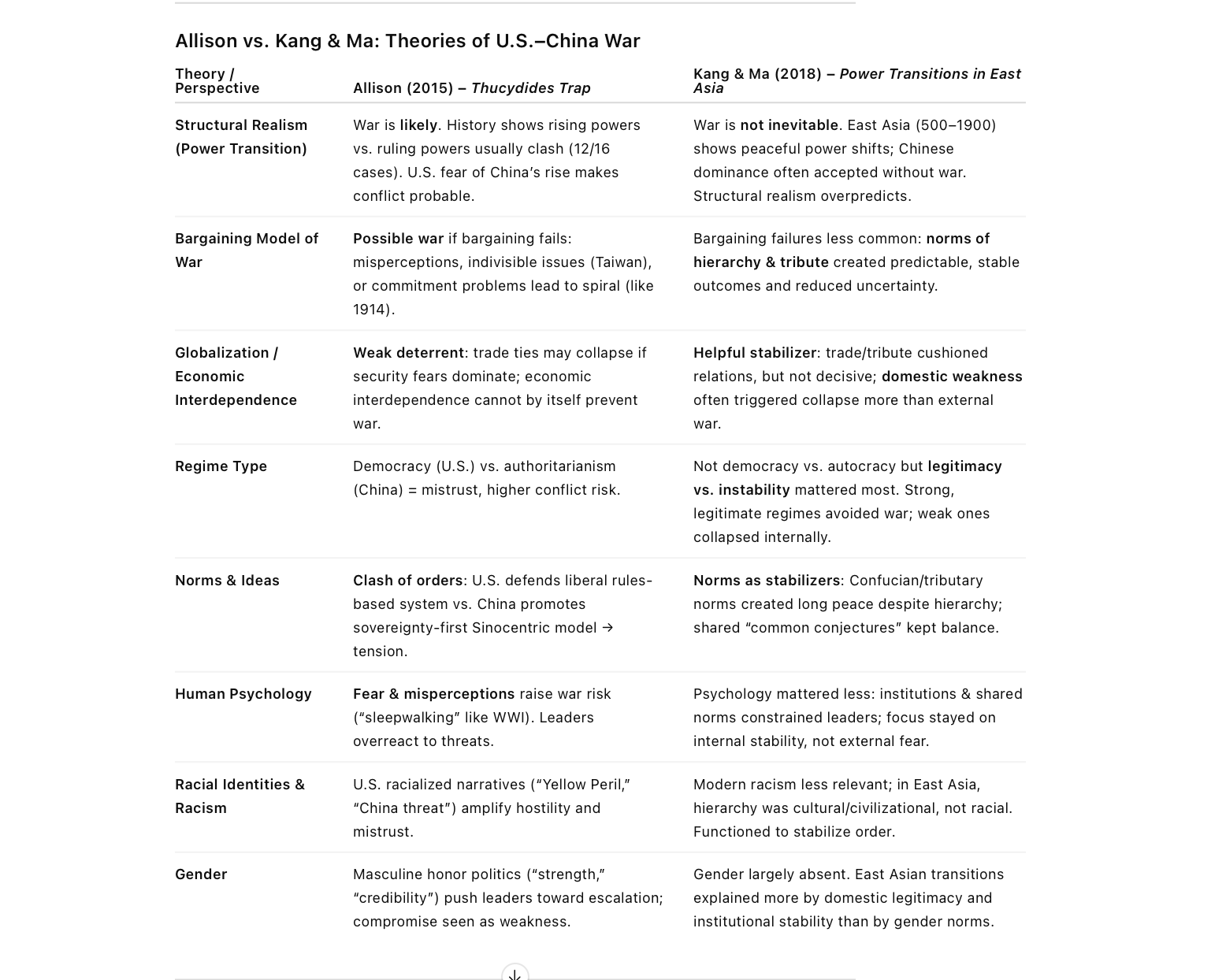
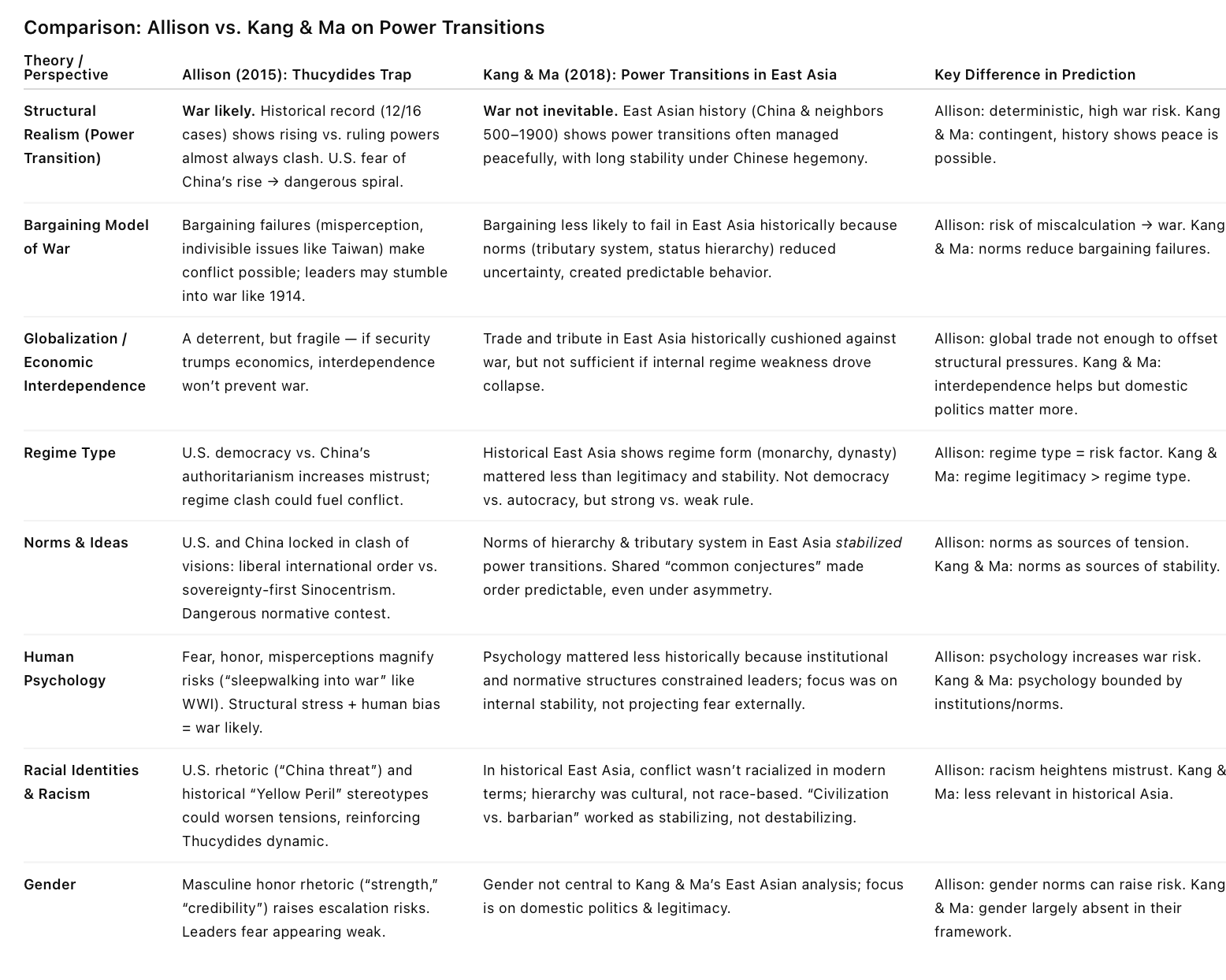
Great question — this is exactly the contrast between Allison’s “Thucydides Trap” argument (2015) and Kang & Ma’s critique (2018). Let’s line up the two perspectives and see how their use of theories produces different predictions about U.S.–China war.
---
# Comparison: Allison vs. Kang & Ma on Power Transitions
| Theory / Perspective | Allison (2015): Thucydides Trap | Kang & Ma (2018): Power Transitions in East Asia | Key Difference in Prediction |
| -------------------------------------------- | ------------------------------------------------------------------------------------------------------------------------------------------------- | ----------------------------------------------------------------------------------------------------------------------------------------------------------------------------------- | ------------------------------------------------------------------------------------------------------------------------------------ |
| Structural Realism (Power Transition) | War likely. Historical record (12/16 cases) shows rising vs. ruling powers almost always clash. U.S. fear of China’s rise → dangerous spiral. | War not inevitable. East Asian history (China & neighbors 500–1900) shows power transitions often managed peacefully, with long stability under Chinese hegemony. | Allison: deterministic, high war risk. Kang & Ma: contingent, history shows peace is possible. |
| Bargaining Model of War | Bargaining failures (misperception, indivisible issues like Taiwan) make conflict possible; leaders may stumble into war like 1914. | Bargaining less likely to fail in East Asia historically because norms (tributary system, status hierarchy) reduced uncertainty, created predictable behavior. | Allison: risk of miscalculation → war. Kang & Ma: norms reduce bargaining failures. |
| Globalization / Economic Interdependence | A deterrent, but fragile — if security trumps economics, interdependence won’t prevent war. | Trade and tribute in East Asia historically cushioned against war, but not sufficient if internal regime weakness drove collapse. | Allison: global trade not enough to offset structural pressures. Kang & Ma: interdependence helps but domestic politics matter more. |
| Regime Type | U.S. democracy vs. China’s authoritarianism increases mistrust; regime clash could fuel conflict. | Historical East Asia shows regime form (monarchy, dynasty) mattered less than legitimacy and stability. Not democracy vs. autocracy, but strong vs. weak rule. | Allison: regime type = risk factor. Kang & Ma: regime legitimacy > regime type. |
| Norms & Ideas | U.S. and China locked in clash of visions: liberal international order vs. sovereignty-first Sinocentrism. Dangerous normative contest. | Norms of hierarchy & tributary system in East Asia stabilized power transitions. Shared “common conjectures” made order predictable, even under asymmetry. | Allison: norms as sources of tension. Kang & Ma: norms as sources of stability. |
| Human Psychology | Fear, honor, misperceptions magnify risks (“sleepwalking into war” like WWI). Structural stress + human bias = war likely. | Psychology mattered less historically because institutional and normative structures constrained leaders; focus was on internal stability, not projecting fear externally. | Allison: psychology increases war risk. Kang & Ma: psychology bounded by institutions/norms. |
| Racial Identities & Racism | U.S. rhetoric (“China threat”) and historical “Yellow Peril” stereotypes could worsen tensions, reinforcing Thucydides dynamic. | In historical East Asia, conflict wasn’t racialized in modern terms; hierarchy was cultural, not race-based. “Civilization vs. barbarian” worked as stabilizing, not destabilizing. | Allison: racism heightens mistrust. Kang & Ma: less relevant in historical Asia. |
| Gender | Masculine honor rhetoric (“strength,” “credibility”) raises escalation risks. Leaders fear appearing weak. | Gender not central to Kang & Ma’s East Asian analysis; focus is on domestic politics & legitimacy. | Allison: gender norms can raise risk. Kang & Ma: gender largely absent in their framework. |
---
## Big Picture Contrast
* Allison (2015): Structural realist → war is probable. Thucydides Trap is the dominant metaphor. Structural stress + fear → miscalculation → war. Avoiding it requires extraordinary leadership.
* Kang & Ma (2018): Historical institutionalist/constructivist → war is not inevitable. East Asian history shows power transitions can be peaceful when domestic stability and shared norms exist. Structural realism overpredicts conflict by ignoring culture, hierarchy, and domestic weakness.
---
✅ Conclusion:
* Allison warns of inevitability unless U.S. and China act heroically to escape the trap.
* Kang & Ma show that history in East Asia undermines inevitability — power shifts often ended peacefully when mediated by norms and domestic legitimacy.
* Taken together: Structural realism gives the alarm bell; Kang & Ma show how context (institutions, ideas, domestic politics) can muffle it.
---