Class 5: Forces Between Particles
Chapter 4: Forces between Particles
Learning Objectives
Draw Lewis structures for representative elements' atoms.
Use the octet rule to predict ionic and covalent compound formation.
Determine formula weights for ionic compounds.
Name ionic and covalent compounds, including those with polyatomic ions.
Use electronegativity to classify covalent bonds and determine molecular polarity.
Session 5 Topics
Compounds, Lewis Structures, and Nobel Gas Configurations.
Ionic and Covalent Compounds.
Formula Weight of Ionic Compounds.
Naming Ionic and Covalent Compounds.
The Polarity of Covalent Molecules.
Other Interparticle Forces.
Compounds and Lewis Structures
Elements lose, gain, or share electrons to form compounds.
Elements achieve a noble gas-like outer shell electron configuration (arrangement of electrons within an atom's orbitals)
Lewis Structures: Valence-shell electrons represented by dots around the element symbol.
Number of valence electrons (outermost shell) equals the Roman numeral group number.
Example: Na (Group IA) has one valence electron.
Example: Al (Group IIIA) has three valence electrons.
Drawing Lewis Structures
Write the element's symbol and place a dot for each valence electron around it.
Imagine a square around the symbol with four locations for dots.
Each side of the square represents one location.
An element with four valence electrons has one dot in each location.
The fifth electron is represented by an additional dot in one location.
Each location can have a maximum of two dots.
Example: Beryllium (Be), element number 4, is in Group IIA and has two valence electrons; its Lewis structure is Be with two dots.
Example: Cesium (Cs) is in group IA(1), has one valence-shell electron, and has the Lewis structure - Cs.
Using Abbreviated Electronic Configurations
Represent elements using abbreviated electronic configurations and Lewis structures.
Ionic Compounds
Octet Rule: Atoms gain, lose, or share electrons to achieve a noble gas electron arrangement, usually eight electrons in the valence shell.
Ionic Compound: A compound containing ions held together by ionic bonds.
Simple ion: Atom with a net positive or negative charge due to electron loss or gain.
Both atoms are changed into ions with noble gas configurations.
Ionic Bond: Electrostatic force between oppositely charged ions in an ionic compound.
Binary Ionic Compound: An ionic compound composed of two different elements.
Determining Ionic Charges
Representative metals form ions with the same positive charge as their group number.
Representative nonmetals form ions with a negative charge equal to 8 minus their group number.
Example: Strontium (Sr), a group IIA metal, forms ions.
Example: Phosphorus (P), a group VA nonmetal, forms ions.
Example: Na can achieve a noble gas configuration by losing one electron to become .
Electronic Transfer Processes
Example: Magnesium (Mg) and Fluorine (F) react ionically. Mg loses two electrons to become and F gains one electron to become . The resulting formula is .
Binary Ionic Compound Formulas
Typically form when a metal and nonmetal react.
Metal loses electrons to form a positive ion.
Nonmetal gains electrons to form a negative ion.
The metal symbol is written first in the formula.
The formula represents the minimum number of each ion needed for equal positive and negative charges.
Example: Sodium (Na) and Fluorine (F):
* Na forms
* F forms
* The resulting formula is NaF.
Example: Sodium (Na) and Sulfur (S):
* Na forms
* S forms
* The resulting formula is .
Covalent Compounds
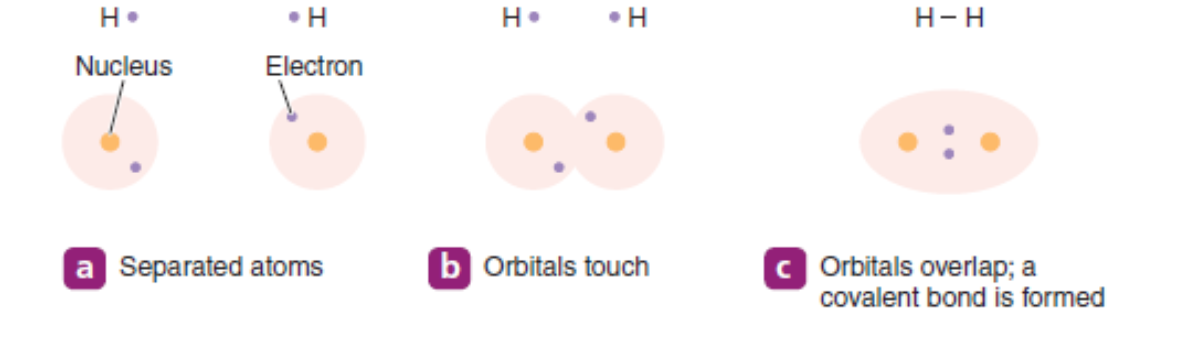
Molecular (or Covalent) Compound: A compound of discrete molecules with atoms held together by covalent bonds.
Covalent Bond: Attraction between two atoms sharing a pair of electrons.
Satisfies the octet rule when atoms share valence electrons.
Sharing occurs when electron-containing orbitals overlap, e.g., formation.
Shared electrons count towards each atom's octet.
Lewis Structures of Covalent Compounds
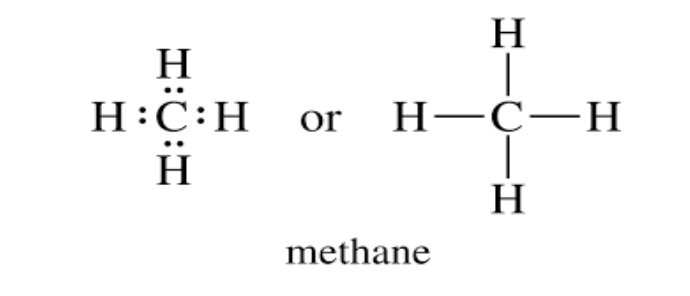
Shared electron pairs can be represented by a single solid line between atoms.
Single covalent bond: One pair of electrons shared.
Double covalent bond: Two pairs of electrons shared.
Triple covalent bond: Three pairs of electrons shared.
Non-bonding pairs are called lone pairs.
Ionic Compound Formulas and Weights
Formulas represent the simplest combining ratio of ions, not the precise number of atoms in a crystal lattice.
Formula weight: Sum of the atomic weights of the atoms in the formula.
Similar to molecular weight.
One mole of an ionic compound contains Avogadro's number () of the simplest combining ratio of ions.
Example: Comparing CO2MgCl2:
* CO2MgCl2 (formula weight = 95.3 u)
Naming Binary Ionic Compounds
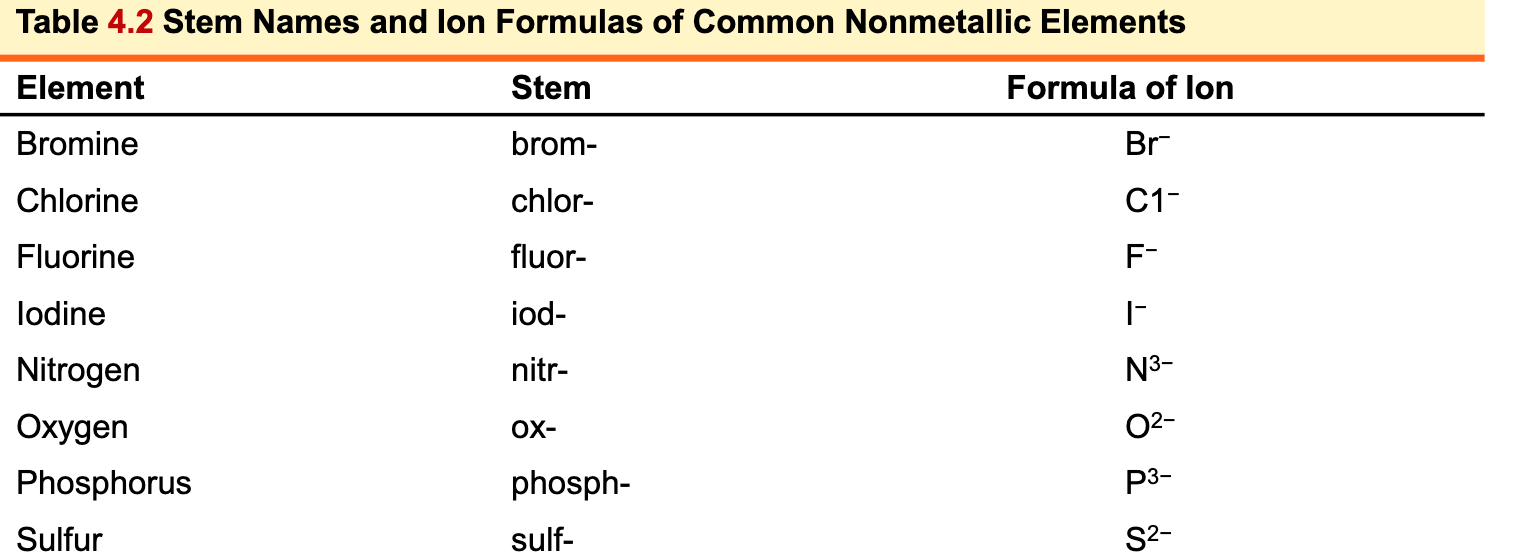
Name = Metal + nonmetal stem + -ide
Stem of the nonmetal is the nonmetal name with the ending dropped.
Stem Names and Ion Formulas
Bromine (brom-,
Chlorine (chlor-,
Fluorine (fluor-,
Iodine (iod-,
Nitrogen (nitr-,
Oxygen (ox-,
Phosphorus (phosph-,
Sulfur (sulf-,
Transition Metals
Some metal atoms (transition and inner-transition elements) form more than one type of charged ion.
The number of positive charges is indicated by a Roman numeral in parentheses.
Example: FeCl2FeCl3 (iron(III) chloride)
Binary Ionic Compound Name Examples
: Potassium oxide
Mg3N2: Magnesium nitride
: Beryllium sulfide
: Aluminum bromide
Polyatomic Ions
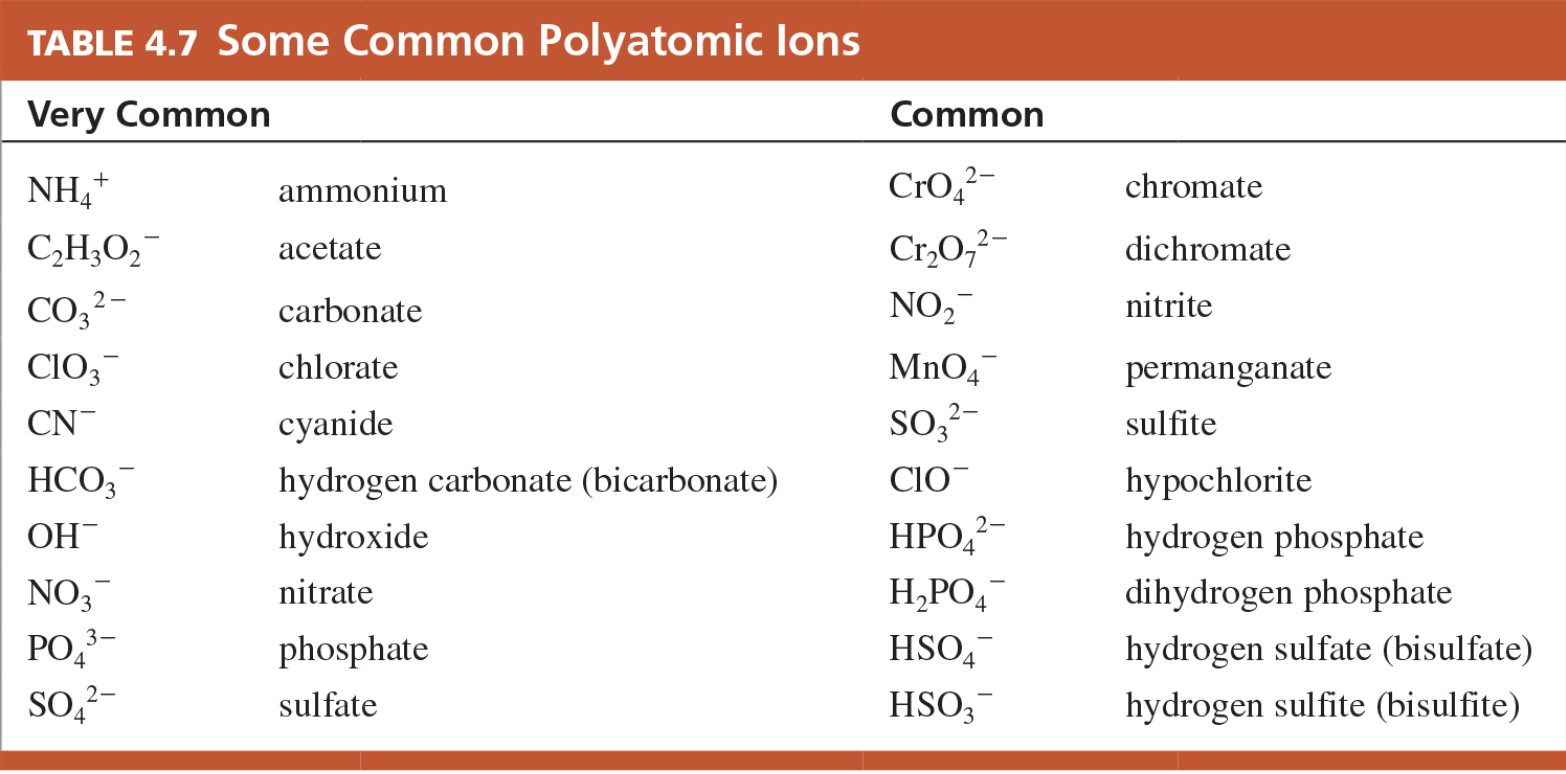
Covalently bonded groups of atoms that carry a net electrical charge, usually negative
Commonly negatively charged.
Ionic Compounds Containing Polyatomic Ions
Formulas: Metal written first, charges must add up to zero, parentheses around the polyatomic ion if more than one is used.
Names: Positive metal ion first, then the name of the negative polyatomic ion.
Example: Na3PO4Mg3(PO4)2(NH4)3PO4
Example: Write formulas and names for compounds composed of ions of the following metals and polyatomic ions indicated: Na and − , K and 2−
Naming Binary Covalent Compounds
Similar to naming binary ionic compounds.
Rules:
Name the less electronegative element.
Give the stem of the more electronegative element and the suffix -ide.
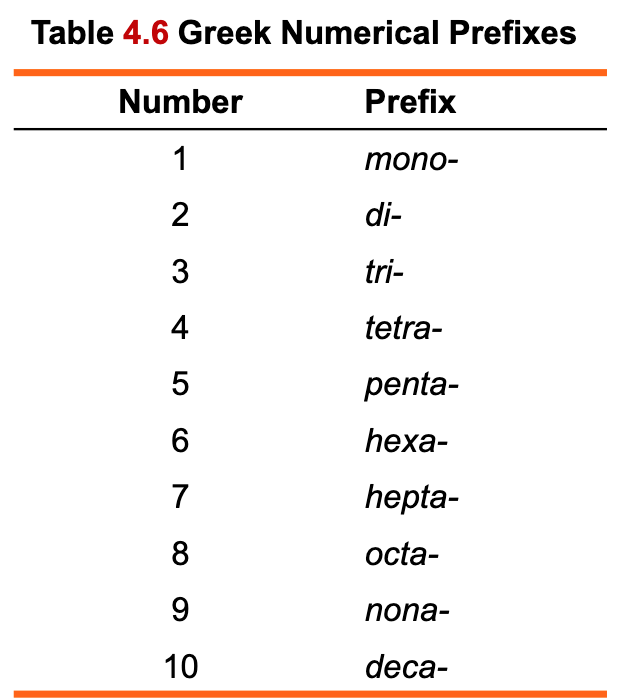
Indicate the number of each type of atom using Greek prefixes.
Prefix mono- is not used at the beginning of the name.
Polatery
Electron pairs in covalent bonds are not always shared equally due to differences in electronegativity.
Polar covalent bond: Unequal sharing of electrons.
because some atoms have a greater tendency (electronegativity) to attract shared electrons
In such a case the bond is said to be polarised and called a polar covalent bond
Nonpolar covalent bond: Equal sharing of electrons; .
Polar covalent bond: and
Ionic bond:
Bond Polarization
Bond polarization: Electrons attracted to the more electronegative atom.
More electronegative atom: Partial negative charge (δ–).
Less electronegative atom: Partial positive charge (δ+).
Polar molecule: Polarized bonds with nonsymmetrical charge distribution.
Nonpolar molecule: No polarized bonds or symmetrical charge distribution.
Classify the bonds in the following compound as nonpolar covalent, ionic, or polar covalent:CIF.
Interparticle Forces
Ionic and covalent bonds are forces between atomic-sized particles.
Other forces:
Metallic bonding
Dipolar forces
Hydrogen bonding
Dispersion forces
Types of Interparticle Forces
Network solids: Solids with lattice sites occupied by covalently bonded atoms (e.g., , diamond).
Metallic bond: Attraction between positively charged atomic kernels and mobile electrons.
Dipolar force: Attraction between the positive end of one polar molecule and the negative end of another.
Hydrogen bonding: Dipolar forces between molecules with H bonded to O, N, or F.
Dispersion forces: Weak attractive forces from momentary nonsymmetric electron distributions.